
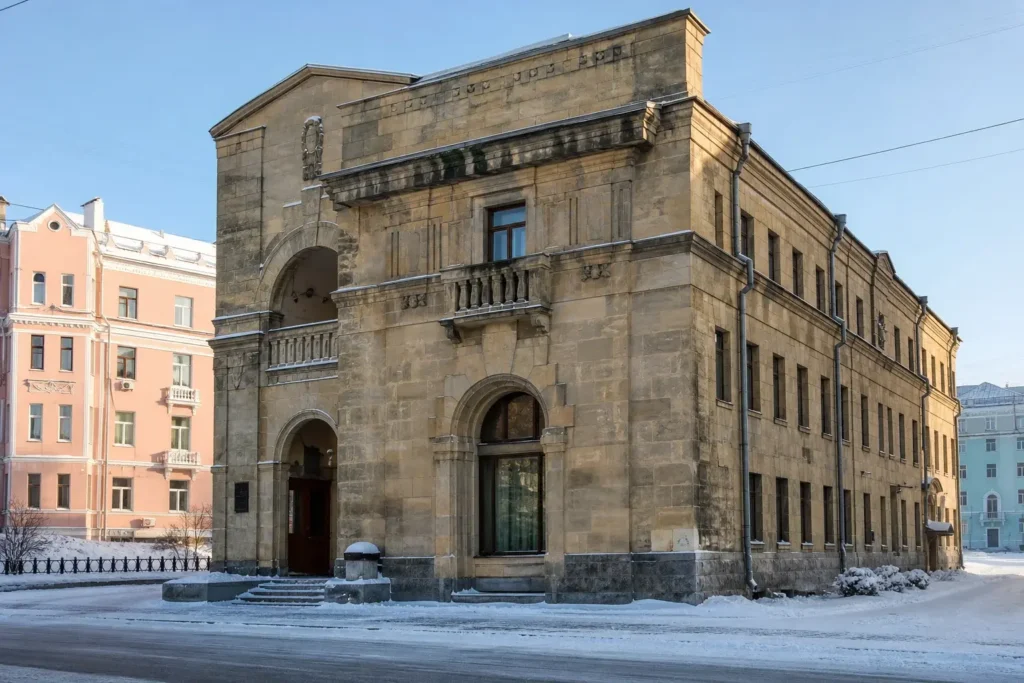
The Murmansk Regional Art Museum is located in the historical center of Murmansk in the first public building made of stone on Kominterna Street. The museum was established in 1990.
The collection now exceeds 11,000 art pieces, including paintings from the 17th–21st centuries, a great collection of graphic works and arts and crafts. More than 60 exhibitions open annually and are visited by more than 50,000 people. The museum sits next to the Five Corners Square.
Quick Facts
| Russian name | Мурманский областной художественный музей |
|---|---|
| Built / opened | 1990 |
| Address | улица Коминтерна, 13, Мурманск 183038 OpenStreetMap · Google Maps |
| District | Oktyabrsky |
| Opening hours | Mon closed; Tue closed; Wed-Sun 11:00-19:00 |
| Admission | ₽ |
| Best time to visit | The museum is open year-round. Winter visits offer the longest nights and best aurora viewing opportunities from the city, though daylight is minimal. Spring and autumn provide comfortable viewing conditions with moderate crowds. Summer (June–July) includes nearly 24-hour daylight; some visitors find viewing art easier with natural light. The museum is quieter on weekday afternoons. Weekends may bring school groups and families. |
| Recommended duration | 2–3 hours |
| Website | artmmuseum.ru |
What Is (and Isn't) Part of a Visit to Murmansk Regional Art Museum, Murmansk?
| Part | Status | Notes |
|---|---|---|
| Permanent exhibition: Russian Fine Art 18th–21st centuries | Included in the standard ticket | Seven sections spanning 300+ years of Russian and Murmansk art. |
| Temporary exhibitions | Included in the standard ticket | Rotating shows featuring works from major Russian museums and contemporary artists. |
| Music lounge and events | Included in the standard ticket | Chamber performances and cultural events held throughout the year. |
| Souvenir shop | Separate ticket or institution | On-site gift shop with postcards, books and local artisan items; separate from main exhibition. |
| Murmansk Regional Museum of Local History | Outside / not part of it | Different institution on Lenin Avenue, not part of this museum; confusion arises because the Art Museum received its core collection from this museum in 1990. |
Why Visit Murmansk Regional Art Museum, Murmansk?
The building itself is historically significant as Murmansk’s first stone structure. The permanent exhibition ‘Domestic Fine Arts of the 17th–21st Centuries’ contains over 200 art pieces divided into seven sections, from 17th–19th century Russian art to modern works by Murmansk artists. The collection of graphics is the most numerous, featuring works by Moscow, Leningrad and Murmansk graphic artists. The exhibition concludes with decorative and applied arts showcasing northern crafts: wood painting, clay toys, bone carving, lace weaving, birch bark weaving and wood carving.
How Murmansk Regional Art Museum, Murmansk Is Laid Out
The museum has four exhibition halls, a music lounge, a storage facility and a library. The permanent exhibition occupies the main gallery space, with temporary exhibitions rotating through additional halls. Ground floor typically features decorative arts and crafts; upper floors house the chronological painting collection and graphics.
Highlights of Murmansk Regional Art Museum, Murmansk
The Historic Building
The museum occupies the very first stone building of Murmansk, located in the historical center on Kominterna Street. The 1927 structure was originally not designed as a museum but has become an integral part of the institution's significance. Its solid stone facade and period architecture reflect Murmansk's early 20th-century development.
Tip: The building's exterior and location near Five Corners Square make it an easy landmark to find; look for the solid stone facade from the street.
18th–19th Century Russian Paintings
The permanent exhibition's first section is devoted to Russian art of the 18th–19th centuries. Though the collection of paintings from this period is small, most works are on display. Artists of particular interest include Harlampius Constandy, Ilya Zankovsky, Mikhail Klodt and Johann Köhler.
Tip: Start with this section to understand the historical sweep; the small scale makes it easy to view closely.
Graphics Collection
The collection of graphics is the largest in the museum. The permanent exhibition presents works by Moscow, Leningrad and regional artists, including Vladimir Favorsky, Ivan Pavlov, George Vereisky and Alexei Pakhomov. This is one of the museum's most distinctive holdings.
Tip: Allow extra time for the graphics galleries; the detailed works reward careful viewing and reveal regional artistic traditions.
20th Century Russian Art
This section presents paintings, graphic works, sculptures and decorative art. Visitors can see work by artists including Boris Johanson, Dmitry Mochalsky, Evsey Moiseenko, Mikhail Konchalovsky and others. This period forms the strongest part of the collection.
Tip: The sculptor Sergey Konenkov is well-represented; his portrait pieces offer insight into early 20th-century artistic vision.
Murmansk Artists' Section
The Kola North has always had special appeal for creative people. The painting section dedicated to Murmansk artists begins with works by the oldest artists of the region and gives insight into the current state of fine art development on the Kola Peninsula. The collection includes more than 8,000 items in the main fund and 2,000 in the scientific and auxiliary fund.
Tip: This section uniquely reflects Arctic artistic traditions; it shows how isolation and climate shaped northern Russian art traditions.
Northern Crafts and Decorative Arts
The exhibition concludes with works of decorative and applied art showcasing main northern crafts: wood painting, making clay toys, bone carving, lace weaving, birch bark weaving and wood carving. Of particular interest are the Pomor kozuli—dough figures that have been baked on the Tersky Coast of the White Sea since ancient times.
Tip: These folk crafts tell the story of Pomor (Russian Arctic) culture; the kozuli figures are especially photogenic if photography is permitted.
Temporary Exhibitions
The museum organizes a large number of various exhibitions each year, including with the participation of federal and regional museums: the State Russian Museum, the State Tretyakov Gallery, the State Historical Museum and others. Temporary exhibitions rotate through dedicated gallery spaces.
Tip: Check the official website before visiting to see what temporary shows are on; they can add significant depth to the permanent collection.
Atmosphere
The museum carries the quiet dignity of a serious regional institution. Its historical stone walls create an intimate scale; the galleries do not overwhelm. Wednesday through Sunday afternoons bring local visitors and school groups, though the museum rarely feels crowded. The lighting in the permanent exhibition is carefully adjusted to protect the artwork, giving galleries a contemplative atmosphere.
In the graphics rooms, visitors often pause for extended periods to study the detailed works. The decorative arts section has a warmer, more tactile feeling with its folk crafts and traditional objects. The music lounge hosts chamber performances and lectures, adding to the cultural atmosphere. Staff are knowledgeable and available in Russian; English speakers may need to rely on signage and the audio guides mentioned in some visitor resources.
History of Murmansk Regional Art Museum, Murmansk
On December 19, 1989, the first specialized exhibition hall was opened in Murmansk, coinciding with the VII zonal exhibition ‘Soviet North’. On January 17, 1990, the exhibition hall was transformed into the Murmansk Regional Art Museum, and paintings, graphics, sculptures and decorative and applied arts from the Murmansk Regional Museum of Local History were transferred to its funds.
One of Russia’s youngest museums was founded in 1989. It is situated in the centre of the city in the building of 1927, which has historical importance as the first stone building of Murmansk. The structure itself predates the museum by more than 60 years, serving various civic functions before its cultural role.
The museum holds the distinction of being the youngest art museum in Russia and the only one in the Arctic. The constant exhibition devoted to the development of Russian Art of the 18th centuries was opened in 1994.
The Kola North attracted Russian artists since the 19th century. A large group of artists arrived in the North in the 1930s. The museum’s founding thus represented recognition of a rich artistic tradition in the region that had developed over decades. Since 1990, it has become the cultural anchor for the Murmansk region, hosting major travelling exhibitions and developing its own permanent collection.
Tickets and Booking for Murmansk Regional Art Museum, Murmansk
| Ticket | Price | Includes |
|---|---|---|
| General admission (adult) | ₽ | Access to all permanent exhibition halls and current temporary exhibitions. |
₽ budget · ₽₽ moderate · ₽₽₽ upscale · ₽₽₽₽ splurge. Price levels are estimates compared with typical prices for visitors.
Tickets can be purchased at the museum entrance. As of October 2026: the museum accepts payment in Russian rubles; international visitors should have cash or use local ATMs nearby. Admission rates for Russian citizens and concessions differ from international visitor rates. Check the official website artmmuseum.ru for all ticket categories, opening hours exceptions and temporary exhibition details.
Plan and Book
Suggested itineraries Murmansk Regional Art Museum, Murmansk
1.5–2 hours
Begin on the ground floor with decorative and applied arts (northern crafts and Pomor culture). Proceed to the first section of Russian 18th–19th century paintings on the main exhibition floor. Then spend time in the graphics galleries, which form the core of the collection. This path gives a good overview of the museum's main strengths without rushing.
2.5–3 hours
Follow the chronological path: 18th–19th century painting, then 20th century art, then the extensive graphics collection. End with the Murmansk artists' section to understand how local traditions developed. Conclude with decorative arts and northern crafts. This gives a complete picture of Russian and Arctic artistic development.
3+ hours with event
View the permanent exhibition in the morning or early afternoon. If a chamber performance or cultural event is scheduled, plan your visit to conclude with that. The music lounge complements the visual arts experience and offers insight into Murmansk's cultural life. Check the website for the current event schedule.
How to Get to Murmansk Regional Art Museum, Murmansk
The museum is located on Kominterna Street in central Murmansk, at the address: 183038, Murmansk, ulitsa Koминтерна, 13.
By metro: Murmansk does not have a metro system. Instead, use the metrotram (light rail) system. Nearest stations are a 10–15 minute walk away.
By bus or metrotram: Check local transport maps for routes to Kominterna Street in the city center. The street is near Five Corners Square, a major central landmark.
By taxi or ride-share: Ride-share apps and local taxis serve central Murmansk. Give the driver the Russian address or the intersection of Kominterna and Leningradskaya Streets.
On foot: If staying in central Murmansk, the museum is within walking distance of most downtown hotels and attractions. The historical center is compact and walkable.
Accessibility
The museum has four exhibition halls, musical guestroom, fund storage and library. Specific accessibility details for wheelchair access, lifts or accessible facilities were not confirmed on the official website. Contact the museum directly at +7 (8152) 450-385 or info@artmmuseum.ru to confirm accessibility features before visiting.
Food Nearby
Central Murmansk has cafés, restaurants and small shops within a short walk of the museum on or near Kominterna, Leningradskaya and Lenin Avenue. The area is the city's main commercial and cultural district. Specific dining venues change; ask museum staff for current recommendations for lunch or refreshments nearby.
What to Bring
Comfortable walking shoes for exploring multiple gallery floors. In winter (October–April), warm clothing and layers are essential; temperatures often fall well below freezing. In summer, sunglasses and light clothing for the bright midnight sun period. A camera if interested in the building's exterior architecture; confirm photography rules for interior exhibits at the entrance. A small notebook to note artist names or exhibit details.
Best Views and Photo Spots of Murmansk Regional Art Museum, Murmansk
Museum exterior on Kominterna Street
The solid stone facade from 1927 framed by the street's historic architecture creates a strong composition reflecting Murmansk's early 20th-century character. The building's contrast to modern surroundings emphasizes its age and cultural significance.
Best time: Morning light from the east or late afternoon from the west illuminates the stone facade. Winter snow or autumn light enhance texture.
Five Corners Square entrance area
The museum sits at this important civic intersection; the square's open perspective shows the building in urban context and captures the historical center's scale.
Best time: Midday for full illumination; summer provides extended golden-hour lighting.
Photography Rules
Photography policies for interior exhibitions were not confirmed on the official website. Always ask staff at the entrance about permissions before photographing artwork. Exterior photography of the historic stone building is permitted.
Family Suitability
The museum is suitable for older children and teens with interest in art and Russian culture. The collection of folk crafts, particularly the Pomor kozuli dough figures, may interest younger children. The decorative arts section is more immediately engaging than abstract graphics for families. The museum's modest size means visits do not overwhelm small children, though two hours is realistic for family attention spans. Stroller access was not confirmed; the historic building may have stairs or narrow passages. Contact the museum to confirm accessibility for families with strollers.
Russia Vibes Tips
- Begin with the decorative arts and northern crafts section. These tangible, visually immediate works prepare the eye for the more demanding abstract graphics and 19th-century paintings in other rooms.
- Spend extra time in the graphics galleries. This is the museum's strongest and most distinctive collection, yet many visitors rush past graphics to see paintings. The works here reveal the Arctic's influence on artistic vision.
- Visit on a Wednesday, Thursday or Friday afternoon (3–5 PM). The museum is quieter than weekends, and staff are more available for questions.
- Check the official website or call ahead before visiting to learn what temporary exhibition is on display. These rotate frequently and often feature major works from Tretyakov Gallery, State Russian Museum or other national collections—sometimes justifying a special trip.
- Allow time to examine the building itself before and after. The 1927 stone structure with its original architectural details is as much a piece of Murmansk history as any artwork inside.
- Do not miss the Pomor kozuli (traditional dough figures) in the crafts section. These ancient folk objects tell the story of life on the Arctic coast and are unique to this region.
Explore Nearby Murmansk Regional Art Museum, Murmansk
Browse more: More in Oktyabrsky · All Murmansk · All Museums · All Sightseeing · All Sightseeing in Murmansk
FAQ: Murmansk Regional Art Museum, Murmansk
Is the Murmansk Regional Art Museum the same as the Regional Museum of Local History?
No. The Art Museum received its initial collection of paintings, graphics, sculptures and decorative arts from the Murmansk Regional Museum of Local History in 1990. They are separate institutions with different locations and focuses. The Local History Museum is on Lenin Avenue; the Art Museum is on Kominterna Street.
What is the museum's best collection?
The collection of graphics is the most numerous. The permanent exhibition presents works by Moscow, Leningrad and Murmansk graphic artists. This is what distinguishes the museum from larger collections in major cities.
Is there a guide or audio guide available?
Information about guides or audio guides was not confirmed on the official website. Contact the museum at +7 (8152) 450-385 or info@artmmuseum.ru to ask about available tour services.
Can I take photographs inside the museum?
Photography rules for the exhibitions were not specified on the official website. Always ask permission at the entrance. Exterior photography of the historic building is generally permitted.
How long should I plan to spend there?
Most visitors spend 1.5 to 3 hours depending on interest level. A complete tour of the permanent exhibition and one temporary show takes about 2.5–3 hours at a moderate pace.
What is the museum open on holidays or special occasions?
More than 60 exhibitions open annually. Check the official website artmmuseum.ru for holiday hours and temporary exhibition opening dates.
Are there dining options inside the museum?
The museum has a music lounge. Specific information about food or beverage service was not confirmed. The museum's souvenir shop sells basic items, but restaurants and cafés are located nearby on central Murmansk streets.
Why is this museum significant for the Arctic?
This is the youngest art museum in Russia and the only one in the Arctic. It represents the unique artistic traditions that developed in the Kola North and serves as the cultural anchor for the Murmansk region.
Russia Vibes is a one-person project. A coffee keeps it going
How we research and update our guides
About this guide: AI assistance and accuracy
This guide is created with the help of AI and is based on official sources where available. Mistakes can still happen. Opening hours, prices, rules and other details are given to the best of our knowledge as of the date shown and can change without notice. It offers general recommendations only, not professional, legal or travel advice. Please confirm important details with the official source before you travel; you are responsible for your own plans and decisions.

Take this guide with you
Get a free PDF of this guide to print or read offline: key facts, tips and a map link on a few clean pages.
Report an issue on this page
Paying for your trip: please read
International sanctions affect payments between Russia and many other countries. In practice, cards issued in the EU, the UK, the US and several other countries often do not work in Russia, Russian cards usually do not work abroad, and some booking platforms, airlines and payment providers limit or suspend their services for Russia. The situation changes frequently.
We do not give legal or financial advice, and this site does not encourage anyone to break or circumvent sanctions. Whatever you plan, you are responsible for following the laws and regulations that apply to you, including those of your country of residence and citizenship.
Many travelers still organise their stay lawfully. It is worth asking your bank or payment provider what is currently permitted, contacting hotels, tour operators and carriers directly about the payment methods they accept, and checking which services are open to customers from your country. Clarify payment, cancellation and refund terms before you commit to a booking, and keep your plans flexible.
Partner links on this site may not be available in every country, and prices, availability and rules in our guides can differ from what you see when you book.