
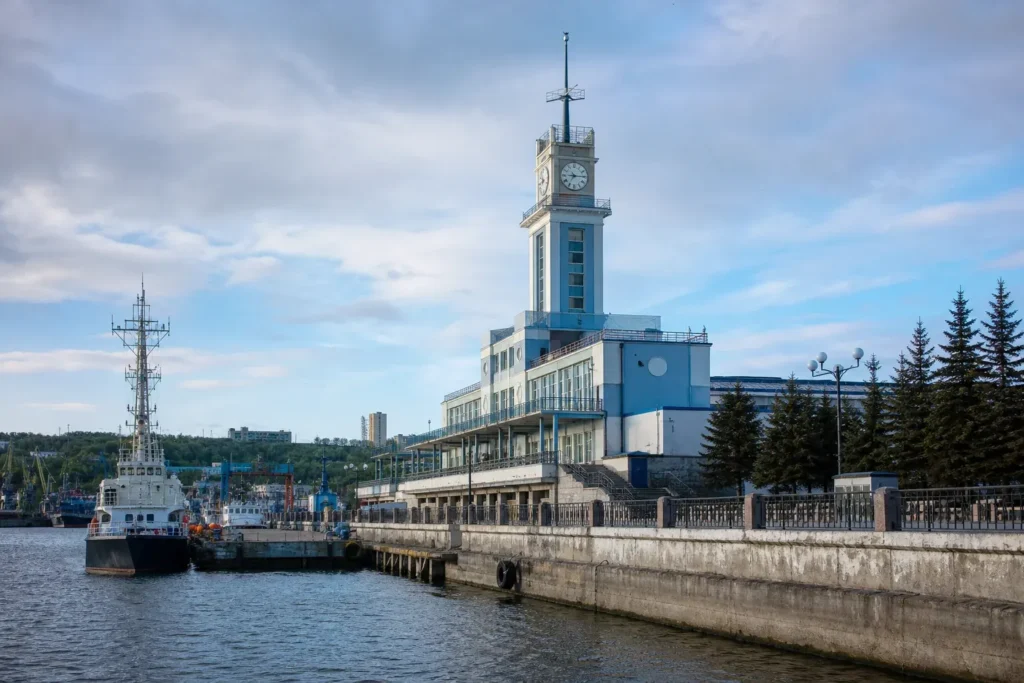
The Marine Station is a maritime passenger terminal in Murmansk, serving as the departure point for coastal voyages and a gateway to one of Russia’s oldest Arctic landmarks. Murmansk is the world’s most populous city north of the Arctic Circle, and the Marine Station sits at the heart of its waterfront, offering an intimate connection to the Barents Sea.
The station is most famous as the berth of the world’s first nuclear-powered icebreaker Lenin, which has been docked near the terminal as a museum ship since 2009. Visitors typically combine a visit to the station with tours of the iconic icebreaker or a scenic walk along the embankment overlooking Kola Bay.
Quick Facts
| Russian name | Морской вокзал |
|---|---|
| Type | River pier / station |
| Built / opened | 1916 |
| Address | Port passage, 25, Murmansk OpenStreetMap · Google Maps |
| District | Murmansk Oblast |
| Admission | free |
| Best time to visit | Late spring through early autumn (May to September) offers the mildest weather and access to coastal voyages. Summer is best for viewing the Lenin museum ship and the embankment in daylight. Winter brings polar darkness and sub-zero temperatures, but the Arctic landscape is stunning and crowds minimal. Polar summer days (June–July) offer nearly 24-hour daylight. Avoid March–April and October–November when weather is unpredictable and daylight hours short. |
| Recommended duration | 1–2 hours |
How to Get to and from Murmansk Marine Station, Murmansk
| Option | Duration | Price | Notes |
|---|---|---|---|
| Murmansk Airport transfer | 30–40 minutes | ₽₽ | Taxi or ride-share from the airport to the Marine Station; arrange in advance or use official taxi services. Distance is approximately 40 km. |
| Murmansk Railway Station connection | 15–20 minutes walk | Free | The railway station is the primary arrival hub; from there, cross the railway overpass and follow signs or local directions to the Marine Station waterfront. |
| City buses and local transport | 20–30 minutes | ₽ | Local buses serve the central waterfront areas; inquire at transport information or your accommodation for the best route. |
| Coastal voyage on Klavdia Yelanskaya | Multi-day (varies by destination) | ₽₽ | The Klavdia Yelanskaya carries passengers along the coast of the Kola Peninsula, connecting Murmansk with Ostrovnoy, Chapoma, Chavanga and Sosnovka. Sailings are seasonal and infrequent; book well in advance. |
₽ budget · ₽₽ moderate · ₽₽₽ upscale · ₽₽₽₽ splurge. Price levels are estimates compared with typical prices for visitors.
Why Visit Murmansk Marine Station, Murmansk?
The Marine Station is essential for understanding Arctic maritime history and Murmansk’s strategic importance. The museum ship Lenin represents a milestone in nuclear technology and Arctic exploration, while the station itself offers views over Kola Bay and the northern gateway to international shipping routes.
From the station, the ship Klavdia Yelanskaya operates passenger services along the coast of the Kola Peninsula, connecting Murmansk with remote settlements including Ostrovnoy, Chapoma, Chavanga and Sosnovka. For visitors with time, the station provides an authentic glimpse of Russian Arctic port life.
Highlights of Murmansk Marine Station, Murmansk
The Marine Terminal Building
The building is constructed in constructivist architectural style. In 2016, a reconstruction added another storey and a clock tower in honor of the 100th anniversary. The restored facade overlooks the Kola Bay embankment, and the building now serves both as a functioning maritime terminal and a cultural landmark. Its solid Soviet-era forms dominate the waterfront.
Tip: The walk to the station from the city centre crosses a railway bridge with steep sections; allow extra time if mobility is limited.
Lenin Nuclear Icebreaker Museum Ship
In 2009, the world's first nuclear-powered icebreaker Lenin was docked near the terminal as a museum ship. The Lenin was launched in 1959 and then sailed the routes of the Northern Sea Route. Guided tours of the vessel reveal its innovative design and the history of Arctic exploration. The ship sits permanently moored at the adjacent berth, a massive steel landmark visible from across the bay.
Tip: Tours of the Lenin require a separate ticket; check hours in advance as they vary seasonally and may be limited in winter.
The Kola Bay Embankment
There is a small embankment at the sea terminal. This promenade offers rare public access to the waterfront in central Murmansk. On clear days, views stretch across the bay; in winter and shoulder seasons, the Arctic landscape is dramatic and subdued.
Tip: Bring warm layers and windproof clothing; the embankment is exposed to Arctic winds even in mild seasons.
The Berths and Pontoon Dock
Marine Station has two berths, one of which is a pontoon berth, with a small embankment at the sea terminal. The functional working harbour provides an authentic atmosphere; visitors often see crew activity and cargo handling. The pontoon is sometimes used for temporary vessels or cruise ship operations.
Tip: Access to the working berths is limited; observe from designated viewing areas and respect any barriers or security markings.
Coastal Passenger Services
The Murmansk Shipping Company's Klavdia Yelanskaya carries passengers along the coast of the Kola Peninsula, connecting Murmansk with the settlements of Ostrovnoy, Chapoma, Chavanga and Sosnovka; prior to January 2013 boats also served Abram-Mys. These voyages are rare opportunities to see the remote northern coast and tundra settlements inaccessible by road.
Tip: Sailings are seasonal and infrequent; contact the station directly or check the official Murmansk Shipping Company website well in advance to plan a voyage.
Atmosphere
The Marine Station sits at the intersection of Arctic industrial heritage and modern tourism. The waterfront is quieter than most city docks, with a contemplative, windswept quality. In daylight, the station is busy with occasional vessels and port workers; the atmosphere is businesslike but not rushed. In summer, when daylight extends into the late evening, the embankment attracts local walks and modest crowds. In winter and polar darkness, the station feels isolated and austere—the Lenin’s dark hull and the reconstructed building are starkly visible under artificial light.
The station building itself, after its 2016 reconstruction, projects Soviet-era monumentality softened by restoration. The surrounding waterfront mixes functional port infrastructure with open promenade space. The bay beyond is often grey-blue, sometimes stormy; seabirds are frequent. Few tourists visit compared to major European ports—the place retains an authentic, slightly remote character.
History of Murmansk Marine Station, Murmansk
The Murmansk Transport Hub was established in 1915 as one of the major gateways to the Russian Arctic and European Russia. The Marine Station building was constructed as part of this foundational infrastructure project to support Arctic shipping and commerce. As a maritime passenger terminal, it anchored Murmansk’s role as a gateway for people and goods between the Russian interior and the Arctic Sea.
In 2009, the world’s first nuclear-powered icebreaker Lenin was permanently docked near the terminal as a museum ship. This transformed the station into not just a working port but also a historic monument. The Lenin, launched in 1959, pioneered nuclear icebreaker technology and sailed the Northern Sea Route, making it a symbol of Soviet Arctic ambition and engineering achievement.
In 2016, a reconstruction of the building added another storey and a clock tower in honor of the 100th anniversary. This modernisation preserved the constructivist character while improving facilities and adapting the station for contemporary tourism and port operations. Today the station balances its role as a functional maritime hub with its status as a cultural and historical landmark in Russia’s Arctic capital.
Tickets and Payment at Murmansk Marine Station, Murmansk
The Marine Station and embankment are free to visit. Access to the Lenin museum ship requires a separate ticket purchased at the ship’s entrance. Tickets for coastal voyages on the Klavdia Yelanskaya must be purchased at the station ticket office or through the Murmansk Shipping Company.
How to reach the station: From Murmansk Railway Station (the main transit hub), follow the railway overpass signs toward the waterfront and port area. The station is approximately 15–20 minutes’ walk from the railway station. Alternatively, use local buses or taxis. Informal taxi touts may approach visitors; use official registered taxis or pre-arranged transport for safety.
For guided tours of the Lenin and current sailing schedules, contact the station directly or check local tourism information. Rates for Russian citizens may differ; inquire at the ticket office for all available categories.
Flights, Transfers and Planning
Search flightsOpen in Yandex MapsOpen in Google MapsOpen in Apple Maps
Advertisement: these are partner links. If you book or buy through them, we may earn a commission at no extra cost to you.
How to Get to Murmansk Marine Station, Murmansk
From Murmansk Railway Station (the main arrival point): Exit the station onto Prospekt Lenina, then follow signs or ask for directions toward the port (морской порт) or Marine Station (Морской вокзал). You will cross a railway overpass with steep ascents and descents. The walk takes 15–20 minutes. The embankment comes into view as you descend toward the waterfront.
By taxi or ride-share: Ask for “Морской вокзал” (Marine Station) or “Portovaya ulitsa” (Port Street). Journey time from the centre is 5–10 minutes depending on traffic.
By bus: Local buses serve the central waterfront; ask at your hotel or tourism office for the nearest stop. Journey time is 20–30 minutes.
From Murmansk Airport: The airport is approximately 40 km south of the city. Arrange a taxi or use ride-share services (typical journey 30–40 minutes and ₽₽).
Accessibility
The Marine Station building has been modernised; ground-floor areas are accessible. However, the walk from the railway station involves a railway overpass with steep sections and steps, which presents challenges for mobility-limited visitors. Benches are available on the embankment. The embankment itself is paved but can be icy in winter. Wheelchair access to the Lenin is limited; contact the museum directly for details. No formal disabled facilities information is published on the official station website; inquire in advance.
Food Nearby
Limited food options are at the Marine Station itself. A small cafe or snack bar may operate at the station building, particularly during summer months. The nearest restaurants are in the central city, a 15–20 minute walk away. For simple meals and supplies, convenience stores are located near the railway station and throughout the city centre.
What to Bring
Warm, windproof clothing even in summer; the Kola Bay waterfront is exposed to Arctic winds. Waterproof jacket and sturdy footwear are essential. In winter, thermal layers, hat, gloves and hand warmers are necessary; temperatures often drop to –10°C or lower. Sunglasses are recommended in summer due to intense light reflection off water. No special bag restrictions; standard security screening may apply during peak periods.
Photography Rules
Photography is permitted freely on the Marine Station embankment and exterior areas. The Lenin museum ship interior has photography restrictions; verify with staff before photographing inside. No drones are permitted without explicit permission from port authorities. Tripods may be restricted in working port areas; ask before setting up. Flash photography is generally allowed outdoors but discouraged indoors on the museum ship.
Family Suitability
The Marine Station and embankment are suitable for families with children aged 6 and older. The walk is level once you reach the waterfront, and views are interesting for all ages. The Lenin museum ship tour is popular with children interested in history and engineering; however, it involves climbing stairs and narrow passages, so younger children and those with mobility issues may find it challenging. Stroller access is limited due to the railway overpass and uneven surfaces on the embankment. Plan for 1–2 hours total. Young children should be supervised closely near the water.
Russia Vibes Tips
- The Marine Station building itself is less visited than the Lenin museum ship; arrive early in the morning or late afternoon for quieter viewing and photography.
- If visiting in polar summer (late June–July), the continuous daylight creates unusual photography opportunities but crowds can be larger. Plan accordingly.
- The walk from the railway station to the Marine Station is marked but steep; wear comfortable, slip-resistant shoes. In winter, the overpass can be icy.
- Coastal voyages on the Klavdia Yelanskaya are infrequent and seasonal; make inquiries immediately upon arrival or contact the station in advance. Summer sailings are more frequent than winter.
- Combine a Marine Station visit with a walk along the central embankment for a fuller sense of Murmansk's Arctic waterfront character.
- The station is at its most atmospheric in the late afternoon or evening, when light on the bay becomes dramatic and tourist numbers drop.
Explore Nearby Murmansk Marine Station, Murmansk
Related guides
 Lenin Nuclear Icebreaker: Arctic Museum and World First
Main image: AI-generated illustration. It may not show the place exactly as it looks.
Browse more: More in Murmansk Oblast · All Airports & Transport · All Airports & Transport in Murmansk · All Murmansk · All River Piers and Stations
FAQ: Murmansk Marine Station, Murmansk
Is the Marine Station building free to enter?
Yes, the Marine Station building and embankment are free to visit. However, tours of the Lenin museum ship require a separate paid ticket.
Can I visit the Lenin icebreaker?
Yes. The Lenin is docked at the adjacent berth and operates as a museum with guided tours. Tickets are purchased at the ship's entrance. Tours are seasonal; confirm hours in advance.
How do I get from the railway station to the Marine Station?
Walk from Murmansk Railway Station (the main transit hub) across the railway overpass toward the port and embankment. The journey takes 15–20 minutes. Alternatively, use a taxi or local bus.
Are there passenger boat trips from the Marine Station?
Yes. The Klavdia Yelanskaya operates seasonal sailings along the Kola Peninsula coast, connecting Murmansk with remote settlements. Sailings are infrequent; inquire at the station ticket office or the Murmansk Shipping Company.
What is the best time to visit?
May–September offers the mildest weather and best daylight. Summer is ideal for photography and embankment walks. Winter brings polar darkness and extreme cold but fewer crowds and dramatic landscapes.
Is the Marine Station accessible for visitors with mobility issues?
The station building itself is modernised and accessible at ground level. However, the walk from the railway station involves a steep overpass. The embankment is paved but can be icy in winter. Contact the station in advance for specific accessibility information.
Can I take photos at the Marine Station?
Photography is allowed freely outdoors on the embankment and exterior areas. Inside the Lenin museum ship, photography restrictions apply. No drones are permitted without permission from port authorities.
Is there food and drink at the Marine Station?
Limited options exist at the station itself; a small cafe may operate seasonally. The nearest restaurants are in the city centre, a 15–20 minute walk away. Bring snacks or plan to eat in the city.
Russia Vibes is a one-person project. A coffee keeps it going
How we research and update our guides
About this guide: AI assistance and accuracy
This guide is created with the help of AI and is based on official sources where available. Mistakes can still happen. Opening hours, prices, rules and other details are given to the best of our knowledge as of the date shown and can change without notice. It offers general recommendations only, not professional, legal or travel advice. Please confirm important details with the official source before you travel; you are responsible for your own plans and decisions.

Take this guide with you
Get a free PDF of this guide to print or read offline: key facts, tips and a map link on a few clean pages.
Report an issue on this page
Paying for your trip: please read
International sanctions affect payments between Russia and many other countries. In practice, cards issued in the EU, the UK, the US and several other countries often do not work in Russia, Russian cards usually do not work abroad, and some booking platforms, airlines and payment providers limit or suspend their services for Russia. The situation changes frequently.
We do not give legal or financial advice, and this site does not encourage anyone to break or circumvent sanctions. Whatever you plan, you are responsible for following the laws and regulations that apply to you, including those of your country of residence and citizenship.
Many travelers still organise their stay lawfully. It is worth asking your bank or payment provider what is currently permitted, contacting hotels, tour operators and carriers directly about the payment methods they accept, and checking which services are open to customers from your country. Clarify payment, cancellation and refund terms before you commit to a booking, and keep your plans flexible.
Partner links on this site may not be available in every country, and prices, availability and rules in our guides can differ from what you see when you book.