
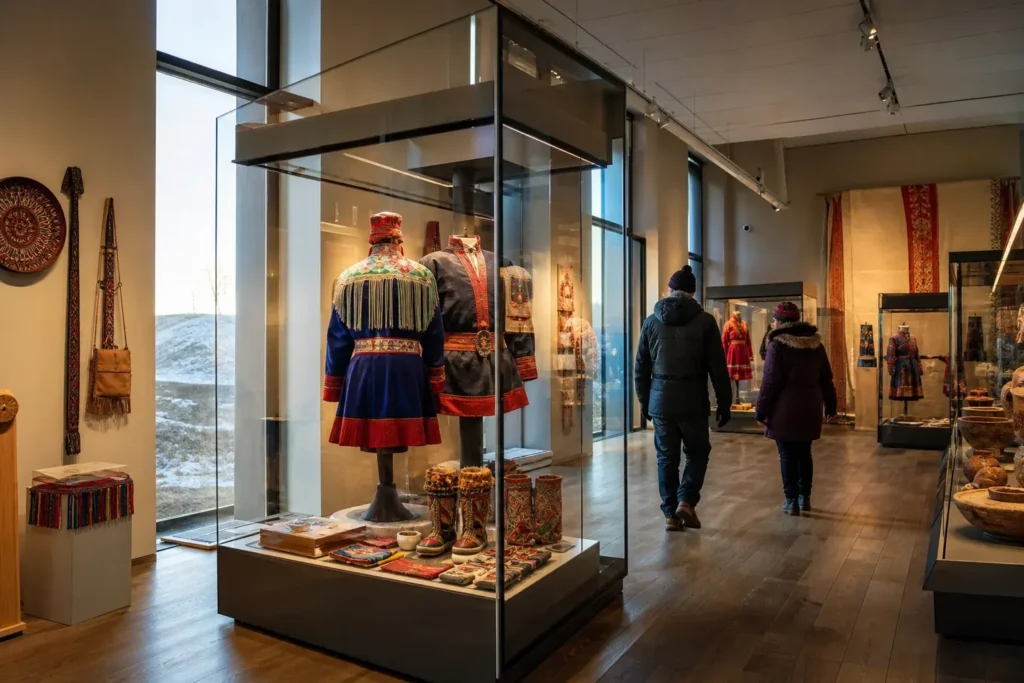
The Murmansk Regional Museum of Local Lore is the oldest museum in the region, founded on October 17, 1926. This museum chronicles the Kola Peninsula’s story from ancient times to the present day, with 14 themed halls dedicated to the Murmansk Region for visitors.
The historic building with an anchor on Lenin Avenue is under reconstruction, the museum is located at Pavlova Street, 1A. Entry is free, making it an accessible introduction to Arctic history, indigenous cultures, and the region’s defining role in World War II.
Current access notice: The historic building with an anchor on Lenin Avenue is under reconstruction; the museum is currently located at Pavlova Street, 1A. The temporary location displays the main permanent collections. As of October 2026, check the official website for updates on the main building's reopening date.
Quick Facts
| Russian name | Мурманский областной краеведческий музей |
|---|---|
| Built / opened | 1926 |
| Address | улица Академика Павлова, 1A, Мурманск Google MapsApple MapsYandex Maps2GISOpenStreetMap |
| District | Murmansk |
| Opening hours | Mon-Sun 11:00-20:00 |
| Admission | free |
| Best time to visit | Murmansk experiences extreme seasonal light variation. Visit in summer (June–July) for continuous daylight to explore before and after the museum visit. Winter (December–February) is darker but offers the possibility of seeing the Northern Lights. Autumn (September–October) and spring (April–May) have more moderate conditions and fewer tourists.Weekday mornings (9:00–11:00) are quietest. School holidays and weekends bring larger groups. December and January attract aurora hunters but also more crowded conditions. |
| Recommended duration | 1–2 hours |
| Website | mokm51.ru |
What Is (and Isn't) Part of a Visit to Murmansk Regional Museum of Local Lore, Murmansk?
| Part | Status | Notes |
|---|---|---|
| Main museum exhibitions (nature, history, ethnography, WWII) | Included in the standard ticket | Free admission; all exhibits included with entry. |
| Museum library and archives | Separate ticket or institution | Research access by appointment; contact the museum directly. |
| Guided tours in English | Separate ticket or institution | Museum staff can arrange English-language guides for an additional fee; book in advance. |
| Museum of the History of the Kola Sami (Lovozero branch) | Separate ticket or institution | Located in Lovozero village; separate institution and visit required. |
| Museum of Culture and Life of the Terek Pomors (Umba branch) | Separate ticket or institution | Located in Umba village; separate institution and visit required. |
| Historic building with anchor monument (Lenin Avenue) | Outside / not part of it | Currently under reconstruction; not open to visitors but visible from outside. |
Why Visit Murmansk Regional Museum of Local Lore, Murmansk?
The museum’s collection includes icons of the XVII century, a collection of handwritten books, including the oldest one, The Lives of the Founders of the Solovetsky Monastery of Zosima and Savvati, 1548; a collection of core samples from the Kola Superdeep Borehole, a herbarium of rare and endemic plants.
Collections tell about the nature of the Murmansk region, the history of the region since ancient times, the economy and life of indigenous peoples, the Arctic during the Great Patriotic War of 1941-1945. Every year, the museum hosts more than a hundred temporary exhibitions, family events, and major festivals.
How Murmansk Regional Museum of Local Lore, Murmansk Is Laid Out
The updated exposition features traditional exhibits, as well as modern information technologies. More than 100 content points and various interactive features have been created. The museum’s displays are organized thematically rather than chronologically, allowing visitors to focus on specific areas of interest.
The main sections cover natural history (including Arctic wildlife and geology), ethnography (Sami and Pomor cultures), regional history from ancient times through the Soviet era, and World War II in the Arctic. Each thematic section is housed in its own exhibition hall, so you can navigate between topics by moving through the museum’s rooms. Entry is through the main lobby where tickets and information are available.
Highlights of Murmansk Regional Museum of Local Lore, Murmansk
Kola Superdeep Borehole Collection
The 'Nature' section displays 'Russia's only exposition of the sea bed' – a dried aquarium which is a unique geological collection extracted from 100 m – 12 km depths while boarding the Kola's ultra deep well. This extraordinary geological display showcases rock and mineral samples retrieved from one of the world's deepest holes, drilled during the Soviet era to study the Earth's interior. Look for the crystalline structures and unusual rock formations.
Tip: This section appeals strongly to geology enthusiasts; allow extra time if you are interested in mineralogy and Earth science.
Sami Culture and Ethnography
The ethnic culture section vividly reproduces the lifestyles of local ethnic groups such as the Sami through traditional costumes, handicrafts, and daily necessities. The museum displays traditional clothing, tools, hunting equipment, and household items that reveal how the indigenous Sami people survived and thrived in the Arctic for centuries. The exhibits cover both historical and contemporary Sami culture.
Tip: Photographs here are excellent; visitors often find the textile displays and reindeer-herding equipment particularly evocative of Arctic life.
World War II Arctic Defense Exhibits
Exhibits cover Arctic wildlife, indigenous Sami culture, WWII Arctic Convoys, and the city's founding. Murmansk played a crucial strategic role during World War II as a port receiving supplies from Allied convoys and serving as a naval base. The museum's extensive WWII section includes photographs, maps, personal documents, and artifacts documenting the Arctic campaigns and the city's fierce defense against Nazi attacks.
Tip: This is the largest and most detailed section; plan to spend 30–45 minutes here if military history interests you.
Anchor Monument to the Icebreaker Ermak
In 1965 the side of the Museum was decorated by a mosaic panel and an anchor on a pedestal which is a monument to the first icebreaker 'Ermak'. This iconic public monument, visible on the exterior of the historic building on Lenin Avenue (currently under reconstruction), honours Russia's pioneering icebreaker. Photographs and explanatory panels inside the current exhibition space contextualize this historical tribute.
Tip: When the main building reopens, this anchor monument will be a distinctive landmark helping you locate the museum entrance.
Arctic Exploration and Polar Achievements
The exposition displays a collection of skis, medals and signs of the annual Polar Olympiad which is chronicled since 1934. The museum documents Murmansk's role as a base for Arctic scientific expeditions and polar achievements. Display cases show expedition equipment, medals, and records from polar competitions and achievements throughout the Soviet period.
Tip: History buffs and those interested in Arctic exploration will find detailed documentation of specific expeditions with dates and objectives.
Handwritten Books and Archival Collections
The collection includes a collection of handwritten books, including the oldest one, The Lives of the Founders of the Solovetsky Monastery of Zosima and Savvati, 1548. The museum's library holds 18,000 volumes and maintains extensive archives of local history manuscripts. These rare documents are not always on public display but can sometimes be viewed by appointment.
Tip: Ask staff if special collections are accessible; researchers and serious history students may arrange viewings of archival materials.
Atmosphere
The temporary location on Pavlova Street creates an intimate, less crowded atmosphere than many major regional museums. The exhibition halls are well-lit and clearly organized, with modern interactive elements alongside traditional displays. Visitor flow is generally calm except during school holiday periods.
Weekday mornings tend to be quietest; you may encounter school groups on weekday afternoons and families on weekends. Most exhibits are labeled in Russian only, so English speakers often spend time photographing displays for later reference. The overall mood is respectful and reflective, particularly in the World War II sections. There is a small gift shop selling local crafts and books.
History of Murmansk Regional Museum of Local Lore, Murmansk
Founded in 1926, the Murmansk Museum of Local Lore is the oldest cultural institution on the Kola Peninsula. The museum was established during the early Soviet period to document and preserve the cultural heritage of the newly developing Murmansk region.
The building was constructed in 1937 as a secondary school and was subsequently used as a military hospital during the Second World War. Its first expositions as a Museum were presented in 1957. This architectural history reflects Murmansk’s rapid transformation during the Soviet era, from a remote Arctic outpost to an industrial port and military strategic center.
In 1965 the side of the Museum was decorated by a mosaic panel and an anchor on a pedestal which is a monument to the first icebreaker ‘Ermak’. This public monument honors Russia’s pioneering Arctic shipping capabilities and became an iconic symbol of the museum building.
Over decades, the museum accumulated an extensive collection documenting the Kola Peninsula’s natural environment, indigenous Sami populations, regional economic development, and especially Murmansk’s critical role during World War II. The museum has been renovated since May 2019. The updated exposition features traditional exhibits, as well as modern information technologies. The permanent main building on Lenin Avenue underwent major reconstruction to integrate contemporary museum practices while preserving the institution’s historical significance.
Tickets and Booking for Murmansk Regional Museum of Local Lore, Murmansk
| Ticket | Price | Includes |
|---|---|---|
| General admission (all visitors) | Free | Access to all permanent exhibitions and displays. |
₽ budget · ₽₽ moderate · ₽₽₽ upscale · ₽₽₽₽ splurge. Price levels are estimates compared with typical prices for visitors.
Entry to the Murmansk Regional Museum of Local Lore is free. There is no advance booking requirement; visitors may arrive and enter during opening hours. The museum is open daily from 11:00 to 20:00.
All exhibits are labeled in Russian only. For English-language information, the museum can arrange guided tours with advance notice; contact the museum directly via phone (+7-8152-99-44-58) or email (mokm.51@yandex.ru) to request an English-speaking guide. Note that rates for Russian citizens and other categories differ; see the official website mokm51.ru for all current ticket categories and any special programs.
Plan and Book
Suggested itineraries Murmansk Regional Museum of Local Lore, Murmansk
1 hour (quick visit)
Enter through the main lobby and head directly to the World War II Arctic section, which is the most popular exhibition. Spend 30–40 minutes here, then take 15–20 minutes to walk through the Sami ethnography displays. This covers the two most visited sections and gives a core sense of regional identity.
90 minutes
Begin with the natural history section (Arctic wildlife and the Kola Superdeep Borehole collection) for 25 minutes. Continue to the Sami ethnography halls (20 minutes). Spend 35–40 minutes in the World War II section. End with a brief walk through the regional history displays (10 minutes).
2–3 hours (comprehensive visit)
Start with natural history and geology. Move through chronological history sections from ancient times through the regional founding period. Spend significant time in the ethnography galleries (Sami and Pomor cultures). Dedicate 45–60 minutes to the World War II Arctic exhibits. If available, view archival or special collections. Browse the gift shop and library materials.
How to Get to Murmansk Regional Museum of Local Lore, Murmansk
The museum is currently located at ulitsa Akademika Pavlova, 1A (Academician Pavlov Street, 1A) in central Murmansk. Murmansk has no metro system. Reach the museum by bus, trolleybus, or taxi.
- By bus or trolleybus: Stops: ‘Regional Hospital’, ‘Prospect Kirova’ (buses No. 3T, trolleybus No. 3, minibus No. 52, No. 54); ‘Kola Avenue’ (bus number 18, trolleybus number 4, 6, 10). Exit at either stop and walk toward Pavlova Street.
- On foot: The museum is roughly a 10-minute walk from Five Corners Square (Ploshchad Pyati Uglov) in the city center.
- By taxi or ride-share: Give the driver the address ‘Pavlova Street, 1A’ or use the Russian name ‘ulitsa Akademika Pavlova, 1A’.
Accessibility
The temporary location at Pavlova Street, 1A is a ground-floor space accessible to wheelchair users. Elevators are available to reach upper exhibition halls if present. Specific details on accessible restrooms, seating areas, or companion facilities should be confirmed directly with the museum staff by phone or email before your visit.
Food Nearby
The museum is in central Murmansk with cafés and restaurants within walking distance along Pavlova Street and nearby Lenin Avenue. Options range from casual cafés serving Russian fare to international restaurants. The museum itself does not have an on-site café; plan to eat before or after your visit, or take a break during your tour.
What to Bring
Bring comfortable indoor shoes; you will spend 1–3 hours walking through exhibition halls. Murmansk is in the Arctic; outdoor temperatures range from mild in summer to extreme cold in winter. If visiting in winter, bring warm clothing for the walk to and from the museum. A notebook and pen can help record details from Russian-language displays if you don't have a camera. Photography is permitted indoors; bring a camera or smartphone. Bags are permitted and a cloakroom is available.
Best Views and Photo Spots of Murmansk Regional Museum of Local Lore, Murmansk
Kola Superdeep Borehole Collection displays
Crystalline rock and mineral samples from extreme depths create striking compositions under museum lighting. The contrast between specimen colors and the dark display backgrounds makes these scientifically significant objects photogenic.
Best time: Any time during opening hours; indoor lighting is consistent.
Sami ethnography section with traditional clothing and handicrafts
Colorful traditional garments, intricately carved wooden items, and beadwork display well in photographs. The detailed textile patterns and bright colors of Sami traditional dress stand out against neutral gallery walls.
Best time: Mid-day when gallery lighting is brightest and crowds are lighter on weekday mornings.
World War II Arctic exhibits with photographs and historical maps
Historical photographs, military maps, and period documents create atmospheric documentary-style images. The scale of some displays and dramatic photograph subjects offer compelling compositions.
Best time: Weekday mornings when fewer people are in the galleries, allowing clearer shots.
Photography Rules
Photography is allowed throughout the museum without flash or tripod. Most displays are well-lit for casual photography. No special permits are required for personal photography. Professional or commercial photography may require advance permission; contact the museum.
Family Suitability
The museum is suitable for families with children aged 8 and older who have some interest in history or science. The natural history section (Arctic animals and geology) engages younger children. Interactive elements throughout the exhibitions help maintain engagement. The Sami ethnography displays are visually interesting and accessible to curious children.Stroller access is possible but may be tight in crowded galleries; carrying young children may be more practical. The museum does not have a dedicated children's area or play space. School-age children and teenagers benefit most from guided tours; arranging an English-language guide helps families follow the narratives and learn the stories behind artifacts. Allow 1–2 hours for family visits depending on children's interests.
Russia Vibes Tips
- Book an English-language guide in advance if you want full context for the exhibits. All displays are in Russian only, and a guide transforms the experience from looking at objects to understanding their historical and cultural significance. Contact the museum by email or phone at least a few days ahead.
- Visit the Kola Superdeep Borehole collection first—it is the most unusual exhibit and requires the least context to appreciate. This builds interest before moving to more narrative-heavy history sections.
- The World War II section is extensive; if time is limited, prioritize this over other sections as it best explains Murmansk's identity and strategic importance during the 20th century.
- Take photographs of Russian-language labels and descriptions to review later or translate using a smartphone app. This helps you understand exhibits even without a guide.
- Plan your visit for a weekday morning if possible. Weekends and afternoons bring school groups and families, which can slow navigation through the galleries.
- Check the official website or call before visiting to confirm the current address and any temporary changes. The museum is in transition from its historic main building, so details may shift as renovation progresses.
Explore Nearby Murmansk Regional Museum of Local Lore, Murmansk
Related guides
 Murmansk Seaport Passenger Terminal: Cruise Gateway and Arctic Port
Main image: AI-generated illustration. It may not show the place exactly as it looks.
 Murmansk Bus Station: Getting Around the Arctic Region
Main image: AI-generated illustration. It may not show the place exactly as it looks.
 Murmansk Railway Station: Arctic Gateway and Soviet Landmark
Main image: AI-generated illustration. It may not show the place exactly as it looks.
 Murmansk Airport: How to Get to the City
Main image: AI-generated illustration. It may not show the place exactly as it looks.
 Murmansk Regional Drama Theater: Arctic Culture on Lenin Avenue
Main image: AI-generated illustration. It may not show the place exactly as it looks.
Browse more: More in Murmansk · All Murmansk · All Museums · All Sightseeing · All Sightseeing in Murmansk
FAQ: Murmansk Regional Museum of Local Lore, Murmansk
Is the museum still at the Lenin Avenue location with the anchor monument?
No. The historic main building on Lenin Avenue is under reconstruction. The museum has temporarily relocated to Pavlova Street, 1A. All permanent exhibitions are open at this new location. The iconic anchor monument on the historic building will remain a symbol once reconstruction is complete.
Is entry really free?
Yes, entry is free for international visitors. Rates may differ for Russian citizens and certain other categories; check the official website for details. There are no additional mandatory fees to enter the main exhibitions.
Are the exhibits in English?
No, all exhibits are labeled in Russian only. To understand the full context, consider hiring an English-language guide (book in advance). Otherwise, photographing labels and using a translation app can help.
How long should I plan to spend?
Allow 1–2 hours for a typical visit. The museum has 14 themed exhibition halls, but most visitors focus on 2–3 main sections (World War II, Sami ethnography, natural history). A comprehensive visit covering all galleries can take 3 hours or more.
What is the Kola Superdeep Borehole collection?
It is a unique geological display of rock and mineral samples extracted from extreme depths (100 m to 12 km) during Soviet-era drilling. The museum calls it 'Russia's only exposition of the sea bed.' These specimens are scientifically significant and visually striking.
Can I visit the Sami culture branches in Lovozero and Umba?
Yes, but they are separate institutions located in villages outside Murmansk (Lovozero and Umba). You need separate travel and visits to these branches. The main Murmansk museum does have a Sami ethnography section, but the branch museums provide deeper focus.
Is the museum accessible by wheelchair?
The ground floor of the temporary location (Pavlova Street, 1A) is accessible. Full accessibility details should be confirmed with the museum directly before your visit.
Can I take photographs inside?
Yes, photography is permitted indoors without flash or tripod. No special permit is needed for personal photography. Commercial photography may require advance permission.
Russia Vibes is a one-person project. A coffee keeps it going
How we research and update our guides
About this guide: AI assistance and accuracy
This guide is created with the help of AI and is based on official sources where available. Mistakes can still happen. Opening hours, prices, rules and other details are given to the best of our knowledge as of the date shown and can change without notice. It offers general recommendations only, not professional, legal or travel advice. Please confirm important details with the official source before you travel; you are responsible for your own plans and decisions.

Take this guide with you
Get a free PDF of this guide to print or read offline: key facts, tips and a map link on a few clean pages.
Report an issue on this page
Paying for your trip: please read
International sanctions affect payments between Russia and many other countries. In practice, cards issued in the EU, the UK, the US and several other countries often do not work in Russia, Russian cards usually do not work abroad, and some booking platforms, airlines and payment providers limit or suspend their services for Russia. The situation changes frequently.
We do not give legal or financial advice, and this site does not encourage anyone to break or circumvent sanctions. Whatever you plan, you are responsible for following the laws and regulations that apply to you, including those of your country of residence and citizenship.
Many travelers still organise their stay lawfully. It is worth asking your bank or payment provider what is currently permitted, contacting hotels, tour operators and carriers directly about the payment methods they accept, and checking which services are open to customers from your country. Clarify payment, cancellation and refund terms before you commit to a booking, and keep your plans flexible.
Partner links on this site may not be available in every country, and prices, availability and rules in our guides can differ from what you see when you book.