
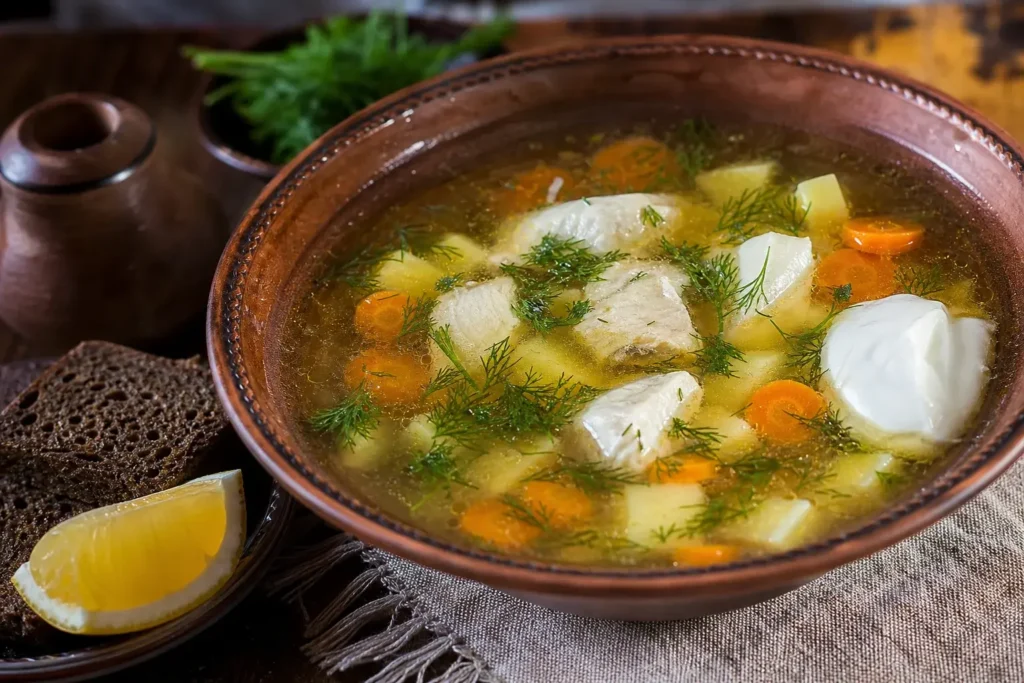
Ukha is one of Russia’s most enduring dishes, known for its delicate fish broth and clean, understated flavour. This article shows you how to make authentic ukha at home, whether you’re a first-time cook or want to master the traditional technique. Ukha: how to make Russian fish soup guides you from choosing your fish to serving it the traditional way—with rye bread, sour cream, and fresh herbs.
The recommended approach is to build a clear fish stock from whole fish or heads and bones, simmer vegetables until tender, then add fresh fish pieces near the end of cooking. The result is a light but deeply flavourful soup that tastes best when cooked simply and served warm.
Quick answer: The fish is cooked whole, from head to tail, to make a clear broth and then simple vegetables are added, such as onions, carrots, potatoes and fresh herbs. Plan for about 2 hours total. Cost is moderate, depending on the fish you choose.
At a Glance
| Type | Dishes |
|---|---|
| Local name | Уха |
| Origin | Ukha is a traditional rustic fish dish that dates back to the 11th century. Originating as a simple game and vegetable broth, the Russians introduced fish to the recipe toward the end of the 16th and beginning of 17th century. The roots of the soup originated in the culture of the Russian Cossack steppe riders and the soup is mostly associated in Russia with the Don region. |
| Servings | 2–4 servings |
| Total time | approximately 2 hours |
| Difficulty | Easy |
History and Story of Ukha, Yekaterinburg
“Ukha” started to be used as a term for fish broth in Russian cuisine in the late 17th to early 18th centuries. In earlier times, this term referred to thick meat broths, and then later chicken. Beginning in the 15th century, fish was more and more often used to prepare ukha. At the Tsar’s table, “amber” ukha, redolent with precious saffron strands, was made with perch or sturgeon. The French chefs working in Russian noble kitchens concentrated on perfecting the flavor and appearance of the bouillon itself, clarifying it with egg whites and eggshells and experimenting with different kinds of fish. In the 19th century, many travellers visiting Russia claimed ukha to be one of the best dishes in Russian cuisine.
Ingredients
- 500g whole fish or fish heads and bones (pike, trout, salmon, or perch)
- 250g additional fish fillet, cut into chunks
- 2 medium potatoes, diced
- 1 large carrot, sliced
- 1 onion, halved
- 1.5 litres water
- Fresh dill and parsley
- Bay leaf, salt and black pepper
How Ukha, Yekaterinburg Is Made
Step 1: Prepare the fish stock
The fish is cooked whole, from head to tail, to make a clear broth. Place the whole fish or fish heads and bones in a large pot with cold water. Add the onion halves, a bay leaf, and salt. Bring to a boil, then reduce heat and simmer gently for 40–50 minutes. The broth should become clear and amber-coloured. Strain through a fine sieve, discard solids.
Tip: For a clearer broth, skim any foam that rises to the surface during the first 10 minutes of cooking.
Step 2: Add root vegetables
Return the strained broth to the pot and bring to a simmer. Add the sliced carrot and diced potatoes. Simmer for 15–20 minutes until the vegetables begin to soften but are not fully cooked.
Tip: Cut potatoes into roughly 1–2 cm pieces so they cook evenly without falling apart.
Step 3: Add fish pieces
When the vegetables are nearly tender, add the diced fish fillets. Simmer gently for 5–7 minutes until the fish is opaque and cooked through. Do not let the soup boil rapidly, as this will break up the fish and cloud the broth.
Tip: White or pale fish varieties such as pike, perch, or cod work best for a delicate flavour, though salmon can be used for a richer version.
Step 4: Season and finish
Taste the soup and add more salt and black pepper as needed. Turn off the heat. Fresh herbs like dill and parsley are classic garnishes that bring a bright contrast to the savory, earthy broth. Stir in chopped fresh dill and parsley just before serving.
Tip: Add fresh herbs at the end to preserve their fragrance and colour.
Step 5: Serve
Serve the soup with sour cream and rye bread or crusty sourdough. Ladle into individual bowls and add a generous dollop of sour cream to each. Serve accompanied by fresh herbs and lemon wedges.
Tip: Some diners prefer to squeeze a little fresh lemon juice into the soup for acidity that brightens the fish flavour.
Variants
- White ukha is made with white fish such as sea bass, cod, and catfish. White fish doesn't necessarily reflect the actual color of the fish, rather, it's a term used to describe the mildness of flavor.
- Black ukha uses fish from the Cyprinidae (carp) family, found in the Black Sea.
- Red ukha has salmon as the main ingredient. Other red fish, such as sturgeon, can also be used.
- The fourth style of ukha is Tsar "Amber" ukha. This was tailored for the wealthier locals. It is prepared with chicken broth, and saffron was used to give it a warm amber color.
- In Northern Russia, around Siberia, ukha is made with salmon and trout.
Common Mistakes to Avoid
- Boiling the broth vigorously instead of simmering gently—this makes the stock cloudy and breaks the fish into small pieces. Keep heat low and steady.
- Adding all the fish at once at the start—the flesh becomes mushy. Add fresh fish pieces only in the final few minutes of cooking.
- Overcooking the vegetables until they disintegrate—add potatoes at the right time so they remain intact. Cut them into uniform chunks.
- Skipping the initial fish stock step and simply boiling fish pieces in water—this misses the concentrated flavour that whole fish or bones build. The bones are essential.
- Adding too many strong seasonings or thickeners—ukha is meant to be clear and delicate. Salt, pepper, bay leaf, and fresh herbs are enough.
- Cooking in a metal pot instead of a heavy-bottomed pot—metal can impart an unpleasant metallic taste. Use stainless steel or enamelled cast iron.
How to Order and Eat It
Ukha can be served hot or cold, in winter or summer. Regardless of the temperature, this fish dish is always served accompanied by fresh herbs and lemon wedges. Spoon the broth and vegetables into a bowl, ensuring each portion has some fish, potatoes and carrot. Serve with sour cream and rye bread or crusty sourdough. A dollop of sour cream stirred into the soup adds richness. Serve accompanied by fresh herbs and lemon wedges. Bite-sized pieces of fish are meant to be eaten with a spoon directly from the bowl. The clear broth is sipped between spoonfuls.
To order: Пожалуйста, уху [Pozhaluysta, ukhu]
Russia Vibes Tips
- Use the freshest fish available, ideally from a fishmonger rather than pre-packaged. The quality of the fish directly affects the broth's clarity and flavour.
- If you cannot find whole fish, ask the fishmonger to give you the heads and bones from fileted fish. These make an equally good stock and are often less expensive.
- Cook ukha outdoors or over an open fire if possible. Historically, Russian ukha was most often cooked over an open fire outside. To this day, it is believed to taste better when cooked in a clay pot outdoors.
- Never add cream, milk, or tomatoes to authentic ukha—these create different soups altogether. Ukha is defined by its simplicity and clear broth.
- Leftover ukha keeps in the refrigerator for 2–3 days and can be reheated gently. Reheat on low heat without letting it boil, and add fresh herbs again just before serving.
- In Russia, ukha is often eaten as a main course at lunch rather than as a starter. A large bowl with dark rye bread and sour cream constitutes a complete, satisfying meal.
Explore Nearby Ukha, Yekaterinburg
Related guides
 Local Food & Market Walk, Yekaterinburg: Central Market, Pelmeni and Street Eats
Main image: AI-generated illustration. It may not show the place exactly as it looks.
 Best Restaurants by Budget, Yekaterinburg: Where to Eat at Every Price Level
Main image: AI-generated illustration. It may not show the place exactly as it looks.
Browse more: All Food & Drink · All Food & Drink in Yekaterinburg · All Other · All Yekaterinburg
FAQ
Can I use fish fillets instead of whole fish?
Whole fish or bones are best for building the initial stock, as they create a richer, more gelatinous broth. However, you can substitute a few cups of shop-bought fish or vegetable stock for the homemade stock if time is short. Always reserve some fresh fillet for the final cooking step.
What type of fish works best for ukha?
You can use just about any type of fish for this soup. Most of the time, Ukha is made from a whole fish. Pike, trout, perch, salmon, cod and carp are all traditional. Oily fish like salmon makes a richer broth; white fish like pike or cod makes a lighter, more delicate version.
Is ukha gluten-free?
Yes, traditional ukha contains no gluten. It is made from fish, vegetables, herbs, and stock. Check that any shop-bought stock you use is also gluten-free.
Can I make ukha without potatoes?
Potatoes are not part of the most ancient versions of ukha, though they are now standard. If you prefer, you can omit them or replace them with other root vegetables such as parsnip or celery root.
How do I keep the broth clear?
Simmer the initial fish stock gently without boiling. Skim any foam or scum from the surface during the first 10 minutes. Use fresh cold water at the start. Add vegetables and fish gently near the end of cooking, and avoid stirring vigorously.
Can I add wine or vodka to ukha?
This traditional Russian fish soup recipe for Ukha is clear fish broth with chunks of salmon, veggies, topped with parsley and dill and the secret ingredient – a shot of vodka. A small splash of vodka or dry white wine can be added just before serving, but this is optional and not part of traditional recipes.
What is the difference between ukha and fish soup?
While ukha is a fish dish that is made with broth, calling it a fish soup may not be absolutely correct. "Ukha" started to be used as a term for fish broth in Russian cuisine in the late 17th to early 18th centuries. The key distinction is that ukha is always clear and light, built on a delicate fish stock, not a thick or cream-based fish soup.
How many servings does a typical pot make?
A standard bowl of soup is 500 ml per person, which for most people is a satisfying portion. A recipe calling for 2 litres of water makes enough for four people, or two and you'll have leftovers.
Russia Vibes is a one-person project. A coffee keeps it going
How we research and update our guides
About this guide: AI assistance and accuracy
This guide is created with the help of AI and is based on official sources where available. Mistakes can still happen. Opening hours, prices, rules and other details are given to the best of our knowledge as of the date shown and can change without notice. It offers general recommendations only, not professional, legal or travel advice. Please confirm important details with the official source before you travel; you are responsible for your own plans and decisions.

Take this guide with you
Get a free PDF of this guide to print or read offline: key facts, tips and a map link on a few clean pages.
Report an issue on this page
Paying for your trip: please read
International sanctions affect payments between Russia and many other countries. In practice, cards issued in the EU, the UK, the US and several other countries often do not work in Russia, Russian cards usually do not work abroad, and some booking platforms, airlines and payment providers limit or suspend their services for Russia. The situation changes frequently.
We do not give legal or financial advice, and this site does not encourage anyone to break or circumvent sanctions. Whatever you plan, you are responsible for following the laws and regulations that apply to you, including those of your country of residence and citizenship.
Many travelers still organise their stay lawfully. It is worth asking your bank or payment provider what is currently permitted, contacting hotels, tour operators and carriers directly about the payment methods they accept, and checking which services are open to customers from your country. Clarify payment, cancellation and refund terms before you commit to a booking, and keep your plans flexible.
Partner links on this site may not be available in every country, and prices, availability and rules in our guides can differ from what you see when you book.