
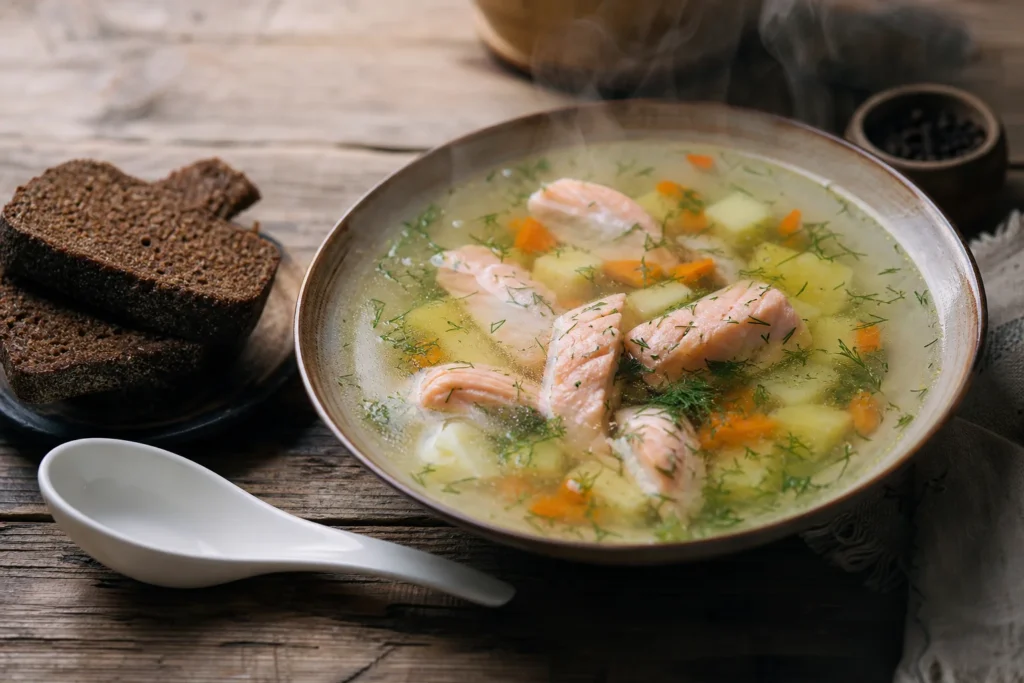
Ukha is a traditional Russian fish soup that visitors to Russia will encounter in restaurants and home kitchens across the country. This guide shows you how to make it yourself with common ingredients available in any kitchen. The recommended approach is to prepare a flavourful fish broth first, then add vegetables and fresh fish for a simple, elegant dish.
How to make ukha Russian fish soup takes about two hours from start to finish, though much of that is simmering time. The result is a light, clear broth with tender vegetables and flakes of fish—a meal that is both satisfying and straightforward to prepare at home.
Quick answer: Ukha is a clear Russian soup made from various types of fish, built in two stages: first, simmer a whole fish or fish bones with aromatics for 45 minutes to build a clear broth; then cook vegetables in the strained broth and add fresh fish. Total time: about two hours.
At a Glance
| Type | Dishes |
|---|---|
| Local name | уха |
| Origin | The roots of the soup originated in the culture of the Russian Cossack steppe riders and the soup is mostly associated in Russia with the Don region. "Ukha" started to be used as a term for fish broth in Russian cuisine in the late 17th to early 18th centuries. Beginning in the 15th century, fish was more and more often used to prepare ukha. In the 19th century, many travellers visiting Russia claimed ukha to be one of the best dishes in Russian cuisine. |
| Servings | 2–4 people |
| Total time | About 2 hours |
| Difficulty | Easy |
History and Story of Ukha, Volgograd
Ukha is a traditional rustic fish dish that dates back to the 11th century. Originating as a simple game and vegetable broth, the Russians introduced fish to the recipe toward the end of the 16th and beginning of 17th century, and since then, fish has been the primary ingredient. Ukha comes from the word “ukho,” the Russian word for ear, which is odd since fish don’t have ears. Ukha originally had nothing to do with fish, but was rather a thick, rich stock made from the leftover parts of cows and pigs, including the ears, the feet, the sinews, and other trimmings. Apparently favoured by Ivan the Terrible, ukha is a Russian “fish soup” that’s light and simple to prepare. A true Russian staple, fishermen would prepare the soup over an open fire with whatever fish was caught that day.
Ingredients
- 800–900 g fresh fish (salmon, trout, bream, cod, pike or similar), whole or parts
- 3 medium potatoes
- 2 carrots
- 1 onion
- 6–8 cups water
- 3–4 bay leaves
- 1 teaspoon black peppercorns
- Salt to taste
- Fresh dill (one small bunch)
How Ukha, Volgograd Is Made
Step 1: Prepare the fish and aromatics
Place the fish skeleton in a large pot with 12 cups of water, one halved onion, 1 teaspoon of salt and a teaspoon of whole peppercorns. If using a whole cleaned fish or fish pieces, simply place them in the pot with the same aromatics. The fish should be covered with cold water.
Tip: If using whole fish, ensure it has been gutted and scaled. Fish heads and tails create the most flavourful broth.
Step 2: Simmer the broth
Bring the mixture to a boil. Reduce heat and simmer for 45 minutes. Skim off any foam which appears on the surface. The broth should become clear and light golden.
Tip: Skimming prevents a cloudy appearance; a truly clear broth is the mark of well-made ukha.
Step 3: Strain the broth
Strain the fish stock through a cheesecloth placed inside a colander over a large bowl. Make sure that the fish broth is clear and free of impurities, discard the fish bones. Return the strained broth to a clean pot.
Tip: Save a little broth and use it later to rinse the cheesecloth and capture any strained liquid.
Step 4: Prepare and cook the vegetables
Peel and dice the potatoes and carrots into bite-sized chunks. Bring the strained broth to a boil, add the diced potatoes and carrots along with bay leaves. Simmer for about 10–12 minutes until the vegetables are tender but not falling apart.
Tip: Cut vegetables into consistent sizes so they cook evenly.
Step 5: Add fresh fish
Chop the salmon and trout fillets into 2-inch cubes. Add them to the saucepan and cook for around 10 minutes. The fish will gently poach and turn opaque. Avoid overcooking; the fish should remain tender.
Tip: Do not cut fish pieces too small or they will disintegrate into the broth.
Step 6: Finish and serve
Add a load of chopped dill and season to taste. Garnish with chopped green onions and/or parsley. Taste and adjust salt and pepper. Serve hot in bowls.
Tip: Fresh dill is essential to the traditional flavour; dried dill is not a good substitute.
Variants
- Amber or saffron ukha: A luxurious version served at imperial tables, made with perch or sturgeon and coloured golden with saffron.
- Northern ukha: Made with salmon and trout, common in Siberia and northern Russia.
- Pike ukha: Prepared using pike carcass and parts, a traditional freshwater version.
- Multi-fish ukha: Some recipes combine two or three types of fish (salmon, trout and bream) for richer flavour.
- Ukha with rice or millet: Some regional versions add grain for extra body, though the classic version is broth-based.
Common Mistakes to Avoid
- Using hot water instead of cold: Starting with cold water and bringing it slowly to a simmer produces a clearer, cleaner-tasting broth than starting with hot water, which can trap impurities.
- Not skimming foam: Foam that rises during the first simmer will cloud the broth. Skim it regularly for a jewel-clear soup.
- Cutting fish pieces too small: Small pieces will break apart and muddy the broth. Cut them into 2-inch (5 cm) chunks.
- Cooking the fish too long: Overcooking toughens the fish and makes it shred into the broth. Ten minutes is usually enough for medium-sized pieces.
- Substituting dried herbs for fresh: Dried dill, parsley and other herbs lack the brightness that makes ukha distinctive. Use fresh whenever possible.
- Skipping the initial broth stage: Some cooks add raw fish directly to water with vegetables, but this produces a muddy, flavourless soup. Always make a clear broth first.
How to Order and Eat It
Serve ukha hot in a deep bowl. It is traditionally accompanied by dark rye bread, which guests tear and add to the soup, or place on the side. Some diners add a dollop of sour cream to cool and enrich the broth. In the Caucasus, a squeeze of fresh lemon is common. Eat the vegetables with a spoon and flake the fish apart as you eat; the bones have been removed during preparation, so the soup is easy to eat.
To order: Чашку ухи, пожалуйста [Chashku ukhi, pozhaluysta]
Russia Vibes Tips
- Use fish with bones and skin. A whole small trout or the head and skeleton of a larger salmon creates far better broth than fillets alone, because bones release gelatin and minerals that clarify and enrich the broth.
- Start with cold water. This allows the broth to extract flavour and colour slowly, producing a clear, delicate result. Hot water shocks the fish and traps impurities.
- Resist the urge to cover the pot. Simmering uncovered allows steam to escape, which keeps the broth clear and prevents it from becoming cloudy or over-reduced.
- Add fresh herbs at the very end. If dill is cooked too long, it loses its bright flavour and the soup becomes dull. Add it during the last minute before serving.
- Taste as you go. Every fish and every water supply is different. Ukha should taste clean and delicate, never oversalted. Adjust seasoning carefully.
- Serve immediately. Ukha is best eaten hot, straight from the pot. It does not improve sitting on the stove for hours.
Explore Nearby Ukha, Volgograd
Browse more: All Food & Drink · All Food & Drink in Volgograd · All Other · All Volgograd
FAQ
Is ukha technically a soup or a broth?
While ukha is a fish dish that is made with broth, calling it a fish soup may not be absolutely correct. "Ukha" started to be used as a term for fish broth in Russian cuisine in the late 17th to early 18th centuries. Today it is served and eaten as a soup, with vegetables and fish in a clear broth.
What type of fish is best for ukha?
Ukha is a clear Russian soup made from various types of fish such as bream, wels catfish, northern pike, or even ruffe. Fish such as perch, tench, sheatfish, and burbot are sometimes used to add flavour to the soup. Salmon and trout are popular in modern kitchens, especially in northern Russia.
Can you use fish fillets instead of whole fish?
Fillets alone will not produce good broth. The best ukha starts with whole fish or at least fish bones and heads. If you do use fillets, save the bones and skin from a previously filleted fish to make the broth. Add only the fillet meat near the end of cooking.
Why is my ukha cloudy instead of clear?
Cloudiness usually comes from not skimming foam during the initial simmer, from boiling the broth too vigorously (it should barely bubble), or from starting with hot water instead of cold. Start over with cold water and simmer gently, skimming often.
How much dill should go in ukha?
A generous handful of fresh, chopped dill is traditional—about one small bunch. The flavour should be noticeable but not overpowering. Add it at the very end so it stays bright. Taste and adjust before serving.
Can you make ukha in advance?
The broth can be made a day ahead and refrigerated, then reheated before adding fresh vegetables and fish. However, the final soup is best served immediately after the fish is added, while it is still hot and the flavours are fresh.
What should I serve with ukha?
Dark rye bread is the traditional accompaniment. Sour cream on the side, lemon wedges, and fresh dill are common additions. In Russia, ukha is often eaten as a full meal, with bread being the only side.
Is ukha vegetarian-friendly?
No, ukha is fundamentally a fish-based dish. A vegetable broth with the same vegetables is not ukha, as the fish broth is essential to the flavour and identity of the dish.
Russia Vibes is a one-person project. A coffee keeps it going
How we research and update our guides
About this guide: AI assistance and accuracy
This guide is created with the help of AI and is based on official sources where available. Mistakes can still happen. Opening hours, prices, rules and other details are given to the best of our knowledge as of the date shown and can change without notice. It offers general recommendations only, not professional, legal or travel advice. Please confirm important details with the official source before you travel; you are responsible for your own plans and decisions.

Take this guide with you
Get a free PDF of this guide to print or read offline: key facts, tips and a map link on a few clean pages.
Report an issue on this page
Paying for your trip: please read
International sanctions affect payments between Russia and many other countries. In practice, cards issued in the EU, the UK, the US and several other countries often do not work in Russia, Russian cards usually do not work abroad, and some booking platforms, airlines and payment providers limit or suspend their services for Russia. The situation changes frequently.
We do not give legal or financial advice, and this site does not encourage anyone to break or circumvent sanctions. Whatever you plan, you are responsible for following the laws and regulations that apply to you, including those of your country of residence and citizenship.
Many travelers still organise their stay lawfully. It is worth asking your bank or payment provider what is currently permitted, contacting hotels, tour operators and carriers directly about the payment methods they accept, and checking which services are open to customers from your country. Clarify payment, cancellation and refund terms before you commit to a booking, and keep your plans flexible.
Partner links on this site may not be available in every country, and prices, availability and rules in our guides can differ from what you see when you book.