
Tsar’s Days is a major annual observance in Yekaterinburg held each July. The festival marks the deaths and martyrdom of Emperor Nicholas II and his family, who were murdered by the Bolsheviks in the Ipatiev House on 17th July 1918. What began as a single memorial service has grown into a ten-day festival that is part of the International Festival of Orthodox Culture, drawing Orthodox pilgrims and visitors from across Russia and abroad.
The festival is a deeply religious event centered on the Russian Orthodox Church, but also encompasses secular elements: exhibitions about the Romanov family, historical conferences, and concerts. For believers, Tsar’s Days represents a moment of national spiritual significance and remembrance of the last imperial family.
Quick Facts
| Russian name | Царские дни |
|---|---|
| When | Every year in mid-July |
| Next occurrence | July 17 (same date every year) |
| Typical duration | 11 days (11-21 July); main ceremony 16-17 July |
| Public holiday | No, an observance (regular working day) |
| District | Sverdlovsk Oblast |
| Admission | free |
| Best time to visit | Tsar's Days is held every July, with the main events on the nights and mornings of July 16-17. Arrive in Yekaterinburg at least one day before to familiarize yourself with the city and locate the Church on the Blood. The largest crowds and most significant atmosphere occur during the Divine Liturgy in the evening of July 16 and the early morning procession of July 17. If you prefer a quieter experience, attend other festival events during the broader 11-21 July period, including exhibitions and conferences at churches and museums throughout the city. |
| Website | ekaterinburg-eparchy.ru |
Dates, programs and prices change from year to year. Always check the official website for the current edition.
Why Visit Tsar's Days, Yekaterinburg?
Tsar’s Days offers visitors a rare glimpse into how Russia commemorates one of its most historically consequential events—the death of the Romanov dynasty. The focal point, the Divine Liturgy held on the night of 16/17 July, followed by a 21-km cross procession from the Church on the Blood to the Monastery of the Holy Royal Passion-Bearers at Ganina Yama, attracts tens of thousands of pilgrims. You will witness a profound expression of Orthodox faith and Russian cultural identity. The festival features bell ringing, concerts and musical evenings, as well as exhibitions and conferences hosted by well-known historians, theologians and authors. The procession itself is an extraordinary spectacle of devotion.
What to Expect at Tsar's Days, Yekaterinburg
The annual holidays are held in mid-July in the Ekaterinburg diocese, during which divine services are held, a cross procession in memory of the death and martyrdom of Emperor Nicholas II and his family, as well as a festival of Orthodox culture, including exhibitions and other social events.
The central event of Tsar’s Days is the Divine Liturgy held on the night of 16/17 July, followed by a 21-km cross procession, from the Church on the Blood in central Ekaterinburg to the Monastery of the Holy Royal Passion-Bearers at Ganina Yama. The cross procession, which began in the early morning hours of 17th July, took about 4 hours to complete on foot. Throughout the ten-day festival, museums and churches become venues for exhibitions dedicated to Emperor Nicholas II, his family and other members of the Romanov dynasty, who were murdered in Ekaterinburg and Alapaevsk.
What It Means for Your Visit
During Tsar’s Days, Yekaterinburg experiences significant crowds and additional religious services across the city. The memorial events traditionally bring together tens of thousands of faithful from across Russia and abroad. Transport may be congested, particularly around the Church on the Blood and along the route of the cross procession. Museum and church venues throughout the city host special exhibitions related to the Romanov family and Orthodox history.
Visitors should expect large gatherings at the Church on the Blood in the evening and early morning of 16-17 July, and street closures or altered traffic patterns along the procession route. Plan accommodation and transport well in advance. Check the official Ekaterinburg Diocese website for the current year’s detailed program, as specific timings and venues can vary annually.
Atmosphere
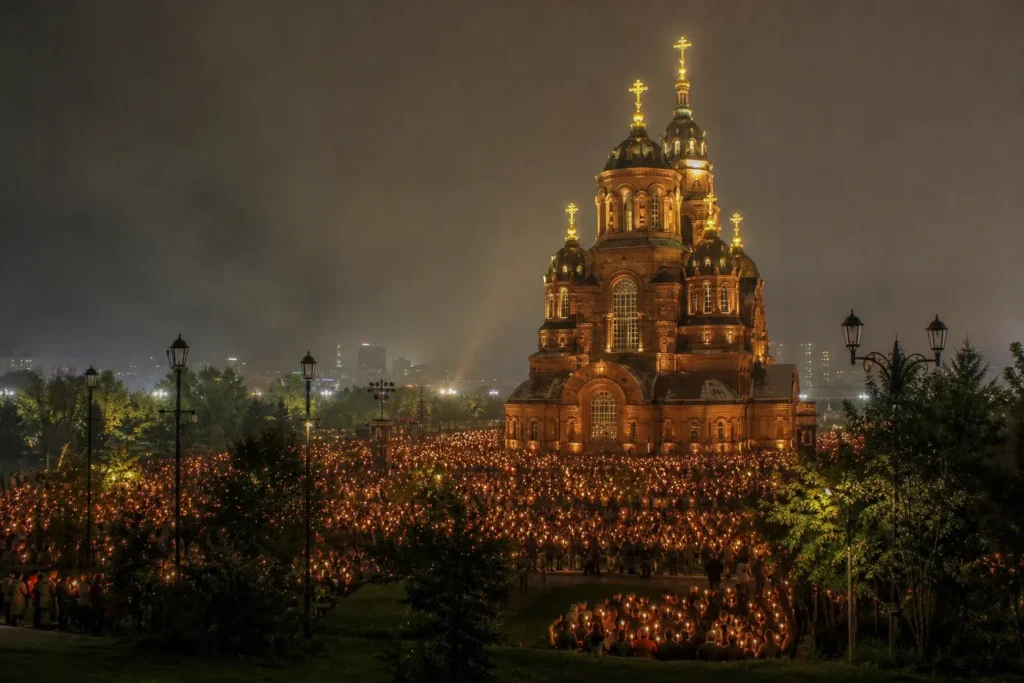
Tsar’s Days creates a profoundly solemn and reverent atmosphere. The memorial events traditionally bring together tens of thousands of faithful from across Russia and abroad. The Church on the Blood square fills with candlelit worshippers, clergy in ornate vestments, and pilgrims standing in silent prayer. Chants and liturgical singing echo through the night. The mood is one of collective mourning mixed with spiritual devotion—a shared national moment of remembrance.
As dawn approaches on 17 July, the procession begins: a slow, solemn walk of tens of thousands carrying candles and religious icons through Yekaterinburg’s streets, heading toward the distant monastery. The atmosphere is meditative and contemplative, with pilgrims from different regions and countries united in this spiritual journey. The festival events during the broader 11-21 July period—exhibitions, conferences, concerts—offer a broader cultural engagement with the history and legacy of the Romanov family, attracting historians, theologians, and the curious alongside devoted Orthodox believers.
History of Tsar's Days, Yekaterinburg
Tsar’s Days in Russia actually began during the Tsarist era, however, it was banned during the Soviet years. It was restored in Ekaterinburg in 2002, to mark the deaths and martyrdom of Nicholas II and his family on 17th July 1918. The first modern observance in Ekaterinburg drew more than 2 thousand pilgrims and about 100 clerics in 2002.
The commemorative date of 17 July marks the execution of Emperor Nicholas II, his wife Empress Alexandra Feodorovna, their five children (Tsarevich Alexei and Grand Duchesses Olga, Tatiana, Maria, and Anastasia), and four loyal retainers in the basement of the Ipatiev House during the Russian Revolution. The execution occurred in the early morning hours of 17 July 1918 during the Bolshevik takeover.
In 2012, for the first time since the construction of the Church on the Blood in Ekaterinburg, an all-night vigil and night Divine Liturgy were performed in the open air. The gathering has grown substantially over the decades; in 2018, the year marking the 100th anniversary of the regicide in the Ural capital, more than 100,000 Orthodox pilgrims, monarchists, among others from across Russia and around the world attended the historic event.
This year’s Tsar’s Days is part of the International Festival of Orthodox Culture, which has expanded the observance to a ten-day cultural festival. The festival includes not only religious services and processions but also exhibitions in museums and churches, historical conferences by scholars and theologians, sacred music concerts, and bell ringing, making it both a pilgrimage and a broader cultural commemoration of Russian Orthodox identity and the Romanov legacy.
Tickets and Booking for Tsar's Days, Yekaterinburg
Tsar’s Days is a free public observance. Entry to the main Divine Liturgy at the Church on the Blood and participation in the cross procession require no tickets. Outdoor public spaces accommodate the gathered faithful and visitors. Tsar’s Days are traditionally held with the support of the Sverdlovsk regional government, the Ekaterinburg city administration and the St. Catherine’s Foundation, which helps in organizing the celebration and supporting pilgrims with water, food, and transport.
Some special exhibitions and conferences held during the festival week may have separate entry arrangements; check the official Ekaterinburg Diocese website or local listings for details on individual venues. Attendance is heaviest on the night of 16-17 July; arriving several hours early is advisable to secure a good vantage point near the Church on the Blood. Plan to check the official source for the current edition’s schedule and any logistical details.
Get Tickets for Tsar's Days, Yekaterinburg
How to Get to Tsar's Days, Yekaterinburg
The Church on the Blood, the starting point of Tsar’s Days events, is located in central Yekaterinburg. Access by public transport: take the Yekaterinburg metro to Ploshchad 1905 Goda station (Red Line), and walk 5-10 minutes to the church, which sits prominently near the city center. The church building is clearly visible and easily found.
By taxi or ride-share, direct travel to the Church on the Blood (ask for Khram na Krovi). Approach roads fill with pilgrims during the observance, so plan extra time for arrival. The cross procession begins at the Church on the Blood and proceeds northwest toward Ganina Yama monastery, approximately 21 km distant; the full walk takes about 4 hours.
Accessibility
The Church on the Blood and surrounding public spaces accommodate standing crowds outdoors. The Divine Liturgy takes place outdoors on an open square, offering no seating; visitors must stand for extended periods during the service. The procession route is an unpaved 21-km walk to Ganina Yama; it is grueling for those with limited mobility. People with wheelchair accessibility needs may find participation in the main procession difficult; alternative viewing of liturgy elements closer to the Church on the Blood is an option. Check with the Ekaterinburg Diocese or St. Catherine's Foundation for accessibility arrangements or assistance.
Food Nearby
During Tsar's Days, the St. Catherine's Foundation and local volunteers distribute water and simple food to pilgrims and participants. Restaurants and cafes near the Church on the Blood and throughout central Yekaterinburg are open, but will be crowded. Stock up on food and water before arriving if you plan to stay through the lengthy liturgy or participate in the procession. Bring or purchase meals ahead, as options near the church become limited during peak times.
What to Bring
Comfortable, sturdy walking shoes are essential, especially if participating in the 21-km procession. Bring water and snacks for the long service and walking. Dress warmly; July evenings and early mornings in the Urals can be cool. A light jacket and possibly rain gear are advisable. If attending the outdoor liturgy, bring a cushion or mat to kneel on if desired. A flashlight or phone light is useful for the nighttime service and early-morning procession. Security is tight at this major gathering; bring minimal bags and be prepared for checks.
Best Views and Photo Spots of Tsar's Days, Yekaterinburg
Church on the Blood (Khram na Krovi), exterior
The dramatic red-brick and white-stone Orthodox church dominates the central square. Photograph it illuminated at night during the liturgy preparations, or in daylight to capture its distinctive Russian ecclesiastical architecture.
Best time: Early evening (before dark) for color and architectural detail; evening of 16 July for candlelit atmosphere and gathered crowds
Church on the Blood square during the Divine Liturgy
Thousands of pilgrims gathered in candlelight during the nighttime service create a powerful spiritual atmosphere. Wide views capture the scale of the gathering and the church as a focal point.
Best time: Night of 16-17 July, during or just before the liturgy begins (typically evening into early morning)
Beginning of the cross procession, Church on the Blood north entrance
The moment tens of thousands begin walking with candles and religious banners creates a dramatic processional image. The street stretches ahead filled with participants.
Best time: Early morning of 17 July, at the start of the procession (typically around midnight or shortly thereafter)
Procession en route on Lenin Prospect or other main streets
Thousands of pilgrims walking with candles through Yekaterinburg's streets at night or dawn, with the city landscape around them.
Best time: Early morning hours of 17 July as the procession moves through the city
Photography Rules
Photography is permitted at Tsar's Days events, including at the Church on the Blood and during the procession. However, observe respectful conduct and avoid obstructing worshippers' views or interfering with religious ceremonies. Avoid flash photography inside religious spaces if services are held indoors. Drones are not permitted. Tripods may be restricted in crowded areas due to safety and access concerns; check with organizers or authorities on-site.
Family Suitability
Tsar's Days is primarily a religious observance attracting pilgrims and believers. Children can attend, particularly during daytime exhibitions and festivals events. However, the main Divine Liturgy is a lengthy nighttime standing service (several hours) unsuitable for very young children or those with limited stamina. The 21-km procession is a serious physical undertaking and not practical for families with small children or strollers. Families with older children and teenagers interested in Orthodox history and Russian culture will find value in daytime exhibitions and shorter festival events. Stroller access is not viable for the procession.
Russia Vibes Tips
- Arrive at the Church on the Blood several hours before the liturgy begins on the evening of 16 July if you want a good vantage point. Crowds build steadily and space fills quickly, particularly near the altar area.
- If you do not plan to walk the full 21-km procession to Ganina Yama, observe the departure and opening section from the Church on the Blood square, then move to a vantage point along the procession route, such as Lenin Prospect, to see the pilgrims pass.
- Bring or purchase substantial amounts of water and food before the liturgy begins. Concessions and restaurants become extremely crowded and may run short during peak hours.
- Wear layers. Although mid-July is summer, nighttime temperatures in Yekaterinburg cool significantly, and the early morning can be chilly. A light jacket and long trousers are practical.
- Check the official Ekaterinburg Diocese website or local tourism information one or two weeks before Tsar's Days for the exact schedule, any changes to procession routes, and information on special exhibitions and events happening during the festival.
- Public transport becomes congested before and after the liturgy and procession. Plan extra time for metro and bus travel, or use a taxi/ride-share app, but expect delays due to street closures and crowds.
Explore Nearby Tsar's Days, Yekaterinburg
Related guides
 EverJazz Festival: Yekaterinburg’s Largest Open-Air Jazz Celebration
Main image: AI-generated illustration. It may not show the place exactly as it looks.
 Malinovka: Traditional Russian Cuisine and a Working Stove in Yekaterinburg
Main image: AI-generated illustration. It may not show the place exactly as it looks.
 Beefstroganoff Grill: Live-Fire Steakhouse in Central Yekaterinburg
Main image: AI-generated illustration. It may not show the place exactly as it looks.
Browse more: More in Sverdlovsk Oblast · All Events & Holidays · All Events & Holidays in Yekaterinburg · All Observance · All Yekaterinburg
FAQ: Tsar's Days, Yekaterinburg
Is Tsar's Days a public holiday in Russia?
No, Tsar's Days is not an official public holiday. However, it is recognized as a significant observance and cultural-religious event by the Orthodox Church and regional authorities. Schools and workplaces operate normally, though some offices and venues near the Church on the Blood may experience disruption due to crowds.
Is entry to the Divine Liturgy free?
Yes, entry is entirely free. The liturgy takes place in an open public square, and anyone may attend and participate. No tickets are required for the Church on the Blood or the procession.
Who was Nicholas II and why is he commemorated?
Nicholas II was the last Emperor of Russia, reigning from 1894 until his abdication in 1917. He, his wife, five children, and four loyal retainers were executed by Bolsheviks on 17 July 1918 during the Russian Revolution. The Russian Orthodox Church canonized them as martyrs in 2000, and Tsar's Days commemorates their deaths.
Must I participate in the entire 21-km procession?
No. You can attend the liturgy at the Church on the Blood without walking the full distance. Many pilgrims walk only part of the route. However, do not underestimate the difficulty; the walk takes about 4 hours and is physically demanding. Wear appropriate shoes.
When exactly does Tsar's Days take place?
The festival runs from 11-21 July each year, spanning 11 days. The main event—the Divine Liturgy and the start of the procession—occurs on the night of 16-17 July, coinciding with the date of the 1918 execution. Other exhibitions and events occur throughout the broader festival period.
Can non-Orthodox believers or non-religious visitors attend?
Yes. Tsar's Days is open to the public. While it is an Orthodox religious observance, many visitors attend out of historical interest, cultural curiosity, or respect for the commemoration. Visitors are expected to conduct themselves respectfully during religious services.
Is Ganina Yama monastery open to visitors after the procession?
The procession ends at the Monastery of the Holy Royal Passion-Bearers at Ganina Yama, approximately 21 km from the Church on the Blood. The monastery is a working religious site and pilgrimage destination. Visitors should check whether it offers tours or accommodations for those arriving after the procession.
What if I cannot attend on 16-17 July but want to experience the festival?
Many festival events—exhibitions, lectures, concerts, and bell-ringing ceremonies—occur throughout the 11-21 July period at various churches and museums in Yekaterinburg. These are often less crowded than the main liturgy and procession. Check the official Ekaterinburg Diocese schedule for specific venues and times.
Russia Vibes is a one-person project. A coffee keeps it going
How we research and update our guides
About this guide: AI assistance and accuracy
This guide is created with the help of AI and is based on official sources where available. Mistakes can still happen. Opening hours, prices, rules and other details are given to the best of our knowledge as of the date shown and can change without notice. It offers general recommendations only, not professional, legal or travel advice. Please confirm important details with the official source before you travel; you are responsible for your own plans and decisions.

Take this guide with you
Get a free PDF of this guide to print or read offline: key facts, tips and a map link on a few clean pages.
Report an issue on this page
Paying for your trip: please read
International sanctions affect payments between Russia and many other countries. In practice, cards issued in the EU, the UK, the US and several other countries often do not work in Russia, Russian cards usually do not work abroad, and some booking platforms, airlines and payment providers limit or suspend their services for Russia. The situation changes frequently.
We do not give legal or financial advice, and this site does not encourage anyone to break or circumvent sanctions. Whatever you plan, you are responsible for following the laws and regulations that apply to you, including those of your country of residence and citizenship.
Many travelers still organise their stay lawfully. It is worth asking your bank or payment provider what is currently permitted, contacting hotels, tour operators and carriers directly about the payment methods they accept, and checking which services are open to customers from your country. Clarify payment, cancellation and refund terms before you commit to a booking, and keep your plans flexible.
Partner links on this site may not be available in every country, and prices, availability and rules in our guides can differ from what you see when you book.