
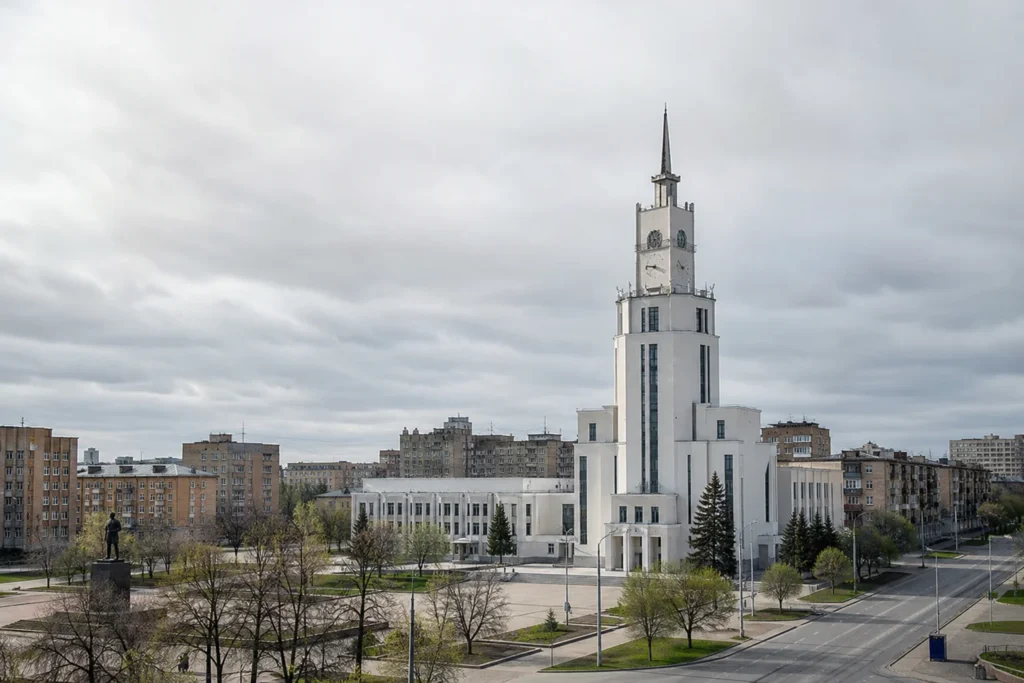
Uralmash was once considered a city within a city, where residents had no need to leave the district. The neighborhood grew around the Ural Heavy Machinery Building Plant, which when built in 1933 was the largest of its kind.
It formed one of the new socialist cities that sprung up in the Urals and Siberia between the 1920s and 1930s, promising a workers’ paradise where the factory provided for all its workers—from food to goods to social security. Though the Soviet era has ended, the neighborhood retains its distinctive constructivist architecture and working-class character, making it one of the most authentic Soviet factory districts still standing.
Quick Facts
| Russian name | Уралмаш |
|---|---|
| Address | OpenStreetMap · Google Maps |
| District | Ordzhonikidze |
| Metro | Uralmash (1, Exit toward Baumana Street; station opened 1991) |
| Best time to visit | Late spring (May–June) and early autumn (September–October) offer mild weather ideal for walking the neighborhood. Summer (July–August) can be warm. Winter (November–March) is cold, though the stark architecture photographs beautifully against snow. Weekday mornings are quieter than weekends; visit midweek to feel the working rhythm of the neighborhood. Weekends bring more families to the public squares. |
| Recommended duration | 2–3 hours |
What Is (and Isn't) Part of a Visit to Uralmash, Yekaterinburg?
| Part | Status | Notes |
|---|---|---|
| Uralmash neighborhood | Included in the standard ticket | The residential and commercial areas surrounding the factory are open to visitors; freely accessible on foot. |
| Uralmash factory | Not open to visitors | The factory complex itself is not open to public tours; only viewable from outside the perimeter. |
| Uralmash metro station | Included in the standard ticket | The metro station opened in 1991 and serves as the main entry point to the neighborhood. |
| Palace of Culture | Separate ticket or institution | Entry requires a ticket; hours and programming vary; check local listings for current events. |
| Plant museum in the old checkpoint | Separate ticket or institution | Museum hours and access should be verified locally; not always consistently open to casual visitors. |
| Church in Madrid Hotel | Included in the standard ticket | The church may be open during services; visitors should respect worship times. |
Why Visit Uralmash, Yekaterinburg?
Uralmash offers visitors a rare, unpolished glimpse into Soviet-era urban planning and industrial society. The creation of industrial giants, such as Uralmash, was accompanied by the creation of unique architectural ensembles in the Constructivist style, including the Uralmash socialist city.
The neighborhood reveals how an entire community was designed to serve a single factory: apartment blocks, a hospital, shops, a cultural center, and recreational spaces all clustered together. The hospital in Uralmash remains one of the best in Yekaterinburg to this day. Walking here, you see genuine Soviet residential life—not a museum exhibit—with local markets, practical communal spaces, and the honest geometry of early modernist architecture.
How Uralmash, Yekaterinburg Is Laid Out
Uralmash is organized as a Soviet planned district centered on the massive factory that gave it its name. The Uralmash metro station is located at the intersection of Baumana and Mashinostroiteley streets and Kosmonavtov Avenue.
The neighborhood consists of concentric rings: at the core lies the factory itself (not publicly accessible), surrounded by workers’ residential buildings from the 1930s–1960s, then larger Khrushchev-era apartment blocks from the 1960s–1980s. The main square holds a plant museum in the old checkpoint, a church in the former Madrid Hotel, a monument to a wartime spy and the White Tower, one of the city’s boldest constructivist landmarks. Beyond the ordered residential sectors, the neighborhood dissolves into private housing and forest edges.
Highlights of Uralmash, Yekaterinburg
The White Tower (Belaya Bashnya)
The White Tower is the former water tower of the Uralmash socialist city, which became the unofficial symbol of the Sverdlovsk avant-garde. This bold constructivist structure stands as the neighborhood's most iconic architectural landmark. Its geometric purity and stark white finish make it instantly recognizable from across the district. The tower once supplied water to the entire settlement and represents the functional beauty that defines early Soviet design. It remains a favorite photography spot for those interested in architectural heritage.
Tip: The tower is best photographed in morning light from the open square to the south; visit a weekday to avoid crowds.
Square of the First Five-Year Plan (Ploshchad Pervoy Pyatiletki)
The main square holds a plant museum in the old checkpoint, a church in the former Madrid Hotel, a monument to a wartime spy and the White Tower. This central gathering space shows how Soviet planners envisioned civic life. The square remains largely unchanged since the 1930s, bordered by period-correct architecture. It is the heart of Uralmash identity and the natural gathering point for any walking tour of the district.
Tip: Visit in late afternoon when local residents gather here; the light softens the concrete facades.
Madrid Hotel (now a Church)
Hotel Madrid was designed by German architect Bela Scheffler for foreign technicians who came to help build the factory. During the first few years of the plant, there were over 200 foreign workers there, half of them German. The building stands as a reminder of international cooperation in early Soviet industrialization. Today the structure houses a church, repurposing Soviet-era architecture for new communal purposes.
Tip: The building's distinctive style reflects 1930s European modernism; look for the Art Deco details on the facade.
Palace of Culture (former Factory Kitchen)
The Factory Kitchen has been transformed into a Palace of Culture. Originally built to feed factory workers, this building now serves as the neighborhood's cultural center for concerts, exhibitions, and performances. It exemplifies how Soviet planning integrated work, food, and culture into one system. The building's functional design reflects its dual purpose.
Tip: Check the schedule online to see if performances are scheduled during your visit; even if you don't attend, the exterior reveals typical Soviet cultural architecture.
Residential Blocks and Urban Planning
Uralmash's apartment blocks tell the story of Soviet architectural evolution. Khrushchev-era buildings of the 1960s stand alongside five-storey 1980s apartment blocks. These low-rise, densely packed residential areas were designed for maximum efficiency and social control. The narrow streets between blocks create unexpected courtyards and intimate spaces. This layering of different periods shows how the city adapted to changing ideologies and construction methods while maintaining the original master plan.
Tip: Walk through the residential blocks in the late afternoon to see how daily life unfolds; you'll see babushkas tending small gardens and children playing in designated courtyards.
Old Market (Rynok)
An old-fashioned market sells clothes on open air stalls, and food produce indoors. This traditional Russian market remains largely unchanged from Soviet times. It serves local residents and offers authentic glimpses of neighborhood commerce. The market is informal, practical, and unadorned—a living contrast to modern shopping malls elsewhere in Yekaterinburg.
Tip: Visit in the morning when vendors are fresh and crowds are manageable; bring small cash denominations.
Atmosphere
Uralmash feels like stepping back into the Soviet era without the romanticism. The neighborhood is calm and orderly, with wide streets designed for collective movement rather than individual cars. Trolley-bus number 10 regularly traverses the entirety of the district, taking workers to and from the factory.
Elderly residents outnumber young families, giving the area a reflective, slightly weathered character. The architecture—all clean lines and functional forms—dominates the visual landscape. On weekdays, the streets are quiet; on weekends, families use the public squares. There is little commercial advertising or neon. The feeling is neither depressed nor joyful, but pragmatic and persistent: this is how Soviet industrial society built itself to last.
History of Uralmash, Yekaterinburg
When the Ural Heavy Machinery Building Plant was built in 1933, it was the largest of its kind—a consequence of Joseph Stalin’s ambitious Five-Year Plan to develop heavy industry across the USSR in the shortest time possible. The plant was built from 1928 to 1933 in the suburbs of Yekaterinburg, and all machinery and equipment had been supplied and installed by German and English companies, with over 200 foreign workers there, half of them German.
The Uralmash neighborhood was created in 1927 as a working-class settlement, a namesake of ‘the plant of plants’, which later became a Socialist city. To house factory workers and their families, a workers’ settlement had to be constructed from the ground up, forming one of the new socialist cities that sprung up in the Urals and Siberia between the 1920s and 1930s.
Uralmash was a producer of blast furnaces and sintering equipment for steel, rolling mills, presses and huge walking excavators. During World War II, the large-scale production of tanks, canons and armored material was organized at the plant. The legendary T-34 tank was produced there, making Uralmash a crucial military-industrial facility during the Soviet-German war.
The appeal was eventually marred when the state lost control of its factories after the dissolution of Soviet Union. As with many similar one-factory towns, the transition to a free market economy was not easy for Uralmash, and during the 1990s, the factory found itself amidst one of the bloodiest turf wars in Russian history. The workforce drastically downsized over the years from tens of thousands to a mere 3000.
Today, the plant remains a supplier of mining equipment, machinery and equipment for the metallurgical and oil industries. The neighborhood, though diminished, has survived the post-Soviet decades as a distinct community, valued by residents for its cohesion and history.
Tickets and Booking for Uralmash, Yekaterinburg
Uralmash neighborhood itself is free to explore on foot. The Uralmash metro station on the First Line serves as the main entry point. No reservation or advance booking is required to walk the streets and view the architecture from outside.
Specific venues (Palace of Culture, plant museum, church) may have their own hours and, in some cases, entrance fees; check locally for the current status of these sites. General neighborhood exploration requires no tickets.
Plan and Book
Advertisement: these are partner links. If you book or buy through them, we may earn a commission at no extra cost to you.
Suggested itineraries Uralmash, Yekaterinburg
1.5–2 hours
Enter via Uralmash metro station. Walk to the Square of the First Five-Year Plan and the White Tower. Photograph the constructivist structures and the Madrid Hotel. Return via the old market to see daily neighborhood life. Quick but captures the essential character.
2.5–3 hours
Start at Uralmash metro station. Cross to the main square and Palace of Culture. Walk through residential blocks to observe housing typology (1930s, 1960s, 1980s). Visit the old market. Detour to the White Tower and the church. Includes time for breaks and reflection.
Half day (3–4 hours)
Extended exploration of all highlights: White Tower, main square, Palace of Culture, Madrid Hotel church, residential blocks by era, old market, and the forest park zone to the north. Includes coffee or lunch at a local café and time to photograph details of constructivist facades.
How to Get to Uralmash, Yekaterinburg
By Metro: Take the Yekaterinburg Metro Line 1 to Uralmash station (final stop heading north). The station opened in 1991 and is located at the intersection of Baumana and Mashinostroiteley streets. Walk north or south from the station to enter the neighborhood.
From the City Center: The metro is the most convenient option. Line 1 connects Uralmash to central Yekaterinburg. Journey time is about 15–20 minutes from central stations like Ploshchad 1905 Goda.
By Trolleybus: Trolleybus number 10 serves the district and connects Uralmash to other parts of the city, though the metro is faster.
Accessibility
Uralmash is generally navigable on foot, though the streets are wide and orderly. The neighborhood is relatively flat. Sidewalks exist but are not always perfectly maintained. The Uralmash metro station has elevators. Most views of historic architecture can be appreciated from street level. Specific venues (palace, church, museum) may have varying accessibility; check ahead for their specific accommodations.
Food Nearby
The old market near the metro station sells fresh produce, baked goods, and local prepared foods. Several informal cafés and street food vendors operate near the main square. The neighborhood has basic Soviet-style canteens and small shops selling bread, dairy, and snacks. Choices are more practical than cosmopolitan. Bring cash, as card payment is not always available at smaller vendors.
What to Bring
Comfortable walking shoes, as exploration involves several kilometers on foot through the district. Bring a camera for architectural photography. Cash (rubles) for purchases at the market and small cafés. In winter, warm clothing and waterproof boots; in summer, sun protection. A light jacket is useful any season due to unpredictable weather. Water and snacks if you plan a long walk.
Best Views and Photo Spots of Uralmash, Yekaterinburg
The White Tower from the south
The bold constructivist water tower stands isolated against the sky, framed by apartment blocks. The geometric purity and stark white form are best captured from the open square to the south, where you can position it against the low residential buildings.
Best time: Morning light (07:00–09:00) creates sharp shadows that emphasize the tower's sculptural form; late afternoon is also acceptable.
Square of the First Five-Year Plan, looking north toward the tower
The entire plaza with the tower, palace, and surrounding buildings in one frame. This captures the scale and order of Soviet urban planning, with clean lines and functional forms.
Best time: Midday or late afternoon when residents gather; the square feels alive rather than empty.
Madrid Hotel church facade
The distinctive building with Art Deco details and European modernist styling stands out from the surrounding Soviet blocks. The facade shows the international character of the settlement.
Best time: Afternoon light reveals the facade details; the angle from the northeast shows the building best.
Residential courtyard between 1960s blocks
Low-angle view showing the intimate scale of Khrushchev-era courtyards, often with small gardens, washing lines, and benches. Children and elderly residents move through these spaces, revealing daily life.
Best time: Early evening (17:00–19:00) when residents use the courtyards; captures authentic neighborhood life.
Street perspective along Baumana or Mashinostroiteley streets
Looking down a straight street lined with period apartments, emphasizing the repetition, rhythm, and scale of Soviet planning. The geometric regularity is striking.
Best time: Any time; the architecture speaks consistently. Morning or late afternoon for warmer light.
Photography Rules
Photography is free and unrestricted in the neighborhood streets and public squares. No drones are permitted. Tripods may draw attention in crowded areas but are not officially forbidden. Respect if locals object to being photographed. The White Tower and main square are the most photogenic spots; morning light is best.
Family Suitability
Uralmash is suitable for families with older children and teenagers interested in Soviet history and architecture. The neighborhood is safe and calm, with little traffic. Young children may find extended walks tiring, as attractions are spread across the district. The main square and courtyards provide open spaces. There are no dedicated playgrounds beyond what residents use. Public restrooms are not abundant; plan ahead. The market and cafés offer basic snacks. Strollers can navigate most streets, though sidewalks vary in condition.
Russia Vibes Tips
- Respect the neighborhood as a living community, not a museum. The majority of residents work in or have family ties to the factory or other local industries. Avoid photographing people without permission; speak quietly in public spaces.
- The factory complex is not accessible to casual visitors. Do not attempt to enter through perimeter gates. Viewing from outside the fence is the permitted approach.
- Visit on a weekday if possible. Weekends are busy with families, and the streets feel less like a working district and more like a weekend destination. The true character of Uralmash is best felt during normal working hours.
- Bring cash. Although the metro and some central shops accept cards, small vendors at the market and informal cafés may not. ATMs are available but scattered.
- The neighborhood transitions gradually into forest park areas to the north and east. Don't venture too far beyond the main residential zone without a map, as wayfinding can become confused.
- Speak to older residents if you encounter them and they seem willing. Many lived through the Soviet era in Uralmash and have stories about factory life, the changes of the 1990s, and their attachment to the place.
Where to Find Uralmash, Yekaterinburg in Russia
More chains in Russia
 Chkalovsky, Yekaterinburg
Main image: AI-generated illustration. It may not show the place exactly as it looks.
 Downtown/City Center, Yekaterinburg
Main image: AI-generated illustration. It may not show the place exactly as it looks.
 Kirovsky, Yekaterinburg
Main image: AI-generated illustration. It may not show the place exactly as it looks.
 Leninsky, Yekaterinburg
Main image: AI-generated illustration. It may not show the place exactly as it looks.
 Verkh-Isetsky, Yekaterinburg
Main image: AI-generated illustration. It may not show the place exactly as it looks.
Browse more: More in Ordzhonikidze · All Neighborhoods · All Neighborhoods in Yekaterinburg · All Soviet Russia · All Yekaterinburg
FAQ: Uralmash, Yekaterinburg
Can I visit the Uralmash factory itself?
No, the factory complex is not open to public tours or casual visits. It remains an operating industrial facility. You can view the perimeter from outside, but entry is restricted. The main square and museum in the old checkpoint offer some factory-related context.
Is Uralmash safe for visitors?
Yes, the neighborhood is generally safe for visitors during daytime and early evening. Like any district with a working-class history, use common sense: stay in populated areas, avoid isolated streets late at night, and keep valuables secure. The main areas tourists visit (square, metro station, residential blocks) are well-populated and low-crime.
How long should I spend in Uralmash?
Plan 1.5 to 3 hours depending on your interest in architecture and Soviet history. A quick visit covering the main square and White Tower takes 90 minutes. A deeper exploration of residential blocks and the market takes 2.5–3 hours. There are no museums with long interiors to occupy a full day.
What is there to eat in Uralmash?
The neighborhood has a traditional market selling fresh produce and simple prepared foods, basic cafés serving Soviet-style soup and pelmeni, and street vendors selling bread and pastries. Choices are practical rather than trendy. For restaurants, you'll need to return to central Yekaterinburg.
Can I photograph the architecture freely?
Yes, photography of streets, squares, and buildings is permitted. No special permission is needed for architectural shots. Respect residents' privacy if they object. Drones are not allowed. The White Tower, main square, and individual facades are all fair subjects.
Is the Uralmash metro station different from other stations?
The Uralmash metro station opened in 1991 as part of the first line. It has a functional, restrained design with cast-iron details. It is less ornate than central stations but functional and well-maintained. It serves as the main entry point to the neighborhood.
What is the White Tower?
The White Tower is a former water tower built in the 1930s to supply the Uralmash settlement. It is a bold constructivist structure that has become an unofficial symbol of Soviet modernism in the city. It stands in the main square and is the neighborhood's most iconic landmark.
Are there any museums in Uralmash?
A small museum in the old factory checkpoint documents the plant's history. Hours and access are inconsistent; verify locally. The Palace of Culture occasionally hosts exhibitions. Beyond these, Uralmash itself—its architecture and urban layout—is the main attraction.
Russia Vibes is a one-person project. A coffee keeps it going
How we research and update our guides
About this guide: AI assistance and accuracy
This guide is created with the help of AI and is based on official sources where available. Mistakes can still happen. Opening hours, prices, rules and other details are given to the best of our knowledge as of the date shown and can change without notice. It offers general recommendations only, not professional, legal or travel advice. Please confirm important details with the official source before you travel; you are responsible for your own plans and decisions.

Take this guide with you
Get a free PDF of this guide to print or read offline: key facts, tips and a map link on a few clean pages.
Report an issue on this page
Paying for your trip: please read
International sanctions affect payments between Russia and many other countries. In practice, cards issued in the EU, the UK, the US and several other countries often do not work in Russia, Russian cards usually do not work abroad, and some booking platforms, airlines and payment providers limit or suspend their services for Russia. The situation changes frequently.
We do not give legal or financial advice, and this site does not encourage anyone to break or circumvent sanctions. Whatever you plan, you are responsible for following the laws and regulations that apply to you, including those of your country of residence and citizenship.
Many travelers still organise their stay lawfully. It is worth asking your bank or payment provider what is currently permitted, contacting hotels, tour operators and carriers directly about the payment methods they accept, and checking which services are open to customers from your country. Clarify payment, cancellation and refund terms before you commit to a booking, and keep your plans flexible.
Partner links on this site may not be available in every country, and prices, availability and rules in our guides can differ from what you see when you book.