
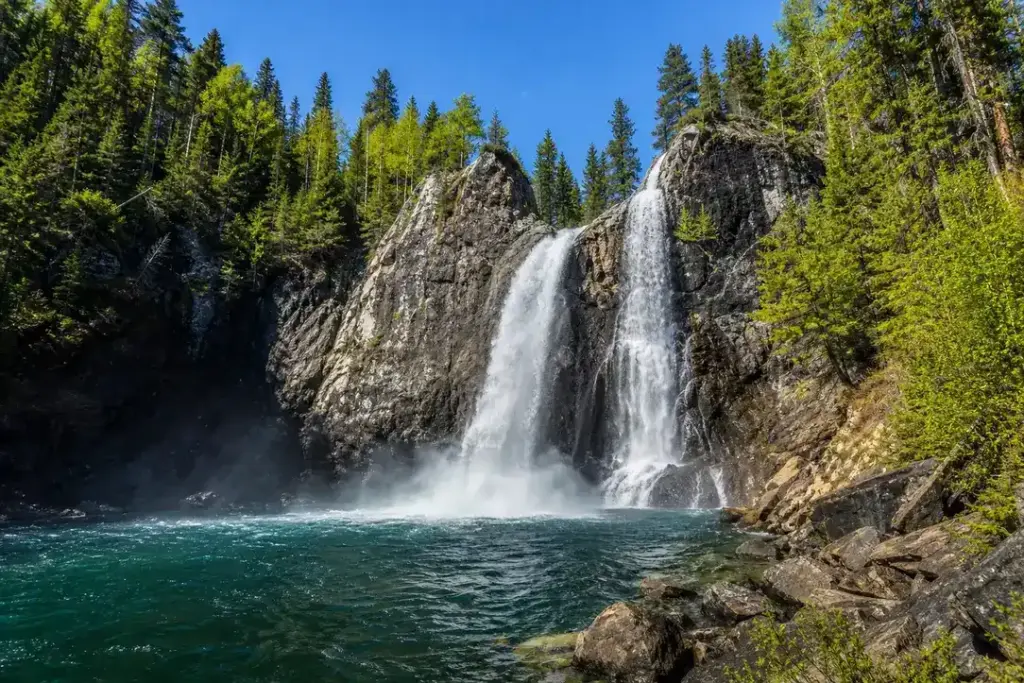
Kamyshlinsky waterfall lies on the Kamyshla River in the foothills of Russia’s Altai Mountains, accessible as a half-day excursion from the main valley settlements. An easy hiking loop from the village of Barangol leads to the waterfall, offering views of the Katun River valley. The site draws both independent walkers and organised tour groups year-round.
On one of the tributaries of the Katun River, the waterfall is an ornament of the Altai Mountains. In summer, it crumbles into sparkling splashes, falling off a cliff, and in winter it turns into an icy mountain.
Quick Facts
| Russian name | Камышлинский водопад |
|---|---|
| Address | Cheposhskoye rural settlement, Chemalsky District, Altai Republic Google MapsApple MapsYandex Maps2GIS |
| District | Chemalsky |
| Best time to visit | Summer (June–September) offers warm weather, firm ground and full daylight (long hours of light in July–August). The water is cold but manageable for swimming. Autumn (September–October) brings clear skies and autumn colours in the forest; fewer tourists arrive. Winter (December–February) transforms the waterfall into ice, but conditions are harsh—short daylight, snow and cold to -15°C. Spring (April–May) sees the forest green again but trails remain wet and muddy until May. July–August brings peak tourist numbers and occasional afternoon rain. |
| Recommended duration | 3–4 hours |
What Is (and Isn't) Part of a Visit to Kamyshlinsky Waterfall, Altai Mountains?
| Part | Status | Notes |
|---|---|---|
| Kamyshlinsky Waterfall (the viewpoint and pool area) | Included in the standard ticket | Free public access; no ticket required. |
| Suspension bridge over the Katun River | Included in the standard ticket | Crosses to the waterfall side; integral part of the hike. |
| Forest hiking trail | Included in the standard ticket | About 2.5 km from bridge to waterfall; no permit required. |
| Organised tour groups and vehicle transport from main villages | Separate ticket or institution | Available through tour operators; not included in free access to the site. |
| Motorboat rides along the Katun River | Separate ticket or institution | Some tours combine motorboat access with the hiking trail; book separately. |
Why Visit Kamyshlinsky Waterfall, Altai Mountains?
The waterfall has two cascades and the water falls from a height, creating powerful streams and splashes. Even under a thick layer of ice, the waterfall manages to shimmer over the rocks and sparkle in the bright winter sun. The waterfall can be reached on foot by crossing a suspension bridge over the Katun River, which adds an element of adventure to the tour. The hiking route is moderately challenging but rewards you with the chance to swim in summer and photograph ice formations in winter.
Highlights of Kamyshlinsky Waterfall, Altai Mountains
The two-tiered cascade
The waterfall consists of two cascades with a total height of about 12 meters. In summer, the water breaks off rocky ledges with tremendous force; in winter, it freezes into sculptural formations. The viewing area sits close to the base, where mist and spray create a sensory experience.
Tip: Wear waterproof layers even in winter; the spray travels far from the falls.
Suspension bridge crossing
The waterfall is reached on foot by crossing a suspension bridge over the Katun River. The bridge sits at the narrowest and deepest point of the river and sways under foot, making the approach as memorable as the destination. The bridge offers views downstream toward the main valley.
Tip: Cross the bridge on the way out if you prefer to save the adrenaline rush for the return journey.
Forest path to the falls
After crossing the Katun suspension bridge to the wooded shore, a forest path winds about 2.5 km through the forest to the waterfall. The trail follows streams and rises gently through mixed pine and birch forest, with rock outcrops and mountain views. Birds and small mammals inhabit this zone.
Tip: The path is well-trodden and easy to follow even without a guide. Insect repellent helps in late spring and summer.
Summer swimming
The pool at the base of the waterfall is deep and cold year-round, formed by centuries of water erosion. In summer when weather permits and water levels are manageable, visitors wade or swim in the chilly water, said locally to have invigorating properties.
Tip: Water temperature stays near freezing even in August. Bring a change of clothes and dry quickly to avoid chilling.
Katun River views
The trail offers views of the Katun River valley. The valley opens out to the south, with the river far below and forested ridges rising on both sides. The landscape changes colour with each season—green in summer, gold and red in autumn, white in winter, and tender green again in spring.
Tip: Arrive in the late afternoon to catch warm sidelight that brings out the colour of rock faces and falling water.
Winter transformation
The waterfall can be visited even under a thick layer of ice, shimmering in the bright winter sun. Guests cross a pedestrian suspension bridge over the frozen Katun River, then walk a forest path to the waterfall. Snow and ice reshape the landscape entirely; the frozen cascade becomes a wall of blue and white ice.
Tip: Winter visits require good winter boots with traction and gaiters. The path becomes slippery and shortens by an hour of daylight.
Atmosphere
The walk to the waterfall follows a forest path through a wooded shore alongside the Katun tributary. The sounds of water build as you approach—first the river below, then the roar of the cascade overhead. The air cools noticeably near the falls. In summer, mist rises and creates a cool microclimate; in winter, ice silence dominates.
The location draws a steady flow of visitors from April to September. Tour groups often spend 30–40 minutes at the site, so morning arrivals tend to be quieter than afternoon when buses from the valley arrive. The pool is popular for photographs and a quick dip in warm months.
Legends and Myths about Kamyshlinsky Waterfall, Altai Mountains
Kamysh and La
Legend – historically unreliable. In ancient times a khan lived in Altai. A herdsman named Kamysh served the khan and loved the khan's daughter La. The Khan was categorically against this alliance. In the end, the shepherd dared and asked the khan for his daughter's hand in marriage. To refuse the impudent man, the khan sent him to carry out an impossible task—to destroy the rocks that held back the river. But Kamysh did not lose his head and went with La to the waterfall, which, according to rumours, fulfilled wishes. As a result, Khan agreed to their union and blessed the couple. The waterfall was named in honour of the lovers.
Place of power and shamanic worship
Legend – historically unreliable. According to some reports, the name comes from the word 'kama'. Local shamans often came here to 'worship', that is, to communicate with the deities of nature. Thus, Kamyshlinsky waterfall was interpreted by many as a place of power. Visitors claim to feel a special energy at the site, and the water is said to have healing properties.
Tickets and Booking for Kamyshlinsky Waterfall, Altai Mountains
The waterfall is free to visit and requires no ticket or advance booking. Visitors arrive independently by car or van and park near the trailhead at Barangol village or travel via organised tours.
To reach the site, book transport from nearby valley settlements (such as Chemal or Gorno-Altaysk). Shuttle minibuses run daily during summer; services are less frequent in winter. Tour operators offer guided half-day and full-day excursions that include transport and a guide.
The site is unmanned and open year-round. No facilities or shops exist at the falls; bring water and snacks. Visitor numbers rise in July–August and decline sharply in winter.
Plan and Book
Suggested itineraries Kamyshlinsky Waterfall, Altai Mountains
Half day (3–4 hours)
Arrive at Barangol trailhead in the morning. Cross the suspension bridge (10 minutes). Hike the forest path to the waterfall (40 minutes). Spend time at the falls viewing, photographing and swimming if summer (1–1.5 hours). Return by the same route (40 minutes). Total round trip hiking time approximately 1.5–2 hours; plan 3–4 hours including stops.
Full day with side routes
Start early from Barangol. Follow the main route to the waterfall (as above). Return partway and branch onto side trails that follow the Kamyshla River upstream toward the secondary cascade. Explore forest clearings with mountain views. Return to the main trail and descend to the bridge by late afternoon. Visit a local café in Barangol for an early supper before returning to your accommodation.
Winter visit (4 hours)
Arrive late morning when daylight is best. Walk the bridge and forest path more slowly due to snow and ice. Allow extra time for footing. Spend 1–1.5 hours photographing the frozen cascade and exploring the immediate vicinity. Descend before mid-afternoon light fades. Pack a thermos of hot tea and warm food; the cold intensifies fatigue.
How to Get to Kamyshlinsky Waterfall, Altai Mountains
By road from Gorno-Altaysk (the main city, 160 km away): Travel via the Chuysky Trakt (the scenic highway). Drive toward Chemal and follow signs toward Barangol village. The drive takes 3–4 hours. Park in the open area near the village. The trailhead is marked.
By organised tour: Book a minibus with a tour operator in Chemal or Gorno-Altaysk. Tours depart daily in summer, less frequently in winter. The operator arranges transport from your accommodation.
Walking from Barangol village: A marked path descends steeply 200 metres to the suspension bridge. From the bridge, the forest path is easy to follow.
No public transport runs to the trailhead. You must either hire a private vehicle or join a tour. Taxis are available in Chemal but are expensive for a round trip.
Accessibility
The route is not wheelchair accessible. The suspension bridge has a safety rail and timber walkway but no handholds for those with limited mobility. The forest path is steep in places and muddy or icy depending on season. No toilets, benches or rest areas exist along the route. Those with mobility constraints should assess fitness carefully or hire a local guide familiar with alternative shorter routes.
Food Nearby
Small cafés operate in Barangol village during summer, serving basic meals and hot drinks. Bring your own picnic and water; no shops or facilities exist at the waterfall. The nearest restaurants and shops are in Chemal, 15–20 km away by road.
What to Bring
Sturdy hiking boots with good ankle support (essential year-round). Lightweight waterproof rain jacket and trousers. Insect repellent in summer. Sunscreen and hat. Plenty of water (at least 2 litres per person). High-energy snacks. Warm layers, even in summer near the spray. In winter, add thermal underwear, winter gloves and gaiters. A dry change of clothes if you plan to swim. No bag searches or security checks apply; leave valuables in your vehicle.
Best Views and Photo Spots of Kamyshlinsky Waterfall, Altai Mountains
Base of the waterfall looking up at both cascades
The full two-tier cascade fills the frame, water descending into a deep pool with cliff faces surrounding it. Mist rises, creating a softer, atmospheric effect. The best light is morning sun from the side.
Best time: Early morning (7–9 a.m.) in summer when sun hits the falls but hasn't fully heated the mist.
Suspension bridge with the river below
The bridge curves across the chasm, the Katun River visible far below. Forest walls frame the shot. Looking back toward the falls from mid-bridge offers a layered perspective.
Best time: Mid-morning or late afternoon for warm side-light that defines the bridge structure and the river gorge.
Forest path approaching the waterfall
Tall pines and birches line a winding path; the roar of water grows louder. Dappled light filters through canopy. The sense of anticipation is visual as well as audio.
Best time: Late afternoon when longer shadows define the trees and the path becomes a golden tunnel.
Frozen waterfall in winter
The cascade becomes a towering sculpture of blue, white and grey ice. Sunlight refracts through the ice, creating sparkle and depth. The contrast with dark rock is stark.
Best time: Clear winter mornings (December–February) when low sun angle maximises sparkle and shadows define the ice texture.
Pool at the base reflecting the cascade
A still pool mirrors the upper tiers, doubling the visual impact. The reflection is clearest on calm mornings before wind disturbs the surface.
Best time: Sunrise to mid-morning, before heat creates shimmer and disturbance.
Photography Rules
The water creates powerful streams and splashes, making fast shutter speeds essential for freezing motion. The suspension bridge offers a dramatic perspective. Mist and spray can fog lenses; keep a microfibre cloth handy. Avoid tripods on narrow paths and the bridge for safety and courtesy to other visitors. Drone flights are restricted; check locally. The site has no commercial photography permits; personal and casual photography are free.
Family Suitability
The hike is manageable for families with children aged 8 and older who have basic hiking fitness. The suspension bridge is exciting but safe for children not afraid of heights. The pool is deep; young swimmers need close supervision and should wear life jackets. Toddlers in carriers can manage the path with help from an adult. In summer, allow breaks for rest and swimming. Winter visits are less suitable for young children due to ice, short daylight and cold exposure. Strollers cannot be used on any part of the route.
Russia Vibes Tips
- Arrive before 10 a.m. or after 3 p.m. to avoid peak tour groups. Tour buses typically dock mid-morning and mid-afternoon, making the path crowded and the viewpoint noisy for 30–60 minutes.
- The suspension bridge sways even with light footsteps; this is normal and safe. Walk steadily and do not bounce or run. Crossing early in the hike when you are fresh and unrushed reduces anxiety.
- In summer, water shoes or sandals that dry quickly are practical if you plan to wade or swim. The pool temperature is shocking; submerge gradually and limit time in water if you are not accustomed to cold.
- Winter visits require departure no later than 2 p.m. to return to the bridge before dark. The path becomes dangerous in twilight due to ice. Bring a headlamp if you depart late.
- The local legend about wishes being granted is widely known. Carry a notebook and leave a note or object as a visitor tradition—this adds to the experience and community feel of the site.
- Barangol village has a small café that opens seasonally. Ask your tour operator or the café owner if they can prepare a packed lunch; ordering a day ahead increases your chances of getting hot food rather than vending-machine fare.
Explore Nearby Kamyshlinsky Waterfall, Altai Mountains
Sights near Kamyshlinsky Waterfall, Altai Mountains
 Chemal, Altai Mountainsabout 36.1 km away · typical visit: 2–3 days
Main image: AI-generated illustration. It may not show the place exactly as it looks.
Related guides
 Altai Mountains: Best Places, Scenic Routes and Travel Tips
Main image: AI-generated illustration. It may not show the place exactly as it looks.
Browse more: More in Chemalsky · All Altai Mountains · All Sightseeing · All Sightseeing in Altai Mountains · All Viewpoints
FAQ: Kamyshlinsky Waterfall, Altai Mountains
Is there an entry fee to visit Kamyshlinsky Waterfall?
No. The waterfall is free to visit year-round. No tickets or permits are required for hiking to it or viewing the site. Organised tours charge a fee for transport and a guide, but the waterfall itself is not gated or ticketed.
How long does it take to hike to the waterfall and back?
The round trip takes 1.5–2 hours of walking time. The hike is easy to moderate in difficulty. From Barangol village, you descend to the suspension bridge (10 minutes), cross it (5 minutes), then hike the forest path to the falls (40 minutes). Most visitors spend 1–2 hours at the waterfall viewing and photographing. Total time on site is 3–4 hours.
Can I swim in the waterfall pool?
Yes, in summer. The pool is deep and the water is cold (close to freezing even in August). Many visitors wade or swim briefly for the experience. Bring a dry change of clothes and leave the water if you start feeling chilled. No lifeguards are present; swim at your own risk.
Is the suspension bridge safe?
Yes. The bridge is used daily by hundreds of tourists, guides and locals. It is well-maintained with safety rails. The bridge sways under foot, which is normal and unsettling but not dangerous. Children and adults with a fear of heights can cross slowly or ask a guide for reassurance.
What is the best time of year to visit?
Summer (June–September) offers warm weather, safe footing and long daylight. July–August see peak crowds and occasional rain. September is quieter with clear skies. Winter is spectacular for ice photographs but requires physical fitness, short daylight hours and winter gear. Spring and autumn are quieter and beautiful but trails can be muddy.
Do I need a guide to reach the waterfall?
No guide is required. The trail is well-marked and easy to follow. Many independent visitors hike without a guide. A guide is helpful for learning local history, legends and natural history, and can arrange transport if you lack a vehicle.
Can I visit in winter?
Yes. The frozen waterfall is stunning, but winter brings risks: short daylight (4–5 hours), temperatures to -15°C, and icy footing. You must depart by early afternoon to return before dark. Winter boots, layers and a headlamp are essential. Winter is not recommended for families or those without hiking experience in cold conditions.
Are there toilets at the waterfall?
No toilets, shops, or facilities exist at the site. Use the bathroom in Barangol village before starting the hike. Bring water and snacks. This is a wilderness area with no services.
Russia Vibes is a one-person project. A coffee keeps it going
How we research and update our guides
About this guide: AI assistance and accuracy
This guide is created with the help of AI and is based on official sources where available. Mistakes can still happen. Opening hours, prices, rules and other details are given to the best of our knowledge as of the date shown and can change without notice. It offers general recommendations only, not professional, legal or travel advice. Please confirm important details with the official source before you travel; you are responsible for your own plans and decisions.
Packing for this trip
* Affiliate link: as an Amazon Associate we earn from qualifying purchases at no extra cost to you.

Take this guide with you
Get a free PDF of this guide to print or read offline: key facts, tips and a map link on a few clean pages.
Report an issue on this page
Paying for your trip: please read
International sanctions affect payments between Russia and many other countries. In practice, cards issued in the EU, the UK, the US and several other countries often do not work in Russia, Russian cards usually do not work abroad, and some booking platforms, airlines and payment providers limit or suspend their services for Russia. The situation changes frequently.
We do not give legal or financial advice, and this site does not encourage anyone to break or circumvent sanctions. Whatever you plan, you are responsible for following the laws and regulations that apply to you, including those of your country of residence and citizenship.
Many travelers still organise their stay lawfully. It is worth asking your bank or payment provider what is currently permitted, contacting hotels, tour operators and carriers directly about the payment methods they accept, and checking which services are open to customers from your country. Clarify payment, cancellation and refund terms before you commit to a booking, and keep your plans flexible.
Partner links on this site may not be available in every country, and prices, availability and rules in our guides can differ from what you see when you book.