
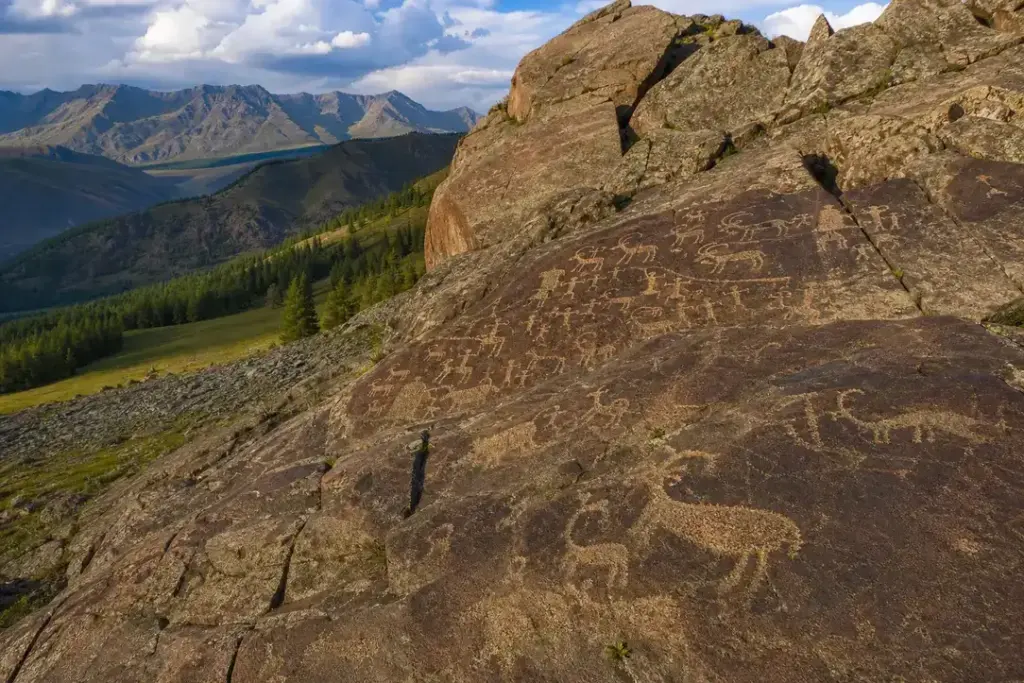
Kalbak-Tash petroglyphs are one of Russia’s most significant collections of ancient rock art, located in the Ongudai district of the Altai Mountains. The name means “flat stone” in Altaian, describing the sloping rocky hill above the Chuya Valley where these carvings lie.
The site contains thousands of engravings created over nearly 8,000 years of human presence. Carved with stone and later metal tools, the petroglyphs record the beliefs, hunts and daily life of successive peoples who used the Chuya Valley as a trade route between Siberia and China. Few places in Asia document such a continuous artistic record across so many cultures and millennia.
Quick Facts
| Russian name | Калбак-Таш |
|---|---|
| Built / opened | 6000-4000 BC |
| Address | Ongudai district, Altai Republic, near Iodro village, Chuyskiy Tract km 723 Google MapsApple MapsYandex Maps2GIS |
| District | Ongudaysky |
| Admission | free |
| Best time to visit | Summer and early autumn (June to September) offer the most comfortable visiting conditions. Temperatures are mild, the path is dry, and daylight is long. Clear weather provides good light for photographing engravings and viewing details. Spring (May) is also pleasant but the ground may be muddy. Winter snow may cover petroglyphs temporarily, though the rock surfaces are usually clear by February and the sparse crowds create a peaceful atmosphere. Avoid early spring (March–April) when snow melt creates muddy conditions. |
| Recommended duration | 1–2 hours |
What Is (and Isn't) Part of a Visit to Kalbak-Tash Petroglyphs, Altai Mountains?
| Part | Status | Notes |
|---|---|---|
| Petroglyphic carvings | Included in the standard ticket | The ancient rock engravings covering the flat stones and hillside, including animals, humans, chariots, hunting scenes, and runic inscriptions. |
| Viewing paths and railings | Included in the standard ticket | Low railings and worn paths guide visitors between petroglyph groupings on the sloping hill. |
| Parking area and entry sign | Included in the standard ticket | A car park at the roadside and sign mark the official entrance; the path begins here. |
| Kalbak-Tash II petroglyph site | Outside / not part of it | A separate petroglyph complex located about 10 km east along the Chuya River, requiring separate travel. |
| Museum or visitor center | Not open to visitors | No enclosed museum or interpretive center; the site is open-air only. |
| Guided tours | Separate ticket or institution | Professional guides are not stationed on-site; arrange tours privately through Altai travel agencies or hotels in nearby Ongudai. |
Why Visit Kalbak-Tash Petroglyphs, Altai Mountains?
Kalbak-Tash offers a unique window into the minds of ancient peoples. The carvings are remarkably varied: from the crude but powerful animal figures of Neolithic hunters to the finely etched hunting scenes of the Scythian era and Old Turkic runic inscriptions. You will see dozens of distinct human types, fantastical creatures, chariots, fighting horses and mysterious humanoid figures that scholars still debate.
The petroglyphs lie directly above a major highway, making the site accessible for an afternoon visit. Protected by low railings, most carvings are clear and can be examined at close range. The Chuya Valley setting is dramatic, with mountain views framing the archaeological landscape.
Highlights of Kalbak-Tash Petroglyphs, Altai Mountains
Neolithic Animal Carvings
The oldest petroglyphs date to 6000–4000 BC and show the largest, most boldly carved animals—deer, goats, camels and predators. Made by hollowing out entire images with stone tools, these figures are crude but powerful. Look for the heavy outlines and deep, broad grooves that distinguish them from later, more refined work. These hunters left their marks while following game through the valley.
Tip: Start at the eastern part of the site where the oldest carvings tend to cluster; their bolder technique makes them easier to spot.
Bronze Age Human Figures and Chariots
Between 3000–1000 BC, herders and warriors added the most diverse imagery. You will see standing humans in pairs and groups, some with raised arms; ox-drawn chariots and carts; mounted warriors; and what appear to be shamans or priests. These compositions are often arranged in deliberate scenes rather than random marks, suggesting a narrative purpose.
Tip: Look for the figures with distinct postures and the wheel symbols of chariots—these stand out clearly against simpler animal outlines.
Mysterious Humanoid Figures
Among the most enigmatic carvings are human-like beings with mushroom-shaped or domed heads, square emblems on their chests, and tail-like projections from their waists. Theories vary: some scholars see shamanic or spiritual imagery, others supernatural beings. One theory suggests the chest square represents the portal for the soul in afterlife beliefs.
Tip: These distinctive figures cluster in several areas; ask at the entry sign or hire a local guide to locate them—their unusual appearance rewards close study.
Scythian-Era Hunting Scenes
From 800–300 BC, fine-lined engravings show hunting episodes with wolves, deer, goats, and feline predators. Made with early metal tools, these lines are thinner and more detailed than earlier work. The scenes often capture motion and drama—animals fleeing, hunters pursuing, weapons poised. This era represents the artistic peak of the site.
Tip: Examine these carvings in strong morning light to see the fine lines clearly; afternoon shadow can obscure the details.
Old Turkic Runic Inscriptions
About 30 lines of runic letters have been identified, forming the Yenisei alphabet. Dating to 700–1000 AD, these are the youngest petroglyphs at Kalbak-Tash. The runic script is among the largest collections of Old Turkic writing in Russia. The inscriptions mark the end of the site's active use as a sacred or public artistic space.
Tip: The runic texts are small and require close inspection; bring binoculars or a camera with zoom to read the shapes clearly.
Latticed Geometric Figures
Chalcolithic-era geometric patterns (late 4th–3rd millennium BC) appear among the animal carvings. Scholars debate whether these latticed or gridded shapes represent abstract symbols, female anthropomorphic figures, or ritual constructions. Their meaning remains mysterious but their frequency suggests they held cultural significance.
Tip: These geometric patterns are less obvious than animal figures; examine the rock surfaces systematically to spot the latticed lines and grids.
Atmosphere
The site feels remote and contemplative despite proximity to the busy highway below. A roadside sign marks the entrance, with a car park and path leading up to the site; the petroglyphs are protected by low railings around each rock but easily viewed. The flattened rocky hill slopes gently, with carved surfaces exposed to weather and light.
Most visitors move slowly between groupings, leaning close to trace finger-worn grooves or photograph details. The Chuya Valley spreads below—forested slopes and river bends creating a landscape that ancient peoples knew intimately. In early morning, angled sunlight emphasizes the depth of carved lines; by afternoon, shadows fill the grooves and details fade. Few crowds gather here compared to popular Altai hiking routes, leaving a sense of direct access to ancient minds.
History of Kalbak-Tash Petroglyphs, Altai Mountains
The first petroglyphs appeared in Kalbak-Tash in the Neolithic era from the 6th to the 4th millennium BC, carved on flat stones by Altay tribes who lived in the Valley of Chuya and Katun. These earliest artists used stone tools to hollow out entire images—large animals rendered with crude power. Their subjects were the creatures they hunted: deer, goats, camels, and predators.
As epochs changed, trade began to develop and the Chuya Valley became the only road that connected the vast territories of Siberia and China. Numerous caravans passed along this road and there is a version that representatives of many nations left their drawings here. To use modern terms, Kalbak-Tash became a kind of social network for several millennia, where representatives of different peoples left petroglyphs depicting their history and traditions.
Between 3000–1000 BC, during the Bronze and Eneolithic ages, herders and warriors dominated the site. The major group of images included both male and female characters, chariots and carts pulled by pack-oxen, cattle drivers and warriors, fantastic predators and pets. These compositions suggest storytelling and ritual significance beyond simple record-keeping. Neolithic drawings were made with stone tools and were not hollowed out with lines but with entire images. With the advent of metal tools, the contours of the drawings became clearer. In the Scythian period and even more in the Turkic period, people possessed strong iron tools, so some later drawings were made using thin lines.
The Scythian epoch (800 BC to 300 BC) brought petroglyphs with scenes of hunting for wildlife, and many animals—goats, wolves, dogs and feline predators. These fine-lined engravings represent the artistic height of the site, capturing movement and detail the earlier cultures could not achieve. Some inscriptions refer to the ancient Turkish time. To this day 30 lines of runic letters have been identified, forming the Yenisei alphabet, dating to 700–1000 AD and marking the final phase of active petroglyph creation.
Kalbak-Tash holds the designation of federal cultural heritage site in Russia. The site remains largely open to the public, protected by simple railings rather than enclosed museums, allowing direct engagement with the ancient carved surfaces.
Legends and Myths about Kalbak-Tash Petroglyphs, Altai Mountains
The Alien Visitors
Legend – historically unreliable. Among the most striking carvings are humanoid figures with mushroom-shaped heads, square emblems on their chests, and tail-like objects at their waists. Popular internet culture has claimed these depict extraterrestrial visitors. The chest squares fuel speculation as they resemble portals or instruments. However, archaeologists interpret these as shamanic or spiritual imagery reflecting Altai beliefs about the soul and the afterlife, not visitors from space.
The Soul Portal Chest Square
Disputed by historians. Scientists suggest that the screen on the chest was a symbol of the portal through which the human soul goes to another world. The figures bearing these emblems may represent shamans, priests, or the deceased preparing for an afterlife journey. This interpretation fits the spiritual beliefs of many Central Asian cultures across millennia, making it plausible rather than fanciful, though exact meaning remains debated.
The Devourer of Sins
Disputed by historians. Above a group of people with mushroom-shaped hats sits a huge and bizarre creature with large teeth and a long tail. One theory suggests that this monster was a devourer of souls, which cleansed humans of their sins before allowing them to enter the upper world. This interpretation resonates with shamanic cosmologies found across Siberia and Central Asia, where spirit beings mediated between worlds.
Tickets and Booking for Kalbak-Tash Petroglyphs, Altai Mountains
Entry to Kalbak-Tash is free and unrestricted. The site lies directly above the Chuyskiy Tract highway (km 723) in Ongudai district. A roadside sign and car park mark the entrance; the path begins immediately. No advance booking, tickets or reservations are required. Simply park and walk up to the petroglyphs at any time.
The site operates year-round and in all weather. Winter snow may cover carvings temporarily, but the rock surfaces are usually visible by February. Summer is the most comfortable season for walking the sloping terrain. No facilities (restrooms, water, food) exist on-site, so bring supplies from Ongudai or nearby settlements along the highway.
For a deeper understanding, consider hiring a local guide through hotels in Gorno-Altaysk or Ongudai. Many guides specialise in Altai archaeology and can explain the periods, techniques and debates surrounding the petroglyphs. This adds context and helps locate the more subtle or significant carvings.
Plan and Book
Suggested itineraries Kalbak-Tash Petroglyphs, Altai Mountains
1 hour
Park at the roadside sign and climb the path to the main petroglyph field. Walk the central ridge, examining the large animal carvings (Neolithic) and noting the technical differences in older versus newer work. Spend time on one or two dramatic figures—a chariot, a fighting horse, or a Scythian hunting scene—to understand the carving technique. Descend via the same path.
1.5–2 hours
Follow the 1-hour route but take more time to locate specific periods. Start with the crude, deep-grooved Neolithic animals on the eastern section. Move to the Bronze Age chariots and warriors in the central area. End with the Scythian fine-line hunting scenes and Turkic runic inscriptions if visible on the western edge. Bring a camera or notebook to record interesting details.
Half day (3–4 hours with guide)
Hire a local guide for the morning or afternoon. Begin with an overview of the site layout and chronology. Methodically visit each era's section, allowing the guide to point out details invisible to untrained eyes—the tiny runic letters, the geometric lattices, the debate around humanoid figures. Examine rubbed carvings and shadows carefully. Take a break mid-visit and return to the highway for food or refreshment before continuing.
How to Get to Kalbak-Tash Petroglyphs, Altai Mountains
Kalbak-Tash lies on the Chuyskiy Tract (Chuya Highway), the main road connecting Gorno-Altaysk to Mongolia, at kilometre 723. The site is 70–80 km south of Gorno-Altaysk, the regional hub.
By car or taxi: From Gorno-Altaysk, drive south on the M-52 highway (Chuyskiy Tract) for approximately 90 minutes. Watch for the roadside sign marking Kalbak-Tash near kilometre marker 723; a car park lies directly opposite. The turn-off is well-marked.
By bus: Minibuses and regional buses travel the Chuyskiy Tract daily, connecting Gorno-Altaysk to towns further south. Request the driver to stop at Kalbak-Tash; confirm the stop before boarding. The bus stops directly at or near the roadside sign.
On foot from nearby villages: Inya village lies close by; walking from there is possible but not recommended without local knowledge of the terrain.
Accessibility
The site has no formal accessibility infrastructure. The sloping rocky terrain is uneven and requires walking on natural stone surfaces with variable footing. Steps or slopes are not graded or stabilized. Wheelchair and stroller access is not feasible. Visitors with mobility limitations or those unable to navigate uneven ground should assess their fitness before visiting. No benches, restrooms or shelter exist on-site.
Food Nearby
No food or drink is sold on-site. The nearest options are in Ongudai village, approximately 20–30 km north along the highway, or at roadside cafés occasionally stationed along the Chuyskiy Tract. Bring water, snacks or a packed lunch before arriving at Kalbak-Tash. Some travellers stop at highway rest areas between Gorno-Altaysk and the site.
What to Bring
Wear sturdy hiking boots or shoes with good grip; the rocky surfaces are uneven and can be slippery when wet. Bring sunscreen, a hat and water, especially in summer. A camera with zoom or binoculars helps examine fine details—runic inscriptions and latticed patterns are small. A notebook aids sketching or recording observations. In winter, dress warmly; in summer, light layers accommodate mountain weather changes. No security bags or equipment checks are required.
Best Views and Photo Spots of Kalbak-Tash Petroglyphs, Altai Mountains
Eastern high point overlooking the Chuya Valley
From the upper eastern edge of the site, the forested valley and river bend frame the rocky hill. The Altai peaks lie distant on the horizon. Petroglyphs in the foreground contrast with the vast landscape, emphasizing the site's scale and isolation.
Best time: Early morning light from the east illuminates the valley and the rock faces simultaneously, creating depth and shadow.
Central cluster of Bronze Age chariots
A dense grouping of ox-drawn carts and warrior figures in the middle section. Multiple figures arranged as a deliberate composition offer a single focal point containing narrative and technique.
Best time: Midday provides flat, even light for clarity; early morning shadow can obscure the finer lines, but emphasizes depth.
Large Neolithic animal carving (deer or camel)
A life-sized or larger animal figure with deep, broad grooves hollowed by stone tools. Its crude power contrasts with later refined work and exemplifies Neolithic technique.
Best time: Angled afternoon light emphasizes the depth of the grooves and shadows; photograph from multiple angles to show the three-dimensionality of the carving.
Humanoid figure with mushroom head and chest square
One of the site's most distinctive and debated carvings. The alien-like appearance and mysterious symbolism make it visually striking and conceptually intriguing for viewers unfamiliar with Altai archaeology.
Best time: Close-up, angled morning light reveals the details of the head shape and chest emblem most clearly.
Scythian hunting scene with predator and prey
Fine-lined engravings showing animals in motion—a wolf pursuing deer or a hunter with raised weapon. The naturalism and drama of these scenes showcase the technical peak of Kalbak-Tash carving.
Best time: Low morning or evening light casts thin shadows that emphasize the fine lines carved with metal tools; strong noon light may render them nearly invisible.
Photography Rules
Photography is permitted and encouraged. Tripods and handheld cameras work well on the outdoor terrain. Drone flights may require permits from local authorities; check locally before launching. Flash photography is not restricted as the petroglyphs are outdoors. Early morning or late afternoon light emphasizes carved details by casting shadows; avoid harsh midday sun which can flatten carved lines. Runic inscriptions and faint carvings photograph best with angled light.
Family Suitability
Kalbak-Tash suits families with children aged 8 and older who can walk on uneven terrain. The site is open-air and free, with no entrance gates or restrictions. Young children may find the scrambling over rocks engaging, but toddlers and strollers are not practical on the sloping, rocky surfaces. Parents should supervise children closely—low railings do not prevent falls. No on-site facilities mean parents must plan for bathroom and food breaks in advance. School-age children with interest in archaeology or ancient peoples find the diverse imagery and chronological span fascinating. The short duration (1–2 hours) suits family schedules. Winter visits are possible in clear weather but require warm clothing.
Russia Vibes Tips
- Arrive early or late in the day for better light and fewer fellow visitors. Morning angled light emphasizes carved details and shadows; afternoon sun is harsher. This timing also avoids crowds from highway tour buses that sometimes stop at midday.
- Bring binoculars or a camera with zoom to spot runic inscriptions and fine geometric patterns. Many petroglyphs are small or faint, and binoculars reveal details invisible to the naked eye.
- Walk the site systematically—start at the eastern end and work westward, following the general progression from oldest to newest work. This chronological order helps you appreciate the evolution of carving technique and imagery.
- If visiting in winter, clear sunny days after snow melt (February–March) offer excellent contrast—white snow background makes carved lines stand out dramatically. Avoid immediately after heavy snowfall when petroglyphs are buried.
- Hire a local guide if you want to understand the scholarly debates around the mysterious humanoid figures and their spiritual significance. Guides can also locate the most stunning carvings quickly, saving time for a shorter visit.
- Don't touch or trace the petroglyphs with your fingers; wear gloves or use only your eyes. Oils from skin damage the ancient surfaces and contribute to slow erosion even though the carvings have survived millennia.
Explore Nearby Kalbak-Tash Petroglyphs, Altai Mountains
Related guides
 Altai Mountains: Best Places, Scenic Routes and Travel Tips
Main image: AI-generated illustration. It may not show the place exactly as it looks.
Browse more: More in Ongudaysky · All Altai Mountains · All Landmarks · All Sightseeing · All Sightseeing in Altai Mountains
FAQ: Kalbak-Tash Petroglyphs, Altai Mountains
Is Kalbak-Tash free to visit?
Yes, entry is completely free. There are no tickets, gates or entry fees. The site is open year-round and access is unrestricted. Simply park at the roadside sign and walk up to the petroglyphs.
Can I visit Kalbak-Tash in winter?
Yes, the site is accessible year-round. Winter snow may temporarily cover petroglyphs, but rock surfaces are usually visible by February. Clear, sunny days after snow melt offer excellent contrast for viewing and photographing. However, the terrain is slippery and steep; wear appropriate boots.
How long does it take to visit Kalbak-Tash?
Plan for 1–2 hours. A quick walk covering the main clusters takes about 1 hour. Spending 2 hours allows you to study different periods and techniques more carefully. A guided tour or detailed visit can extend to 3–4 hours.
Are there guides or tours available at the site?
No guides are stationed on-site. However, you can arrange private guides through hotels and travel agencies in Gorno-Altaysk or Ongudai. Guides specialising in Altai archaeology can explain the carvings' ages, meanings and scholarly debates. Visiting without a guide is entirely possible—the petroglyphs are self-explanatory and do not require interpretation.
What are the mysterious figures with mushroom heads?
These humanoid carvings are among the site's most debated images. Scholars interpret them as shamanic or spiritual beings, possibly representing the soul, afterlife deities or shamans in trance states. Popular culture has dubbed them "aliens," but this is unsupported by archaeological evidence. Their exact meaning remains a scholarly mystery.
What is the oldest petroglyph at Kalbak-Tash?
The oldest carvings date to the Neolithic era, 6000–4000 BC. These large animal figures—deer, goats, camels—were carved with stone tools using a hollowing-out technique. They are recognisable by their crude, heavily grooved appearance compared to the finely etched later work.
Can I touch or trace the petroglyphs?
It is best not to touch the petroglyphs. Skin oils damage the ancient carved surfaces gradually. The carvings have survived thousands of years through natural weathering; human contact accelerates erosion. Observe and photograph from a respectful distance or wear gloves.
Are there facilities at the site (restrooms, food, water)?
No. The site has no restrooms, food vendors, drinking water or shelter. Bring water, snacks and plan toilet breaks before arriving. Ongudai village, 20–30 km north, has basic shops and cafés. Some travellers stop at roadside cafés along the Chuyskiy Tract.
Russia Vibes is a one-person project. A coffee keeps it going
How we research and update our guides
About this guide: AI assistance and accuracy
This guide is created with the help of AI and is based on official sources where available. Mistakes can still happen. Opening hours, prices, rules and other details are given to the best of our knowledge as of the date shown and can change without notice. It offers general recommendations only, not professional, legal or travel advice. Please confirm important details with the official source before you travel; you are responsible for your own plans and decisions.
Packing for this trip
* Affiliate link: as an Amazon Associate we earn from qualifying purchases at no extra cost to you.

Take this guide with you
Get a free PDF of this guide to print or read offline: key facts, tips and a map link on a few clean pages.
Report an issue on this page
Paying for your trip: please read
International sanctions affect payments between Russia and many other countries. In practice, cards issued in the EU, the UK, the US and several other countries often do not work in Russia, Russian cards usually do not work abroad, and some booking platforms, airlines and payment providers limit or suspend their services for Russia. The situation changes frequently.
We do not give legal or financial advice, and this site does not encourage anyone to break or circumvent sanctions. Whatever you plan, you are responsible for following the laws and regulations that apply to you, including those of your country of residence and citizenship.
Many travelers still organise their stay lawfully. It is worth asking your bank or payment provider what is currently permitted, contacting hotels, tour operators and carriers directly about the payment methods they accept, and checking which services are open to customers from your country. Clarify payment, cancellation and refund terms before you commit to a booking, and keep your plans flexible.
Partner links on this site may not be available in every country, and prices, availability and rules in our guides can differ from what you see when you book.