
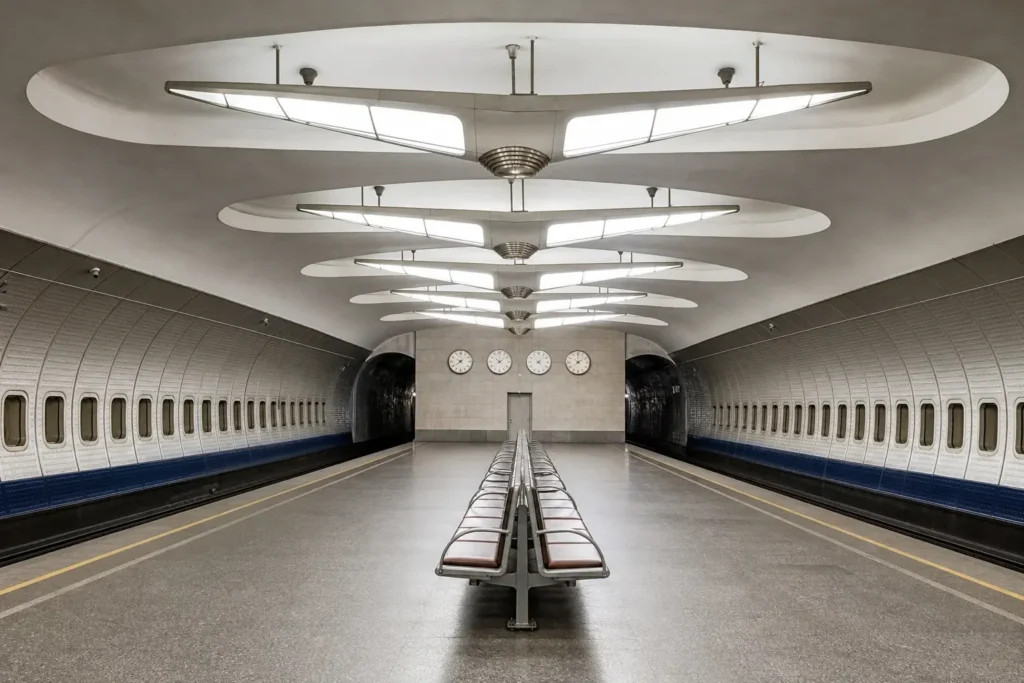
The Yekaterinburg Metro is a one-line rapid transit system serving Russia’s fourth-largest city, the unofficial capital of the Urals. With 9 stations stretched over 12.7 kilometres running north to south, it is compact but integral to moving people across the city’s dense centre and industrial neighbourhoods.
Opened on 26 April 1991, the Yekaterinburg Metro holds unique historical significance: it was the 13th and last metro system to open in the Soviet Union, inaugurated just weeks before the country’s dissolution. Construction began in 1980, but decades of political and economic shifts shaped its gradual build-out into the system visible today.
Quick Facts
| Russian name | Екатеринбургский метрополитен |
|---|---|
| Type | Transport hub |
| Built / opened | 1991 |
| Address | ул. Фрунзе, 26, 620042 Екатеринбург OpenStreetMap · Google Maps |
| District | Sverdlovsk Oblast |
| Opening hours | Daily 06:00-00:00 |
| Admission | ₽ |
| Best time to visit | Off-peak hours (10:00–16:00, excluding weekday lunch rush 12:00–13:00) are quietest for exploring stations and photography. Weekday mornings 06:00–10:00 and evenings 17:00–19:00 are crowded with commuters. Weekends see moderate, steady crowds throughout the day. Winter (November–March) means fewer tourists but sometimes slippery platform surfaces near station entrances. Summer (June–August) is busiest for visitors but manageable outside rush hours. |
| Recommended duration | 0.5–1 hour to explore major stations |
| Website | metro-ektb.ru |
How to Get to and from Yekaterinburg Metro, Yekaterinburg
| Option | Duration | Price | Notes |
|---|---|---|---|
| Metro to City Centre | 20–25 minutes (Prospekt Kosmonavtov to Botanicheskaya) | ₽ | Single fare on EKARTA card, contactless bank card, or QR ticket. 4–5 minute intervals peak hours (roughly 07:00–10:00 and 17:00–19:00), 6–8 minute intervals off-peak. Trains run 06:00–00:00 daily. |
| Metro to Railway Station (Uralskaya) | 12–15 minutes from Prospekt Kosmonavtov | ₽ | Direct access to Yekaterinburg-Passazhirsky railway station and Northern bus terminal via underground passages and escalators. This is the main interchange for surface transport and regional trains. Uralskaya is the deepest station; allow extra time on escalators. |
| Metro to Southern Bus Station (Chkalovskaya) | 28–32 minutes from Prospekt Kosmonavtov | ₽ | Exit at Chkalovskaya for connections to Southern bus terminal (8 Marta Street, 145). Buses depart from here to regional cities and suburbs. 10–12 minute walk or short bus connection depending on exact destination. |
| Metro to Airport Connection (Botanicheskaya) | 30–35 minutes from city centre; then bus 4–6 km | ₽₽ | No direct metro link to Koltsovo Airport. Exit Botanicheskaya (southern terminus); bus 01 runs from nearby stops to the airport (roughly 20–30 minutes depending on traffic). Alternatively, buses 1 and 21 serve airport routes from other stations. |
₽ budget · ₽₽ moderate · ₽₽₽ upscale · ₽₽₽₽ splurge. Price levels are estimates compared with typical prices for visitors.
Why Visit Yekaterinburg Metro, Yekaterinburg?
The Yekaterinburg Metro is essential transit for visitors exploring the city’s spread-out attractions, connecting the railway station near Uralskaya to the green belt and botanical areas at Botanicheskaya. The system’s stations reveal Soviet-era design philosophy: from the deep, imposing passages of Uralskaya (the deepest station) to the honeycomb-patterned ceiling of Botanicheskaya, each platform tells a story of post-Soviet ambition and industrial pride. Stations like Chkalovskaya feature aviation-themed art honouring pioneering pilot Valery Chkalov, while others reference Uralmash, the giant factory that shaped the city’s identity.
Highlights of Yekaterinburg Metro, Yekaterinburg
Prospekt Kosmonavtov – The Northern Terminal
The northernmost terminus sits at the edge of the city's industrial zone. Opened on 26 April 1991 with the first stage, this station marks the starting point of the line and serves workers and residents in the Uralmash district. The station's name refers to Cosmonauts' Avenue, honouring Soviet space pioneers. From here, southbound trains carry you toward the city centre in approximately 20 minutes.
Tip: Arrive early morning to see the flow of commuters; the station is far quieter in mid-afternoon.
Uralmash – Industrial Heart
Named after the nearby Uralmash heavy machinery plant, this station opened 27 April 1991 as the system's second operational station. The plant's dominance shaped the neighbourhood; multiple bus and tram routes converge here. Architecturally, the station reflects Soviet industrial aesthetic with straightforward, functional design. It serves as a key transfer point for surface transport and workers heading to the massive factory complex.
Tip: This is an excellent transfer hub if you need buses to suburbs; check the station's comprehensive list of routes posted near exits.
Mashinostroiteley – Working-Class Transit
The third station in the original opening phase, Mashinostroiteley (Machinery Builders) represents the Soviet emphasis on occupational pride in naming. The station serves a densely residential area and opened in the April 1991 phase. Its austere platform design and modest décor reflect the economic constraints of the early 1990s. Daily crowds of commuters reflect its role as a genuine transport artery, not a tourist showcase.
Tip: Not a sightseeing stop, but excellent for observing how locals navigate the system during rush hours.
Uralskaya – Deepest and Darkest
Opened 23 December 1992 as the fourth station, Uralskaya is Yekaterinburg's deepest metro station, descending far below street level due to difficult geology. Construction began in August 1980 with ceremonial first excavation; the station required over a decade to complete. Located next to the railway station and Northern bus terminal, it is the main interchange for arriving travellers. The platforms feel cavernous and dramatic, with long escalators emphasising the depth.
Tip: Allow extra time when changing to surface transport; escalator queues can be long during peak hours. Exits connect directly to the railway station via underground passages.
Ploshchad 1905 Goda – Civic Centre
Opened 22 December 1994, this sixth station sits directly above 1905 Square, the city's central public plaza. Named after the 1905 Russian Revolution, the station marks the symbolic heart of Yekaterinburg. Above ground, the square hosts civic gatherings and public events. The station's location makes it the closest metro point to the city circus and major administrative buildings. Architecturally, it captures the early post-Soviet period's attempt to reclaim public spaces.
Tip: Use this station to reach the city's civic attractions and main shopping streets; signs from the station guide you to 1905 Square exits.
Geologicheskaya – Central Passage
Opened 30 December 2002, this seventh station represents later-phase expansion. Situated in the city's central district at the intersection of 8th Marta and Kuybysheva streets, Geologicheskaya (Geological) honours the mining heritage of the Urals region. The station took over two decades to complete after planning began in the late 1970s. Its relatively recent opening means the platforms feel fresher than the original 1991 stations.
Tip: This station is a quieter alternative to Ploshchad 1905 Goda for reaching central streets; less crowded during daytime hours.
Chkalovskaya – Aviation Romance
Opened 28 July 2012 after 13 years of construction delays and a builders' strike, Chkalovskaya is the eighth station and features exceptional thematic design honouring Soviet pilot Valery Chkalov. The ceiling lamps in niches resembling an aeroplane wing, and track walls evoking a fuselage create a unique underground theatre of flight. Four clocks showing Moscow, Arkhangelsk, Vancouver, and Washington time add to the aviation-explorer theme. The station marked a major step in expanding south; construction began in 1992 but stalled for years.
Tip: Visit this station to see the most ambitious artistic vision in the system; photographs are excellent from the central platform looking up at the winged ceiling.
Botanicheskaya – Southern Terminal with Unique Design
Opened 28 November 2011, the ninth and final station brings the line to its current southern limit near the city's botanical gardens. The station's roof design is uniquely based on honeycomb patterns representing the gardens above. Botanicheskaya serves as the line's southern terminus and connection point for buses to the airport and outlying areas. The honeycomb ceiling makes it the system's most visually distinctive modern station. Expansion southward took from 1991 planning through 2011 opening.
Tip: The honeycomb ceiling is best photographed from the platform looking upward; visit mid-morning for softer light and fewer commuters.
Atmosphere
The Yekaterinburg Metro feels like a snapshot of Soviet urban aspiration frozen mid-transition. The original stations from 1991 carry the weight of that moment—Soviet ambition meets post-Soviet economic struggle, evident in functional designs and modest materials. Mornings pulse with purposeful commuters in dark coats, climbing long escalators with practiced efficiency. Afternoons grow quieter, revealing the cavernous beauty of corridors and platforms.
The trains themselves are older rolling stock, audibly rattling through tunnels with the metallic clang of heavy rail. Station halls echo with announcements. The newer stations (Chkalovskaya, Botanicheskaya) feel slightly fresher, their designs more playful—aviation themes, honeycomb ceilings—suggesting a city slowly embracing its aesthetic identity after the austere 1990s. Crowds on weekday evenings tell a working city’s story: factory shifts changing, students heading home, pensioners navigating escalators. The underground feels industrial yet human.
History of Yekaterinburg Metro, Yekaterinburg
In the late 1970s, Yekaterinburg—then named Sverdlovsk—was recognised as one of Russia’s great industrial hubs, a city that warranted rapid transit. Construction began officially on 28 August 1980 with ceremonial first earth moved at the Uralskaya station shaft, marking the start of the most ambitious project in the city’s modern history. Soviet planners envisioned a multi-line system; reality proved more complex.
The first stage, connecting Prospekt Kosmonavtov to Mashinostroiteley (3 stations), opened on 26 April 1991. The system became the 13th and final metro to open in the Soviet Union—weeks before the country’s dissolution. That opening was both triumphant and bittersweet, a final Soviet achievement as the state crumbled. Construction of additional stations continued through the 1990s economic chaos. Uralskaya station, deepest in the system, opened 23 December 1992; the next two stations (Dinamo and Ploshchad 1905 Goda) opened together on 22 December 1994 after years of slow progress.
The 1990s and 2000s saw glacial expansion hampered by funding crises. Geologicheskaya opened 30 December 2002—over two decades after planning began. Chkalovskaya presented particular challenges: construction started in 1992 but a builders’ strike halted work in 1999. The station remained unfinished for years before finally opening 28 July 2012. Botanicheskaya, the southern terminus, opened 28 November 2011, extending the line southward toward the botanical gardens and airport approach roads.
Today the system remains a single line with nine stations, 12.7 kilometres of track. A second line has been discussed since the 1990s but no construction has begun. The metro operates daily from 06:00 to midnight, carrying approximately 130,000 riders per day in normal conditions. Payment evolved from tokens to cards and now accepts contactless bank payments, reflecting Russia’s shift into the 21st century.
Tickets and Payment at Yekaterinburg Metro, Yekaterinburg
Metro fares are purchased at ticket windows or vending machines in station halls, or via mobile payment. Authorised payment methods include EKARTA plastic card (rechargeable transport card), contactless bank cards (Mir, Visa, Mastercard), QR code single tickets (purchased on phone apps or at machines), and newer biometric systems. Single fares and multi-journey passes are available; prices differ for Russian citizens and beneficiaries compared to international visitors.
Same-day tickets are available at all stations. The system operates on a single-fare model regardless of distance travelled. Digital payment has largely replaced cash; machines accept card insertions or contactless tap. For current rates and concession categories, visit the official website metro-ektb.ru. Journey planning: trains run every 4–5 minutes in peak hours (morning and evening commute), every 6–8 minutes otherwise. First train departs 06:00, last train departs around 23:50 to reach the terminus by midnight.
Flights, Transfers and Planning
How to Get to Yekaterinburg Metro, Yekaterinburg
The Yekaterinburg Metro consists of one line running north to south. Entry points vary by purpose:
- From Yekaterinburg Railway Station: Use Uralskaya station (4th station). Exit underground from the station’s main hall; follow signage to metro turnstiles. The descent via escalators to the platform is lengthy due to the station’s depth. Journey time to central stations: roughly 10 minutes to Ploshchad 1905 Goda.
- From Northern Bus Station: Also served by Uralskaya, adjacent to the railway station. Underground passages connect the two; follow bus station exit signs.
- From City Centre (1905 Square area): Use Ploshchad 1905 Goda station, located directly below the square. Multiple surface exits connect to streets; follow signage.
- From Airport Koltsovo: Bus 01 from the airport terminates near Botanicheskaya station (southern terminus). Walk or use connecting tram to reach the metro entrance. Journey from airport: approximately 45–60 minutes including bus and wait time.
Each station has clear signage in Russian and Latin characters. Station names are announced in Russian on trains; a mental note of station order or a transit app (Yandex Maps has metro directions) is helpful.
Accessibility
The system includes escalators and lifts at major stations, particularly Uralskaya, but not all stations are equally accessible. Uralskaya's depth requires escalators; several other stations have lifts. The official website provides accessibility information by station. Passengers with mobility difficulties should contact the metro operator (post@ettu.ru) for specific accessibility details at individual stations before visiting. Tactile guidance and audio announcements are present at some stations but not comprehensive throughout the system.
Food Nearby
The metro system itself has no cafés or food vendors inside stations. Food options are located on street level near station exits. Central stations like Ploshchad 1905 Goda and Geologicheskaya exit into areas with cafés, bakeries, and shops within a 5-minute walk. The railway station complex near Uralskaya has a small food court and convenience stores. Bring a snack if planning to spend time underground; nearest restaurant dining requires exiting the metro.
What to Bring
Comfortable walking shoes are essential—stations involve long corridors and escalators, especially at Uralskaya. Dress for the season (winters are cold, summers warm above ground but cool underground). Carry a water bottle; stations can be dry due to ventilation systems. A mobile phone is useful for checking Yandex Maps metro directions and station names. Small change or a card for metro fare (card payment preferred). Photography equipment is welcome; no flash restrictions are evident, though crowds may limit tripod use during rush hours.
Photography Rules
Photography is permitted throughout the metro system. No restrictions on non-flash photography, tripods, or mobile phone images. Artistic architectural details are best captured during off-peak hours when platforms are clearer. The honeycomb ceiling at Botanicheskaya and the aviation-themed details at Chkalovskaya are popular subjects. Flash photography is disruptive during crowded periods; use available light or avoid flash in dimly lit corridors.
Family Suitability
The system is suitable for families with children and accessible strollers at most stations thanks to escalators, though some narrow corridors can be tight. Uralskaya station's depth and long escalators may tire younger children; sit them in a stroller if possible. Trains themselves are not crowded during off-peak hours, making for a calmer, safer experience with small children. Older children (8+) generally enjoy the historic significance and architectural variety. Busy rush hours (07:00–10:00, 17:00–19:00) are challenging for families; travel mid-morning or mid-afternoon. Toilets are not always obvious at stations; plan accordingly.
Russia Vibes Tips
- Obtain an EKARTA card at any station kiosk and load credit. It is faster than buying individual tickets and works on trams and buses too, giving you seamless transit across the entire city transport system.
- Station names on train announcements are in Russian only. Note the station sequence (Prospekt Kosmonavtov → Uralmash → Mashinostroiteley → Uralskaya → Dinamo → Ploshchad 1905 Goda → Geologicheskaya → Chkalovskaya → Botanicheskaya) or use a transit app to avoid missing your stop.
- Uralskaya is genuinely deep; arriving late in the evening when the station is quiet reveals its full scale and architectural drama. Avoid peak hours if you want to experience the cavernous beauty of the platforms.
- The metro runs until midnight, not 24 hours. Final trains depart around 23:50 from each terminus; plan evening travel accordingly, or use night buses and taxis instead.
- Chkalovskaya station was under construction for 13 years (opened 2012). Its aviation-themed décor and lamps resembling aeroplane wings make it unlike any other station in the system—worth a stop even if not changing trains.
- From Botanicheskaya station, buses 01, 1, and 21 connect to Koltsovo Airport, but service is infrequent. For predictable airport transport, book a taxi in advance or use a ride-share app; metro to airport can take 45–60 minutes including waits.
Where to Find Yekaterinburg Metro, Yekaterinburg in Russia
More chains in Russia
 Central Market Transport Hub, Irkutsk
Main image: AI-generated illustration. It may not show the place exactly as it looks.
 Nizhny Novgorod Metro, Nizhny Novgorod
Main image: AI-generated illustration. It may not show the place exactly as it looks.
 Yunost Island Pier, Irkutsk
Main image: AI-generated illustration. It may not show the place exactly as it looks.
Related guides
 EverJazz Festival: Yekaterinburg’s Largest Open-Air Jazz Celebration
Main image: AI-generated illustration. It may not show the place exactly as it looks.
 Tsar’s Days, Yekaterinburg: Memorial Festival and Pilgrimage
Main image: AI-generated illustration. It may not show the place exactly as it looks.
 Malinovka: Traditional Russian Cuisine and a Working Stove in Yekaterinburg
Main image: AI-generated illustration. It may not show the place exactly as it looks.
 Beefstroganoff Grill: Live-Fire Steakhouse in Central Yekaterinburg
Main image: AI-generated illustration. It may not show the place exactly as it looks.
Browse more: More in Sverdlovsk Oblast · All Airports & Transport · All Airports & Transport in Yekaterinburg · All Other Hubs · All Yekaterinburg
FAQ: Yekaterinburg Metro, Yekaterinburg
Is the metro the best way to get from the railway station to the city centre?
Yes. Uralskaya station is directly beneath the railway station (accessed via underground passages and escalators). From there, trains reach Ploshchad 1905 Goda (city centre) in about 10 minutes. It is faster and cheaper than taxis, though escalator queues can be long during peak hours. The metro operates 06:00–00:00 daily.
How do I get to Koltsovo Airport from the metro?
There is no direct metro link to the airport. Exit at Botanicheskaya station (southern terminus) and catch bus 01, 1, or 21 to the airport from nearby stops. Total travel time is approximately 45–60 minutes including waits. Alternatively, book a taxi or use a ride-share app for direct, faster transport.
What payment methods are accepted?
EKARTA rechargeable card (fastest), contactless bank cards (Mir, Visa, Mastercard), QR code single tickets on apps, and biometric systems. Cash is not accepted at turnstiles. Prices differ for Russian citizens versus international visitors; see the official website metro-ektb.ru for current rates.
How often do trains run?
4–5 minutes during peak hours (roughly 07:00–10:00 and 17:00–19:00 on weekdays), 6–8 minutes off-peak and on weekends. All stations operate 06:00–00:00 daily.
Which station is best for visiting the city centre?
Ploshchad 1905 Goda is the central interchange, located directly below 1905 Square. Geologicheskaya (7th station) is also central and often quieter. Both are on the main metro line, 5 stations apart from Uralskaya (railway station) heading south.
Is there a second metro line planned?
A second line has been discussed since the 1990s, but no construction has begun. The system currently remains a single line with 9 stations.
What is Uralskaya station known for?
Uralskaya is the deepest metro station in Yekaterinburg, requiring long escalator descents. It opened in December 1992 after construction began in August 1980. It is the main interchange for the railway station and Northern bus terminal, serving as the main transit hub for arriving passengers.
Is the metro accessible for wheelchairs and strollers?
Most stations have escalators and some have lifts. Uralskaya has lifts to accommodate depth. However, not all stations offer full accessibility. Contact the metro operator (post@ettu.ru) or check metro-ektb.ru for specific station details before visiting with mobility equipment.
Russia Vibes is a one-person project. A coffee keeps it going
How we research and update our guides
About this guide: AI assistance and accuracy
This guide is created with the help of AI and is based on official sources where available. Mistakes can still happen. Opening hours, prices, rules and other details are given to the best of our knowledge as of the date shown and can change without notice. It offers general recommendations only, not professional, legal or travel advice. Please confirm important details with the official source before you travel; you are responsible for your own plans and decisions.

Take this guide with you
Get a free PDF of this guide to print or read offline: key facts, tips and a map link on a few clean pages.
Report an issue on this page
Paying for your trip: please read
International sanctions affect payments between Russia and many other countries. In practice, cards issued in the EU, the UK, the US and several other countries often do not work in Russia, Russian cards usually do not work abroad, and some booking platforms, airlines and payment providers limit or suspend their services for Russia. The situation changes frequently.
We do not give legal or financial advice, and this site does not encourage anyone to break or circumvent sanctions. Whatever you plan, you are responsible for following the laws and regulations that apply to you, including those of your country of residence and citizenship.
Many travelers still organise their stay lawfully. It is worth asking your bank or payment provider what is currently permitted, contacting hotels, tour operators and carriers directly about the payment methods they accept, and checking which services are open to customers from your country. Clarify payment, cancellation and refund terms before you commit to a booking, and keep your plans flexible.
Partner links on this site may not be available in every country, and prices, availability and rules in our guides can differ from what you see when you book.