
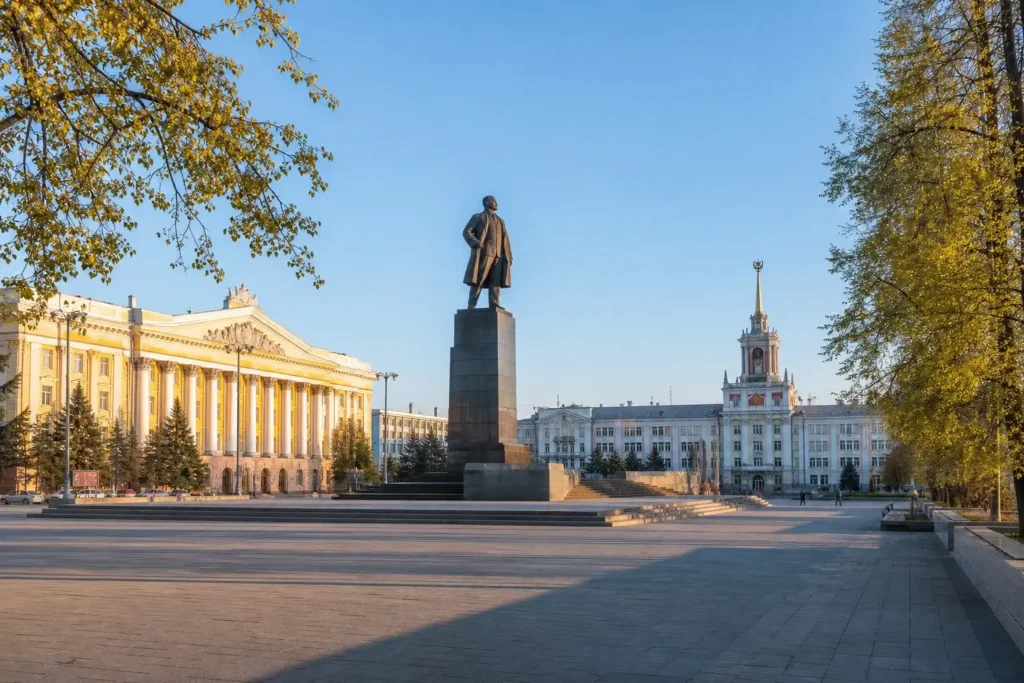
Leninsky District is one of Yekaterinburg‘s eight official administrative divisions, covering about 34 square kilometers in the heart of the city. Named after Vladimir Lenin and established in 1934, it spans from the industrial north to the residential south, straddling the Iset River. The district is home to several major attractions including the Yekaterinburg Circus, museums, theaters, and significant Soviet-era architecture, making it a focal point for understanding the city’s history and contemporary culture.
This diverse district serves as a working neighborhood rather than a tourist enclave, with markets, shops, apartment blocks, and parks scattered throughout. Visitors using Leninsky as a base can explore on foot or via the metro, which has two principal stations serving different parts of the district.
Quick Facts
| Russian name | Ленинский район |
|---|---|
| Address | OpenStreetMap · Google Maps |
| District | Leninsky |
| Metro | Geologicheskaya (Line 1, 5 min walk south) Ploshchad 1905 Goda (Line 1, 10 min walk west) |
| Best time to visit | May to September offers pleasant weather for walking the district. Winter (December–February) brings snow and cold temperatures, making indoor attractions like the Circus more appealing. Spring and autumn provide mild conditions and thinner crowds. |
| Website | len.ekburg.ru |
Why Visit Leninsky, Yekaterinburg?
Leninsky offers an authentic view of how Yekaterinburg functions beyond the city center. The district contains the Circus—a distinctive neoclassical building with ornate decoration—and serves as a transport hub connecting the metro system. The west bank of the Iset River features historic streets like Dobrolyubov Street, one of the oldest in Yekaterinburg, with original residential architecture from the 18th and 19th centuries. Visitors interested in Soviet urban planning, residential life, and local commerce will find Leninsky reflects the real city where residents work and live.
History of Leninsky, Yekaterinburg
Leninsky District was formally established on February 21, 1935, during the Soviet era when Yekaterinburg (then Sverdlovsk) was undergoing rapid industrial expansion. The district was carved from the growing city to organize and manage the central and south-central areas as they developed.
The western bank of the Iset River preserves some of Yekaterinburg’s oldest urban development. Dobrolyubov Street, located in Leninsky, traces its origins to practically the city’s foundation in 1723, when it formed part of the Kupetsky settlement—a trading community established behind the southern wall of the wooden Ekaterinburg fortress. Over time, the street changed names multiple times before settling on its current designation in 1919.
During the 1930s to 1950s, the district acquired significant Soviet-era architecture reflecting neoclassical principles that marked the period. The Circus building, completed in 1930, exemplifies this ornate, symbolic architecture. The district’s development as a residential and cultural center continued through the Soviet period, with the construction of apartment blocks, theaters, and public institutions serving the local population and the wider city.
Following Soviet collapse, Leninsky adapted to post-1991 Russia. The metro system, beginning construction in 1980, was extended through the district with its final sections opening decades later, fundamentally changing accessibility and transportation patterns. Modern commercial development has proceeded alongside preservation of historic buildings, creating the mixed-use character visible today.
Plan and Book
Advertisement: these are partner links. If you book or buy through them, we may earn a commission at no extra cost to you.
How to Get to Leninsky, Yekaterinburg
Leninsky District is served by two metro stations on Line 1 of the Yekaterinburg Metro: Geologicheskaya (south-central) and Ploshchad 1905 Goda (central). From Geologicheskaya, the Circus and surrounding cultural attractions lie a short walk north. From Ploshchad 1905 Goda, the historic center square and western districts are directly accessible. The metro runs north–south through the city; most district points are within 10–15 minutes’ walk from a station.
By surface transport, trolleybuses and trams connect the district to other parts of the city. Taxis and ride-share apps are available throughout.
Food Nearby
Leninsky contains a mix of local eateries, cafés, and small shops typical of Russian residential districts. The area around Ploshchad 1905 Goda and Geologicheskaya has more commercial options. Street-level bakeries and kiosks serve local food; proper restaurants and cafés exist but are scattered rather than concentrated.
What to Bring
Comfortable walking shoes for exploring residential streets and parks. A metro card (purchased at station ticket windows or kiosks) for easy transit. In winter, warm clothing and waterproof boots for snow and ice.
Best Views and Photo Spots of Leninsky, Yekaterinburg
Iset River west bank near Dobrolyubov Street
Historic 18th- and 19th-century residential buildings reflected in the river. Older architecture contrasts with modern apartment blocks upstream. Water creates natural framing and mirror effects.
Best time: Late afternoon in spring or autumn for warm light; winter ice creates a different aesthetic.
Ploshchad 1905 Goda (Square of 1905) looking east
The central plaza with Lenin monument and surrounding neoclassical and Soviet-era facades. Winter: ice city installations (seasonal). Views toward the historic center and metro area.
Best time: Early morning or late afternoon for soft light; during New Year decorations (late November–early January) for festive framing.
Yekaterinburg Circus exterior (Geologicheskaya area)
Ornate neoclassical building with distinctive yellow-cream facade and decorative elements. Set back from street with plaza in front. Architectural detail and symmetry reward close-up photography.
Best time: Afternoon when facade catches warm light; clear days show exterior detail best.
Photography Rules
Photography is generally unrestricted in public areas of the district. The Iset River embankments and historic architecture offer good photo opportunities. Check individual venue rules at museums or cultural centers before photographing inside.
Family Suitability
Leninsky is a working residential district suitable for families exploring authentic local life. Ploshchad 1905 Goda has open space for children; nearby parks and the Circus provide entertainment. Stroller access is generally good on main streets, though older residential areas have uneven pavements. The district lacks concentrated family attractions but offers a safe, walkable environment for families interested in urban exploration.
Russia Vibes Tips
- The Yekaterinburg Circus operates performances most days; check the schedule in advance rather than dropping in, as showtimes fill quickly.
- Dobrolyubov Street on the west bank is quieter and more atmospheric than main thoroughfares; wander side streets to see residential Yekaterinburg.
- Ploshchad 1905 Goda is the district's true hub; this is where metro, trams, buses, shops and food converge. Orienting yourself here first makes navigation easier.
- Winter ice installations and New Year decorations appear in the plaza from late November; timing a visit then captures the city's festive mood.
- The metro stations themselves are worth seeing; Geologicheskaya and Ploshchad 1905 Goda both feature Soviet-era design with local Ural stone and marble finishes.
Where to Find Leninsky, Yekaterinburg in Russia
Related guides
 Chekhov, Yekaterinburg: A Historic Boutique Hotel in the City Center
Main image: AI-generated illustration. It may not show the place exactly as it looks.
 Khmeli Suneli: Authentic Georgian Cuisine in Yekaterinburg
Main image: AI-generated illustration. It may not show the place exactly as it looks.
 Proletarskaya: Nizhny Novgorod’s Original Metro StationOpen daily 05:30–00:15
Main image: AI-generated illustration. It may not show the place exactly as it looks.
 Alyosha Monument: War Memorial and Arctic Guardian
Main image: AI-generated illustration. It may not show the place exactly as it looks.
 Zuma, Vladivostok: Upscale Pan-Asian Dining on Partizanskiy Prospekt
Main image: AI-generated illustration. It may not show the place exactly as it looks.
Browse more: More in Leninsky · All Hidden Russia · All Neighborhoods · All Neighborhoods in Yekaterinburg · All Yekaterinburg
FAQ: Leninsky, Yekaterinburg
What is Leninsky District and how is it different from central Yekaterinburg?
Leninsky is one of eight official administrative districts, established in 1934. It encompasses central and south-central areas rather than being a distinct neighborhood. The district includes both the tourist-oriented city center near Ploshchad 1905 Goda and quieter residential zones. It is not a separate destination but an administrative division visitors pass through or use as a base.
Are the metro stations in Leninsky accessible and worth visiting for the architecture?
Yes. Geologicheskaya and Ploshchad 1905 Goda are functioning metro stations with Soviet-era design featuring Ural stone, granite, and marble. They operate as part of the regular transit system (paid entry via ticket or card). The stations reflect 1990s–2000s late-Soviet design principles and are worth a brief visit if interested in transport heritage.
Where should I start exploring Leninsky?
Ploshchad 1905 Goda (Square of 1905) is the natural hub and a good orientation point. It is near two metro lines, surrounded by shops and cafés, and serves as the district's social center. From there, you can walk to the Circus (northeast), historic streets (west toward the Iset), or residential areas (south).
Is Leninsky residential or tourist-focused?
Leninsky is primarily residential and commercial, serving everyday city life. It contains major cultural institutions (Circus, theaters) but lacks the density of museums and curated attractions found in dedicated tourist zones. Visitors here experience authentic local Yekaterinburg rather than a packaged tourist experience.
What are the oldest parts of Leninsky?
Dobrolyubov Street on the west bank of the Iset River is one of Yekaterinburg's oldest streets, dating to practically the city's 1723 foundation. Historic 18th- and 19th-century residential buildings still stand in this area, contrasting with Soviet-era blocks built later in the district's development.
Can I visit the Circus without a ticket if I just want to see the building?
The Circus is an operating performance venue; you can view the exterior from the street for free. To enter the building or see a performance, you need a ticket. Performances run most days; check the schedule at the venue or online before visiting.
How long should I spend in Leninsky?
As a district, Leninsky is not a single destination with a fixed tour length. Half a day allows for walking key streets, visiting the Circus exterior, and seeing Ploshchad 1905 Goda. A full day lets you explore residential areas, visit museums if open, and relax in local cafés.
Is it safe to walk around Leninsky at night?
Ploshchad 1905 Goda and areas near metro stations remain reasonably busy and safe in the evening. Residential areas are quiet after dark; use normal city caution and stick to well-lit main streets. The metro provides safe transport; note final train times for your return.
Russia Vibes is a one-person project. A coffee keeps it going
How we research and update our guides
About this guide: AI assistance and accuracy
This guide is created with the help of AI and is based on official sources where available. Mistakes can still happen. Opening hours, prices, rules and other details are given to the best of our knowledge as of the date shown and can change without notice. It offers general recommendations only, not professional, legal or travel advice. Please confirm important details with the official source before you travel; you are responsible for your own plans and decisions.

Take this guide with you
Get a free PDF of this guide to print or read offline: key facts, tips and a map link on a few clean pages.
Report an issue on this page
Paying for your trip: please read
International sanctions affect payments between Russia and many other countries. In practice, cards issued in the EU, the UK, the US and several other countries often do not work in Russia, Russian cards usually do not work abroad, and some booking platforms, airlines and payment providers limit or suspend their services for Russia. The situation changes frequently.
We do not give legal or financial advice, and this site does not encourage anyone to break or circumvent sanctions. Whatever you plan, you are responsible for following the laws and regulations that apply to you, including those of your country of residence and citizenship.
Many travelers still organise their stay lawfully. It is worth asking your bank or payment provider what is currently permitted, contacting hotels, tour operators and carriers directly about the payment methods they accept, and checking which services are open to customers from your country. Clarify payment, cancellation and refund terms before you commit to a booking, and keep your plans flexible.
Partner links on this site may not be available in every country, and prices, availability and rules in our guides can differ from what you see when you book.