
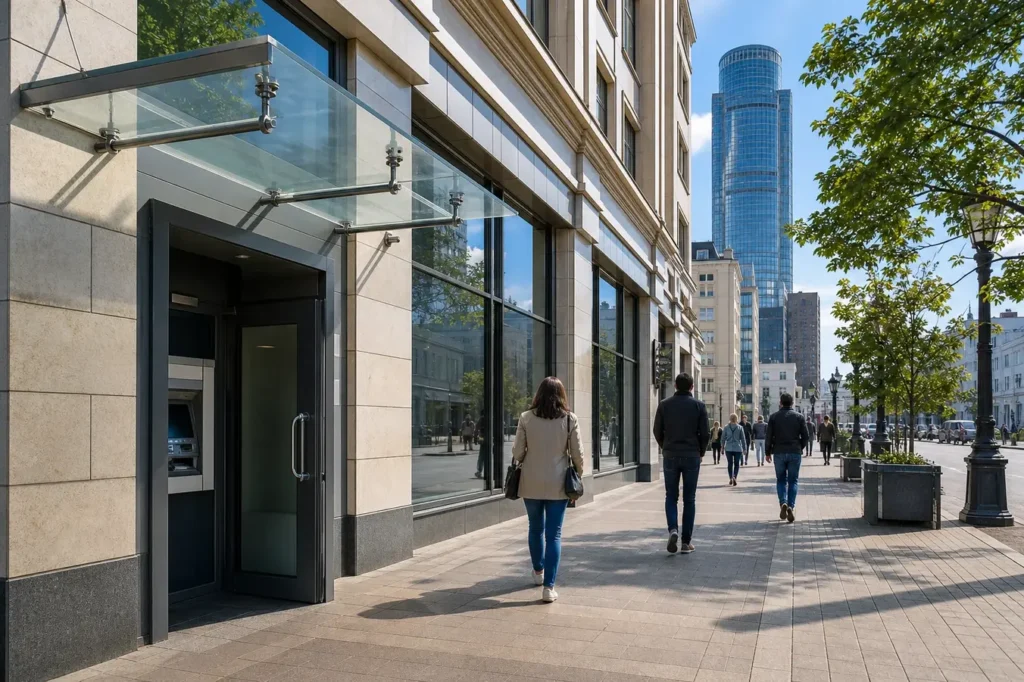
Whether you’re arriving with foreign currency or need to withdraw cash, this guide walks you through the practical steps to get rubles in your pocket and pay for everything during your stay in Yekaterinburg. The city has abundant ATMs and bank branches where you can exchange money, though your options depend on what cards you carry and which currencies you hold.
The recommended approach is straightforward: arrive with cash in US dollars or euros (the most widely exchanged), withdraw additional rubles at an ATM using an international card that works in Russia, or visit a bank branch to exchange currency face-to-face. Payment is always in rubles—no other currency is accepted.
Quick answer: Withdraw rubles at an ATM (10–15 minutes, fee applies) or exchange cash at a bank branch (20–30 minutes, better rates). Bring cash instead of relying solely on cards. Avoid accepting currency conversion offers at ATMs.
At a Glance
| Total time | 10–30 minutes depending on method |
|---|---|
| Typical cost | ₽ |
What You Need Before You Start
- Foreign cash (US dollars or euros preferred) or an international card that works in Russia
- Passport or other ID (may be required for exchanges over a certain amount)
- PIN for your debit card (if withdrawing from ATM)
- Knowledge that Visa and Mastercard issued outside Russia do not work
Compare Your Options
| Option | Duration | Price | Notes |
|---|---|---|---|
| ATM withdrawal with international card | 10–15 minutes | ₽ | Fastest method. Fee depends on your home bank and card type. UnionPay, Mir (if issued by Russian bank), and some cards with domestic systems work. Visa and Mastercard issued outside Russia do not work. Available 24/7 at most locations. |
| Bank branch currency exchange (cash to rubles) | 20–30 minutes | ₽ | Better exchange rates than ATMs. Requires passport. Available during business hours (typically 9 AM–5 PM weekdays). Sberbank, Gazprombank, and other major banks throughout the city. Good for larger amounts. |
| Hotel concierge exchange | 15–25 minutes | ₽₽ | Convenient if you cannot leave your hotel early, but rates are typically worse than banks. May charge an additional service fee. Useful only for small emergency exchanges. |
| Bring sufficient cash from home | No waiting | Free | Safest for short trips under 3 days. Carry USD or EUR (largest denominations), exchange to rubles before leaving the airport or at your hotel on day one. Avoids ATM fees and card compatibility issues. Airports have exchange counters, though rates are average. |
| Open a Russian bank account and get a MIR card | 1–2 days (setup time) | ₽ | For longer stays (1+ weeks). Some banks allow quick account opening for tourists. MIR cards work everywhere in Russia. Useful if your foreign card doesn't work or fees are high. Requires passport and may require a Russian address. |
| Use a UnionPay card if you have one | instant (at point of sale) | ₽ | UnionPay cards issued by non-Russian banks work at most ATMs and many shops. Better than relying on Visa or Mastercard, though not accepted everywhere. Check with your bank before travel whether your card is UnionPay. |
₽ budget · ₽₽ moderate · ₽₽₽ upscale · ₽₽₽₽ splurge. Price levels are estimates compared with typical prices for visitors.
Step-by-Step Instructions
Step 1: Find an ATM in a safe, visible location
Look for ATMs at metro stations, inside commercial buildings, hotel lobbies, or at bank branches along Lenina Avenue and other central streets. Search Yandex Maps for "Банкомат" (ATM) to locate the nearest machine. Avoid standalone ATMs on empty streets; choose machines inside shops, malls, or recognised bank buildings for security.
Tip: T-Bank ATMs operate 24/7 at several locations across the city; Sberbank and Gazprombank also have extensive networks.
Step 2: Insert your card and select Russian rubles
Insert your international card (UnionPay or another system compatible with Russia). Enter your PIN. Choose to withdraw in rubles—if the ATM asks whether to accept conversion at the ATM's own exchange rate or decline conversion, always select decline. Declining gives you the better rate from your card's bank instead of the ATM's markup.
Tip: ATMs in Russia often show withdrawal options in thousands; select an amount that feels safe to carry (not excessive).
Step 3: Withdraw a manageable amount
Most ATMs allow withdrawals between equivalent of moderate to substantial amounts per transaction. Typical limits are 100,000–300,000 rubles per transaction, though daily or weekly limits may apply depending on your bank. Start with a smaller amount if uncertain.
Tip: Withdraw enough to cover a few days of spending, then return to an ATM rather than carrying very large cash amounts.
Step 4: Collect your cash and card
Take your rubles and card from the machine. Check the bills in good light before leaving the ATM area. Russian banknotes come in denominations of 10, 50, 100, 500, 1000, and 5000 rubles. Smaller denominations are helpful for transit fares and small purchases.
Tip: Count your cash immediately and store it securely before you leave the ATM location.
Step 5: To exchange cash instead: visit a bank branch during business hours
If you prefer exchanging cash to using an ATM, walk into a bank branch. Sberbank and Gazprombank have numerous branches throughout Yekaterinburg, especially along Lenina Avenue and in the city centre. Bring your passport. Complete the exchange form at the counter and present your foreign currency.
Tip: Bank exchange rates are typically better than ATM rates, but queues can be longer. Go early in the morning or mid-afternoon to avoid peak times.
Step 6: Understand ID requirements for larger exchanges
Russian law requires ID verification (passport) for any currency exchange exceeding a certain amount. Have your passport ready when you approach the exchange counter. Most exchanges for tourists are routine and take 15–20 minutes once you're at the counter.
Tip: Keep a copy of your passport's identification page separate from the original in case of loss.
Step 7: Pay in rubles for all purchases
Once you have rubles, use them for everything: metro fares, food, museums, taxis, shops. The rouble is the only legal payment currency in Russia. Most cafés, shops, and transport accept cash. Some places, especially larger retailers and cafés, also accept card payments via MIR or UnionPay systems.
Tip: Keep small bills (100 and 500 ruble notes) for small purchases; vendors sometimes claim not to have change for very large notes.
Step 8: Use QR codes for restaurant and café payments when available
Many restaurants and cafés display QR codes linked to their payment systems. You can scan and pay directly from a Russian bank account if you open one, or use a MIR card app. This is optional but convenient if you have time to set up a Russian account.
Tip: Cash is still preferred in smaller shops and old-fashioned establishments; always ask if QR or card payment is available before ordering.
Common Mistakes to Avoid
- Accepting the ATM's 'convert now' or 'with conversion' offer: always decline and let your card's bank do the conversion instead. The ATM's own exchange rate includes a markup that costs you money.
- Carrying only Visa or Mastercard: these cards stopped working in Russia years ago. Foreign-issued Visa and Mastercard will not work at ATMs or in shops, even if marked with logos. Check your card's payment system before you travel.
- Not bringing any cash: a small amount of backup cash (USD or EUR) is essential because ATM outages happen and your card may not work unexpectedly. At minimum, bring cash for the first day.
- Trying to exchange pounds, Australian dollars, or other currencies: most banks in Yekaterinburg only exchange US dollars and euros. Check the bank's currency list before entering, or ask staff.
- Withdrawing too much cash at once: carrying huge amounts is risky. Withdraw modestly and return to an ATM as needed instead of walking around with excessive cash.
- Forgetting that only rubles are legal tender: restaurants, shops, and taxis will not accept dollars, euros, or any foreign currency, no matter how much you offer. All prices are in rubles.
- Changing money at unmarked or private exchange kiosks: use only banks or their official ATMs. Unofficial changers may give poor rates or handle counterfeit notes.
Tickets, Payment and Booking
How to get cash or exchange currency:
- Bank branches: Visit any Sberbank, Gazprombank, or other major bank branch to exchange foreign cash for rubles. Branches are open 9 AM–5 PM on weekdays, with some Saturday hours. Bring your passport. Exchange rates are competitive and better than ATMs.
- ATMs: Use ATMs run by banks whose cards are compatible with your payment system. T-Bank, Sberbank, and Gazprombank have widespread ATM networks. ATMs operate 24/7. Avoid ATMs that are isolated or unmarked.
- Payment systems that work: UnionPay (Chinese payment system) works in Russia and accepts most international cards. Mir (Russian domestic payment system) works everywhere but is issued only by Russian banks. Visa and Mastercard issued outside Russia do not work. Maestro and other systems have very limited support.
- Important for foreign visitors: Your home country’s banking sanctions regulations may restrict you from using Russian banks or payment systems. Check with your own bank before you travel. You are responsible for ensuring you follow your country’s laws regarding financial transactions in Russia.
- Avoid resellers: Do not use unofficial money changers, street vendors, or online intermediaries. These sources offer poor rates and sometimes handle counterfeit notes. Stick to banks and official ATMs only.
Helpful Links
Compare hotel pricesSearch flights
Advertisement: these are partner links. If you book or buy through them, we may earn a commission at no extra cost to you.
Russia Vibes Tips
- Open a Google Maps search for 'Sberbank' or 'банк' (bank) to find branches with extended Saturday hours or locations near your hotel. This saves time compared to searching during typical business hours.
- If your international card is declined at an ATM, try a different machine from a different bank rather than trying the same machine repeatedly. ATM networks vary, and one bank's ATM may accept your card while another does not.
- Keep a small reserve of home-country cash (USD 50–100 equivalent) separate from your main wallet. If your card stops working and all ATMs fail, you have a backup way to exchange money at your hotel or a bank during business hours.
- Metro fares and many small purchases work best with cash. Carry a mix of 100, 500, and 1000 ruble notes for flexibility. Do not break large notes (5000 rubles) at small shops—they often lack change or view it as inconvenient.
- Exchange currency when you arrive at the airport or immediately on day one rather than waiting. This avoids the stress of searching for a bank on day two and gives you a full day to explore if your card fails later.
- If paying by card at a restaurant or shop, ask first whether they accept your payment system. Saying 'MIR?' or 'UnionPay?' saves time and avoids awkwardness at the till.
Explore Nearby Pay and exchange money in Yekaterinburg
Browse more: All How-To · All How-To in Yekaterinburg · All Money and Cards · All Yekaterinburg
FAQ
Do credit cards work in Yekaterinburg?
Visa and Mastercard issued outside Russia no longer work in shops, ATMs, or online. UnionPay (Chinese system) works at many ATMs and shops but not everywhere. For the safest option, bring cash and use ATMs or exchange at banks. Some Russian banks issue free MIR debit cards to tourists, which work everywhere inside Russia.
What should I do if my ATM card is declined?
Try a different ATM from a different bank. If all ATMs decline you, visit a bank branch during business hours (9 AM–5 PM weekdays) and exchange your foreign cash for rubles directly at the counter. Bring your passport. This always works as long as the bank accepts your currency (USD, EUR).
Should I exchange money at the airport or in the city?
Both options work. Airport exchange rates are average but convenient upon arrival. City bank rates are typically better. If you arrive early in the day, exchange at the airport and get settled. For larger sums, city banks are more economical. Avoid hotel exchanges unless you have no other option—rates are usually poor.
What currencies can I exchange in Yekaterinburg?
US dollars (USD) and euros (EUR) are the easiest to exchange at any bank. Other currencies like British pounds require specific banks and may take longer. Check with the bank before visiting. UnionPay is also accepted for ATM withdrawals if your card has it.
Can I withdraw more than I need and store it at my hotel?
Yes, but carry only what you need for a few days in your pocket or a money belt. Store larger amounts in your hotel safe. ATM limits are typically 100,000–300,000 rubles per withdrawal, and daily limits apply. Splitting withdrawals over multiple days is safer and avoids carrying excessive cash.
Do I need my passport to exchange money?
Russian law requires ID for exchanges above a certain amount (roughly 40,000 rubles). For smaller exchanges, you may not need it. However, always carry your passport when visiting a bank. It takes seconds to show and avoids delays.
Is it safe to carry rubles in cash around the city?
Yes, like any city, use normal precautions: keep cash in a hidden pocket or money belt, not a backpack or visible pocket. Yekaterinburg is generally safe for tourists. Carry only what you need for the day; store the rest in your hotel safe.
What if I need to exchange rubles back to foreign currency before leaving?
Banks will exchange rubles back to USD or EUR, but rates may be less favourable than the forward exchange (home currency to rubles). Plan to spend most of your rubles on your final days. If you have leftover rubles, the airport exchange will convert them, though again at average rates. Do not overstuff with foreign currency.
Russia Vibes is a one-person project. A coffee keeps it going
Not legal advice. This is general information for visitors. Rules on visas, entry, registration, customs and similar matters change often and can depend on your nationality. Check the official source and, if in doubt, ask your embassy or a qualified adviser.
How we research and update our guides
About this guide: AI assistance and accuracy
This guide is created with the help of AI and is based on official sources where available. Mistakes can still happen. Opening hours, prices, rules and other details are given to the best of our knowledge as of the date shown and can change without notice. It offers general recommendations only, not professional, legal or travel advice. Please confirm important details with the official source before you travel; you are responsible for your own plans and decisions.

Take this guide with you
Get a free PDF of this guide to print or read offline: key facts, tips and a map link on a few clean pages.
Report an issue on this page
Paying for your trip: please read
International sanctions affect payments between Russia and many other countries. In practice, cards issued in the EU, the UK, the US and several other countries often do not work in Russia, Russian cards usually do not work abroad, and some booking platforms, airlines and payment providers limit or suspend their services for Russia. The situation changes frequently.
We do not give legal or financial advice, and this site does not encourage anyone to break or circumvent sanctions. Whatever you plan, you are responsible for following the laws and regulations that apply to you, including those of your country of residence and citizenship.
Many travelers still organise their stay lawfully. It is worth asking your bank or payment provider what is currently permitted, contacting hotels, tour operators and carriers directly about the payment methods they accept, and checking which services are open to customers from your country. Clarify payment, cancellation and refund terms before you commit to a booking, and keep your plans flexible.
Partner links on this site may not be available in every country, and prices, availability and rules in our guides can differ from what you see when you book.