
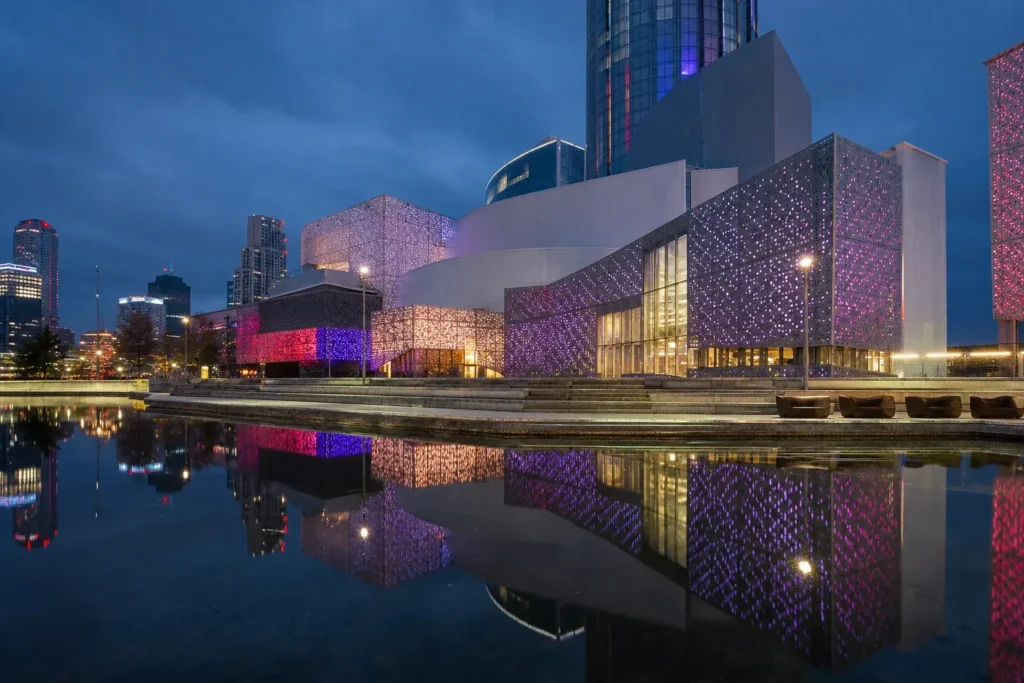
The Yeltsin Center (often called the Boris Yeltsin Presidential Center) is a landmark public, cultural, and educational complex in Yekaterinburg on Boris Yeltsin Street. Opened in 2015, it quickly became one of the most modern and multifunctional venues not only in the city but in all of Russia.
It is designed as a social-political institution, encouraging the growth of a democratic country and exploring how the presidential institution evolved in Russia. The center is dedicated to the first president of the Russian Federation, who was born in the region.
Quick Facts
| Russian name | Президентский центр Бориса Ельцина |
|---|---|
| Built / opened | 2015 |
| Architect(s) | Boris Bernaskoni |
| Address | 3 Ulitsa Borisa Yeltsina, Yekaterinburg Google MapsApple MapsYandex Maps2GISOpenStreetMap |
| District | Verkh-Isetsky |
| Metro | Ploshchad 1905 Goda (Red Line, 10–12 min walk south along Boris Yeltsin Street toward the river) |
| Opening hours | Building: Daily 10:00-22:00 Museum and gallery: Tue-Sun 10:00-21:00; Mon closed Ticket office closes at 20:30 |
| Admission | Building entry free; museum and gallery admission ₽₽ |
| Best time to visit | The museum opens year-round Tue–Sun (Mon closed). Visit on weekday mornings (Tue–Fri, 10:00–12:00) for the smallest crowds and most peaceful experience. Saturdays and Sundays are busier, especially 14:00–18:00. Late afternoon (after 18:00) tends to be quieter again. Evening light is best for photographing the illuminated exterior facade. Winter offers fewer international tourists; spring and early summer bring school groups and families. |
| Recommended duration | 2–3 hours for the main museum; 4–5 hours to see the full complex |
| Website | yeltsin.ru |
What Is (and Isn't) Part of a Visit to Yeltsin Center, Yekaterinburg?
| Part | Status | Notes |
|---|---|---|
| Boris Yeltsin Museum (main permanent exhibition) | Included in the standard ticket | The core attraction; requires paid admission; located on ground and upper floors. |
| Contemporary Art Gallery | Included in the standard ticket | Rotating exhibitions by various curators; included with combined ticket or available separately. |
| Piotrovsky Bookstore | Included in the standard ticket | Independent bookstore and educational center; free to browse; no museum ticket required. |
| Building access and lobby areas | Included in the standard ticket | Open daily 10:00–22:00; free entry to circulate through public spaces, cafés, and shops. |
| Cinema and theater | Separate ticket or institution | Tickets purchased separately; check website for current programming. |
| Educational center and children's programs | Separate ticket or institution | Some programs require advance registration; inquiry at the information desk or website. |
| Archive and research library | Not open to visitors | Accessible by appointment to researchers; not available for general walk-in visitors. |
| Monument to Boris Yeltsin | Outside / not part of it | Located near the center on Boris Yeltsin Street; separate 10-meter obelisk sculpture, not part of the complex. |
Why Visit Yeltsin Center, Yekaterinburg?
The main object is Boris Yeltsin’s Museum, dedicated to the contemporary political history of Russia and its first president. Through nine halls with authentic documents, videos and installations, you trace Yeltsin’s life and, along the way, get to grips with the turbulent 1990s and the end of the USSR.
Within the complex are a museum, an art gallery, a cinema, a library, an educational center, and many other spaces for leisure and enlightenment. The location on the embankment of the City Pond makes it accessible from any part of the city, and many tourists combine a visit with a walk through the nearby Historical Square and the famous Plotinka, which is only a 15-minute walk away.
How Yeltsin Center, Yekaterinburg Is Laid Out
The building was designed by the Bernaskoni bureau with a futuristic design: its central part resembles a giant amphitheater, and the facades are made of perforated metal that transforms into a massive media screen after dark.
The complex is organized around the main Boris Yeltsin Museum on the ground floor and upper levels. Within the building are a museum, an art gallery, a cinema, a library, an educational center, and many other spaces for leisure. The building opens to public circulation from 10:00 to 22:00 daily, but exhibitions themselves operate on a separate schedule. The building features a 24-hour underground parking garage.
Highlights of Yeltsin Center, Yekaterinburg
Boris Yeltsin Museum
The museum and archive contain more than 30,000 exhibits and over 130,000 photographs, serving to store, research and give meaning to the historic legacy of Yeltsin in the context of political and social events of the 1990s. Nine halls feature authentic documents, videos and installations that trace Yeltsin's life and the turbulent 1990s and the end of the USSR. The exhibition uses interactive technology to immerse visitors in the era.
Tip: Plan 2–3 hours minimum for the main exhibition; themed tours are available by advance booking through the official website.
Freedom Hall
A memorable space where videos about freedom are played, and visitors can record their own opinions to be included in the playlist. This interactive feature reflects the center's focus on democratic values and personal expression.
Tip: The hall offers a unique opportunity for visitor participation; consider what you'd like to express before entering.
1990s Immersive Experience
The exhibition uses an innovative approach to present material, immersing visitors in the atmosphere of the 1990s. Interactive installations recreate the period in vivid detail, making abstract historical events tangible and personal.
Tip: This is not a traditional chronological museum; allow time to explore the atmosphere and interact with installations rather than rushing through.
Contemporary Art Gallery
The Art Gallery engages the broader public in a dialogue on Ural, Russian, and international art of the 20th and 21st centuries, with exhibitions produced by the center's curators and invited curators, as well as festivals and events for children and people with disabilities. Exhibition programs rotate regularly.
Tip: Check the website before visiting to see current exhibitions, as programming changes throughout the year.
Architecture and Exterior Light Installation
The facade is made of perforated metal that transforms into a massive media screen after dark, making it not just a building, but a true art object within the urban environment. The exterior lighting creates an ever-changing visual experience.
Tip: Visit after dusk to see the full impact of the facade's LED transformation; the plaza provides a free light show accessible to all.
Piotrovsky Bookstore
The center houses the Piotrovsky Bookstore, an independent bookstore that also functions as an educational center. It offers a curated selection of books about Russian history, politics, and contemporary art, as well as city souvenirs.
Tip: The bookstore is accessible without museum admission; it's a good place to browse or find gifts related to Yeltsin and 1990s Russian culture.
Cinema and Event Spaces
The complex includes a cinema that screens both art films and documentaries, as well as cultural events and concerts. The theatrical platform hosts various performances throughout the year.
Tip: Check the website for current cinema schedules and special events; many performances have limited seating and benefit from advance booking.
Atmosphere
The huge building is crowded with people and dozens of visitors stroll through the hallways of the museum. The atmosphere blends intellectual seriousness with contemporary accessibility—there are no ropes or barriers preventing close interaction with most displays. The 1990s aesthetic, with its chaotic energy and experimental spirit, pervades the design.
Younger visitors and international tourists are especially common; the Yeltsin Center is packed with interactive exhibits and historical context, making it feel more like an experience than a lecture. The building buzzes with activity: conversations in multiple languages, people pausing at video stations, family groups exploring together. Mornings are quieter; weekends and late afternoon tend to be busiest.
History of Yeltsin Center, Yekaterinburg
The history of the Yeltsin Center dates back to the spring of 2009, when the decision was made to establish a presidential center in Yekaterinburg. The location in what is now Yekaterinburg City, a development on the shores of the City Pond, was begun in the 1980s when Boris Yeltsin ran the city and ordered construction of the first skyscraper, jokingly called “the party shaft” by the locals. The symbolic choice of Yekaterinburg was deliberate: Yeltsin was born in the region, and the city was the foundation of his political rise.
The Yeltsin Center was established in accordance with the 2008 law “On centers of historical heritage of presidents of the Russian Federation ceased to carry out its powers” for the preservation, study and public presentation of the heritage of the first President of the Russian Federation “in the context of the recent history of the Fatherland, the development of democratic institutions and the rule of law”.
The center opened in Yekaterinburg on November 25, 2015. The architect of the project is Boris Bernaskoni, the founder of BERNASKONI interdisciplinary bureau that works on intersection of architecture, communication, art and industrial design. Architect Boris Bernaskoni faced a unique challenge: not to create a new structure, but to skillfully integrate a modern complex into the existing construction.
In 2017, the Yeltsin Center was recognized as the best museum in Europe by the Council of Europe, the first of the museums in Russia. This honor reflected the center’s innovative approach to presenting recent political history and its impact on museum practice internationally.
Tickets and Booking for Yeltsin Center, Yekaterinburg
| Ticket | Price | Includes |
|---|---|---|
| Boris Yeltsin Museum only | ₽₽ | Access to all nine permanent exhibition halls; valid Tue–Sun 10:00–21:00 |
| Museum + Contemporary Art Gallery combined | ₽₽ | Access to both the main museum and rotating gallery exhibitions |
| Gallery only | ₽ | Access to the Contemporary Art Gallery; separate from museum admission |
| Children (6–18 years) and student | ₽ | Discounted admission to museum and/or gallery; rates for Russian residents and students differ |
| Guided tour (group or individual) | ₽₽ | Thematic or general guided tour in Russian or English; must be booked in advance |
₽ budget · ₽₽ moderate · ₽₽₽ upscale · ₽₽₽₽ splurge. Price levels are estimates compared with typical prices for visitors.
Purchase museum tickets online through yeltsin.ru or at the on-site ticket office (open Tue–Sun until 20:30). Online booking is strongly recommended, especially for weekend and holiday visits, as dates sell out.
Advance booking: Online sales typically open several weeks ahead. If a date is grayed out, all time slots have sold out; same-day tickets are available at the box office (subject to availability).
Entry by time slot: Tickets are valid for entry within a specific one-hour window. Arrive within your assigned time; entry after the window may not be permitted.
ID and concessions: Discounted tickets for students, pensioners, pilgrims, and other categories require original ID at the box office. Rates for Russian citizens and concessions differ significantly from international adult prices. For all categories and current rates, refer to the official ticket page on yeltsin.ru.
Plan and Book
Suggested itineraries Yeltsin Center, Yekaterinburg
2 hours
Enter at 10:00 (or your assigned time slot). Start with the main exhibition halls on the ground floor, moving through the 1990s timeline. Focus on the Freedom Hall and key video installations. Exit by 12:00 to allow time for cafe or nearby sightseeing. Sufficient for a first-time overview.
3 hours
Begin with the main museum exhibition (ground and first floor); allow time to interact with key interactive installations. Spend 30 minutes in the Contemporary Art Gallery if rotating exhibits interest you. Explore the Piotrovsky Bookstore for 15 minutes. Visit the cafe for refreshment. Covers the core experience thoroughly.
Half-day (4–5 hours)
Complete the main museum, including all nine halls. Spend time in the Contemporary Art Gallery. Browse the Piotrovsky Bookstore. Enjoy a meal in the on-site cafe or restaurant. Explore the public plaza outside. Consider a cinema program in the evening if available. Allows a leisurely, immersive visit.
Full day (7+ hours)
Combine the Yeltsin Center with nearby attractions: start with the museum morning (3 hours), lunch at the cafe, visit the Contemporary Art Gallery and bookstore (1.5 hours), walk to the Plotinka Weir and Historical Square (1 hour walk), explore the embankment area, and return for an evening cinema screening if desired.
How to Get to Yeltsin Center, Yekaterinburg
By metro: The nearest metro station is Ploshchad 1905 Goda on the Red Line. Exit toward the historic center; walk south for 10–12 minutes along Boris Yeltsin Street toward the river. The street is well-marked and descends gently toward the City Pond.
By foot from the center: From Vaynera Street or the historic downtown, the walk is 15–20 minutes. Head toward the Plotinka Weir and follow signs to Boris Yeltsin Street; the building’s distinctive futuristic architecture is visible from several blocks away.
By taxi or ride-share: The address is well-known; any driver will recognize “Yeltsin Center” or “Boris Yeltsin Street, 3.” As one of the city’s most famous landmarks, any driver will easily take you to the entrance.
By car: The building features a 24-hour underground parking garage, which is especially convenient given its location in a busy part of the city. The entrance is clearly marked from Boris Yeltsin Street.
Accessibility
The Contemporary Art Gallery program includes events for people with disabilities. The building features modern facilities including elevator access to all exhibition levels. Accessible restrooms are available. Inquire at the information desk upon arrival about accessible routes or assistance needed. Contact the center in advance at +7 343 312-43-43 or yeltsin.ru for specific accessibility questions.
Food Nearby
The Yeltsin Center itself contains a cafe and restaurant on-site for visitors. The Plotinka Weir area, only a 15-minute walk away, offers several casual dining options and cafes along the embankment. The nearby Historic Square (Ploshchad 1905 Goda) and Vaynera Street have additional restaurants and cafes ranging from budget to upscale options, within 10–20 minutes' walk.
What to Bring
Comfortable walking shoes (there is significant standing and walking through the museum). A light jacket or sweater—museum interiors are climate-controlled but the building circulates cool air. Power bank for phones if you plan a long visit. A notebook if you wish to take notes (photography is permitted but may distract from reading displays). In winter, warm outerwear for the walk between metro and building.
Best Views and Photo Spots of Yeltsin Center, Yekaterinburg
Building exterior at dusk or night
The facades are made of perforated metal that transforms into a massive media screen after dark, creating a dynamic light installation. The plaza provides unobstructed views of the entire facade from multiple angles.
Best time: Evening (18:00–22:00) when the LED light show is most visible; winter evenings offer the darkest sky for contrast.
Building plaza with City Pond backdrop
Capture the full futuristic structure reflected in the water of the City Pond. The embankment and surrounding modernist architecture frame the building well.
Best time: Morning (09:00–11:00) for warm light and fewer crowds; overcast days reduce unwanted reflections.
Boris Yeltsin Street approach
Photograph the building from the north along the street as it comes into view; the street is clean and tree-lined, framing the approach.
Best time: Late afternoon (16:00–18:00) for side-lit building with street life activity.
Interior Freedom Hall
If permitted, capture the visitor interaction with the video screen and the minimalist hall design. The varied human responses create compelling moments.
Best time: Mid-morning (11:00–13:00) when crowds are moderate and lighting is even.
Photography Rules
Photography is generally permitted in the museum and gallery spaces. Tripods, selfie sticks, and flash photography are typically not allowed in exhibition areas. Drones are not permitted in or around the building. Check with staff upon entry if you plan professional or commercial photography; advance permission may be required.
Family Suitability
The Contemporary Art Gallery program includes events for children and young people. The main museum exhibition on the 1990s and Soviet transition is best suited for children age 10 and up who can read and engage with historical context; younger children may find the lengthy text-heavy sections tiring. Interactive installations hold younger children's interest. Stroller access is limited in exhibition areas due to close spacing of displays; families with infants should plan accordingly. The Piotrovsky Bookstore, cafe, and public plaza areas are family-friendly and require no admission.
Russia Vibes Tips
- Book tickets online in advance, even if visiting mid-week. Same-day purchases at the box office are subject to availability, and popular times (weekends, holidays, tour groups) can sell out hours ahead.
- Arrive 10–15 minutes before your assigned ticket time slot to account for entry procedures and orientation. Latecomers may be denied entry if the slot window has closed.
- The exhibition is thematic and experiential rather than strictly chronological; do not expect a traditional timeline. Allow time to sit, watch videos, and absorb the 1990s atmosphere rather than rushing through.
- If you do not read Russian, audio guides or a guided tour in English (book in advance) will greatly enhance understanding. Many detailed wall texts lack English translation.
- Visit the exterior at night to see the full effect of the LED facade transformation; this is a free public spectacle and a major architectural feature often missed by daytime visitors.
- Combine your visit with a walk along the nearby Plotinka Weir and embankment (15 minutes away). The waterfront offers respite from museum fatigue and extends your Yekaterinburg experience affordably.
Explore Nearby Yeltsin Center, Yekaterinburg
Browse more: More in Verkh-Isetsky · All Museums · All Sightseeing · All Sightseeing in Yekaterinburg · All Yekaterinburg
FAQ: Yeltsin Center, Yekaterinburg
Is the building itself free to enter?
Access to the building is free, and you can circulate through public spaces, the bookstore, cafes, and shops without a museum ticket. However, entry to the museum costs an admission fee, and the museum requires a separate ticket to view the permanent exhibitions.
Can I visit the Yeltsin Center on Mondays?
Monday is a day off for both the museum and the gallery. The building itself remains accessible (10:00–22:00) for cafes and the bookstore, but you cannot view the main exhibitions or gallery.
How long should I plan to spend?
For a brief but meaningful introduction to the main exhibition—the Boris Yeltsin Museum—an average of 2–3 hours is required, which is enough time to walk through all the halls, see the key installations, and immerse yourself in the atmosphere of the 1990s. For a leisurely and thorough visit that includes the museum, the gallery, and other spaces, it is better to set aside 4–5 hours or even a full half-day.
Are audio guides available in English?
English audio guides are available. However, they are not mentioned on all sources. Contact the center via yeltsin.ru to confirm availability before your visit and to book if needed.
Can I take photos inside the museum?
Photography is generally permitted in most museum areas. Flash and tripods are typically not allowed in exhibition spaces. Check with staff at the entrance for any temporary restrictions on specific exhibitions.
Is the museum suitable for children?
The museum is best suited for children age 10 and up who can engage with the 1990s history and Soviet transition narrative. Younger children may find the lengthy, text-heavy displays tiring. The center offers special children's programs and events; check the website for current options.
How close is the Yeltsin Center to other attractions?
The Plotinka Weir and Historical Square are only a 15-minute walk away. The metro station Ploshchad 1905 Goda is 10–12 minutes' walk. Vaynera Street (the main historic shopping and dining street) is 10–15 minutes' walk.
Can I buy tickets at the door?
Ticket offices close at 20:30. It is recommended to purchase tickets for the museum and exhibitions in advance, especially if you plan to visit on a weekend or holiday. Same-day tickets are available subject to capacity, but online booking is strongly advised.
Russia Vibes is a one-person project. A coffee keeps it going
How we research and update our guides
About this guide: AI assistance and accuracy
This guide is created with the help of AI and is based on official sources where available. Mistakes can still happen. Opening hours, prices, rules and other details are given to the best of our knowledge as of the date shown and can change without notice. It offers general recommendations only, not professional, legal or travel advice. Please confirm important details with the official source before you travel; you are responsible for your own plans and decisions.

Take this guide with you
Get a free PDF of this guide to print or read offline: key facts, tips and a map link on a few clean pages.
Report an issue on this page
Paying for your trip: please read
International sanctions affect payments between Russia and many other countries. In practice, cards issued in the EU, the UK, the US and several other countries often do not work in Russia, Russian cards usually do not work abroad, and some booking platforms, airlines and payment providers limit or suspend their services for Russia. The situation changes frequently.
We do not give legal or financial advice, and this site does not encourage anyone to break or circumvent sanctions. Whatever you plan, you are responsible for following the laws and regulations that apply to you, including those of your country of residence and citizenship.
Many travelers still organise their stay lawfully. It is worth asking your bank or payment provider what is currently permitted, contacting hotels, tour operators and carriers directly about the payment methods they accept, and checking which services are open to customers from your country. Clarify payment, cancellation and refund terms before you commit to a booking, and keep your plans flexible.
Partner links on this site may not be available in every country, and prices, availability and rules in our guides can differ from what you see when you book.