
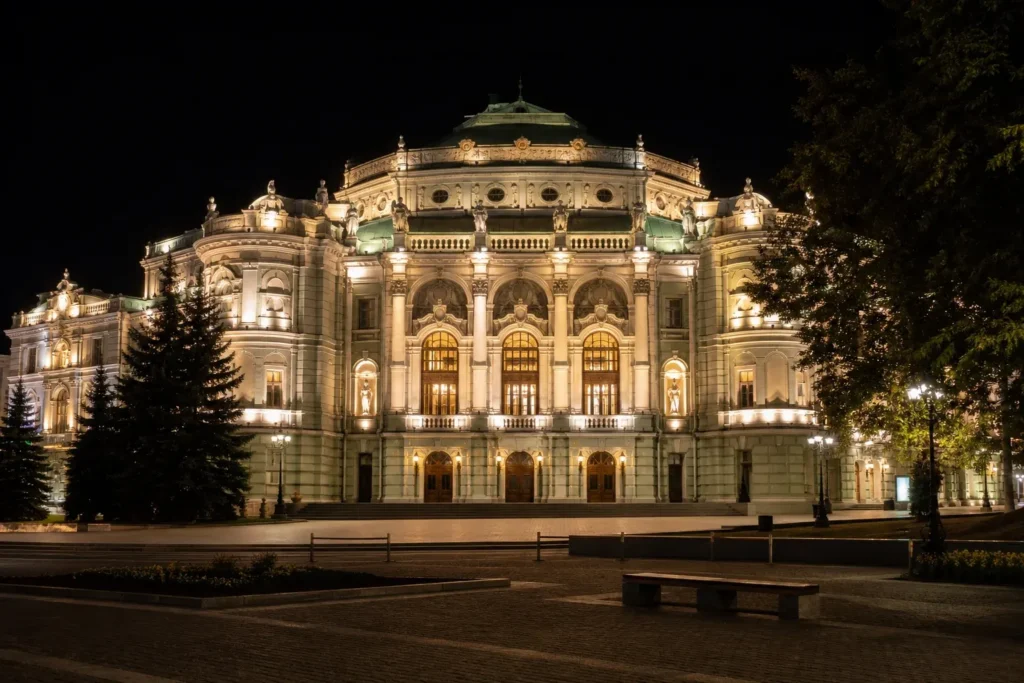
The Yekaterinburg State Academical Opera and Ballet Theatre stands as a landmark of Russian cultural achievement in the Urals. Designed by civil engineer Vladimir Nikolaevich Semenov and opened on September 12, 1912, with Glinka’s “A Life for the Tsar,” the theatre has maintained its position as one of the four principal federal musical theatres in Russia. Its horseshoe-shaped auditorium reflects the architecture of prestigious opera houses in Vienna and Odessa.
The theatre draws on a century of tradition while presenting both classical masterworks and new compositions. Generations of celebrated performers—from Sergei Lemeshev to Galina Gorchakova—launched their careers on its stage. Today it remains active in the international opera and ballet circuit, touring to more than 30 countries annually and participating in Russia’s premier Golden Mask National Theatre Festival.
Quick Facts
| Russian name | Екатеринбургский государственный академический театр оперы и балета |
|---|---|
| Built / opened | 1912 |
| Architect(s) | Vladimir Nikolaevich Semenov |
| Address | 1 Ulitsa Krasnoarmeyskaya, Yekaterinburg Google MapsApple MapsYandex Maps2GISOpenStreetMap |
| District | Oktyabrski |
| Metro | Teatralnaya (Red Line, Main exit leads to Theatre Square) |
| Best time to visit | The theatre operates year-round. The main opera and ballet season typically runs from September through May, with lighter programming during summer months. Performances are scheduled most evenings and occasionally during daytime matinees. Popular productions and galas sell out rapidly, so booking tickets 2–4 weeks in advance is advisable for well-known works.Daytime visits to view the building's exterior and surrounding square are pleasant in any season. Spring and autumn offer comfortable walking temperatures. Winter brings snow and dramatic lighting at night on the illuminated facade. Summer crowds are lighter if you prefer a quieter view of the exterior. |
| Recommended duration | 3–4 hours |
What Is (and Isn't) Part of a Visit to Yekaterinburg State Academical Opera and Ballet Theatre, Yekaterinburg?
| Part | Status | Notes |
|---|---|---|
| Main auditorium performances (opera and ballet) | Included in the standard ticket | Standard ticket includes admission to the main horseshoe-shaped auditorium for the scheduled performance. |
| Foyer and lobby areas | Included in the standard ticket | Ticket holders may arrive early to view the public interior spaces; some foyers contain café facilities. |
| Building exterior and Theatre Square setting | Outside / not part of it | The outside of the building and surrounding square are freely visible at any time; no ticket needed for exterior photographs. |
| Backstage tours or technical tours | Separate ticket or institution | Special guided tours of backstage areas, technical facilities, or costume workshops may require a separate ticket or advance arrangement; verify with the theatre's education office. |
| Drama performances or other theatre companies | Separate ticket or institution | This venue hosts primarily opera and ballet; other theatre genres or touring productions may use different Yekaterinburg venues. |
Why Visit Yekaterinburg State Academical Opera and Ballet Theatre, Yekaterinburg?
The building itself is an architectural treasure: a Baroque structure with classical proportions that sits prominently on Theatre Square. Inside, the intimate auditorium creates an engagement between performer and audience rarely found in larger venues. The theatre presents a carefully curated repertoire of canonical operas and ballets alongside contemporary works, offering a window into how Russia’s major opera and ballet traditions remain vital today.
For international visitors, an evening at this theatre provides both artistic substance and a direct connection to how Russian cultural institutions evolved in the pre-Soviet era. The building’s survival and adaptation across political systems—from imperial times through Soviet collectivism to the present day—makes it emblematic of continuity in Russian arts.
Highlights of Yekaterinburg State Academical Opera and Ballet Theatre, Yekaterinburg
The Auditorium and Horseshoe Design
The theatre's defining feature is its horseshoe-shaped auditorium, a classical design element that optimizes sightlines and acoustics. Completed in 1912 with a capacity of approximately 1,200 seats, the auditorium was considered state-of-the-art for its time. The configuration allows performers and audience members in the balconies and side galleries a direct connection that large arena-style theatres lack. The interior decoration reflects late imperial Russian taste, with ornamental detailing that frames the stage.
Tip: Book a seat in the front rows of the orchestra or a side balcony seat for the best view; avoid upper balconies if your view of the stage matters more than the experience of the space itself.
Facade and Theatre Square Setting
The exterior exemplifies Semenov's eclectic approach, combining Baroque ornamentation with classical proportions. Built in 1910–1912 on the site of a wooden circus (which had stood on Drovyanoy Square since 1896), the stone building's sculptural detailing and symmetrical composition make it an instantly recognizable landmark. The surrounding Theatre Square, now formally Paris Commune Square, provides generous viewing distance. The illumination after dark emphasizes the building's volumetric qualities.
Tip: Visit in early evening to photograph the illuminated facade against the darkening sky, or during daytime to see the sculptural ornament clearly.
Operatic Premieres and Classical Repertoire
The theatre opened with Mikhail Glinka's "A Life for the Tsar," establishing its commitment to Russian opera. Throughout its history it has premiered works by major Russian composers. Today the repertoire balances Russian classics (Tchaikovsky, Rimsky-Korsakov) with European standards (Mozart, Verdi, Wagner, Bizet, Puccini) and occasional contemporary commissions. Performances regularly compete in the Golden Mask National Theatre Festival, Russia's most prestigious theatre award.
Tip: Check the current season schedule before planning your visit, as major works rotate and international touring sometimes affects the local season's availability.
Ballet Companies and Ural School Traditions
The ballet companies perform both classical full-length works and shorter contemporary pieces. The Ural school of ballet carries forward a distinctive interpretive tradition rooted in 20th-century Soviet practice. Famous dancers including Valentina Kitaeva and others shaped the company's style across decades. The theatre's dance repertoire emphasizes dramatic storytelling alongside technical virtuosity.
Tip: If you prefer pure spectacle and recognizable stories, choose classical full-length ballets such as Swan Lake or Giselle; if you want to experience the company's own creative voice, seek out shorter contemporary works when available.
Historical Role and Soviet Transformation
The theatre building witnessed crucial moments in Russian history. On November 8, 1917, in the theatre building itself, an emergency meeting of the Yekaterinburg Council of Workers' and Soldiers' Deputies announced that Soviet power had been established in the city. During the Soviet era it was known as the Lunacharsky Academic Opera and Ballet Theatre. The building's survival and continued operation through Soviet collectivization, World War II, the Cold War, and transition to the market economy reflects the cultural importance placed on high arts in Russian society.
Tip: The historical significance of the location adds layers to a performance; understanding this context enriches appreciation of how the institution adapted across radically different political systems.
Architectural Influences and Semenov's Career
Vladimir Nikolaevich Semenov won an all-Russian competition in 1902 for the theatre design with a project titled "Svetlana." The design drew inspiration from Vienna's State Opera House and Odessa's Opera House, adapting European Baroque tradition to Russian materials and proportions. Semenov later became chief architect of Moscow, making this Yekaterinburg theatre an important early work. The building demonstrates how Russian architects of the early 20th century synthesized European models with local building practices.
Tip: Visitors interested in architecture can ask about guided tours that explain the building's structural systems and decorative programs; such tours are sometimes available through the theatre's education department.
Atmosphere
The theatre’s atmosphere shifts dramatically between day and evening. During the day, the building reads as a solidly monumental Baroque structure of stone and ornament, with the surrounding square providing breathing room and context. The ticket windows and lobby convey the purposefulness of a working cultural institution—functional rather than glamorous.
Once evening arrives and performances begin, the interior transforms. The auditorium’s warmth and intimacy, created by the horseshoe configuration and decorative detailing, contrasts with the scale of larger opera houses. The audience skews toward people of all ages, from families with teenagers to elderly patrons who have attended for decades. An atmosphere of cultural seriousness prevails—this is not entertainment as spectacle alone, but as an activity meaningful to those present. The orchestra tunes, conversation drops, and the historical weight of the building seems to settle as the lights dim.
History of Yekaterinburg State Academical Opera and Ballet Theatre, Yekaterinburg
The origins of opera performance in Yekaterinburg trace to the 1870s, when members of the local intelligentsia founded the Yekaterinburg Musical Circle, officially recognized in 1881. Opera companies began occasional visits in the 1879–1880 season, brought by entrepreneur Pyotr Medvedev. By 1907, opera performances had become annual events, establishing local demand for a permanent venue.
In 1902, the Yekaterinburg City Duma launched an all-Russian architectural competition to design a building dedicated exclusively to opera. Vladimir Nikolaevich Semenov, a young civil engineer from Pyatigorsk, won with his project titled “Svetlana,” created with architect Konstantin Babykin. The design synthesized the Vienna State Opera House and Odessa Opera House models while adapting them to Russian conditions. Construction began in 1910 on Drovyanoy Square (now Paris Commune Square), on the site of a wooden circus that had stood there since 1896.
The theatre opened on September 12, 1912, with a gala performance of Mikhail Glinka’s “A Life for the Tsar,” the first major Russian opera. The building featured a horseshoe-shaped auditorium seating approximately 1,200, representing contemporary best practice in acoustics and sightlines. The construction cost and technical sophistication made it a point of civic pride in the Urals.
During the Russian Revolution’s chaos, the building witnessed a pivotal moment: on November 8 (October 26 by the old calendar), 1917, an emergency meeting of the Yekaterinburg Council of Workers’ and Soldiers’ Deputies announced in the theatre that Soviet power had been established in the city. This historical meeting underscores how even revolutionary upheaval recognized the theatre as a civic institution of sufficient importance to host such declarations.
Under Soviet rule, the theatre became the Lunacharsky Academic Opera and Ballet Theatre, named after Anatoly Lunacharsky, the early Soviet Commissar of Enlightenment. The company developed a distinctive Ural school of ballet and opera performance, and throughout the Soviet period famous singers and dancers either started their careers here or performed during tours. The theatre received the Order of the Red Banner of Labour, a major Soviet state honour. It survived World War II and the Cold War, remaining active despite resource constraints and ideological pressures.
In 2018, the theatre underwent rebranding and acquired the name Ural Opera Ballet, reflecting its contemporary identity as one of Russia’s four principal federal opera and ballet theatres. The building itself underwent restoration work in recent decades, maintaining its architectural integrity while upgrading systems. Today it maintains an international touring schedule while hosting a full season of performances in Yekaterinburg, participating annually in the Golden Mask National Theatre Festival—Russia’s premier theatre awards competition.
Legends and Myths about Yekaterinburg State Academical Opera and Ballet Theatre, Yekaterinburg
Semenov's "Svetlana" and the Winning Design
Disputed by historians. Legend holds that when Vladimir Semenov submitted his competition entry titled "Svetlana" in 1902, the judges recognized instantly that the young engineer had grasped something essential about how a theatre building should breathe and carry light. The name itself—meaning "luminous" or "radiant"—was said to capture Semenov's philosophy that a theatre should seem to emit rather than merely reflect light. Visitors often describe the building's nighttime illumination as appearing almost weightless, and local tradition attributes this ethereal quality to Semenov's deliberate design intention embedded in the winning project.
The Revolutionary Announcement and Fate
Legend – historically unreliable. Soviet-era accounts emphasized that on November 8, 1917, when the Yekaterinburg Council announced the establishment of Soviet power in the city from within the theatre building itself, this proved that culture would remain central to the new socialist state. The theatre's subsequent survival and flourishing under Soviet rule—despite the closure and repurposing of many religious buildings and aristocratic estates—was presented as evidence of the Bolsheviks' commitment to high culture. Some accounts suggest that this historical association protected the building from destruction during periods of institutional upheaval.
Tickets and Booking for Yekaterinburg State Academical Opera and Ballet Theatre, Yekaterinburg
Ticket information and online booking are available through the theatre’s official website and partner ticket platforms. International visitors should note that prices and ticket categories differ for Russian citizens and concession holders (students, pensioners, etc.). Online sales typically open well in advance of each season, with popular performances selling out weeks ahead. If a performance date does not appear in the booking system, it may not yet be on sale or may be fully booked. Same-day tickets may occasionally be available at the box office, depending on cancellations and house capacity. Voucher exchange and ID requirements vary; consult the official ticket page for current procedures and all ticket categories.
Plan and Book
Suggested itineraries Yekaterinburg State Academical Opera and Ballet Theatre, Yekaterinburg
Evening performance (3–4 hours including pre-show)
Arrive 30–45 minutes before curtain to view the auditorium, consult the program, and settle. Enjoy the full performance (typically 2–2.5 hours with one or two intermissions). Allow time afterward to exit and absorb the experience. For a complete evening, include a pre-theatre dinner at a nearby restaurant or a walk around Theatre Square.
Daytime visit (1–2 hours)
Spend 30 minutes examining the theatre's exterior, facade details, and the surrounding Theatre Square. Enter the lobby if open to view interior spaces and consult the season schedule. Visit nearby attractions such as the Yekaterinburg Museum or walk along adjacent streets. Return in the evening if a performance is scheduled, or plan for another visit.
Architecture and history focus (2 hours)
Study the building's Baroque facade, sculptural details, and proportions from multiple angles around Theatre Square. If available, book a guided architectural or historical tour (contact the theatre's education department). Read plaques and historical markers. Conclude by viewing the interior foyer if a performance is not scheduled.
How to Get to Yekaterinburg State Academical Opera and Ballet Theatre, Yekaterinburg
By metro: The nearest station is Teatralnaya (Red Line). Exit and follow signs toward Theatre Square. The station is approximately 5 minutes’ walk from the theatre’s main entrance. The walk descends slightly from the station and passes through a plaza area before reaching the theatre building.
On foot: Theatre Square is centrally located in Yekaterinburg’s cultural district. If walking from the city center (Sverdlov Square area), allow 10–15 minutes. The building is prominently sited and easily identified by its Baroque silhouette and surrounding open space.
By bus or taxi: Public buses serve Theatre Square and adjacent streets. Taxis and ride-share apps can deliver you to the front of the building. Address for navigation: Yekaterinburg, улица Красноармейская (Krasnoarmeyskaya Street).
Accessibility
Accessibility information specific to wheelchair access, companion requirements, lifts, and seating accommodations should be verified directly with the theatre before purchase. Soviet-era theatre buildings typically have limited accessibility on some levels; the theatre's renovation history may have addressed some barriers. Contact the ticket office or official website to discuss specific mobility needs and available options.
Food Nearby
Theatre Square and surrounding streets in central Yekaterinburg contain numerous restaurants and cafés suitable for pre- or post-performance meals. Options range from casual cafés and pizzerias to established restaurants serving Russian, European, and international cuisine. The immediate area around the theatre itself has limited dining; plan your meal at a restaurant within 5–10 minutes' walk on adjacent streets. Some visitors dine before performances and explore the square afterward to avoid crowds.
What to Bring
Bring a program or ticket confirmation on your phone to have documentation ready. Formal or smart-casual dress is customary for evening performances, though not strictly required. A light wrap or shawl can be useful as interior temperatures vary. Phone should be silenced during performances. The theatre likely has coat check facilities; carry valuables with you rather than leaving them unattended.
Best Views and Photo Spots of Yekaterinburg State Academical Opera and Ballet Theatre, Yekaterinburg
Theatre Square direct view
Face the main facade from the centre of Theatre Square. The symmetrical Baroque composition, sculptural detailing, and proportioned stone walls form a cohesive image. The surrounding open space allows you to capture the full height and breadth of the building without obstruction. Seasonal plantings in the square's garden areas frame the base.
Best time: Late afternoon and early evening for warm light; night hours when the facade is illuminated (October–April)
Facade corner detail
Stand at the theatre's corner (northeast or northwest) to capture the sculptural ornament, window arcading, and cornice detailing in angled light. The three-dimensional relief becomes visible and photogenic from oblique angles rather than direct frontality.
Best time: Mid-morning for northeastern corner; mid-afternoon for northwestern corner; focus on clear sky days
Teatralnaya metro exit approach
Photograph the building as it comes into view while ascending the metro station stairs or emerging from the station. The theatrical framing created by the urban context shows how the building occupies its civic setting. The converging perspective of the square's approach dramatizes the structure.
Best time: Any time of day; evening hours add ambient urban light and the illuminated facade
Nighttime illuminated facade
After dark, the strategic lighting highlights the building's volumetric form and architectural articulation. The interplay of light and shadow creates an ethereal effect that complements the Baroque sensibility. The surrounding darkness isolates the building visually.
Best time: Dusk and night, October–April when darkness falls early; ideally 30 minutes after sunset or any time after full darkness
Photography Rules
Photography policies vary by performance and programme. Typically, interior photography during performances is prohibited. Flash is always restricted. Exterior photography of the building facade and Theatre Square is generally permitted. Clarify photography rules before the show begins or with staff upon arrival.
Family Suitability
The theatre welcomes families with children, though suitability depends on the child's age and temperament. Ballet performances, especially well-known classics like Swan Lake or The Nutcracker, appeal to children aged 8 and up who can sit quietly for 2–2.5 hours. Opera performances may be less engaging for younger children unless the story is simple and the music familiar. Children under 12 sometimes become restless during longer or less conventional works. Stroller access depends on the foyer and aisle widths; collapsible strollers may be checked. The theatre does not typically offer child-specific seating or programs. Arrive early to allow children time to acclimate to the space. Some performances include shorter children's matinees; inquire when booking.
Russia Vibes Tips
- Book at least 2–3 weeks in advance for popular works and evening performances. The theatre's loyal local audience and touring productions from other Russian cities mean that seats for well-known ballets and operas sell quickly. Last-minute cancellations do happen, so a same-day visit to the box office may yield tickets if you are flexible.
- Choose performances carefully if you are unfamiliar with Russian opera and ballet traditions. Seek out works you know well on your first visit—Swan Lake, Sleeping Beauty, or popular operas by Verdi or Mozart—rather than avant-garde or lesser-known pieces. This allows you to focus on the experience of the space and the company's interpretive style rather than struggling with unfamiliar narratives.
- Arrive 20–30 minutes early to explore the foyer and read the program notes. The auditorium's intimacy means performances begin promptly; latecomers may not be seated until an intermission. The pre-show period allows your eyes and ears to adjust to the interior acoustics and lighting.
- Use the intermission strategically. Do not leave the building; the foyer area offers facilities and allows you to absorb the experience incrementally. The second and final acts of many classical works contain climactic moments; staying focused through intermissions pays off.
- Photograph the exterior thoroughly in daylight before or after your performance visit. Once inside for an evening show, you will not exit until well after dark, and the exterior photography opportunities will have passed. Plan your photo session separately from your performance visit if you want both.
- The theatre's location on Theatre Square means the surrounding area is calm and cultural rather than commercial. Restaurants and cafés nearby tend to be quieter than those in busier commercial districts. Use this to your advantage by dining nearby in a less rushed atmosphere than you might find elsewhere in central Yekaterinburg.
Explore Nearby Yekaterinburg State Academical Opera and Ballet Theatre, Yekaterinburg
Browse more: More in Oktyabrski · All Entertainment · All Sightseeing · All Sightseeing in Yekaterinburg · All Yekaterinburg
FAQ: Yekaterinburg State Academical Opera and Ballet Theatre, Yekaterinburg
Is the Yekaterinburg Opera and Ballet Theatre the same as the Ural Opera Ballet?
Yes. In 2018, the theatre rebranded itself as Ural Opera Ballet, but it remains the same institution located on Theatre Square. The official legal name is still the Yekaterinburg State Academical Opera and Ballet Theatre. The rebranding reflected a contemporary repositioning rather than a move or change in function.
How long should I plan for an evening performance?
Plan 3–4 hours total. Arrive 30–45 minutes before curtain to find your seat and settle. Most performances run 2–2.5 hours including one or two intermissions. Add 15–20 minutes for exit and transition afterward. A meal or walk before or after extends the evening accordingly.
Can I see the interior if I am not attending a performance?
The foyer and lobby areas are typically accessible to ticket holders and may be open during non-performance hours for visitors to view. Contact the theatre directly to confirm whether architectural or guided tours are available for non-ticket holders. Special group tours can sometimes be arranged with advance notice.
What is the difference between opera and ballet performances, and which should I choose?
Opera is sung drama with orchestral accompaniment; ballet is wordless dance. Both are performed here. Choose ballet if you prefer pure movement and spectacle; opera if you enjoy vocal performance and storytelling through music and voice. Well-known classical works (Swan Lake ballet, Verdi operas) are recommended for first-time visitors regardless of preference.
How far in advance should I buy tickets?
For popular performances, buy 2–4 weeks ahead. Less well-known works may have tickets available days or weeks before the performance. Popular ballet performances and famous opera roles often sell out 1–2 months in advance. Check the season schedule online and book as soon as dates are confirmed for what interests you.
Is formal dress required?
No formal dress code is enforced, though smart-casual or formal wear is customary for evening performances. Many attendees wear business clothes, nice casual wear, or evening attire. Comfortable clothes are acceptable if you prefer, though the cultural context leans toward dressed-up occasions.
Can I visit the theatre during daytime to see the building even if I do not attend a performance?
Yes. The building's exterior is always visible in Theatre Square for free. The surrounding plaza is a public gathering space. Entry to interior foyers and the auditorium depends on whether a performance is scheduled and ticket availability. Call ahead if you want to view the interior without attending a show.
What is the seating like, and are some seats better than others?
The auditorium is horseshoe-shaped with orchestra seating and multiple balcony levels. Front orchestra seats and side balcony seats have excellent sightlines. Upper balcony seats are farther from the stage but offer a view of the entire auditorium. The horseshoe design means most seats have decent views. Request your preferred section when booking.
Russia Vibes is a one-person project. A coffee keeps it going
How we research and update our guides
About this guide: AI assistance and accuracy
This guide is created with the help of AI and is based on official sources where available. Mistakes can still happen. Opening hours, prices, rules and other details are given to the best of our knowledge as of the date shown and can change without notice. It offers general recommendations only, not professional, legal or travel advice. Please confirm important details with the official source before you travel; you are responsible for your own plans and decisions.

Take this guide with you
Get a free PDF of this guide to print or read offline: key facts, tips and a map link on a few clean pages.
Report an issue on this page
Paying for your trip: please read
International sanctions affect payments between Russia and many other countries. In practice, cards issued in the EU, the UK, the US and several other countries often do not work in Russia, Russian cards usually do not work abroad, and some booking platforms, airlines and payment providers limit or suspend their services for Russia. The situation changes frequently.
We do not give legal or financial advice, and this site does not encourage anyone to break or circumvent sanctions. Whatever you plan, you are responsible for following the laws and regulations that apply to you, including those of your country of residence and citizenship.
Many travelers still organise their stay lawfully. It is worth asking your bank or payment provider what is currently permitted, contacting hotels, tour operators and carriers directly about the payment methods they accept, and checking which services are open to customers from your country. Clarify payment, cancellation and refund terms before you commit to a booking, and keep your plans flexible.
Partner links on this site may not be available in every country, and prices, availability and rules in our guides can differ from what you see when you book.