
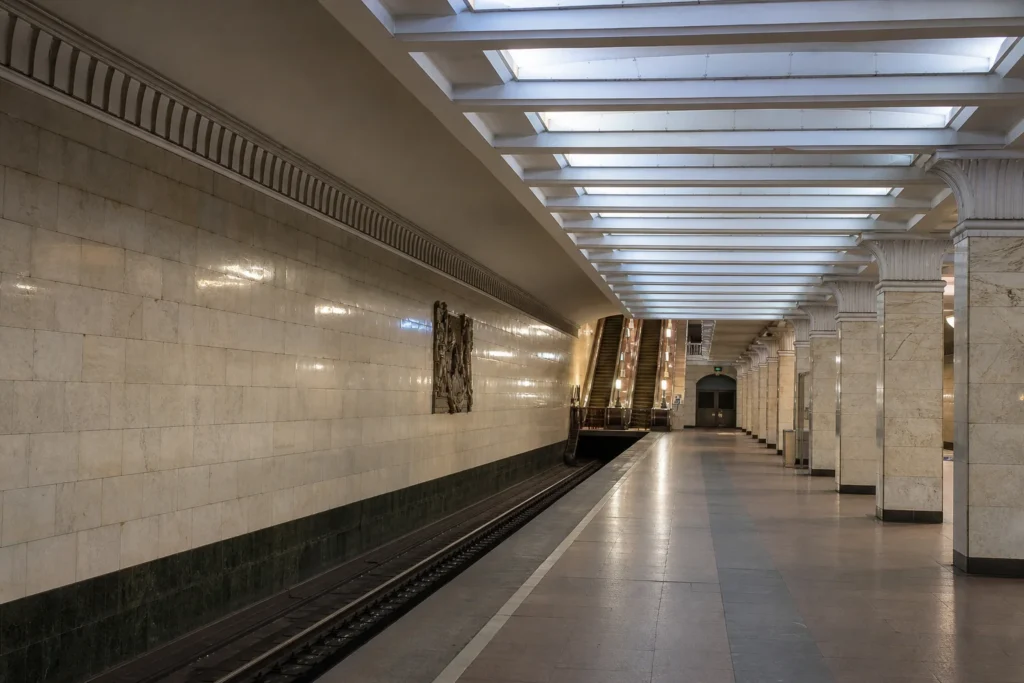
Dinamo metro station sits in the heart of Yekaterinburg‘s central zone, a short walk from the city’s main sporting venues and the river. Dinamo metro is one of two stations that opened in December 1994, three years after the system’s debut, marking the metro’s first significant expansion into the downtown core.
The station connects the industrial north (via Uralskaya toward Prospekt Kosmonavtov) to the historic center (via Ploshchad 1905 Goda). For visitors, it offers quick access to sporting landmarks and is a logical junction for exploring both Soviet-era Yekaterinburg and the contemporary city center.
Quick Facts
| Russian name | Динамо |
|---|---|
| Built / opened | 1994 |
| Address | Yekaterinburg, Sverdlovsk Oblast, Russia OpenStreetMap · Google Maps |
| District | Verkh-Isetsky |
| Interchanges | Dinamo (Line 1, Main lobby exit) |
| Opening hours | Daily 06:00-00:00 |
| Best time to visit | Weekdays outside rush hours (10:00–16:00 and after 20:00) are quieter. Early morning before 07:00 and late evening after 19:00 see lighter crowds. Summer allows pleasant walks to and from the station along the Iset River embankment. Avoid weekday mornings and early evenings if you prefer less congestion. |
Why Visit Dinamo, Yekaterinburg?
Dinamo serves practical purposes for transit rather than sightseeing on its own. Its main value lies as a gateway to nearby attractions: the Dinamo Stadium, an iconic Soviet-era sports complex, and the Palace of Sporting Games (Uralochka), a modern multi-purpose arena on the Iset River’s banks. The station also positions visitors halfway between the working-class industrial north and the commercial and administrative heart around Ploshchad 1905 Goda. If you’re attending an event or need to cross the city quickly, this is an essential transfer point.
Highlights of Dinamo, Yekaterinburg
Dinamo Stadium Nearby
The Dinamo Stadium, located just metres from the station exit, is a constructivist-era sports complex built in 1934 and designed by architect Veniamin Sokolov. The stadium's robust concrete form reflects Soviet sporting ideology and remains in active use for local events. Visitors can see its distinctive architecture from the station plaza; entry to events depends on the program.
Tip: Check local event schedules before visiting; the stadium is not open for casual interior tours unless there is a scheduled match or performance.
Palace of Sporting Games (Uralochka)
Across from the stadium sits the Palace of Sporting Games, opened in 2003 with capacity for 4,281 spectators. It hosts volleyball, basketball and other indoor sports. The modern arena sits on the Iset River's shore and represents post-Soviet investment in Yekaterinburg's sporting infrastructure. Designed by architects Mikhail Motin, Evgeniy Kuranov, and Stjepan Stipaničić, it contrasts sharply with the nearby Soviet-era stadium.
Tip: The Palace is a venue for events only; public access is restricted to ticketed performances and matches. Check the official schedule online.
Iset River Access
The Iset River flows near the station, and riverside paths offer a scenic route connecting Dinamo to other parts of the city center. The embankments are particularly pleasant in summer for walks and photo opportunities. The river marks the historic boundary of Yekaterinburg's central zone.
Tip: Visit the embankment in late spring through early autumn for the best conditions; winter ice makes some paths less accessible.
Connection to Historic Center
Dinamo sits just two stations south of the historic downtown core at Ploshchad 1905 Goda. A two-minute metro ride connects you to the main square, administrative buildings, and shopping areas. The station marks the transition zone between industrial Soviet Yekaterinburg and the reconstructed historic center.
Tip: If exploring on foot, allow 10-15 minutes to walk from Dinamo to Ploshchad 1905 Goda station; the route follows Respubliki Street, a major axis.
Atmosphere
Dinamo station reflects the orderly, functional Soviet metro aesthetic. The underground hall is clean and straightforward, with pale stone finishes and standard Soviet-era lighting. Unlike newer stations with thematic decoration, Dinamo prioritizes utility over spectacle. During rush hours (7–9 a.m. and 5–7 p.m. on weekdays), the platform fills with commuters; otherwise it is quiet and unhurried. Above ground, the station plaza is often bustling with sports fans on event days. The immediate surroundings mix Soviet-era sports facilities with modern commercial activity. The station feels like a genuine working transit node rather than a tourist landmark.
History of Dinamo, Yekaterinburg
Long design phase (1973–1981). Planning for Dinamo began during the Soviet era’s ambitious metro expansion dreams. In 1973, engineers drilled exploratory wells in the area to assess geological conditions, studying whether constructing a metro beneath Yekaterinburg was feasible. Construction formally began in February 1981 with capital mining operations and surface site preparation. By October 1981, shaft sinking was complete—the vertical shaft through which crews would tunnel deeper.
Tunnel construction (1983–1987). Actual tunnel boring commenced in June 1983 on the stretch toward Ploshchad 1905 Goda to the south. By January 1984, tunneling toward Uralskaya station (to the north) was underway. The work proceeded slowly. In July 1987, the first tubing for the escalator tunnel was installed. Late that year, construction crews achieved a breakthrough: after tunneling several hundred metres under an underground pond, builders made a crucial connection between the sections, uniting the left and right running tunnels.
Opening (1994). After a 13-year construction span, Dinamo and Ploshchad 1905 Goda opened simultaneously on December 22, 1994. This marked the metro system’s first major expansion since its debut in April 1991. Nine years of delay reflected the Soviet Union‘s collapse, the loss of central funding, and Yekaterinburg’s adaptation to a post-Soviet economy. The opening finally brought rapid transit to the city center—a symbolic achievement even as economic hardship was still gripping the region.
Later role (1995–present). For many years, Dinamo remained relatively isolated as a transit point. The station had limited surface-level public transport connections for decades. A trolleybus line (No. 4) eventually began serving the station, improving accessibility. The neighboring sports venues—both the historic Dinamo Stadium and the newer Uralochka Palace—gave the station its identifying character. Today it functions as a reliable, straightforward midpoint on the single-line metro system, connecting working-class industrial zones to the commercial center.
Tickets and Booking for Dinamo, Yekaterinburg
Fares and Payment (as of October 2026): Metro rides cost a flat fare per journey. Single tickets are available at station ticket windows; contactless payment cards and mobile payment apps (including Mir cards and some international systems with local partnerships) are accepted at automated gates. Most tourists find it practical to purchase a card or use mobile payment rather than individual paper tickets.
For international visitors: Check whether your home country’s payment card or app works in Russia, as sanctions may affect some systems. ATMs near the station can provide cash if needed. The Yekaterinburg Metro operates daily from 06:00 to midnight. Rush hours (07:00–09:00 and 17:00–19:00 on weekdays) see crowding but trains run frequently (4–5 minute intervals). Visit the official metro website (metro-ektb.ru) for current fare information and accepted payment methods, as these change periodically.
Plan and Book
How to Get to Dinamo, Yekaterinburg
By metro: Dinamo is a stop on Line 1 (the only metro line). Trains arrive every 4–8 minutes depending on time of day. The main exit is a single lobby with escalators leading to street level.
By surface transport: Trolleybus No. 4 serves the Dinamo station area. Taxis and ride-share apps are available throughout Yekaterinburg and can drop you at the station entrance on Respubliki Street or nearby streets.
Walking from nearby stations: Dinamo lies just 5 minutes by foot from Uralskaya station (northbound) and 7 minutes from Ploshchad 1905 Goda (southbound) along Respubliki Street or riverside paths in good weather.
Accessibility
The station has one underground lobby connected to the platform by multiple escalators. Elevator access is not mentioned in official sources; check metro-ektb.ru for current accessibility details. Mobility-impaired visitors should contact the station ahead or check the official website for specific assistance options.
Food Nearby
The station and immediate plaza area do not have restaurants or cafés inside. However, Dinamo's location near the central zone means commercial areas with food options are a 10–15 minute walk south toward Ploshchad 1905 Goda and the downtown core. Vending machines may be present in the station hall.
What to Bring
Standard items for metro travel: a valid ID card or passport (carry it when using public transport), payment card or cash for the fare, and a phone for mobile payment if using digital systems. Bags are subject to standard security screening but are not prohibited. Winter visitors should wear warm clothing; the underground is temperature-controlled but above-ground access points are exposed.
Best Views and Photo Spots of Dinamo, Yekaterinburg
Platform from the south end
The clean, orderly platform with its Soviet-era design and pale stone finishes provides a straightforward metro interior shot. The overhead lighting and simple geometry create an understated, functional aesthetic typical of 1990s Russian metro design.
Best time: Off-peak hours (10:00–16:00 on weekdays) when the platform is less crowded; fluorescent lighting is consistent throughout the day.
Main lobby staircase
The escalator bank leading from the platform to the street-level lobby offers a classic metro architecture shot, with multiple escalators rising in geometric repetition against stone walls.
Best time: Early morning or late evening when crowds are minimal and the space feels open.
Station plaza exterior
The station plaza and surrounding area with views toward the Dinamo Stadium and modern sporting facilities offer context for how the metro integrates into the city's sporting quarter.
Best time: Daylight hours, especially late afternoon light in summer; avoid midday harsh sun in July–August.
Photography Rules
Photography is allowed throughout the station and on platforms. Tripods, professional filming equipment, and drones require prior permission from metro management. Flash photography is not restricted but may disturb other passengers.
Family Suitability
The station is suitable for families with school-age children and older. Escalators are the primary access route; no elevators are confirmed, which may complicate visits with strollers or very young children. The surrounding area (sports venues, river paths) offers limited family attractions on the immediate station site itself, but proximity to the central zone and river embankments makes it a useful transit hub for family outings elsewhere in the city.
Russia Vibes Tips
- Dinamo has historically had minimal surface-level transit connections (only one trolleybus line for many years), so plan your exit route carefully. The metro platform itself is straightforward, but reaching attractions near the stadium may require a short walk or a second transfer.
- The station's name comes from the nearby Dinamo Stadium, an iconic Soviet sporting complex from 1934—knowing this context helps explain why the metro stop sits where it does. Most other city-center metro stations are named after squares or streets, making Dinamo distinctive.
- If attending an event at the Dinamo Stadium or Palace of Sporting Games, arrive on the metro and allow 5–10 minutes for the walk from the station; signage is minimal, so look for crowds moving in the same direction or ask station staff for directions.
- The Iset River embankment to the east of the station offers pleasant walking routes in warmer months, connecting to other parts of downtown. This is less obvious than the main street-level exits and provides an alternative route for exploring the city.
- Unlike central stations such as Ploshchad 1905 Goda, Dinamo does not attract many tourists or have notable interior design features. It is a working commuter station; treat it as such and don't expect themed decoration or tourist facilities.
Explore Nearby Dinamo, Yekaterinburg
Related guides
 Verkh-Isetsky: Soviet Heritage and Local Life in Yekaterinburg
Main image: AI-generated illustration. It may not show the place exactly as it looks.
 Emerald Hotel, Yekaterinburg: Central 3-Star Stay with Free Parking
Main image: AI-generated illustration. It may not show the place exactly as it looks.
 Yeltsin Center: Museum of Modern Russia and 1990s History
Main image: AI-generated illustration. It may not show the place exactly as it looks.
Browse more: More in Verkh-Isetsky · All Metro Stations · All Metro Stations in Yekaterinburg · All Other Hubs · All Yekaterinburg
FAQ: Dinamo, Yekaterinburg
Is Dinamo a tourist destination or just a transit station?
Dinamo is purely a transit hub. The station itself has no attractions inside. Its value for visitors lies in accessing nearby sports venues (Dinamo Stadium, Palace of Sporting Games) and as a connection point between the industrial north and the commercial center via metro. Most tourists use it to transfer lines rather than spend time there.
What is the nearest metro station if I want to explore downtown Yekaterinburg?
Ploshchad 1905 Goda, one stop south on the same line, is the main downtown hub near the central square and shops. From Dinamo, it is a 2-minute metro ride or a 10–15 minute walk south along Respubliki Street. Dinamo itself is more of a midpoint between the working districts and the center.
Can I see the Dinamo Stadium from the metro station?
Yes. The Dinamo Stadium is within metres of the station exit. You can see its distinctive Soviet-era concrete architecture from the plaza. However, entry to the stadium is only for ticketed events; it is not open for casual touring unless a match or performance is scheduled.
What transit options are available near Dinamo station?
The metro itself is the primary transit. Trolleybus No. 4 serves the station area. Taxis and ride-share apps are available throughout the city. Surface-level connectivity has historically been limited compared to other central stations, so plan ahead if using other transport.
How far is Dinamo station from the Yekaterinburg railway station?
Uralskaya metro station is one stop north of Dinamo and is adjacent to the railway station. It takes 1–2 minutes by metro or about 10 minutes on foot from Dinamo to reach the railway station area via Uralskaya.
Is Dinamo station wheelchair accessible?
The station has escalators and appears to have standard metro infrastructure, but specific elevator access is not confirmed in publicly available sources. Contact the metro management or check metro-ektb.ru for current accessibility details before visiting if you require assistance.
What are the operating hours of the metro?
The Yekaterinburg Metro, including Dinamo, operates daily from 06:00 to midnight. Last trains depart around 23:50. Trains run every 4–5 minutes during peak hours (07:00–09:00 and 17:00–19:00 on weekdays) and every 6–8 minutes off-peak.
Can I use an international payment card or mobile app to pay for metro fares?
Most international cards face restrictions in Russia due to sanctions. Contactless payment with local Russian cards (Mir) and some local mobile apps is standard. Visitors should carry cash or check with their bank in advance whether their card will work. The station has ticket windows for cash purchases.
Russia Vibes is a one-person project. A coffee keeps it going
How we research and update our guides
About this guide: AI assistance and accuracy
This guide is created with the help of AI and is based on official sources where available. Mistakes can still happen. Opening hours, prices, rules and other details are given to the best of our knowledge as of the date shown and can change without notice. It offers general recommendations only, not professional, legal or travel advice. Please confirm important details with the official source before you travel; you are responsible for your own plans and decisions.

Take this guide with you
Get a free PDF of this guide to print or read offline: key facts, tips and a map link on a few clean pages.
Report an issue on this page
Paying for your trip: please read
International sanctions affect payments between Russia and many other countries. In practice, cards issued in the EU, the UK, the US and several other countries often do not work in Russia, Russian cards usually do not work abroad, and some booking platforms, airlines and payment providers limit or suspend their services for Russia. The situation changes frequently.
We do not give legal or financial advice, and this site does not encourage anyone to break or circumvent sanctions. Whatever you plan, you are responsible for following the laws and regulations that apply to you, including those of your country of residence and citizenship.
Many travelers still organise their stay lawfully. It is worth asking your bank or payment provider what is currently permitted, contacting hotels, tour operators and carriers directly about the payment methods they accept, and checking which services are open to customers from your country. Clarify payment, cancellation and refund terms before you commit to a booking, and keep your plans flexible.
Partner links on this site may not be available in every country, and prices, availability and rules in our guides can differ from what you see when you book.