
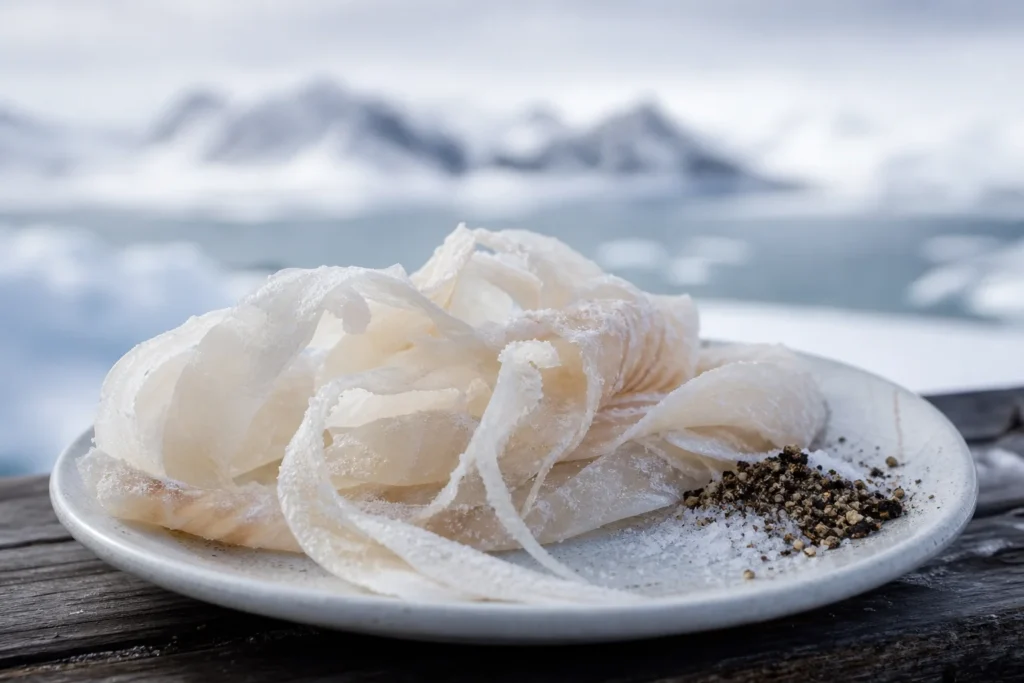
Stroganina is a raw frozen fish dish native to the Russian Arctic, particularly associated with Murmansk and the northern regions. If you are visiting Murmansk or travelling in the far north and want to taste an authentic regional specialty that few outsiders ever encounter, stroganina offers a genuine connection to Arctic traditions.
This guide shows you how to prepare and eat stroganina, what the dish truly tastes like, and the precise technique that keeps it from melting before it reaches your mouth. The recommended way is to serve it immediately on a frozen plate with salt and pepper, paired with vodka.
Quick answer: Slice a piece of frozen Arctic whitefish or salmon paper-thin using a sharp blade, serve it on a chilled plate with salt and pepper, and eat it immediately while still frozen. The entire preparation takes 15–20 minutes once the fish is acquired.
At a Glance
| Type | Dishes |
|---|---|
| Local name | строганина |
| Origin | Stroganina is a dish of the northern Russians and indigenous people of northern Arctic Siberia consisting of raw, thin, long-sliced frozen fish. The origins of stroganina can be traced back to the practice of preserving fish in the extreme cold of the Arctic winter. The freezing temperatures act as a natural preservative, allowing the fish to be stored for extended periods without spoilage. The name of the dish stems from the word strogat, meaning to shave. |
| Servings | 2–4 servings |
| Total time | 15–20 minutes |
| Difficulty | Easy |
History and Story of Stroganina, Murmansk
The history of stroganina can be traced back to ancient times, where it originated in the indigenous Arctic communities of Russia. The dish has its roots in the traditional practices of preserving fish for sustenance during the harsh winter months. This dish is popular with native Siberians, and is present in Yakutian cuisine, Eskimo cuisine, Komi cuisine and Yamal cuisine. Although stroganina originated in Siberia, it is now found across Russia’s Arctic regions, including Murmansk.
Ingredients
- 600–800 g frozen whitefish (muksun, omul, chir or nelma) or salmon, sushi-grade and frozen solid
- Coarse salt, 1–2 teaspoons
- Black pepper, freshly ground, 1 teaspoon
- Sharp knife or Yakutian knife
- Chilled or frozen non-metallic plate
- Cold hands and a work surface that stays cold
How Stroganina, Murmansk Is Made
Step 1: Prepare the frozen fish
Start with a fish that is frozen solid and whose freezing is confirmed to make raw fish safe. Working fast so it never thaws, stand the fish upright, tail up, or brace it firmly, and strip the skin away in sections.
Tip: Keep everything as cold as possible. Work quickly to prevent any thawing.
Step 2: Slice the flesh into thin ribbons
Plane the flesh in long strokes, drawing the blade down the body from tail toward head to peel off thin, curling ribbons. The fish is braced on a wooden balturmas board, which holds it steady and protects both the edge and the table. If you do not have a specialized board, use a chilled cutting board. Use firm, even pressure and let the sharp blade do the work.
Tip: A sharp chef's knife works well, though a meat slicer produces more uniform slices. Practice makes the technique smoother.
Step 3: Arrange on a chilled plate
In order to keep the slices frozen as long as possible, the stroganina is served immediately on non-metallic frozen plates or in ice-cold bowls with the slices arranged loosely so they stay separate and do not re-freeze into clumps.
Tip: Pre-chill your plate in the freezer for at least 30 minutes. Avoid metal plates, which conduct heat too quickly.
Step 4: Season and serve at once
Serve with salt and black pepper powder. Sprinkle the seasonings evenly over the slices just before serving. The frozen fish must not melt until it is inside your mouth. Being served melted stroganina is considered a bit of an insult by the Yakutians.
Tip: Serve immediately after slicing. Even a few minutes at room temperature will begin to thaw the fish.
Variants
- Traditional stroganina is made with freshwater whitefish salmonids found in the Siberian Arctic waters such as nelma, muksun, chir, and omul.
- Stroganina is traditionally made with muksun, a fish not often found outside the Siberian Arctic waters. In Moscow and other 'southern' cities, salmon is often substituted, and it works well.
- Halibut and sea bass are other good alternatives.
- Stroganina is also prepared using foal meat and liver.
- In Kaliningrad it is made with Sarda.
Common Mistakes to Avoid
- Some of the best stroganina is made of freshly caught fish, frozen once. Avoid fish that has been thawed and refrozen, as ice crystals will have damaged the tissue. Check that any commercial fish you buy was frozen only once and kept frozen.
- Do not use warm or room-temperature plates. Metal plates conduct heat rapidly and will thaw the slices before they reach your mouth. Always use a plate that has been chilled or frozen for at least 30 minutes.
- Do not slice the fish in advance and store it. The moment you slice stroganina, it begins to thaw. Slice and serve in quick succession, even if there is a wait for guests.
- Do not confuse stroganina with beef stroganoff, a creamed dish from southern Russia. Stroganina is raw, never cooked, never sauced, and never warm.
- Avoid fish varieties that are too fatty or too soft when frozen. Fatty cuts like salmon ribcage meat will thaw too quickly. Soft fish will tear instead of producing clean, thin slices.
- Do not attempt this with grocery-store refrigerated fish. The fish must be sushi-grade and frozen solid at the point of purchase. If it has been thawed at any stage, it is not safe to eat raw.
How to Order and Eat It
The fish freezes once out of the water, then it is skinned and sliced into strips with a sharp blade, never getting a chance to melt until it is inside your mouth. The frozen flesh has a raspy texture on first bite, but that gives way to a fattier feel once it starts to melt, turning into something like good toro or salmon sashimi. Stroganina is traditionally paired with vodka and comes served on ice, usually accompanied by a combination of salt and pepper. Pick up a slice with your fork or fingers, dip it lightly in salt and pepper if desired, and eat it immediately. The contrast between the icy exterior and the cold melt as it thaws on your tongue is the point of the dish.
To order: Мне подайте строганину, пожалуйста [Mne podayte stroganinung, pozhaluysta]
Russia Vibes Tips
- The best time to eat stroganina in Murmansk is November through February, when Arctic river fish are caught and the outdoor temperatures are reliably cold. In summer months, even indoor freezers may struggle to keep the dish frozen long enough to serve properly.
- If you catch stroganina at a restaurant in Murmansk, ask which fish was used. Muksun or omul is traditional and preferable to farm-raised salmon, which has a less distinctive Arctic flavour. The restaurant should be willing to tell you.
- Do not attempt to recreate stroganina at home unless you have access to sushi-grade frozen fish. Ordinary grocery-store frozen fish is not safe to eat raw. Mail-order seafood suppliers in Russia and neighbouring countries can deliver sushi-grade Arctic fish, but confirm freezing history before ordering.
- Small tasting portions are traditional. Stroganina is served as an appetizer in thin, elegant slices, not as a main course. A plate for four might hold only 100–150 g of finished slices.
- Have all your tools and plates ready before you begin slicing. Once you start, you cannot pause—the entire sequence from skinning to plating should take no more than 10 minutes to prevent thawing.
Explore Nearby Stroganina, Murmansk
Browse more: All Food & Drink · All Food & Drink in Murmansk · All Murmansk · All Other
FAQ
Is stroganina safe to eat raw?
Yes, when made correctly from fish that has been frozen solid at very low temperature. The fish for stroganina is usually caught by ice fishing during the late fall and fresh frozen in order to avoid the formation of ice crystals in the meat. Freezing kills parasites that might be present in raw fish. Ordinary grocery store fish is not safe; sushi-grade frozen fish is required.
What does stroganina taste like?
Muksun is a fatty fish, releasing a kind of freshness which can only be described as Arctic. The frozen flesh has a raspy texture on first bite, but that gives way to a fattier feel once it starts to melt, turning into something like good toro or salmon sashimi. The exact flavour depends on which fish species was used.
Can I make stroganina in a warm climate?
Not practically. The entire dish depends on keeping the fish frozen until it reaches your mouth. Unless you have access to a very deep freezer and will serve it outdoors in cold weather or indoors seconds after slicing, the stroganina will thaw and lose its distinctive texture and appeal.
What is the difference between stroganina and sashimi?
Stroganina is frozen ribbons of fresh-water whitefish. The frozen flesh has a raspy texture on first bite, but that gives way to a fattier feel once it starts to melt, turning into something like good toro or salmon sashimi. The key difference is that stroganina is eaten frozen, while sashimi is served at room temperature or chilled but not frozen.
What do I serve with stroganina?
Stroganina, like caviar, is meant to be consumed with good vodka, as its equal. Unlike the salty pop of the fish eggs, the taste of stroganina isn't sharp enough to interfere with the earthy flavor of a fine vodka. Salt and pepper are the only other accompaniments.
Is stroganina available in restaurants outside Murmansk?
Stroganina appears occasionally in upscale restaurants in Moscow and Saint Petersburg, but it is rare and expensive in those cities because the fish must be air-shipped and the dish cannot be kept long. In Murmansk and Siberian Arctic towns, it is more common and more affordable.
What is the Yakutian knife used for stroganina?
The geometry of the Yakutian knife is best suited to cut long slices that will form ribbon curls. It is a specialized tool with a particular blade geometry designed for slicing frozen fish. A sharp chef's knife works as an alternative, though it requires more technique.
How much stroganina should I buy per person?
Stroganina is served in small portions as an appetizer. In Siberia it is common to serve a large fillet, even if there are just a few guests. When serving this at home, a small portion per person is used.
Russia Vibes is a one-person project. A coffee keeps it going
How we research and update our guides
About this guide: AI assistance and accuracy
This guide is created with the help of AI and is based on official sources where available. Mistakes can still happen. Opening hours, prices, rules and other details are given to the best of our knowledge as of the date shown and can change without notice. It offers general recommendations only, not professional, legal or travel advice. Please confirm important details with the official source before you travel; you are responsible for your own plans and decisions.

Take this guide with you
Get a free PDF of this guide to print or read offline: key facts, tips and a map link on a few clean pages.
Report an issue on this page
Paying for your trip: please read
International sanctions affect payments between Russia and many other countries. In practice, cards issued in the EU, the UK, the US and several other countries often do not work in Russia, Russian cards usually do not work abroad, and some booking platforms, airlines and payment providers limit or suspend their services for Russia. The situation changes frequently.
We do not give legal or financial advice, and this site does not encourage anyone to break or circumvent sanctions. Whatever you plan, you are responsible for following the laws and regulations that apply to you, including those of your country of residence and citizenship.
Many travelers still organise their stay lawfully. It is worth asking your bank or payment provider what is currently permitted, contacting hotels, tour operators and carriers directly about the payment methods they accept, and checking which services are open to customers from your country. Clarify payment, cancellation and refund terms before you commit to a booking, and keep your plans flexible.
Partner links on this site may not be available in every country, and prices, availability and rules in our guides can differ from what you see when you book.