
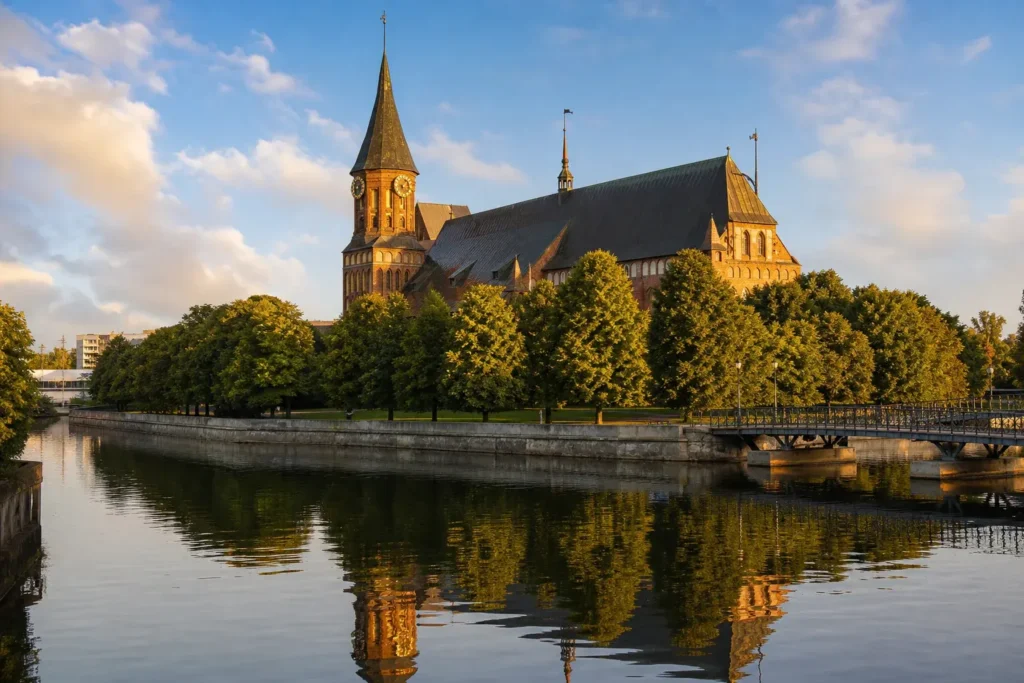
This Kaliningrad travel guide is for first-time visitors who want to understand a city that looks quite different from most of Russia. Kaliningrad lies on the Baltic coast between Poland and Lithuania, and until 1946 it was the German city of Königsberg, so its center mixes Prussian brick, Soviet buildings and modern Russian life.
Most visitors spend two days in the city and add a day or two on the coast. The sights are close to the Pregolya river and Kant Island, and the Curonian Spit is the best-known excursion. Hours, tickets and transport details change, so check the official source for each place before you go.
Quick Facts
| Russian name | Калининград |
|---|---|
| Address | OpenStreetMap · Google Maps |
| Best time to visit | Summer, from June to August, is the warmest time and the best for the beaches and the Curonian Spit, but it is also the busiest. Spring and autumn are quieter and mild, and winter is cold with short days, which suits visitors who plan museums and indoor sights. Check the forecast and the schedules for buses and boats, since services change with the season. |
| Recommended duration | 2 days in the city, plus 1 to 2 days for the coast |
| Last updated | October 13, 2026 |
Why Visit Kaliningrad?
Kaliningrad is a place where several periods are visible at once. Königsberg Cathedral stands on Kant Island, in the middle of the Pregolya river, and the philosopher Immanuel Kant, who lived and worked in Königsberg, is buried beside it. Brick fortifications and gates from the Prussian period survive across the city.
It also suits visitors who like the sea and nature. The Museum of the World Ocean sits on the river, the Amber Museum is in a 19th-century tower, and the Curonian Spit, a UNESCO-listed strip of dunes shared with Lithuania, is within a short bus ride of the city. It makes a good first trip to Russia outside the main cities.
Highlights of Kaliningrad
Königsberg Cathedral and Kant Island
The Gothic cathedral stands on Kant Island, formerly Kneiphof, in the Pregolya river, and it is the symbol of the city. It was founded in 1333, according to a travel source, damaged in the Second World War and largely rebuilt afterward. Inside there are a museum devoted to Kant, which needs its own ticket, and an organ used for concerts. The island is now a calm green park with the cathedral as its main building.
Tip: Check the official site for visiting times and for concert dates, since both change.
Immanuel Kant's tomb
The tomb of the philosopher Immanuel Kant lies beside the cathedral, at its northeast corner, and it can be seen from outside without a ticket, according to travel sources. Kant was born in Königsberg and spent his life in the city. The tomb is a short stop that fits easily into a walk around the island.
Tip: Look for the colonnade around the grave, which is a later addition.
The Fish Village
A riverside complex on the Pregolya, built in the old Königsberg style in 2005 and 2006, according to travel sources, when the city marked its 750th anniversary. Its houses hold cafes, restaurants, shops and a hotel, and the quay gives a view of the cathedral. It is a recreation of old buildings, not original ones, but it is pleasant for a walk and a meal.
Tip: Come in the evening, when the buildings are lit and the riverside is busy.
The Museum of the World Ocean
A museum complex along the Pregolya, with exhibitions on the sea, maritime history and oceanography, and with museum ships moored on the quay, including a research vessel and a submarine, according to travel sources. It also has other buildings, such as Morskoy Königsberg, which covers the city's port history. It suits families and anyone interested in ships.
Tip: Check the official site for opening days, since the museum is closed on Mondays, according to a travel source.
The Amber Museum in the Dohna Tower
The museum is housed in the Dohna Tower, a brick fortification of the 19th century surrounded by water, beside the Upper Pond. It is devoted to amber, the fossil resin that the region is known for, and shows raw pieces and finished objects. It opened in 1979, according to a travel source, and the setting is as much a draw as the collection.
Tip: Combine it with a walk around the pond and the nearby gates.
The Prussian gates and fortifications
Several old gates of Königsberg's defensive ring survive across the city, built in brick, and some of them now house small museums or exhibitions. Examples include the Friedland Gate, with a museum, and the Königsberg Gate. They show the Prussian side of the city away from the river and give good reasons to walk through the quieter streets.
Tip: Plan them as a walk, and check which gates are open as museums.
The Curonian Spit
A narrow sandy peninsula of about 98 km that separates the Curonian Lagoon from the Baltic Sea and is shared with Lithuania, according to travel sources. It is a UNESCO World Heritage site, known for its high dunes, pine forests and beaches. It starts at Zelenogradsk, about a 40-minute bus ride from Kaliningrad, according to a travel source, and needs a day trip of its own.
Tip: Check the national park's entry rules and the transport times in advance.
Atmosphere
Kaliningrad feels quiet and spread out. The center runs along the Pregolya, with red brick fortifications, green parks and long avenues, and Soviet-era blocks stand beside older gates and new waterfront buildings. The sky is wide and the air carries the Baltic.
The pace is relaxed. In summer the riverside and the Fish Village fill with walkers and the coast draws crowds, while in winter the city is quieter and the days are short. The mix of German-era buildings and Russian everyday life is what many visitors notice first.
History of Kaliningrad
The city grew from a castle that the Teutonic Order built beside the Pregolya river in 1255, according to a general source, and it was named Königsberg. The cathedral, begun in 1333, became the main church of the island district of Kneiphof.
In the following centuries Königsberg developed as a Baltic trading city and a cultural center. It became the capital of the Duchy of Prussia and later a coronation city of Prussian kings. The philosopher Immanuel Kant was born in Königsberg in 1724 and lived and taught there for his whole life.
The city was also known for its amber workshops and its university, founded in the 16th century, and it kept its importance as a port into the 19th and early 20th centuries, when fortifications, gates and new districts were built.
During the Second World War the city was heavily damaged, notably in the bombardment of August 1944 and in the fighting in early 1945, according to general sources. The cathedral was among the buildings that were left in ruins, and the Kneiphof district was largely destroyed.
After the war the area became part of the Soviet Union, and in 1946 the city was renamed Kaliningrad, after the Soviet head of state Mikhail Kalinin. The population changed and new Soviet districts were built, while many surviving German buildings were kept or adapted.
The cathedral was rebuilt in the following decades, and the island, where Kant’s tomb stands, became a park. After the end of the Soviet Union, Kaliningrad became a Russian exclave on the Baltic, separated from the rest of the country by neighboring states.
In the 2000s the city restored parts of its historic center. The Fish Village was built in 2005 and 2006, around the 750th anniversary of the city, in the style of old Königsberg, and several gates, forts and towers were converted into museums. Today Kaliningrad is the administrative center of Kaliningrad Oblast and a destination for visitors interested in its Prussian heritage, amber and the Baltic coast.
The dates and details above come from general sources and should be checked against official museum and city sources.
Tickets and Booking for Kaliningrad
Entry rules. Entry and transit rules depend on your nationality and your route, and they can change. Check the official website of the Russian Ministry of Foreign Affairs and the rules of any country you cross on the way, as of October 2026.
Arriving by air. The main airport is Khrabrovo (KGD), about 22 km from the center, according to a travel source, with flights from Moscow and other Russian cities. A bus or a taxi is the usual way into town, but routes and fares change, so check them with the official operators.
Arriving by train or road. The city has railway stations and road links, and routes depend on the border and transit rules for your nationality. Check them in advance.
Confirm before you go. Schedules, ticket types and entry conditions for transport and sights depend on the operator and can change. Always confirm times and tickets with the official operator or the official website of each place, and keep your booking confirmations offline.
How to Get to Kaliningrad
Most visitors arrive by air.
- By air: Khrabrovo Airport (KGD) is about 22 km from the center. Flights from Moscow take about two hours; check current schedules with the airlines. A bus and a taxi are the usual ways into town.
- By train or road: the city is linked to the rest of Russia by rail and road, and the routes depend on the transit rules between countries. Check them with the official sources.
- To the Curonian Spit: the coastal town of Zelenogradsk is about 40 minutes from the city by bus, according to a travel source, and the spit starts there.
Check routes, schedules and booking steps with the official operators, and save your hotel address offline in Latin letters and in Russian.
Accessibility
Accessibility differs between sights, and many historic buildings, towers and gates have steps and narrow passages. The cathedral and the Fish Village are largely flat, but check the official website of each place for lifts, ramps and support for visitors with reduced mobility, and plan extra time for trips outside the city.
Food Nearby
The center and the Fish Village have many cafes and restaurants, with Russian dishes, seafood and international cuisine. Menus differ from place to place, so ask staff for local dishes and mention any allergies. Specific venues were not verified here, so check opening hours before you go.
What to Bring
Bring comfortable walking shoes, since the sights are spread along the river and across the center. In summer pack a light jacket and sun protection for the coast, and in winter pack warm layers, a hat and gloves. A portable charger and offline maps are useful, and large bags may need to go in a cloakroom at museums.
Photography Rules
Photography is usually allowed on Kant Island and along the river, but rules differ in museums and in the cathedral, and flash and tripods are often restricted. Check the signs at each entrance and ask staff if you are unsure. Drone rules also apply in cities and near the coast, so check the current regulations with the official source before you use one.
Family Suitability
Kaliningrad suits families who like ships, aquariums and the beach. The Museum of the World Ocean has museum ships and exhibitions that children enjoy, and the Curonian Spit has easy walks. Cobbled paths and steps in some towers and gates can be hard with strollers, so check access at each sight.
Russia Vibes Tips
- Plan your first day around Kant Island, the Fish Village and the Museum of the World Ocean, which are close together along the river.
- Use the second day for the Amber Museum, the gates and one of the old forts, which are spread out in the city.
- Add a coastal day only if you have time, and leave early, since the Curonian Spit takes a while to reach.
- Remember that the Fish Village is a recreation from the 2000s, and look for original Prussian buildings in the quieter districts.
- If you buy amber, buy from a shop that can explain what you are getting, and keep the receipt.
- Check the weather before a Baltic day trip, since wind and rain can change plans quickly.
Explore Nearby Kaliningrad
Browse more: All Cities · All Landmarks
FAQ: Kaliningrad
How many days do I need in Kaliningrad?
Two full days cover the city, including Kant Island, the Fish Village, the Museum of the World Ocean and the Amber Museum, according to a travel source. Add one or two days for the coast and the Curonian Spit.
Do I need a special visa for Kaliningrad?
Entry rules depend on your nationality and your route, and they can change. Check the official website of the Russian Ministry of Foreign Affairs and the transit rules of the countries you cross, and confirm with an embassy.
How do I get to Kaliningrad from Moscow?
Many visitors fly, with a flight of about two hours, to Khrabrovo Airport. Check current schedules with the airlines and the official sources, since routes and conditions change.
Can I see Kant's tomb for free?
Yes, the tomb stands outside the cathedral, at its northeast corner, and can be seen without a ticket, according to travel sources. The Kant museum inside the cathedral needs its own ticket.
Is the Königsberg Cathedral original?
Its origins date to the 14th century, but it was left in ruins after the Second World War and largely rebuilt. The tomb of Kant beside it is a main reason to visit.
How far is the Curonian Spit?
Zelenogradsk, where the spit begins, is about a 40-minute bus ride from the city, according to a travel source. Check the transport and the national park rules before you go.
What should I buy in Kaliningrad?
Amber is the best-known souvenir, as the region is known for it. Buy from a reliable shop or from the Amber Museum area, and keep the receipt and any certificate.
Is Kaliningrad a good first trip outside Moscow?
Many visitors like it for its compact center and its mix of Prussian and Russian heritage. Check the entry and transit rules for your passport well before you book.
Last updated: October 13, 2026. Found an error or something out of date? Report it and we will check and fix it.
About this guide: AI assistance and accuracy
This guide is created with the help of AI and is based on official sources where available. Mistakes can still happen. Opening hours, prices, rules and other details are given to the best of our knowledge as of the date shown and can change without notice. It offers general recommendations only, not professional, legal or travel advice. Please confirm important details with the official source before you travel; you are responsible for your own plans and decisions.
International sanctions affect payments between Russia and many other countries. In practice, cards issued in the EU, the UK, the US and several other countries often do not work in Russia, Russian cards usually do not work abroad, and some booking platforms, airlines and payment providers limit or suspend their services for Russia. The situation changes frequently. We do not give legal or financial advice, and this site does not encourage anyone to break or circumvent sanctions. Whatever you plan, you are responsible for following the laws and regulations that apply to you, including those of your country of residence and citizenship. Many travelers still organise their stay lawfully. It is worth asking your bank or payment provider what is currently permitted, contacting hotels, tour operators and carriers directly about the payment methods they accept, and checking which services are open to customers from your country. Clarify payment, cancellation and refund terms before you commit to a booking, and keep your plans flexible. Partner links on this site may not be available in every country, and prices, availability and rules in our guides can differ from what you see when you book.Paying for your trip: please read
 Ask Masha