
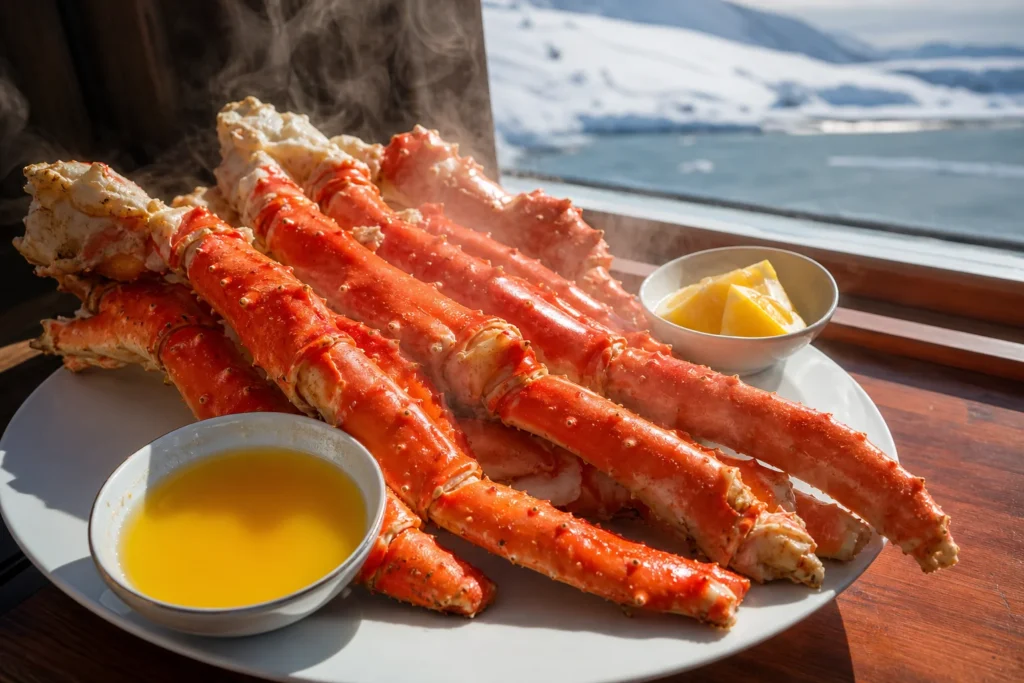
King crab is Murmansk‘s most celebrated seafood, harvested from the cold waters of the Barents Sea. If you want to try king crab in Murmansk, you will find it at restaurants across the city, or you can buy legs at markets and cook them yourself. This guide shows you the simplest method: steaming or baking pre-cooked crab legs and serving them hot with melted butter and lemon.
Most visitors encounter king crab legs that are already cooked and frozen; they need only gentle reheating at home or in a hotel kitchen.
Quick answer: Steam or bake pre-cooked king crab legs for 5–10 minutes until heated through. Serve with melted butter and lemon wedges. Total time: 15–20 minutes. Budget-friendly to moderate cost depending on the market.
At a Glance
| Type | Dishes |
|---|---|
| Local name | Королевский краб |
| Origin | Barents Sea near Murmansk, introduced from the Pacific in the 1960s |
| Servings | 2–4 servings |
| Total time | 15–20 minutes (not including thawing) |
| Difficulty | Easy |
History and Story of King Crab, Murmansk
King crab, also known as red king crab or Kamchatka crab, was deliberately introduced to the Barents Sea near Murmansk by Soviet scientists between 1961 and 1969. Originally native to the cold waters of the Bering Sea and North Pacific, the species thrived in the Arctic conditions and became a major commercial fishery. Crabs are harvested during the autumn and winter months, from August to December, using traditional pots in the Barents Sea. The catch is sold frozen or fresh and has become an iconic symbol of Arctic cuisine in Murmansk.
Ingredients
- 500–750 g pre-cooked king crab legs (thawed overnight in the refrigerator)
- 100 g butter
- 2 lemons
- Salt and pepper
- Water (if steaming)
How King Crab, Murmansk Is Made
Step 1: Thaw the crab overnight
Place frozen crab legs in the refrigerator the night before. If you are short on time, run them under cool running water for 10–15 minutes until thawed. Pat dry with a clean towel. Do not use hot water as it toughens the meat.
Tip: Thawed crab should be used within one day.
Step 2: Prepare for steaming (recommended method)
Fill a large pot with about 5 cm of water and place a steamer basket or rack above the water level. Bring the water to a boil. Arrange the thawed crab legs on the steamer basket in a single layer; they do not need to be fully submerged.
Tip: If steaming is not possible, skip to the baking method below.
Step 3: Steam the crab legs
Cover the pot with a lid and steam for 6–8 minutes until the crab is heated through. The meat should feel warm when you crack open a leg. Do not overcook or the meat becomes tough. You will notice a distinctive crab aroma when ready.
Tip: Pre-cooked crab only needs gentle reheating, not full cooking.
Step 4: Alternatively, bake in the oven
Preheat the oven to 180°C (350°F). Place the thawed crab legs on a baking tray. Add about 1–2 cm of hot water to the bottom of the tray. Cover tightly with foil to keep moisture in. Bake for 8–10 minutes until heated through.
Tip: You can brush a little melted butter on the legs before baking for extra flavour.
Step 5: Melt the butter and season it
While the crab heats, melt 100 g butter in a small pan over low heat. Squeeze the juice of half a lemon into the butter and add a pinch of salt and freshly ground pepper. Keep the butter warm but do not allow it to brown.
Tip: Garlic butter is traditional: add 2–3 cloves of finely minced garlic to the melted butter.
Step 6: Remove and serve immediately
Using tongs or a slotted spoon, carefully transfer the hot crab legs to a serving platter. Pour the warm butter into small bowls for dipping. Cut the remaining lemon into wedges and place them around the plate.
Tip: Have napkins ready—eating crab is a hands-on, juicy affair.
Variants
- Grilled crab legs (brushed with oil, grilled for 5 minutes per side)
- Baked crab legs with garlic butter and herbs
- Steamed crab served with spicy or herb-infused melted butter
- Crab legs in creamy seafood soup
- Cold cooked crab meat in salads
Common Mistakes to Avoid
- Using hot or boiling water to thaw the crab. This cooks the outer meat unevenly and toughens it. Thaw slowly in the refrigerator overnight or under cool running water.
- Overcooking pre-cooked crab. Since the legs are already cooked, you only reheat them for 5–10 minutes. Longer cooking dries out the meat and makes it rubbery.
- Neglecting to pat the thawed crab dry. Excess water makes the meat watery and dilutes the flavour. A dry surface also helps the butter coat the meat better.
- Forgetting that frozen crab from the market is already salty. Do not add extra salt when steaming or cooking; taste first, then add a small pinch if needed.
- Not having melted butter ready. King crab meat is best enjoyed immediately while hot and dipped in warm, fresh butter. Prepare the butter while the crab heats.
- Trying to eat the crab without a tool. Use a small crab fork or even a regular fork to extract meat from the legs. Do not pull hard at the joints; gentle pressure works better.
How to Order and Eat It
Sit at the table with plenty of napkins. Crack the leg shell with your hands or a small mallet—start at the thinner end and work toward the thick joint. Extract the meat with a small fork or by pushing it out with your fingers. Dip each bite in the warm melted butter, squeeze lemon juice over it, and enjoy. The thickest part of the leg, near the body, contains the largest pieces of meat. Work through each leg methodically; do not rush.
To order: Королевский краб [Korolevskiy krab]
Where to Try King Crab, Murmansk
Yekaterinburg
 Troekurov, Yekaterinburg Russian, European
Main image: AI-generated illustration. It may not show the place exactly as it looks.
Russia Vibes Tips
- Buy your king crab at a fish market or supermarket in Murmansk rather than at restaurants if you want to cook it yourself. The crab will be fresher and far cheaper. Markets near the waterfront or in the city centre stock frozen legs year-round.
- Winter (September–December) is the main harvest season when fresh crab is most abundant and prices at restaurants may be more competitive. Summer and early autumn also offer good availability.
- Never cut the legs before cooking. Always cook them whole, then crack and extract the meat at the table. Cutting before cooking allows the juices and flavour to escape.
- If you buy whole crabs (rarely seen in tourist areas), ask the market stall holder to clean and remove the gills and stomach. This saves you a messy step at home.
- King crab legs are large—one leg per person is usually enough. Two or three legs make a generous single portion. A whole crab feeds 4–6 people.
- Do not be alarmed by the strong, distinctive smell while cooking. This 'crab aroma' is a sign the meat is fresh and properly cooked, not spoiled.
Explore Nearby King Crab, Murmansk
Browse more: All Food & Drink · All Food & Drink in Murmansk · All Murmansk · All Other
FAQ
Where do king crabs in Murmansk come from?
King crabs are harvested from the Barents Sea near Murmansk. The species was introduced from the Pacific Ocean in the 1960s by Soviet scientists and now thrives in the cold Arctic waters. The fishery is managed and regulated, and crabs are caught using traditional pots between August and December each year.
Can I buy fresh (not frozen) king crab in Murmansk?
Mostly you will find frozen legs at markets and in restaurant kitchens. Some restaurants may advertise fresh crab in the brief harvest season (August–December), but nearly all crab sold to tourists is pre-cooked and frozen. Thaw overnight in the refrigerator before cooking.
How much crab should I buy per person?
One large leg (about 250–300 g) per person is a typical portion. If you are very hungry or serving it as a single main course, allow two legs. A whole cooked crab feeds 4–6 people as a main course.
Is king crab expensive?
Yes, king crab is a luxury seafood everywhere. In Murmansk, a restaurant serving prepared crab will cost more than ordinary fish dishes, but less than you would pay in Western Europe or North America. Buying raw legs at a fish market is significantly cheaper than ordering cooked crab at a restaurant.
Can I cook king crab in a hotel room?
Yes, if your hotel room has a kettle, small pot and access to a heat source (stove, hotplate or microwave). Steaming or baking works well in most simple kitchens. Boiling requires a large pot and is less practical. Ask your host for cooking equipment before you arrive.
What part of the crab is edible?
The meat in the legs and claws is tender and sweet. Most legs you buy have already been split or halved, making the meat easy to extract. The body cavity contains darker meat and must be cleaned carefully; avoid the gills and digestive organs. If buying whole, ask the market stall to clean it.
How long does thawed crab keep?
Once thawed, use the crab within one day. Do not refreeze thawed legs. If you thaw it and do not cook it immediately, keep it in the refrigerator and use it as soon as possible.
What is the difference between king crab and other crabs?
King crab legs are much larger and meatier than smaller crabs. The meat is sweet and tender. Red king crabs (Kamchatka crabs) are a specific species that lives in the Arctic and are prized for their size—leg span can reach nearly 2 metres. They are among the most valuable commercial crabs in the world.
Russia Vibes is a one-person project. A coffee keeps it going
How we research and update our guides
About this guide: AI assistance and accuracy
This guide is created with the help of AI and is based on official sources where available. Mistakes can still happen. Opening hours, prices, rules and other details are given to the best of our knowledge as of the date shown and can change without notice. It offers general recommendations only, not professional, legal or travel advice. Please confirm important details with the official source before you travel; you are responsible for your own plans and decisions.

Take this guide with you
Get a free PDF of this guide to print or read offline: key facts, tips and a map link on a few clean pages.
Report an issue on this page
Paying for your trip: please read
International sanctions affect payments between Russia and many other countries. In practice, cards issued in the EU, the UK, the US and several other countries often do not work in Russia, Russian cards usually do not work abroad, and some booking platforms, airlines and payment providers limit or suspend their services for Russia. The situation changes frequently.
We do not give legal or financial advice, and this site does not encourage anyone to break or circumvent sanctions. Whatever you plan, you are responsible for following the laws and regulations that apply to you, including those of your country of residence and citizenship.
Many travelers still organise their stay lawfully. It is worth asking your bank or payment provider what is currently permitted, contacting hotels, tour operators and carriers directly about the payment methods they accept, and checking which services are open to customers from your country. Clarify payment, cancellation and refund terms before you commit to a booking, and keep your plans flexible.
Partner links on this site may not be available in every country, and prices, availability and rules in our guides can differ from what you see when you book.