
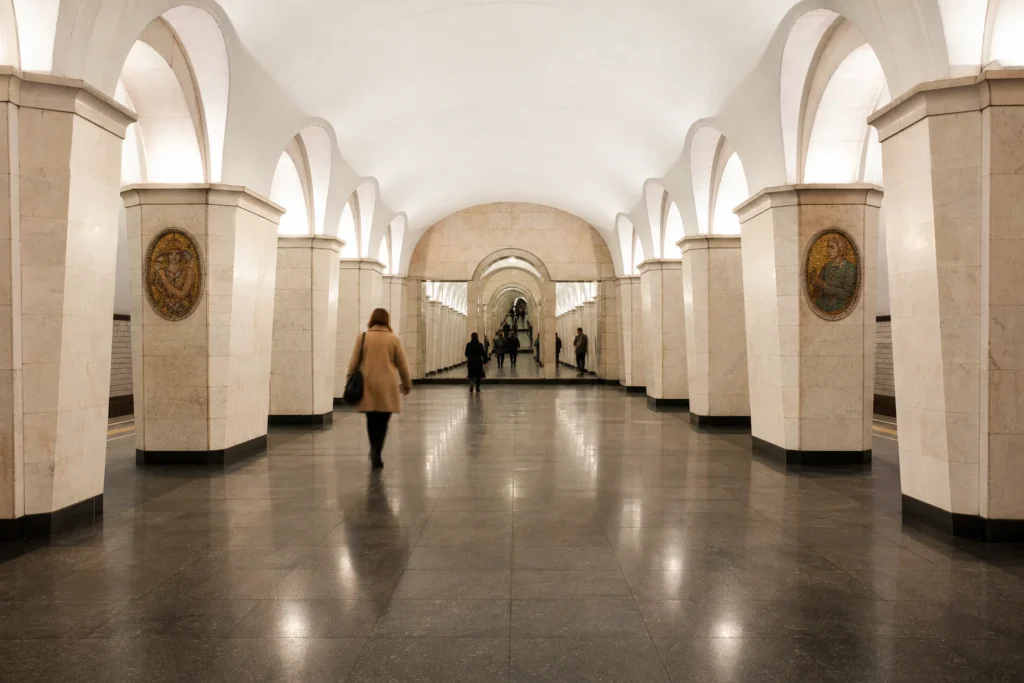
Krestovsky Ostrov Metro Station opened on 3 September 1999 on Line 5 and serves Krestovsky Island in the north of the city. Its pavilion stands at the crossing of Morskoy Prospekt and Ryukhina Street, beside the main entrance to Primorsky Victory Park, and it is the usual metro stop for the park and a long walk to the Gazprom Arena.
It was the first station in the city where the underground hall and the surface pavilion were designed as one thematic whole. Above ground, a transparent cube meets a stone arcade; below, light limestone columns and arches stand against travertine track walls, and a mirror on the end wall makes the hall look longer. It is easy to see in a few minutes on the way to the park.
Quick Facts
| Russian name | Крестовский остров |
|---|---|
| Built / opened | 1999 |
| Architect(s) | E. M. Rapoport and G. A. Vasilyev |
| Address | Санкт-Петербург, Морской проспект / улица Рюхина, у входа в Приморский парк Победы OpenStreetMap · Google Maps |
| District | Petrogradsky District |
| Interchanges | Krestovsky Ostrov (Line 5, the glass-and-stone pavilion at Morskoy Prospekt and Ryukhina Street, by the entrance to Primorsky Victory Park) Staraya Derevnya (Line 5, previous stop towards Komendantsky Prospekt) Chkalovskaya (Line 5, next stop towards Shushary) |
| Opening hours | The metro runs daily from early morning until shortly after midnight, and the station follows the network schedule; hours can change with works on the line (as of October 2026 – check the official site of the Saint Petersburg Metro). |
| Best time to visit | The station is indoors, so it works in any season and in any weather. The park outside is best from late spring to early autumn, and on a dry day. On match days the walk to the stadium is crowded, so leave extra time. |
| Last updated | October 16, 2026 |
Why Visit Krestovsky Ostrov Metro Station, Saint Petersburg?
Krestovsky Ostrov is one of the best-designed stations of the post-Soviet period. The pavilion draws on the stone arcades of the city’s palace-and-park ensembles, and the hall keeps the same light, classical language underground.
It is also a practical stop. The station opens onto Primorsky Victory Park, one of the largest green spaces in the city, and onto the island’s sports and leisure areas. You pay only for a metro ride, and 10 to 15 minutes is enough to see the pavilion and the hall.
Highlights of Krestovsky Ostrov Metro Station, Saint Petersburg
The glass cube and stone arcade
The pavilion stands on a stepped base and consists of two volumes offset from each other at 45 degrees. A transparent cube that holds a view of the park landscape cuts across an open stone arcade, a motif familiar from the palaces and parks of the city.
It was designed by E. M. Rapoport and G. A. Vasilyev and stands at the corner of Morskoy Prospekt and Ryukhina Street.
Tip: Look at it from the pavement on Morskoy Prospekt to see the two volumes and the angle between them.
Pavilion and hall as one design
Krestovsky Ostrov was the first station in the city where the underground part and the surface vestibule were designed as one thematically united and connected whole. The language of arcades and light stone runs from the entrance down to the platform.
This gives the station a coherence that few older stations have.
Tip: Notice how the pavilion's arcade echoes the arches in the hall as you descend.
Limestone and travertine
The columns and arches are finished in light limestone of the type typical of Saint Petersburg, and the track walls are faced with travertine. The combination of the two warm stones gives the hall a calm, classical look.
It is a deep station, about 49 metres below the surface, with an island platform.
Tip: Stand mid-platform to see the limestone arches against the travertine walls.
The mirrored end wall
The end wall of the hall is decorated with mirrors, which was a first in Russia. The mirror visually enlarges the station and makes the arches seem to continue into the distance.
A Roman-numeral date for the opening year, MCMXCIX, is set on the frieze of the pediment at the end of the hall, separated from the arch.
Tip: Walk to the end of the platform to see the mirror and the date on the pediment.
Mosaic medallions of rivers and islands
Each wall that links two columns carries mosaic medallions that show the rivers and islands of the city in allegorical form. They are small, rounded panels set into the stone.
They tie the station to its setting on an island in the delta.
Tip: Look at the medallions one by one as you walk along the platform.
The gateway to Primorsky Victory Park
The pavilion stands by the entrance to Primorsky Victory Park, which covers almost half the island. Next to it is the Divo Ostrov amusement park, and the Gazprom Arena stadium is on the far side of the park.
On foot, the stadium is about a 20 to 25 minute walk through the park.
Tip: Allow time for the walk to the stadium on match days, and use the park paths rather than the road.
Atmosphere
The pavilion is light and open, with glass and stone catching the sky and the trees of the park behind. Inside, the hall is calm and warm, with pale stone, mirror and soft light, and passengers moving unhurriedly.
The station is busy at match time, when fans pour out towards the park, and on summer weekends, when families head for the park and the amusement park. On quiet weekdays it is a calm and uncluttered stop.
History of Krestovsky Ostrov Metro Station, Saint Petersburg
Krestovsky Ostrov opened on 3 September 1999 as part of the Sadovaya to Chkalovskaya section of what was then the Pravoberezhnaya, or orange, line. It should have opened earlier, but the opening was postponed because of delays in building the vestibule. On 7 March 2009 it became part of Line 5, the Frunzensko-Primorskaya, or purple, line, when the line was joined to the section between Dostoevskaya and Spasskaya.
The station is named after the island on which it stands and was designed by the architects E. M. Rapoport and G. A. Vasilyev. For the first time in the city, the underground station and its ground vestibule were designed as one thematically united and architecturally connected whole.
The pavilion stands at Morskoy Prospekt and Ryukhina Street, near the entrance to Primorsky Victory Park. It rises from a stepped base and consists of two volumes turned at 45 degrees to each other: a transparent cube that includes the park landscape, and an open stone arcade of the kind found in the city’s palace-and-park ensembles.
The hall is a column-and-wall station, about 49 metres below the surface. The columns and arches are in light limestone, the track walls in travertine. The end wall is decorated with mirrors, a first in Russia, which visually enlarges the station. The Roman-numeral date of the opening year is set on the frieze of the pediment at the end of the hall, and each wall between two columns carries mosaic medallions with allegorical images of rivers and islands.
The station serves Krestovsky Island, which was developed in the Soviet period as a sports centre. The Kirov Stadium stood there until it was demolished in 2006 and replaced by the Gazprom Arena, and Primorsky Victory Park was laid out on what had been forest at the centre of the island. A second station on the island, Zenit on Line 3, opened in 2018 at the western tip.
Today Krestovsky Ostrov remains a through station on Line 5, between Staraya Derevnya and Chkalovskaya. It is the usual metro stop for the park, the amusement park and, on foot, the stadium.
Tickets and Booking for Krestovsky Ostrov Metro Station, Saint Petersburg
Krestovsky Ostrov needs no ticket of its own: you pay for a ride on the Saint Petersburg Metro. The fare is a flat one regardless of distance (₽).
- Contactless bank card: accepted at turnstiles marked for bank-card payment, but whether a card issued outside Russia works varies, and the sanctions rules of your own country may restrict the use of Russian payment services, so check this yourself before you travel.
- Podorozhnik card: a reusable transport card sold at metro ticket offices, and usually the simplest option for visitors who plan several rides.
Rates for Russian citizens and concession categories differ from the standard fare. The station is busy in the weekday rush and crowded before and after matches at the stadium. The official website of the Saint Petersburg Metro lists current fares, payment methods and categories.
Plan and Book
How to Get to Krestovsky Ostrov Metro Station, Saint Petersburg
By metro: take Line 5 (the purple Frunzensko-Primorskaya line) and get off at Krestovsky Ostrov, between Staraya Derevnya and Chkalovskaya. From the centre, change to Line 5 at Sadovaya, Spasskaya or Sennaya Ploshchad and ride north.
On arrival: the pavilion stands at the junction of Morskoy Prospekt and Ryukhina Street, by the entrance to Primorsky Victory Park.
On foot or by bus: the Gazprom Arena is about 20 to 25 minutes’ walk through the park. Several bus and minibus routes stop outside the station.
Accessibility
Krestovsky Ostrov is a deep station reached by escalators. Whether a lift or other step-free route is available was not verified for this article, so check the accessibility information on the official website of the Saint Petersburg Metro and consider asking staff before you travel.
Food Nearby
There are no verified cafes inside the station. Cafes and snack stands operate around Morskoy Prospekt and the park entrance, and the island has more places to eat in the warm season.
What to Bring
A payment card or a Podorozhnik card, and comfortable shoes for the park paths. In summer, water and sun protection for the long walk to the stadium.
Best Views and Photo Spots of Krestovsky Ostrov Metro Station, Saint Petersburg
Morskoy Prospekt, facing the pavilion
The glass cube and stone arcade turned at an angle, with the park behind.
Best time: Daylight, ideally in clear weather or at dusk when the glass is lit.
End of the platform at the mirror
The mirrored end wall makes the limestone arches seem to continue into the distance.
Best time: Between trains, when the platform is clearer.
A mosaic medallion between two columns
A close-up of a rounded medallion with its allegory of rivers and islands.
Best time: Off-peak, when fewer passengers cross the frame.
Park entrance on Ryukhina Street
The pavilion with the green of Primorsky Victory Park beside it.
Best time: Late spring to early autumn.
Photography Rules
Casual photography on the platform is generally tolerated, but tripods and professional filming typically need permission from the metro. Do not block the escalators or passengers, and avoid photographing staff or other people.
Family Suitability
Good for families, since the park, the amusement park and open space are right outside. The long escalator ride and crowds on match days need care with small children, and strollers should be folded or carried. A visit to the station itself takes only a few minutes.
Russia Vibes Tips
- Look at the pavilion from Morskoy Prospekt; the 45-degree turn of the two volumes is easiest to see from there.
- Check the end wall for the mirror and the Roman-numeral date MCMXCIX on the pediment.
- Use the park paths for the walk to the Gazprom Arena rather than the road; it takes about 20 to 25 minutes.
- On match days leave extra time for the return, as the crowds leave all at once.
- If you only want the stadium and Zenit is open, the Line 3 station is closer, but its hours are limited.
- Combine a visit with a walk in Primorsky Victory Park and, with children, the amusement park next to it.
Explore Nearby Krestovsky Ostrov Metro Station, Saint Petersburg
Metro stations near Krestovsky Ostrov Metro Station, Saint Petersburg
 Zenit Metro Station, Saint Petersburgabout 2.6 km away
Main image: AI-generated illustration. It may not show the place exactly as it looks.
Related guides
 Yelagin Island Pier, Saint Petersburg: Park Landing for Boat Trips
Main image: AI-generated illustration. It may not show the place exactly as it looks.
 Chkalovskaya Metro Station, Saint Petersburg: Aviation Hall
Main image: AI-generated illustration. It may not show the place exactly as it looks.
 Petrogradskaya Metro Station, Saint Petersburg: Closed-Type Hall
Main image: AI-generated illustration. It may not show the place exactly as it looks.
 Sportivnaya Metro Station, Saint Petersburg: Travelator Guide
Main image: AI-generated illustration. It may not show the place exactly as it looks.
 Gorkovskaya Metro Station, Saint Petersburg: Fortress Stop
Main image: AI-generated illustration. It may not show the place exactly as it looks.
Browse more: More in Petrogradsky District · All Metro Stations · All Metro Stations in Saint Petersburg · All Other Hubs · All Saint Petersburg
FAQ: Krestovsky Ostrov Metro Station, Saint Petersburg
Do I need a ticket to see Krestovsky Ostrov station?
You need to pay for a metro ride to enter the platform area. There is no separate sightseeing ticket. See the fares section for payment options.
Why is the pavilion shaped like that?
It combines a transparent cube with a stone arcade, turned at 45 degrees to each other, echoing the arcades of the city's palace and park ensembles. It was designed by E. M. Rapoport and G. A. Vasilyev.
What is special about the end wall?
It is decorated with mirrors, a first in Russia, which visually enlarges the hall. The opening year is shown in Roman numerals on the pediment above.
How do I get to the Gazprom Arena from here?
Walk through Primorsky Victory Park, about 20 to 25 minutes. Zenit station on Line 3 is closer but has limited hours.
How deep is the station?
It is reported at about 49 metres below the surface, so you reach the platform by escalator.
What is near the station?
Primorsky Victory Park, the Divo Ostrov amusement park and, farther on, the Gazprom Arena. See the nearby section for walking options.
How do I get there from the centre?
Change to Line 5 at Sadovaya, Spasskaya or Sennaya Ploshchad and ride north. See the getting there section for details.
Is it worth a special trip?
If you like modern station design or are visiting the park, yes. It is also the usual stop for the stadium on foot.
Russia Vibes is a one-person project. A coffee keeps it going
Last updated: October 16, 2026. Found an error or something out of date? Report it and we will check and fix it.
How we research and update our guides
About this guide: AI assistance and accuracy
This guide is created with the help of AI and is based on official sources where available. Mistakes can still happen. Opening hours, prices, rules and other details are given to the best of our knowledge as of the date shown and can change without notice. It offers general recommendations only, not professional, legal or travel advice. Please confirm important details with the official source before you travel; you are responsible for your own plans and decisions.
International sanctions affect payments between Russia and many other countries. In practice, cards issued in the EU, the UK, the US and several other countries often do not work in Russia, Russian cards usually do not work abroad, and some booking platforms, airlines and payment providers limit or suspend their services for Russia. The situation changes frequently. We do not give legal or financial advice, and this site does not encourage anyone to break or circumvent sanctions. Whatever you plan, you are responsible for following the laws and regulations that apply to you, including those of your country of residence and citizenship. Many travelers still organise their stay lawfully. It is worth asking your bank or payment provider what is currently permitted, contacting hotels, tour operators and carriers directly about the payment methods they accept, and checking which services are open to customers from your country. Clarify payment, cancellation and refund terms before you commit to a booking, and keep your plans flexible. Partner links on this site may not be available in every country, and prices, availability and rules in our guides can differ from what you see when you book.Paying for your trip: please read

Take this guide with you
Get a free PDF of this guide to print or read offline: key facts, tips and a map link on a few clean pages.