
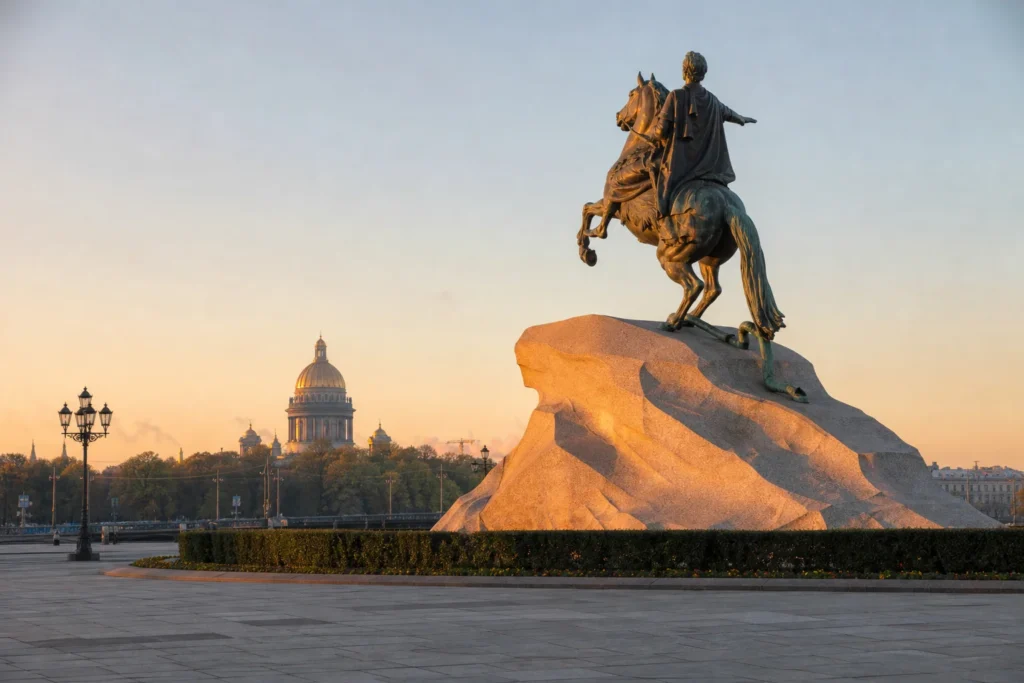
The Bronze Horseman in Saint Petersburg is the equestrian statue of Peter the Great on Senate Square, by the Neva in the Admiralteysky District. It was made by the French sculptor Étienne Maurice Falconet for Catherine the Great and unveiled in 1782.
The monument is free and open at any time. This guide explains what to look for, why the huge rock under the horse matters, and how to include the square in a walk through the centre.
Quick Facts
| Russian name | Медный всадник |
|---|---|
| Built / opened | 1782 |
| Architect(s) | Étienne Maurice Falconet (sculptor) |
| Address | Сенатская площадь, Санкт-Петербург |
| District | Admiralteysky District |
| Metro | Admiralteyskaya (Line 5, About a 15-minute walk through the Admiralty gardens) |
| Opening hours | An outdoor monument on a public square, accessible at all times. |
| Admission | Free. |
| Best time to visit | Early morning is quiet. Evenings are good for light. White nights in June give long daylight. Winter snow gives a dramatic look. |
| Recommended duration | 20–40 minutes |
| Last updated | October 15, 2026 |
What Is (and Isn't) Part of a Visit to Bronze Horseman, Saint Petersburg?
| Part | Status | Notes |
|---|---|---|
| The statue and Thunder Stone | Included in the standard ticket | Free to view at any time. |
| Senate Square | Included in the standard ticket | Open public space around the monument. |
| St Isaac's Cathedral | Outside / not part of it | Next to the square; entry is separate. |
| Admiralty | Outside / not part of it | On the east side; the building is used by the navy and is not a museum. |
| Senate and Synod buildings | Not open to visitors | Government and legal use; seen from outside. |
| Alexander Garden | Outside / not part of it | A public garden beside the Admiralty. |
Why Visit Bronze Horseman, Saint Petersburg?
The statue is one of the most recognizable symbols of the city. Peter sits on a rearing horse, his arm stretched out toward the Neva.
The rock beneath it, the Thunder Stone, was brought from Lakhta to Saint Petersburg in a famous transport operation, and the statue is linked with a famous poem by Pushkin that gave it its popular name.
The square is also the site of the Decembrist uprising of 1825, and it sits beside St Isaac’s Cathedral and the Admiralty, which makes it easy to include in a walk.
How Bronze Horseman, Saint Petersburg Is Laid Out
The statue stands in the middle of Senate Square, facing the Neva. St Isaac’s Cathedral is on the south side, the Admiralty and its garden are on the east side, and the buildings of the Senate and Synod are on the western side.
Walk around the monument to see the inscription, the horse and the rock from different sides. The best view of the face and outstretched arm is from the front, from the side of the Neva.
Highlights of Bronze Horseman, Saint Petersburg
Peter on the rearing horse
Falconet portrayed Peter as a rider raising his horse on its hind legs at the edge of a cliff. The emperor wears a laurel wreath and points toward the Neva.
The head was modelled by his pupil Marie-Anne Collot, according to the Presidential Library.
Tip: Look at the horse's tail and the snake beneath its hooves.
The Thunder Stone
The pedestal is a giant granite boulder found at Lakhta, which was moved to Senate Square in a long operation. It was unloaded on the square in 1770, according to the Presidential Library.
The name comes from a local legend that lightning split a piece off the rock.
Tip: Look at the natural shape of the rock; it was not carved into a pedestal.
The inscription
The monument carries a dedication in Latin and Russian meaning that Catherine the Second dedicated it to Peter the First, with the year 1782.
It shows how Catherine linked herself to Peter.
Tip: The inscription is on the pedestal sides; walk around to find both languages.
Senate Square
The square was the site of the Decembrist uprising of December 1825. In the Soviet period it was called Decembrists Square.
It is bordered by St Isaac's Cathedral and the Admiralty.
Tip: Stand with your back to the Neva to see how the ensemble fits.
The Pushkin connection
The statue is known as the Bronze Horseman because of Pushkin's poem of that name, although the statue is bronze.
The poem made the monument a symbol of the city and of its founder.
Tip: Read a summary of the poem before you come; it changes how the monument feels.
Atmosphere
The monument stands in an open space with wind from the Neva. The bronze is dark and the rock is rough grey granite, and the horse seems to leap toward the river.
In the morning it is quiet, with photographers and early walkers. During the day tourist groups gather around the rail. In the evening the statue is lit, and couples and wedding groups often come for photographs.
History of Bronze Horseman, Saint Petersburg
Catherine the Great wanted a monument to Peter the Great, whom she saw as the founder of the Russian Empire. On the advice of Denis Diderot, she invited the French sculptor Étienne Maurice Falconet, who signed a contract in 1766.
Falconet made a model of the horseman, and his pupil Marie-Anne Collot modelled the head. A giant granite boulder known as the Thunder Stone was found at Lakhta, and it was moved to Senate Square, arriving in 1770.
Falconet left Russia in 1778, and the casting and completion of the monument were finished by others. The monument was unveiled on 7 (18) August 1782.
The inscription records Catherine’s dedication to Peter. In the nineteenth century the monument received its popular name from Pushkin’s poem.
In December 1825 the Decembrist uprising took place on Senate Square, close to the monument. During the siege of Leningrad in the Second World War the statue was covered with sandbags and a wooden shelter to protect it.
The square later regained its name, Senate Square, and the monument remains one of the most visited symbols of the city.
Legends and Myths about Bronze Horseman, Saint Petersburg
The city will not fall while the horseman stands
Legend – historically unreliable. A nineteenth-century legend says that as long as the Bronze Horseman stands in the middle of Saint Petersburg, enemy forces will not be able to conquer the city.
The story is popular, but it is not historical; it was told especially during wartime.
The lightning-split Thunder Stone
Legend – historically unreliable. The boulder is said to have been split by lightning, which gave it the name Thunder Stone.
The story is part of local tradition and is repeated in accounts of the monument, but it cannot be confirmed.
Tickets and Booking for Bronze Horseman, Saint Petersburg
No ticket is needed. The monument and the square are open to the public at all times.
- Nearby sights such as St Isaac’s Cathedral have their own tickets.
- Tours: guided walks of the centre usually include the square.
For city information use the city’s official tourism portal (visit-petersburg.ru).
Plan and Book
Suggested itineraries Bronze Horseman, Saint Petersburg
30 minutes
Walk around the monument, read the inscription and look at the Thunder Stone from different sides, then view the Neva from the embankment.
1 hour
Add a look at St Isaac's Cathedral from the square and a stroll through the Alexander Garden by the Admiralty.
Half day
Combine the monument with Palace Square, Saint Petersburg and the State Hermitage Museum, Saint Petersburg.
How to Get to Bronze Horseman, Saint Petersburg
The nearest metro is Admiralteyskaya (Line 5). Walk toward the Admiralty and the Alexander Garden to reach Senate Square, about fifteen minutes.
- From Palace Square, walk west along the Admiralty garden.
- Buses and taxis stop near St Isaac’s Square.
Accessibility
The square is open and flat, with paved areas. Some sections near the monument have cobbles, so wheelchair users may prefer the paved paths. Check local sources for current works.
Food Nearby
Cafes and restaurants are on the streets around St Isaac's Square and along Bolshaya Morskaya Street. Nevsky Prospekt has more choice a few minutes away.
What to Bring
A windproof layer, since the square is open to the Neva.
Best Views and Photo Spots of Bronze Horseman, Saint Petersburg
In front of the statue
The rearing horse and rider seen from the Neva side with the sky behind.
Best time: Morning.
Behind the rock
The Thunder Stone in the foreground with St Isaac's Cathedral behind.
Best time: Sunset.
Admiralty garden edge
The statue seen through trees with the square around it.
Best time: Autumn.
Neva embankment
The Neva with the monument to one side.
Best time: White nights.
Photography Rules
Photography is allowed. Drone use over the centre is regulated, so check current rules before flying.
Family Suitability
Easy for families: free, open and short. Children usually enjoy the huge rock and the horse. The square is flat, so strollers can manage.
Russia Vibes Tips
- Walk around the statue; the rock is more impressive from behind.
- Read the poem summary before visiting.
- Plan the stop between St Isaac's Cathedral and the Admiralty.
- Visit on a clear evening for the best light.
- Do not climb on the rock or fence; it is protected.
Explore Nearby Bronze Horseman, Saint Petersburg
Sights near Bronze Horseman, Saint Petersburg
 Saint Isaac's Cathedral, Saint Petersburg · typical visit: 1.5–2 hours for the cathedral interior; allow another 45–60 minutes for the colonnade.
Main image: AI-generated illustration. It may not show the place exactly as it looks.
 Palace Square, Saint Petersburg · typical visit: 30–60 minutes, more with the Hermitage
Main image: AI-generated illustration. It may not show the place exactly as it looks.
 State Hermitage Museum, Saint Petersburg · typical visit: 3-5 hours for the main highlights
Main image: AI-generated illustration. It may not show the place exactly as it looks.
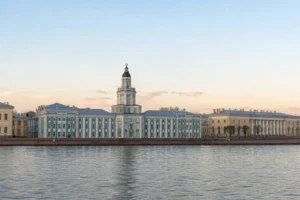 Kunstkamera, Saint Petersburg · typical visit: 2 hours
Main image: AI-generated illustration. It may not show the place exactly as it looks.
Related guides
 Best Bridges and Drawbridge Viewing Spots, Saint Petersburg: 9 Picks
Main image: AI-generated illustration. It may not show the place exactly as it looks.
 Best Parks and Gardens, Saint Petersburg: 8 Green Escapes in the City
Main image: AI-generated illustration. It may not show the place exactly as it looks.
 Best Churches and Religious Sites, Saint Petersburg: 9 Places to See
Main image: AI-generated illustration. It may not show the place exactly as it looks.
 Best Palaces and Historic Mansions, Saint Petersburg: 10 Interiors
Main image: AI-generated illustration. It may not show the place exactly as it looks.
 Best Things to Do, Saint Petersburg: 10 Sights, Boats and Views
Main image: AI-generated illustration. It may not show the place exactly as it looks.
Browse more: More in Admiralteysky District · All Landmarks · All Saint Petersburg · All Sightseeing · All Sightseeing in Saint Petersburg
FAQ: Bronze Horseman, Saint Petersburg
Is the statue made of bronze?
Yes. The name comes from Pushkin's poem, although some mistakenly say it is copper.
Who made the statue?
The French sculptor Étienne Maurice Falconet, with Marie-Anne Collot modelling the head.
What is the rock under the horse?
The Thunder Stone, a giant granite boulder brought from Lakhta.
When was it unveiled?
On 7 (18) August 1782.
Is it free?
Yes, and it is open at any time.
Is it on Palace Square?
No. It stands on Senate Square, a short walk west of Palace Square.
Why is it called the Bronze Horseman?
After Pushkin's poem of that name.
How long do I need?
Twenty to forty minutes.
Russia Vibes is a one-person project. A coffee keeps it going
Last updated: October 15, 2026. Found an error or something out of date? Report it and we will check and fix it.
How we research and update our guides
About this guide: AI assistance and accuracy
This guide is created with the help of AI and is based on official sources where available. Mistakes can still happen. Opening hours, prices, rules and other details are given to the best of our knowledge as of the date shown and can change without notice. It offers general recommendations only, not professional, legal or travel advice. Please confirm important details with the official source before you travel; you are responsible for your own plans and decisions.
International sanctions affect payments between Russia and many other countries. In practice, cards issued in the EU, the UK, the US and several other countries often do not work in Russia, Russian cards usually do not work abroad, and some booking platforms, airlines and payment providers limit or suspend their services for Russia. The situation changes frequently. We do not give legal or financial advice, and this site does not encourage anyone to break or circumvent sanctions. Whatever you plan, you are responsible for following the laws and regulations that apply to you, including those of your country of residence and citizenship. Many travelers still organise their stay lawfully. It is worth asking your bank or payment provider what is currently permitted, contacting hotels, tour operators and carriers directly about the payment methods they accept, and checking which services are open to customers from your country. Clarify payment, cancellation and refund terms before you commit to a booking, and keep your plans flexible. Partner links on this site may not be available in every country, and prices, availability and rules in our guides can differ from what you see when you book.Paying for your trip: please read

Take this guide with you
Get a free PDF of this guide to print or read offline: key facts, tips and a map link on a few clean pages.