
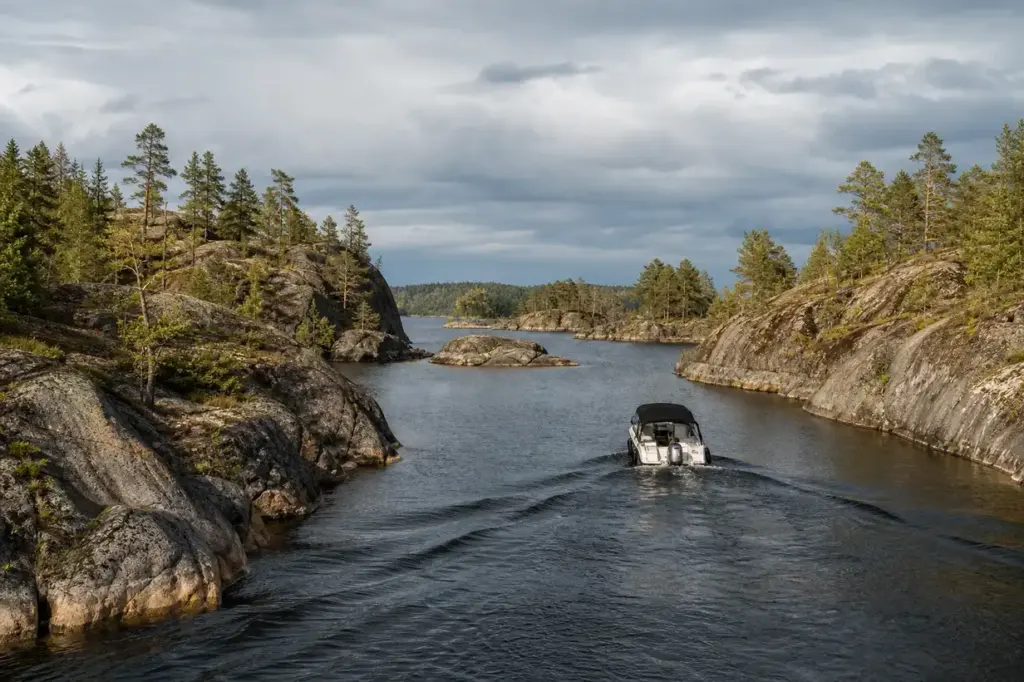
Lake Ladoga, the largest lake entirely in Europe, dominates the landscape of Karelia. Roughly the size of Lake Ontario, its 17,891 km² surface area is split between the Republic of Karelia and Leningrad Oblast, just 40 km east of Saint Petersburg. Visitors come for boat tours among granite islands, monasteries on remote archipelagos, and the raw Nordic scenery shaped by glaciers thousands of years ago.
The lake’s depression was created by glaciers, resulting in northern shores that are high and craggy with fjord-like inlets, while southern shores are low and sandy. Fed by the Svir, Volkhov, and Vuoksi rivers, it drains into the Gulf of Finland via the Neva.
Quick Facts
| Russian name | Ладожское озеро |
|---|---|
| Address | Google MapsApple MapsYandex Maps2GIS |
| District | Karelia |
| Best time to visit | Summer (June–August) offers the warmest weather, longest daylight, and most reliable boat service. Water is warmest for swimming. Spring (May–June) and autumn (September–October) bring clearer skies and fewer crowds but colder water. Winter freezes southern sections; ice roads and winter activities appeal to adventurers, but many boat tours cease. July sees peak tourist season. |
| Recommended duration | 2–7 days |
What Is (and Isn't) Part of a Visit to Lake Ladoga, Karelia?
| Part | Status | Notes |
|---|---|---|
| Lake Ladoga open water and islands | Included in the standard ticket | The lake itself is free to view from shores; boat access and island visits require separate tours or boat rentals. |
| Valaam Monastery | Separate ticket or institution | Separate boat ticket required from Sortavala; monastery entrance may have additional donation or entry fee. |
| Oreshek Fortress | Separate ticket or institution | Separate institution near Shlisselburg; requires boat access and own entrance fee. |
| Ladoga Skerries National Park | Separate ticket or institution | Access via licensed tour operators or private boat; protected area with regulations. |
| Sortavala town | Outside / not part of it | Shore town on Lake Ladoga's western bank; it is the main launching point for lake tours but a separate destination. |
| Lake Onega | Outside / not part of it | Separate lake to the east, connected via rivers; not part of Lake Ladoga itself. |
Why Visit Lake Ladoga, Karelia?
Exploring this beautiful lake by boat allows you to take in views of its untouched banks, especially those on the north side, with picturesque rock faces carved by the lake forming numerous coves. The Valaam islands offer an untamed feel with rock formations, and other islands in the northern part of the lake reward exploration.
Ladoga Skerries National Park, created in 2017, features numerous small rocky islands on narrow bays and channels along the north and northwestern shores. Summer swimming, kayaking, multi-day sailing expeditions, and visits to historic monasteries and fortresses scattered around the shoreline appeal to different interests.
How Lake Ladoga, Karelia Is Laid Out
Lake Ladoga is not a single destination but a system of experiences accessed from different shores. The lake spans north to south, with distinct regions: the rocky, island-studded north and northwest (home to Valaam Monastery and the Skerries); the more remote eastern shore; and the developed southern and western shores closer to Saint Petersburg and towns like Sortavala and Shlisselburg.
Most of the 660 islands cluster in the northwest, including Valaam, Kilpola, and Konevets. Access is primarily by water—speedboat tours depart from towns like Sortavala, or visitors rent boats or kayaks for independent exploration. The mainland offers viewing points, fortress ruins, and cabin accommodations from which to base multi-day trips.
Highlights of Lake Ladoga, Karelia
Valaam Monastery
The 14th-century Orthodox monastery on Valaam Island is one of Lake Ladoga's most iconic landmarks. Located on an island in the northwest archipelago, it features a white cathedral and scattered wooden sketes (hermitage churches) surrounded by forest and rocky shoreline. Accessed by speedboat from Sortavala, it requires at least a half-day visit and a separate boat ticket. The monastery is active but operates as a heritage site for pilgrims and tourists.
Tip: Book accommodation or guide services in advance if visiting overnight; same-day boat returns are possible but tours last several hours.
Ladoga Skerries
The Ladoga Skerries are a picturesque archipelago in the north of Lake Ladoga consisting of small rocky islands separated by straits. The area features 'reef mountains'—mountains that break off into the lake with sheer cliffs reaching 80 metres high—including the picturesque capes of Honkasalo Island with narrow bays and steep stone walls. The area is protected as Ladoga Skerries National Park, officially created in 2017.
Tip: Multi-day boat tours with camping or cabin stays offer the fullest experience; day cruises from Sortavala also depart regularly.
Granite Shores and Northern Coastline
Northern shores are high and craggy with fjord-like inlets formed by glacial action. Rocky outcrops, pine forests, and sheltered coves characterize the landscape. Distinctive features include reef mountains with sheer cliffs and a culminating ascent to beautiful viewing platforms with magnificent vistas. These areas are best seen from the water.
Tip: Bring a camera: the interplay of granite, forest, and water in clear Nordic light creates exceptional photographs, especially in summer.
Oreshek Fortress
Located at the narrow outlet where Lake Ladoga drains into the Neva River near Shlisselburg, this 14th-century fortress played a strategic role in Russian and Swedish conflicts. The fortress stands on a small island and is accessible by boat from the town. It represents the area's contested history between Russian Novgorod and Swedish interests.
Tip: Combine a visit with a trip to nearby Shlisselburg town; this is a separate ticket and institution from the lake itself.
Kilpola Island
Kilpola is an island 6 x 8 km among the skerries in the northwestern part of Lake Ladoga, composed of granite hills rising to about 60 m and covered by Scots Pine forest. Connected to the mainland by a bridge, it offers accessible exploration without a full lake crossing and provides views of the archipelago.
Tip: This is one of the few major islands with road access, making it useful for those without boat transportation.
Clear Waters and Island Ecology
Lake Ladoga contains around 660 islands with a total area of about 435 km². The clear freshwater supports fishing traditions and wildlife. Pine and birch forests dominate the islands, and the rocky geology creates dramatic visual contrasts. Summer water temperatures allow swimming in protected bays.
Tip: Summer months (June–August) offer warmest water and best visibility; prepare for sudden wind and weather changes.
Atmosphere
On the water, Lake Ladoga feels immense and borderless—a Nordic sea rather than a lake, despite being freshwater. The light is characteristically Nordic: long summer evenings with low sun angles, winter darkness punctuated by ice and rare clear days. Rocky granite shores rise suddenly from the water, often forested to the waterline with dark spruce and pine that smell sharp and fresh.
On boat tours, the atmosphere mixes peaceful solitude with occasional encounters with fishing communities, day-trippers, and pilgrims traveling to island monasteries. Sunset over the northern skerries, with their jagged outlines, is contemplative and dramatic. In summer, tourists cluster around Sortavala departure points and popular islands; winter brings isolation and silence, with the lake freezing solid in its southern and protected sections.
History of Lake Ladoga, Karelia
In the Middle Ages, Lake Ladoga was a vital trade route between the Eastern Roman Empire and the Varangians. The territory was at stake as rival groups—Russians from Novgorod, Swedes, Varangians, and Finns—fought for control; it constituted the Swedish-Russian border during the Great Northern War before Russia took full control.
Following the Treaty of Stolbovo in 1617, Russia ceded the western and northern coast to Sweden, only to regain the territory in 1721 after the Great Northern War. From the early 19th century to the mid-20th century, Lake Ladoga was shared by Finland and Russia.
During World War II, Lake Ladoga served as a crucial lifeline to Leningrad (St. Petersburg) amidst the German siege. The “Road of Life” ice road ran across the frozen lake in winter, supplying the city during the 900-day blockade. Many ships were sunk in its waters, and the lake became synonymous with Soviet resilience.
In the post-World War I era, the lake became popular among tourists. The islands hosted dachas (country retreats) and pilgrimage communities. Modern Karelia has preserved the lake’s cultural heritage while developing controlled tourism and environmental protection frameworks.
Legends and Myths about Lake Ladoga, Karelia
The Road of Life
Legend – historically unreliable. During the 900-day German siege of Leningrad in World War II, a supply route across the frozen surface of Lake Ladoga became the only lifeline to the starving city. Thousands of trucks carrying food and ammunition risked breaking through thin ice or being bombed by German aircraft. Thousands died, but the city was saved. The "Road of Life" became a symbol of Soviet defiance.
Valaam's Hermit Saints
Legend – historically unreliable. Local tradition holds that monks fleeing religious persecution in the 10th century retreated to the remote Valaam islands to establish a monastery and seek solitude. The harsh northern conditions and isolation tested their faith. Some traditions claim that mystic hermits chose even more remote skerries, establishing small sketes (prayer cells) on individual islands.
Tickets and Booking for Lake Ladoga, Karelia
Lake Ladoga itself has no central ticketing office. Access depends on your chosen activity:
- Boat tours: Book through tour operators in Sortavala, Shlisselburg, or Saint Petersburg. Speedboat tours (often called “meteors”) to islands depart regularly in summer; tickets are often reserved for tour groups but can be purchased individually at kiosks near piers.
- Independent boat rental: Available in several towns; require boating experience or a licensed captain.
- Kayaking: Guided kayak tours and rentals available from regional operators.
- Accommodation: Lakeside cabins, camping grounds, and guesthouses can be booked directly or via travel agencies.
No advance online booking system exists for the lake as a whole. Check with the official Karelia tourism website or local tour companies (tours vary seasonally) for current options and pricing. Rates for Russian citizens often differ from international visitor rates.
Plan and Book
Suggested itineraries Lake Ladoga, Karelia
Day trip
Depart Sortavala early on a speedboat tour to the Ladoga Skerries, exploring granite islands and reef mountains with viewing platforms. Return by late afternoon. Alternatively, visit Valaam Monastery in a guided half- or full-day excursion, including the cathedral and island forest walks.
2–3 days
Base yourself in Sortavala or a lakeside cabin. Day 1: Skerries boat tour. Day 2: Independent walk around town, visit viewpoints, or relax by the shore. Day 3: Visit Valaam Monastery or explore a different island group. Include swimming and photography time.
4–7 days
Multi-day sailing or motorboat expedition. Camp on remote islands, kayak through protected bays, and explore the northern archipelago. Include a stop at Valaam Monastery, hikes on Kilpola or other large islands, and visits to small fishing communities. Requires booking with a tour operator offering full-expedition packages.
How to Get to Lake Ladoga, Karelia
From Saint Petersburg: Lake Ladoga is roughly 40 km away. Options include:
- Train to Sortavala (3–4 hours); buses depart Saint Petersburg daily. Sortavala is the main departure point for boat tours.
- Hire a car or join a tour from Saint Petersburg; the drive takes 2–3 hours depending on destination and road conditions.
- Train to Shlisselburg (1 hour) for access to Oreshek Fortress and the Neva outlet.
Regional access: Sortavala is the primary hub for boat tours. From the Sortavala train station, the town center and pier are walkable (15–20 minutes). Taxis and local transport are available.
By boat: Speedboat tours operate from Sortavala, Shlisselburg, and other towns. Independent boat rentals available through local companies.
Accessibility
Lake Ladoga itself is widely accessible by boat from mainland ports. Shore towns like Sortavala have varying accessibility; older buildings may lack elevators. Boat tours are typically accessible to those with mobility aids, though boarding and disembarking require assistance. Island visits involve uneven terrain and natural rock formations. Wheelchair-accessible facilities are limited on remote islands. Check with specific tour operators and accommodations for detailed accessibility information.
Food Nearby
The towns of Sortavala, Shlisselburg, and smaller shoreside settlements offer basic cafes and restaurants serving Russian and Karelian cuisine—fish soups, pelmeni, and local bread. Larger towns have supermarkets for self-catering. Remote island camping sites typically require bringing food or pre-arranged meal packages with tour operators.
What to Bring
Summer: swimsuit, sun protection, insect repellent (mosquitoes can be intense in June–July), waterproof jacket, and sturdy walking shoes with grip for rocky shores. Winter: heavy cold-weather gear, thermal layers, and waterproof boots. Year-round: camera, binoculars for wildlife watching, seasickness medication if prone, and plenty of water. Boats have limited facilities; bring snacks. Leave large bags at your accommodation when on day boat tours.
Best Views and Photo Spots of Lake Ladoga, Karelia
Northern granite cliffs from boat
Sheer rock faces rise directly from clear water, often reflected perfectly on calm days. Pine forests frame the upper edges, creating layers of depth. The scale and raw geology are best captured from a moving boat in mid-morning or late afternoon light.
Best time: Golden hour (6–8 pm in summer); calm water conditions maximize reflections. Avoid midday glare.
Valaam Monastery cathedral and island shoreline
The white monastery buildings stand against forest backdrop with lake in foreground. The island's rocky shore and small beaches provide compositional foreground. Best approached from the water or higher ground on the island.
Best time: Early morning light from the east; late afternoon from the west. Overcast days reduce shadow contrast.
Skerries archipelago from elevated viewpoint
Dozens of rocky islands create a maze pattern with water channels between them. Granite tones contrast with dark forest. The perspective from a boat or island summit shows the full geography.
Best time: Mid-morning for even lighting; overcast skies emphasize texture and rock forms.
Sortavala waterfront and pier at sunset
Town buildings and church spires reflected in still water, with the lake and islands visible beyond. A accessible shore-based shot capturing both settlement and wilderness.
Best time: Golden hour before sunset; summer provides longest twilight.
Photography Rules
Drone flying is prohibited in the protected Ladoga Skerries National Park area without permits. Tripods are permitted on public areas but not in protected zones. No restrictions on standard handheld cameras or smartphone photography. Flash photography is not restricted outdoors but should be respectful in monastery buildings. Golden hour light (early morning and late evening) is exceptional.
Family Suitability
Lake Ladoga appeals to families seeking nature and outdoor adventure. Boat tours suit most ages if children are comfortable on water; younger children may find long crossings challenging. Swimming in designated bays is possible in summer. Multi-day camping or island exploration requires children comfortable with hiking and basic self-sufficiency. Valaam Monastery welcomes families but involves walking on uneven terrain. Stroller use is impractical on boats and island paths. Teenagers and active children thrive; very young children (<5) may find logistics difficult on remote islands.
Russia Vibes Tips
- Book boat tours at least one day in advance in summer; speedboats to Valaam and Skerries fill with tour groups. Individual seats are sometimes available at the pier ticket kiosk, but departures are not guaranteed.
- Lake Ladoga's weather changes rapidly. Even on a clear morning, afternoon storms with high waves can occur. Bring rain gear and check conditions before departing; many tours are cancelled for safety in poor weather.
- Visit the northern skerries and Valaam in summer (June–August) when all boat services operate; in winter and shoulder seasons, only a few tours run from Sortavala.
- Don't confuse Lake Ladoga with Lake Onega (the second-largest in Europe, to the east). They are separate lakes connected by rivers; tours typically visit one or the other, not both in a day trip.
- Stay in Sortavala if you want flexible lake access; it's the main hub with the most frequent boat departures and accommodation options. Saint Petersburg day trips are possible but require early morning travel.
- Pack insect repellent for June and July. Mosquitoes around sheltered bays and campsites can be intense. Higher elevations and open water areas are less affected.
Explore Nearby Lake Ladoga, Karelia
Browse more: More in Karelia · All Karelia · All Landmarks · All Sightseeing · All Sightseeing in Karelia
FAQ: Lake Ladoga, Karelia
Is there a town or city on Lake Ladoga?
Lake Ladoga itself is a natural water body without a central town. Sortavala, Shlisselburg, and smaller settlements sit on its shores and serve as access points for boat tours. Saint Petersburg, the nearest major city, is 40 km away.
Can I visit Lake Ladoga as a day trip from Saint Petersburg?
Yes. Train to Sortavala (3–4 hours) or drive (2–3 hours) for boat tours departing the same day. Speedboat tours to Skerries or Valaam typically last 3–8 hours. You can return to Saint Petersburg the same evening but will have limited time to explore.
Is Valaam Monastery included in a lake tour?
No. Valaam Monastery requires a separate boat ticket from Sortavala (usually 2–3 hours each way). It may be included in a multi-day tour package but not in standard day cruises of the Skerries. Entrance to the monastery may have its own fee.
What is the best time to visit Lake Ladoga?
Summer (June–August) offers the warmest weather, reliable boat service, and longest daylight. Water warms to swimable temperatures. May–June and September–October provide fewer crowds but colder conditions. Winter freezes the southern lake; ice roads attract adventurers, but most tours cease.
Can I swim in Lake Ladoga?
Yes, in designated bays and beaches during summer (July–August) when water temperatures reach 15–18°C. Water is cold; most swimmers wear wetsuits. Rocky areas and currents require caution. Always swim in designated, supervised areas on organized tours.
Do I need a boat tour, or can I explore independently?
Most islands require a boat. You can rent a kayak or motorboat with captain; independent boating requires experience and navigation skills. Kilpola Island is accessible by car. Shore walks and viewpoints are accessible from towns without a boat.
Is Lake Ladoga the same as Lake Baikal?
No. Lake Baikal is in Siberia and is the world's deepest lake and Russia's largest. Lake Ladoga is Europe's largest lake, located in northwestern Russia near Saint Petersburg and Finland.
Are there hotels and cabins on Lake Ladoga shores?
Yes. Sortavala and other towns have guesthouses and hotels. Lakeside cabins are available for rent; many offer boat access and direct water views. Remote island camping is available through organized multi-day tours.
Russia Vibes is a one-person project. A coffee keeps it going
How we research and update our guides
About this guide: AI assistance and accuracy
This guide is created with the help of AI and is based on official sources where available. Mistakes can still happen. Opening hours, prices, rules and other details are given to the best of our knowledge as of the date shown and can change without notice. It offers general recommendations only, not professional, legal or travel advice. Please confirm important details with the official source before you travel; you are responsible for your own plans and decisions.
Packing for this trip
* Affiliate link: as an Amazon Associate we earn from qualifying purchases at no extra cost to you.

Take this guide with you
Get a free PDF of this guide to print or read offline: key facts, tips and a map link on a few clean pages.
Report an issue on this page
Paying for your trip: please read
International sanctions affect payments between Russia and many other countries. In practice, cards issued in the EU, the UK, the US and several other countries often do not work in Russia, Russian cards usually do not work abroad, and some booking platforms, airlines and payment providers limit or suspend their services for Russia. The situation changes frequently.
We do not give legal or financial advice, and this site does not encourage anyone to break or circumvent sanctions. Whatever you plan, you are responsible for following the laws and regulations that apply to you, including those of your country of residence and citizenship.
Many travelers still organise their stay lawfully. It is worth asking your bank or payment provider what is currently permitted, contacting hotels, tour operators and carriers directly about the payment methods they accept, and checking which services are open to customers from your country. Clarify payment, cancellation and refund terms before you commit to a booking, and keep your plans flexible.
Partner links on this site may not be available in every country, and prices, availability and rules in our guides can differ from what you see when you book.