
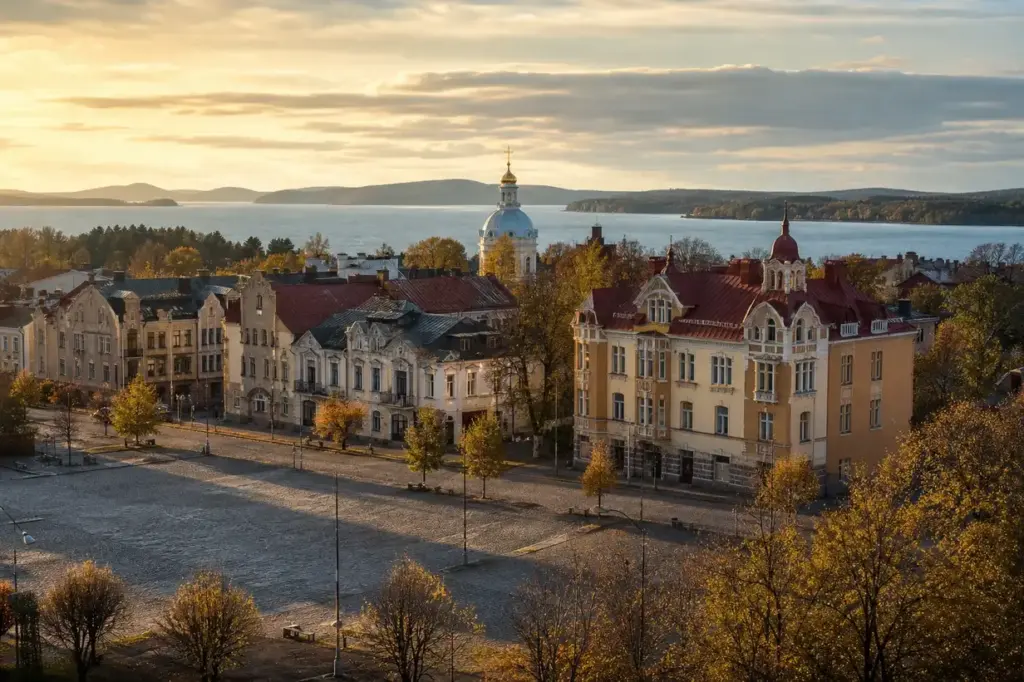
Sortavala sits at the northern tip of Lake Ladoga, 246 km west of Petrozavodsk, near the Finnish border. Once known as Serdobol, it changed hands between Swedish, Finnish and Russian rule, accumulating layers of cultural identity visible in its compact centre. Today the town functions as the second most popular tourist hub in Karelia after Petrozavodsk, offering a unique blend of early 20th-century Nordic architecture, compact heritage sites and proximity to the Ladoga wilderness.
The town operates as an ideal base for exploring nearby Ruskeala Mountain Park with its marble quarries and waterfalls, Lake Ladoga islands, and trekking routes into Karelia’s forested interior.
Quick Facts
| Russian name | Сортавала |
|---|---|
| Address | Sortavala, Republic of Karelia, Russia Google MapsApple MapsYandex Maps2GIS |
| District | Sortavalsky |
| Best time to visit | Summer (June–August) brings the most reliable weather, warmth, and lake navigation. Winter (December–February) transforms Sortavala into a quieter destination; Lake Ladoga freezes, but many outdoor attractions become less accessible. Spring (April–May) and autumn (September–October) offer mild weather, fewer tourists and dramatic lighting on the historic architecture. Autumn colours and clear air make September particularly rewarding for photography.Weekdays are quieter than weekends; summer weekends may see day-trippers from nearby areas and occasional cruise ship traffic. |
| Recommended duration | 1–2 days |
Why Visit Sortavala, Karelia?
Sortavala rewards visitors with distinctive Finnish and Swedish Art Nouveau buildings clustered around Kirov Square, notably the Nordic Bank buildings designed by architect Uno Ulberg in 1913–1915, and the Church of St. Nicholas from 1873. The town holds 56 stone architecture monuments and 165 wooden buildings registered as heritage structures. Beyond the architecture, Sortavala offers access to Lake Ladoga’s skerries and islands, including Valaam with its ancient monasteries, and serves as the jumping-off point for Ruskeala Mountain Park’s marble quarries, waterfalls and hiking trails—making it essential for anyone exploring northern Karelia.
Highlights of Sortavala, Karelia
Church of St. Nicholas
Built in 1873, this Orthodox church sits on the central Kirov Square, anchoring the town's religious landscape. The stone structure reflects the town's role as an Orthodox spiritual centre—it became the seat of the Orthodox archbishop from 1925. The church's modest but solid presence contrasts with the more ornate Finnish-designed civic buildings surrounding it, capturing the competing cultural influences that shaped Sortavala's character.
Tip: Visit early morning or late afternoon when light falls across the square and the surrounding architecture photographs well.
Nordic Bank Buildings, Kirov Square
The spectacularly ornate 1913–1915 structures designed by Finnish architect Uno Ulberg represent the peak of Art Nouveau in Karelia. The United Bank of the Nordic Countries and the Finnish Bank buildings showcase elaborate facades with period details. These monuments capture the town's prosperity and cosmopolitan character during the Finnish autonomy period. Both buildings remain architectural highlights even though they no longer operate as banks.
Tip: Walk around both sides to see the full facades, which are best seen from the square itself rather than the street level.
Vakkosalmi City Park
This green space offers views across the Ladoga shore and contains walking paths and recreational areas. The park functions as a peaceful counterpoint to the compact historic centre, popular with locals and visitors seeking fresh air without leaving town. On clear days the park provides views toward the Ladoga skerries.
Tip: Bring binoculars to scan the distant islands and inlets of Lake Ladoga on clear days.
Leander's House
This historic wooden villa represents the domestic architecture of Sortavala's prosperous era. Built in the early 1900s, it stands as an example of the town's significant wooden heritage—165 registered wooden monuments survive, though many lack proper maintenance. The house captures the residential scale of the town during its cultural heyday.
Tip: Located on the residential streets away from the centre, it's best found by exploring beyond Kirov Square where many other wooden buildings are scattered throughout town.
Mount Paaso
This hill near the town centre holds archaeological significance as the probable site of Paaso, a fortified Karelian settlement from the 12th century with stone walls. Remains visible on the hillside represent some of Sortavala's oldest traces. The site connects Sortavala to medieval Karelian history before Swedish and Russian administration.
Tip: The sites are modest and require local knowledge to identify; ask at the visitor information or hotels for specific directions to recognised remains.
Kronid Gogolev Cultural Exhibition Centre
This museum houses a collection of sculptural reliefs created by artist Kronid Gogolev over 30 years, featuring works displayed across two floors. The exhibition represents the town's contribution to contemporary regional art. As a smaller, visitor-friendly museum, it works well for rainy days or shorter stays.
Tip: Check opening times locally, as museum hours can vary seasonally.
Lake Ladoga Embankment
Sortavala's shoreline walk offers views across northern Europe's largest lake. The embankment functions as the town's connection to water-based history—Lake Ladoga was the primary shipping route that made Sortavala an important trading centre from the 15th century onward. Today the waterfront provides quiet observation points and boat access.
Tip: Walk the embankment in early evening when the light turns golden across the lake and the town's historic buildings come alive in silhouette.
Atmosphere
Sortavala feels like a time capsule of Nordic Karelia, with the compact historic centre arranged around Kirov Square. Early 20th-century stone buildings in warm ochres and reds face quieter residential streets lined with weathered wooden villas, many showing their age but retaining distinctive detail. The town is small enough to explore on foot in a few hours, yet the heritage architecture and lake vistas create a contemplative atmosphere rather than a bustling tourist hub.
The lakeside location gives the town a frontier quality—the Finnish border is close, the wilderness begins at the town’s edge, and the scale feels human-sized compared to larger Karelian cities. Summer brings modest tourist activity centred around the square and the Ladoga ferry connections. Winter transforms Sortavala into a quieter, more introspective place where the lake freezes and the town’s isolation becomes palpable.
History of Sortavala, Karelia
Archaeological evidence places Karelian settlements on the Ladoga shore as far back as the 12th century, with fortified structures recorded on Mount Paaso. The Karelian settlement of Paaso may have been associated with a significant 1187 seaborne raid on Swedish Sigtuna. Russian records first mention the location as Serdovol or Serdobol around 1500, when a Karelian settlement was established on Riekkalansaari island.
Sortavala’s strategic position drew competing powers. Following the Ingrian War in the 1610s, the territory transferred to Swedish control in 1617. In 1632, Swedish King Gustav II Adolph issued a decree for building new towns in conquered Karelian lands, and Sordavala received town status in 1646. The Swedish period established Sortavala as a merchant hub, with Lake Ladoga serving as a critical shipping route connecting Scandinavian goods to Russian markets.
After the Great Northern War, Russia regained the territory in 1721. Sortavala later became part of the Grand Duchy of Finland, an autonomous region within the Russian Empire, from 1812 onward. The town’s late 19th-century development into the cultural centre of Ladogan Karelia created the architectural heritage visible today—the 1873 Church of St. Nicholas and, most significantly, the 1913–1915 Nordic Bank buildings by Finnish architect Uno Ulberg, which showcase the cosmopolitan prosperity of the autonomous Finnish period.
In 1893, the Karelian Railway branch from Vyborg reached Sortavala, enhancing trade and cultural exchange. The town became a significant administrative and religious centre, serving as the seat of the Orthodox archbishop from 1925. However, the 1939–1944 wars fundamentally altered Sortavala’s trajectory. After the Winter War in 1940 and the Continuation War in 1944, Soviet control over the entire Sortavala district replaced the previous mixed population of Russians, Finns and Karelians. Many inhabitants were evacuated; the town’s population and strategic importance diminished as Soviet industrialisation focused elsewhere.
In 1990, Sortavala was formally designated a historic city, recognising its 56 stone and 165 wooden architecture monuments. Today it survives as a heritage destination and gateway to natural attractions rather than as an economic hub, offering visitors a window into the cultural layering of the Ladoga borderlands.
Legends and Myths about Sortavala, Karelia
The 1187 Karelian Raid on Sigtuna
Disputed by historians. Medieval sources record a Karelian seaborne raid on the Swedish fortress town of Sigtuna in 1187. Archaeological evidence and settlement patterns suggest the raid may have been mounted from fortified positions near Sortavala on Mount Paaso, making the town an early centre of Karelian power. The raid became part of Nordic legend as a daring act of resistance against Swedish expansion.
Sortavala's Finnish Cultural Heart
Legend – historically unreliable. After Finnish autonomy within Russia (1812–1917), Sortavala developed into the cultural capital of Ladogan Karelia, attracting artists, intellectuals and merchants. The magnificent 1913–1915 Nordic Bank buildings symbolise this golden age. Local memory preserves Sortavala as the keeper of Karelian-Finnish identity—a place where Nordic architecture and sensibility survived even after the 1944 Soviet takeover and population evacuation.
Tickets and Booking for Sortavala, Karelia
Sortavala is a free-to-visit town with no entry fees for walking the streets and viewing exterior architecture. Individual museums and attractions have their own tickets; check locally for current hours and admission. Most sites are clustered around or near Kirov Square and are accessible on foot.
Plan and Book
Suggested itineraries Sortavala, Karelia
2–3 hours
Walk Kirov Square and the surrounding historic centre, viewing the 1873 Church of St. Nicholas and the 1913–1915 Nordic Bank buildings. Stroll residential streets to see wooden heritage buildings, visit Leander's House if accessible. End at the Lake Ladoga embankment for views across the water.
Half day
Complete the 2–3 hour historic centre walk, then visit Vakkosalmi City Park for lake views and walking paths. If the Kronid Gogolev museum is open, spend an hour viewing the sculptural collection. Alternatively, arrange a boat excursion on Lake Ladoga to view the Ladoga skerries.
Full day
Explore Sortavala's centre in the morning (3 hours), visit Vakkosalmi Park and the embankment for lunch. Afternoon: take a day trip to Ruskeala Mountain Park (25 km away, 30 minutes by car or organised tour) to explore the marble quarries, waterfalls and hiking trails. Return to Sortavala for evening.
2 days
Day 1: Historic centre and Lake Ladoga embankment. Day 2: Full day trip to Ruskeala Mountain Park in the morning and afternoon; alternatively, arrange a boat excursion to Valaam Island's monasteries if ferry schedules permit. Stay overnight to experience Sortavala's evening quietness and morning light on the historic buildings.
How to Get to Sortavala, Karelia
Sortavala has no metro system. The town is served by rail from Saint Petersburg (approximately 5–6 hours) via the St. Petersburg–Petrozavodsk route; trains stop at Sortavala Railway Station on the southern edge of town. From the station, the historic centre and Kirov Square are about 1 km north—a 15-minute walk or short taxi ride.
By road: the A121 Sortavala Highway connects Saint Petersburg (256 km south) and continues toward the Finnish border. Minibuses and private cars run regularly from Saint Petersburg and Petrozavodsk. From Petrozavodsk (246 km east), travel time by car is approximately 4–5 hours.
Lake Ladoga ferry connections operate seasonally to islands including Valaam and Konevets. Check locally for current schedules, as these depend on water conditions and ice.
Accessibility
Sortavala's historic centre is compact and largely walkable on level ground around Kirov Square. However, the town's wooden heritage buildings and many surrounding streets are not purpose-built for accessibility. Sidewalks are uneven in places; some heritage buildings have narrow doorways and stairs. Lake Ladoga embankment walks are generally level.Hotels and restaurants in the centre may have limited accessibility features; inquire ahead. Taxis and private transport are available for those with mobility concerns. The railway station is 1 km south of the centre and accessed by road.
Food Nearby
Sortavala's small size means dining options are modest but locally oriented. Small cafés and restaurants cluster around Kirov Square and the central streets, serving Russian and Karelian cuisine. Karelian specialties include traditional pastries, fish dishes from Lake Ladoga, and local mushroom preparations. Visitors should eat where locals gather rather than expecting tourist-oriented menus; inquire at your hotel or wander the square to find family-run establishments. Grocery shops and a market near the centre supply provisions for self-catering or picnics.
What to Bring
In summer: sun protection and insect repellent (mosquitoes can be active near water and forests). Comfortable walking shoes for uneven heritage streetscapes. In autumn and spring: layers and a windproof jacket for lake-side winds. Winter: heavy winter coat, boots with good grip, warm layers—the town has heating but exteriors are exposed. A camera or phone for photographing the architecture in good light. If exploring Lake Ladoga or Ruskeala, sturdy hiking boots and water.Security: carry minimal valuables; Sortavala is a safe town, but standard precautions apply in any Russian destination.
Best Views and Photo Spots of Sortavala, Karelia
Kirov Square, facing the Nordic Bank buildings
The 1913–1915 Nordic Bank structures frame the square's north side, showcasing Art Nouveau detail and warm stone facades. The Church of St. Nicholas dome adds vertical interest. Early morning or late afternoon backlighting creates dramatic shadows and warm tones.
Best time: 7:00–8:00 AM or 18:00–19:30, clear days in spring or autumn for golden light.
Lake Ladoga embankment, facing south toward the water
The shoreline and distant islands create a sweeping vista across Europe's largest lake. The town's heritage buildings rise behind the embankment; the combination frames Sortavala's relationship to the water and the borderland landscape.
Best time: Sunset (18:00–20:00 in summer) when the water reflects orange and pink tones. Clear days offer the sharpest visibility of distant shorelines.
Residential street west of Kirov Square (Leander's House area)
Weathered wooden villas with characteristic early 20th-century Nordic detail line quiet streets. The decay and layered paint convey Sortavala's post-Soviet heritage preservation struggle. The human scale and quietness contrast with the grandiose civic architecture of the square.
Best time: Midday or overcast conditions; the muted light suits the melancholic character of heritage wooden buildings.
Vakkosalmi Park overlooking Lake Ladoga
The park's elevation offers a broader perspective on the Ladoga landscape, with the town visible in the middle ground and the lake and distant shores stretching across the horizon. The composition captures Sortavala's frontier position.
Best time: Clear days in any season; summer provides green vegetation, autumn offers colour, winter reveals the frozen lake surface.
Church of St. Nicholas, viewed from the southeast corner of Kirov Square
The Orthodox church's stone and modest dome dominate the square's focal point, surrounded by other heritage buildings. The composition captures the town's religious and civic centre in one frame.
Best time: Morning light (8:00–10:00) when the building's south and east facades are illuminated without harsh contrast.
Photography Rules
Photography in Sortavala's public spaces is free and unrestricted. The historic centre and Lake Ladoga embankment are excellent for exterior architecture and landscape shots. Early morning and late afternoon light flatters the stone buildings on Kirov Square. Museums have their own interior photography policies—ask staff before shooting. Drones and tripods should be checked with local authorities if used extensively. Indoor churches or museums may restrict flash or professional photography.
Family Suitability
Sortavala is moderately family-friendly. The compact historic centre is walkable with older children; young children's strollers work on level ground around Kirov Square but encounter uneven surfaces on residential streets. Lake Ladoga embankment walks are suitable for all ages. Museums are small and may not sustain interest for young children. Ruskeala Mountain Park nearby offers better-developed family activities: marble quarry exploration, waterfall viewing and easier hiking trails. Food options in town are simple; families should eat early or plan ahead. Overall, Sortavala works best for families with children aged 8+ interested in architecture and nature, or as a base for day trips to Ruskeala.
Russia Vibes Tips
- Sortavala is often overlooked in favour of Petrozavodsk; arriving on a weekday means fewer tourists and a more authentic experience of the town's heritage quietness.
- The Nordic Bank buildings (1913–1915) are the architectural highlights. Photograph and view them from multiple angles around Kirov Square—the facades differ from each side.
- Lake Ladoga ferry schedules to Valaam Island and other locations depend on seasonal navigation windows and ice. Confirm schedules at the embankment ticket office or local hotels weeks in advance if island visits are important to your trip.
- Many wooden heritage buildings, while beautiful, are privately owned and not open to visitors. Respect boundaries and photograph from the street. The Leander's House area is the most accessible concentration of visible wooden heritage.
- Ruskeala Mountain Park (25 km away) is Sortavala's primary day-trip activity. Arrange transport in advance (organised tours from hotels, private car rental, or minibus). The park offers better-developed facilities than Sortavala itself.
- Early morning light (7:00–9:00 AM) bathes Kirov Square and surrounding heritage buildings in warm, shadow-free illumination—ideal for photography and the best time to explore architecture without crowds or harsh midday contrast.
Explore Nearby Sortavala, Karelia
Browse more: More in Sortavalsky · All Karelia · All Landmarks · All Sightseeing · All Sightseeing in Karelia
FAQ: Sortavala, Karelia
Is Sortavala the same as the nearby Ruskeala Mountain Park?
No. Sortavala is the town; Ruskeala Mountain Park is a separate attraction 25 km away featuring marble quarries, waterfalls and hiking trails. Sortavala serves as the main base for visiting Ruskeala. You can visit both on a day trip from Sortavala town.
What is the best time to visit Sortavala?
Summer (June–August) offers reliable weather and lake access. Autumn (September–October) brings dramatic light, fewer tourists and excellent architecture photography. Winter is quiet but cold; many facilities reduce hours. Spring can be muddy and unpredictable. Weekdays are quieter than weekends.
Can I visit Valaam Island monastery from Sortavala?
Yes, seasonal ferry connections operate from Sortavala's Lake Ladoga embankment, typically May–October depending on navigation conditions. Confirm schedules weeks in advance with local hotels or the embankment ticket office, as sailings are limited and weather-dependent.
How long should I spend in Sortavala town itself?
The historic centre can be explored thoroughly in 2–3 hours on foot. A full day allows time for museums, Lake Ladoga walks and cafés. Most visitors combine Sortavala with a day trip to nearby Ruskeala Mountain Park, making 1–2 nights in town a typical stay.
Are there entry fees to walk around Sortavala's historic centre?
No. Walking the streets, viewing exterior architecture and visiting Kirov Square are free. Individual museums and attractions charge separate admission; check locally for current hours and prices.
Is Sortavala accessible by public transport from Saint Petersburg?
Yes. Trains run from Saint Petersburg to Sortavala (approximately 5–6 hours). Minibuses and private cars also operate the route. From Petrozavodsk, travel time by road is 4–5 hours. Check schedules in advance as frequency varies seasonally.
What makes the Nordic Bank buildings special?
Built in 1913–1915 by Finnish architect Uno Ulberg, these Art Nouveau structures represent the peak of Sortavala's prosperity during Finnish autonomy. Their ornate facades and symbolic role as seats of Nordic financial power make them architectural landmarks and symbols of the town's layered cultural identity.
Is Sortavala safe for visitors?
Yes. Sortavala is a safe, quiet town. Standard precautions apply (avoid leaving valuables unattended, be aware of surroundings). The compact historic centre and modest tourism infrastructure make the town straightforward to navigate.
Russia Vibes is a one-person project. A coffee keeps it going
How we research and update our guides
About this guide: AI assistance and accuracy
This guide is created with the help of AI and is based on official sources where available. Mistakes can still happen. Opening hours, prices, rules and other details are given to the best of our knowledge as of the date shown and can change without notice. It offers general recommendations only, not professional, legal or travel advice. Please confirm important details with the official source before you travel; you are responsible for your own plans and decisions.
Packing for this trip
* Affiliate link: as an Amazon Associate we earn from qualifying purchases at no extra cost to you.

Take this guide with you
Get a free PDF of this guide to print or read offline: key facts, tips and a map link on a few clean pages.
Report an issue on this page
Paying for your trip: please read
International sanctions affect payments between Russia and many other countries. In practice, cards issued in the EU, the UK, the US and several other countries often do not work in Russia, Russian cards usually do not work abroad, and some booking platforms, airlines and payment providers limit or suspend their services for Russia. The situation changes frequently.
We do not give legal or financial advice, and this site does not encourage anyone to break or circumvent sanctions. Whatever you plan, you are responsible for following the laws and regulations that apply to you, including those of your country of residence and citizenship.
Many travelers still organise their stay lawfully. It is worth asking your bank or payment provider what is currently permitted, contacting hotels, tour operators and carriers directly about the payment methods they accept, and checking which services are open to customers from your country. Clarify payment, cancellation and refund terms before you commit to a booking, and keep your plans flexible.
Partner links on this site may not be available in every country, and prices, availability and rules in our guides can differ from what you see when you book.