
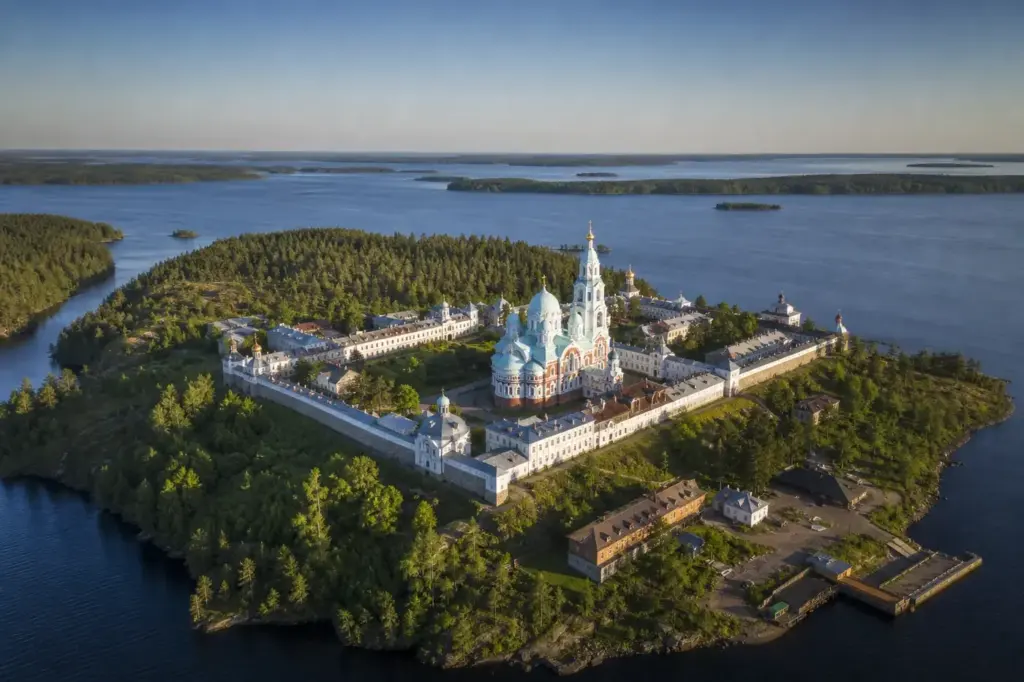
Valaam Island and Monastery is a stauropegic Orthodox monastery on Valaam, the largest island in Lake Ladoga, Europe’s largest lake, in Russian Karelia. The monastery stands at the centre of an archipelago of more than 50 islands, with numerous smaller hermitages (called sketes) scattered across them.
The monastery dates back to the 14th century and is part of the Silver Ring of cultural and historical centers of Northwestern Russia. Today it is one of the most important pilgrimage sites in Orthodox Russia, reopened to monks and visitors after decades of Soviet closure. The island feels remote and contemplative, shaped by harsh winters, pristine forests, and the voices of monks in centuries-old churches.
Quick Facts
| Russian name | Валаамский монастырь |
|---|---|
| Built / opened | 1407 |
| Architect(s) | Aleksey Gornostayev |
| Address | Valaam Island, Lake Ladoga, Republic of Karelia, Russia Google MapsApple MapsYandex Maps2GIS |
| District | Republic of Karelia |
| Admission | ₽₽ |
| Best time to visit | Late spring through early autumn (May to September) is optimal. Summer offers the most reliable ferry schedules, daylight for walking, and mild temperatures. Autumn (September) brings fewer visitors and dramatic light on the lake.Winter (November to March) is extreme: ice may make ferry access difficult or impossible, temperatures drop well below freezing, and daylight is brief. Winter visits are for dedicated pilgrims only.Weekdays are quieter than weekends and holidays, especially in summer when cruise visitors arrive. |
| Recommended duration | 4–6 hours |
| Website | valaam.ru |
What Is (and Isn't) Part of a Visit to Valaam Island and Monastery, Karelia?
| Part | Status | Notes |
|---|---|---|
| Main monastery complex with cathedral, refectory, and monks' cells | Included in the standard ticket | Open to visitors during daylight hours; guided tours available. |
| Transfiguration Cathedral services | Included in the standard ticket | Services open to visitors; check schedule on arrival. Some services may be in Church Slavonic. |
| Walking paths to outer hermitage chapels | Included in the standard ticket | Some sketes are accessible by marked trails; others are restricted to monks. |
| Skitsky Island hermitage | Separate ticket or institution | Requires abbatial blessing and separate boat or walking route; not open to casual visitors. |
| Museum or visitor centre | Not open to visitors | No dedicated museum; monastic library not open to public. |
| Lake Ladoga ferry or cruise from Sortavala or Saint Petersburg | Outside / not part of it | Access to the island requires ferry booking. Ferries are a separate service; see Getting There. |
Why Visit Valaam Island and Monastery, Karelia?
The Valaam monastery was the first Orthodox monastery in Karelia, a northern outpost of the Eastern Orthodox Church. The monastery complex reveals layers of history in its architecture and sacred art, from 18th-century restoration to Soviet-era survival and post-Soviet revival.
Visiting means encountering working monastic life: chant echoes in stone churches, monks move through courtyards, and the island’s forests and shores offer quiet reflection. The journey itself—by ferry across Lake Ladoga—is part of the experience, isolating you from mainland noise and ritual.
How Valaam Island and Monastery, Karelia Is Laid Out
The monastery complex includes a central estate with cathedrals, cells, and administrative buildings, as well as numerous sketes (smaller hermitages) scattered across the archipelago’s islands. The main complex sits on the largest island, Valaam proper.
The Transfiguration Cathedral, rebuilt in the 19th century, anchors the central compound. Stone walls and gates enclose the main monastery precinct. Walking paths connect the central buildings to the surrounding forests and beaches. Smaller hermitages on nearby islands (such as Skitsky Island) can be reached by boat or on foot across narrow straits, but some are closed to casual visitors.
A single main entrance serves most day visitors. Plan to walk the monastery’s central grounds in 2–3 hours; exploration of outlying sketes requires extra time and may require special permission.
Highlights of Valaam Island and Monastery, Karelia
Transfiguration Cathedral
The stone Transfiguration Cathedral was built under Father Superior Damaskin (1839–1881), when the monastery reached a peak of prosperity. The cathedral's white stone walls and orthodox domes dominate the skyline. Inside, icons and liturgical art reflect decades of restoration. The cathedral is the spiritual centre of the monastery and the site of daily services open to visitors.
Tip: Attend a service to experience chant and ritual in a working church. Services typically occur in the early morning and evening; ask staff for the current schedule on arrival.
Skitsky Island
The white Hermitage is located in the depths of the Skitsky island and is the largest and most austere monastery of Valaam. It is only possible to visit with the blessing of the Abbot. The island lies just northwest of the main monastery. Its remote, forested setting exemplifies the monastery's hermitage tradition—monks living in solitude for prayer and contemplation.
Tip: Do not attempt to visit Skitsky without explicit permission. Ask the main monastery office if a blessing for a visit can be arranged in advance.
Central Monastery Grounds
The heart of the complex contains the refectory, monks' cells, abbatial residence, and workshop buildings arranged around courtyards. Stone walls frame the ensemble. The buildings blend 19th-century Russian Revival style with practical monastic design. Visitors can walk between major structures and observe daily monastic rhythms—monks moving to prayer, work, and meals.
Tip: Respect the working monastery: do not enter cells or private areas, and speak quietly. Photography may be restricted in certain buildings; ask before photographing.
18th- and 19th-Century Restoration Layers
In the 18th century, under Russian rule, the monastery was magnificently restored. Architect Aleksey Gornostayev was notable as a pioneer in Russian Revival and the builder of Valaam Monastery hermitages. The visible architecture—stone walls, multi-domed churches, hermitage chapels—reflects this 18th- and 19th-century rebuilding after centuries of abandonment and ruin.
Tip: Pay attention to architectural details: domes, bell towers, carved stone, and wooden roofs. The interplay of older and restored elements tells the monastery's survival story.
Lake Ladoga Views
The monastery sits on Valaam Island's shores, with views across Europe's largest lake to forested islands and distant mainland. The waterscape changes dramatically with season—summer's blue calm, autumn's storms, winter's ice. The lake's isolation and scale reinforce the monastery's remote spiritual mission.
Tip: Walk to the lakeshore at sunset. The light on water and distant islands is stunning, and the quiet amplifies the sense of remoteness that drew monks here centuries ago.
Hermitage Chapels and Sketes Network
Monastic sketes are dotted all over the island. These are small chapels and monks' dwellings, some accessible to visitors, others restricted. They dot the archipelago's forests and clearings, each a retreat for individual prayer and contemplation. Walking between them reveals the vast territorial scope of the monastery's authority.
Tip: Ask at the main office which sketes are open to visitors. Some are on walking paths; others require boat access or abbatial permission. Marked trails guide you, but guides are recommended for first-time visitors.
Atmosphere
The monastery feels suspended in time and isolation. Church bells ring across water and forest. Incense drifts from open chapel doors. Monks in dark vestments move quietly through stone courtyards and along forest paths, absorbed in prayer and work. The air carries both sacred stillness and practical monastic bustle—repairs underway, gardens tended, chant rehearsed.
Summer brings pilgrims and visitors; the island feels less solitary but still reverent. Autumn storms roll across Ladoga. Winter silence deepens, with snow, frozen paths, and few visitors. The landscape—rocky shores, pine and birch forests, patches of cleared ground—feels harsh and demanding, matching the monks’ vocation. Visitors are welcome but not entertained; the monastery prioritizes prayer over tourism.
History of Valaam Island and Monastery, Karelia
It is not clear when the monastery was founded, as the cloister is not mentioned in documents before the 16th century. Dates from the 10th to the 15th centuries have been suggested. According to one tradition, the monastery was founded by a 10th-century Greek monk, Sergius of Valaam, and his Karelian companion, Herman of Valaam. According to scholarly consensus, the monastery was founded at some point towards the end of the 14th century.
The Valaam monastery was the first Orthodox monastery in Karelia, a northern outpost of the Eastern Orthodox Church against pagans and soon a western outpost against the Catholic, and later Lutheran, Sweden. The monastery grew modestly, but its remote location made it vulnerable to raids. The 16th century brought intense border struggles between Russia and Sweden, transforming Karelia into a contested frontier.
In 1578, monks and novices were beaten to death by the (then) Lutheran Swedes. After another attack, the monastery was depopulated between 1611 and 1715. The buildings were burnt to the ground, and the Karelian border between Russia and Sweden was drawn through the lake.
In the 18th century, under Russian rule, the monastery was magnificently restored. Emperor Alexander I visited in 1819 and elevated it to first-class status, granting benefits that fueled growth. Under Father Superior Damaskin (1839–1881), the monastery reached a peak of prosperity: the stone Transfiguration Cathedral was built. Architect Aleksey Gornostayev was a Russian architect notable as a pioneer in Russian Revival and the builder of Valaam Monastery hermitages.
The monastery was gradually evacuated during the Winter War. The monastery was repeatedly bombed, but the books in the library, built to withstand fire, and the main church were unhurt. When the area was annexed by the Soviet Union after the Winter War, the monastery was moved to Heinävesi in the Finnish Lakeland as the ‘New Valamo’. With the loss of its monastic community and the inclusion of Lake Ladoga in the Soviet Union the buildings of the original monastery on Valaam Island remained unused as a secular population moved on to the island. In time the island became a Soviet military base.
The monastery was closed during the Soviet era, but since being reopened it has gone from strength to strength, becoming a major site of tourism and pilgrimage and practically taking over the whole island, amid some controversy.
Legends and Myths about Valaam Island and Monastery, Karelia
Sergius and Herman of Valaam: Founders from the North
Legend – historically unreliable. Church tradition attributes the monastery's establishment to two 10th-century missionaries: the Greek monk Sergius of Valaam and his Karelian companion, Herman of Valaam, who are venerated as saints and considered the monastery's patrons. According to this legend, they arrived in the region as evangelists from Novgorod, establishing a monastic community on the island to spread Orthodoxy among local pagan tribes. In the 1790s the monastery provided the group of eight missionaries that was sent to Alaska in the North American northwest to evangelize the natives for Orthodox Christianity. This group of monastics included St Herman and St Juvenaly.
Alexander I's Imperial Visit and Elevation
Disputed by historians. Emperor Alexander I visited in 1819 and elevated it to first-class status, granting benefits that fueled growth. The visit marked the monastery's recognition as one of Russia's most important spiritual centres, boosting its prestige and resources. This elevation shaped its grand 19th-century expansion.
Tickets and Booking for Valaam Island and Monastery, Karelia
| Ticket | Price | Includes |
|---|---|---|
| Day visitor admission | ₽₽ | Entry to the monastery grounds, access to the Transfiguration Cathedral and central buildings, walking paths, and skete chapels open to the public. |
₽ budget · ₽₽ moderate · ₽₽₽ upscale · ₽₽₽₽ splurge. Price levels are estimates compared with typical prices for visitors.
Admission is managed on-site; there is no online ticketing system for day visitors. Visitors arrive via ferry from Sortavala or as part of cruises from Saint Petersburg. Ferries typically operate May to September; winter access is limited due to lake conditions.
Upon arrival, proceed to the main monastery office near the entrance to pay admission and receive guidance on accessible areas. Group visitors should arrange advance notice. Photography rules vary by area; ask staff before photographing inside churches.
Rates for Russian citizens, pilgrims, and children may differ. Check the official website at valaam.ru for current visiting conditions, service schedules, and any seasonal restrictions.
Plan and Book
Suggested itineraries Valaam Island and Monastery, Karelia
3–4 hours
Main monastery grounds tour. Start at the central entrance and visit the Transfiguration Cathedral. Walk the monastery courtyard, observe the refectory and administrative buildings. Attend a service if timing allows. Explore one nearby skete chapel if open. Return to ferry.
5–6 hours
Full-day monastic immersion. Morning service in the cathedral. Guided walk to one or two outer hermitage chapels. Lunch break (picnic or at a simple cafe if available). Afternoon walk along the lakeshore and to forest trails. Second service (evening) or quiet prayer time. Return to ferry.
Overnight or multi-day pilgrimage
Stay in monastery guest quarters (book in advance; reserved for pilgrims and serious visitors). Attend dawn and evening services daily, explore multiple sketes with guidance, participate in monastic rhythm. Ideal for spiritual retreat rather than sightseeing.
How to Get to Valaam Island and Monastery, Karelia
By ferry from Sortavala: The nearest town is Sortavala, on the mainland. Ferries depart from Sortavala harbour to Valaam Island (approximately 40–60 minutes crossing). Ferries run during warmer months (May to September); winter access is limited. Book tickets in advance via a local travel agency or at Sortavala harbour.
By cruise from Saint Petersburg: Overnight cruises depart Saint Petersburg and arrive at Valaam the following morning. These include accommodation and are popular with pilgrims and tourists. Multiple cruise operators offer this route in summer.
Getting to Sortavala: Sortavala is reachable by car (approximately 4–5 hours from Saint Petersburg) or by local bus services. Arrange a taxi or rental car in Saint Petersburg for the journey.
Accessibility
The monastery is built on uneven, often rocky terrain. Many buildings have stairs, and paved paths are limited. Wheelchair access to the main complex is restricted. The Transfiguration Cathedral has steps at its entrance.Paths to outer sketes are forest trails with roots and stones—not accessible to wheelchairs or those with mobility difficulties. The ferry itself may have limitations for wheelchair users depending on weather and vessel design; confirm with the ferry operator in advance.There are benches and shaded rest areas in the monastery courtyard. Accessible toilets are located near the entrance. Ask staff upon arrival about specific accessibility concerns; monastic staff can suggest adapted routes or assist as possible.
Food Nearby
The monastery does not operate a public cafe or restaurant. A small monastery canteen may serve simple meals to pilgrims; ask at the office. Most day visitors bring packed food or lunch from Sortavala before boarding the ferry.Water is available on the island. Bring snacks, water, and a picnic lunch. In summer, a kiosk near the pier may sell basic supplies.
What to Bring
Comfortable walking shoes with good grip (paths are rocky and can be muddy). A light jacket even in summer—the lake creates cool breezes. Sunscreen and a hat. A water bottle. Binoculars for wildlife and distant island views. A notebook for reflection. Modest, respectful clothing (covered shoulders and knees when entering churches). A camera; use discretion near monks and in sacred spaces.Ferry and weather can cause delays; bring a book. Insect repellent in summer. No heavy luggage—ferries are small and crowded. Bag checks may occur at the ferry; nothing controversial or restricted items.
Best Views and Photo Spots of Valaam Island and Monastery, Karelia
Lakeshore north of the main monastery
The total area of the Valaam archipelago's more than 50 islands is 36 km2. The largest island is Valaam. From the northern shore, the Transfiguration Cathedral domes rise above the treeline, framed by water and distant islands.
Best time: Late afternoon light, clear days in June to August. The sun angles across the water, illuminating the stone architecture.
Monastery entrance courtyard at sunrise
The central buildings, cathedral dome, and bell tower backlit by early light. Mist often rises from the ground and water, creating an ethereal atmosphere. Monks move through the courtyard preparing for dawn service.
Best time: 30 minutes before sunrise, May to July. Arrive early or stay overnight.
Forest path between main monastery and outer skete
Dappled light through pine and birch forest, stone chapel emerging from trees, the contrast between wild and sacred architecture.
Best time: Mid-morning or late afternoon, any season. Autumn colours intensify the effect.
Lake Ladoga from the pier at Sortavala
Distant view of Valaam Island and its forested outline. Ferries departing or arriving across a vast, often grey-blue expanse.
Best time: Early morning before ferry departure, or at sunset. Weather determines visibility; calm days best show the island's profile.
Photography Rules
Photography is permitted on the monastery grounds and in many outdoor areas. However, flash and tripods are prohibited inside churches and cathedrals. Do not photograph monks without permission. Interior religious art and liturgy may be restricted; ask staff before photographing inside. Drones are not permitted. Be respectful of sacred spaces and posted notices.
Family Suitability
The monastery is suitable for families with older children (10+) and teenagers who can appreciate history and quiet reflection. Young children may struggle with the rocky terrain, lack of dedicated children's facilities, and the long ferry journey. There are no playgrounds, limited food options, and services are lengthy and in Church Slavonic.Strollers are impractical on uneven paths; carriers are better. Families should arrange for quiet, supervised time so children do not disturb worship. Plan shorter visits (3–4 hours) for younger children. Overnight stays suit families wanting deeper immersion but require advance booking.
Russia Vibes Tips
- Book your ferry in advance, especially in July and August. Summer ferries fill quickly, and a missed boat strands you for hours or a full day.
- Attend at least one service—dawn or evening. Even if you do not understand Church Slavonic, the chant, incense, and ritual are powerful and central to understanding the monastery's purpose.
- Respect 'no photography' signs and ask permission before photographing monks. Monasteries are not theme parks; your presence as a visitor is tolerated, not celebrated.
- Hire a guide if available. The monastery's layout, history, and spiritual significance are best understood with expert explanation. Ask at the entrance or book via a Sortavala travel agency.
- Do not expect modern amenities. Bring everything you need—food, water, sunscreen, medicines. The island has no shops, restaurants, or ATMs for visitors.
- Plan extra time for the ferry crossing. Lake Ladoga is large and weather can change rapidly, delaying departures. Arrive at the pier 30 minutes early.
Explore Nearby Valaam Island and Monastery, Karelia
Related guides
 Karelia: Best Places, Lakes, Islands and Travel Tips
Main image: AI-generated illustration. It may not show the place exactly as it looks.
Browse more: More in Republic of Karelia · All Churches · All Karelia · All Sightseeing · All Sightseeing in Karelia
FAQ: Valaam Island and Monastery, Karelia
Is Valaam Island accessible by car?
No. The island is only reachable by ferry from Sortavala or by cruise from Saint Petersburg. There is no bridge or vehicle ferry. Bring only a day pack; luggage is inconvenient on small ferries.
Do I need a Russian visa to visit Valaam?
Yes, if you are a foreign national. Valaam is inside Russian territory. Obtain a tourist visa before travel. Visa requirements vary by nationality; check with a Russian embassy or consulate.
Can I stay overnight on the island?
Yes, but only in monastery guest quarters reserved for pilgrims. Book well in advance through the monastery office or a Sortavala travel agency. Accommodation is simple and prioritized for religious visitors.
Is Valaam Monastery the same as New Valamo in Finland?
No, they are separate monasteries. When the area was annexed by the Soviet Union after the Winter War, the monastery was moved to Heinävesi in the Finnish Lakeland as the 'New Valamo'. The original Valaam in Russia was repopulated and reopened after Soviet closure. Both honour the same founding saints but operate independently.
Are services in Russian Orthodox tradition?
Yes. Services follow Russian Orthodox tradition and are conducted in Church Slavonic, the liturgical language of the Russian Orthodox Church. Services are lengthy (1–2 hours or more). Visitors are welcome to attend but should expect unfamiliar ritual.
What are sketes?
Sketes are small monastic settlements or hermitage chapels where individual monks or small groups live in solitude and prayer. The monastery complex has numerous sketes scattered across the archipelago's islands. Some are accessible to visitors by walking or boat; others are restricted.
Is Valaam safe for solo travellers?
Yes. The island is safe; it is an active monastery and pilgrimage site with visitors daily. Ferry journeys are routine. Bring basic supplies and a basic map. English is not widely spoken; a Russian phrasebook is helpful.
When should I book a ferry ticket?
Book 1–2 weeks in advance for summer travel; earlier for July and August. Winter ferries (if operating) can be booked with less notice, but sailings are infrequent and weather-dependent. Use a Sortavala travel agency or contact the ferry operator directly.
Russia Vibes is a one-person project. A coffee keeps it going
How we research and update our guides
About this guide: AI assistance and accuracy
This guide is created with the help of AI and is based on official sources where available. Mistakes can still happen. Opening hours, prices, rules and other details are given to the best of our knowledge as of the date shown and can change without notice. It offers general recommendations only, not professional, legal or travel advice. Please confirm important details with the official source before you travel; you are responsible for your own plans and decisions.
Packing for this trip
* Affiliate link: as an Amazon Associate we earn from qualifying purchases at no extra cost to you.

Take this guide with you
Get a free PDF of this guide to print or read offline: key facts, tips and a map link on a few clean pages.
Report an issue on this page
Paying for your trip: please read
International sanctions affect payments between Russia and many other countries. In practice, cards issued in the EU, the UK, the US and several other countries often do not work in Russia, Russian cards usually do not work abroad, and some booking platforms, airlines and payment providers limit or suspend their services for Russia. The situation changes frequently.
We do not give legal or financial advice, and this site does not encourage anyone to break or circumvent sanctions. Whatever you plan, you are responsible for following the laws and regulations that apply to you, including those of your country of residence and citizenship.
Many travelers still organise their stay lawfully. It is worth asking your bank or payment provider what is currently permitted, contacting hotels, tour operators and carriers directly about the payment methods they accept, and checking which services are open to customers from your country. Clarify payment, cancellation and refund terms before you commit to a booking, and keep your plans flexible.
Partner links on this site may not be available in every country, and prices, availability and rules in our guides can differ from what you see when you book.