
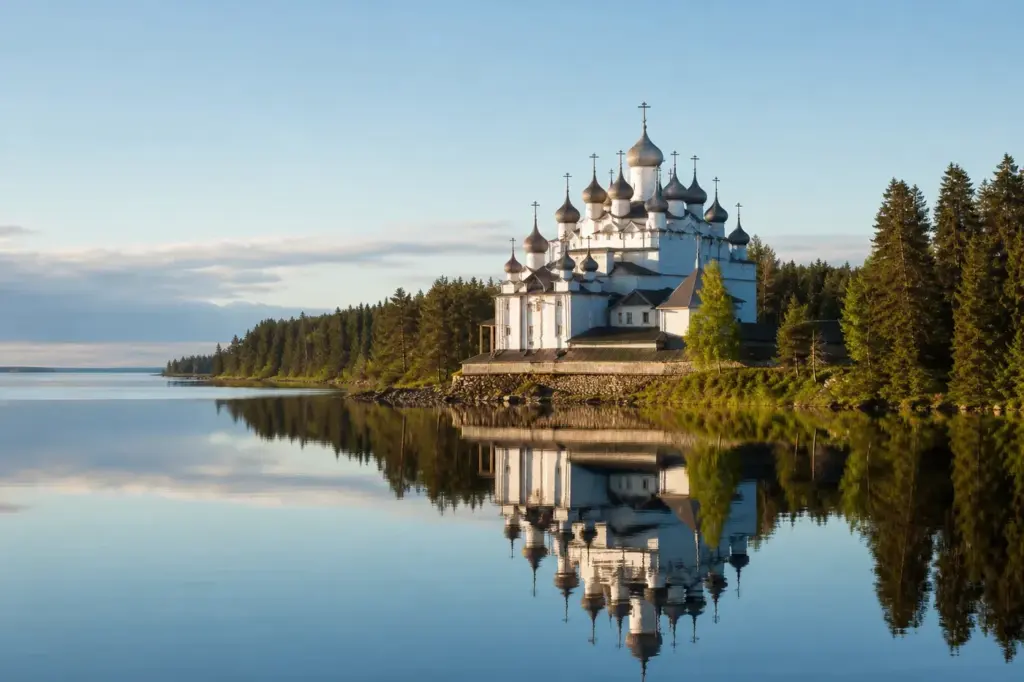
Photographers and landscape lovers find Karelia‘s northern geography irresistible: a region where ancient wooden churches rise above mirror-like lakes, marble canyons glow with jewel-coloured water, and pine forests meet rocky shores. This guide covers 10 essential viewpoints and photo locations across Karelia, chosen for their visual impact, accessibility to visitors, and reliability as operating locations.
Each site offers distinct advantages depending on the season and time of day. Summer brings crystal-clear water and midnight light; autumn turns the forests gold and red; winter reveals the lakes frozen beneath snow. All sites are verified to be open to visitors as of October 2026.
At a Glance
| # | Place | Best for | Good to know |
|---|---|---|---|
| 1 | Ruskeala Mountain Park | Most photographed canyon | Near Sortavala (60 km from Petrozavodsk); paid entry. Best accessed by car or tour. |
| 2 | Kizhi Island, Church of the Transfiguration | Iconic wooden architecture | Lake Onega, 68 km from Petrozavodsk; ferry access takes 1 hour 15 minutes by hydrofoil. Paid museum entry. |
| 3 | Lake Onega Embankment, Petrozavodsk | Urban waterfront views | Petrozavodsk city centre; free access. Walking distance from hotels and the railway station. |
| 4 | Valaam Island, Mount Yeleon Viewpoint | Monastery island panorama | Valaam Island, Lake Ladoga; ferry from various northern ports (5–8 hours travel). Paid monastery access. |
| 5 | Valaam Island Rocky Coastline | Rugged lakeshore landscape | Valaam Island; reachable by ferry from Sortavala, Petrozavodsk or Saint Petersburg. Paid access. |
| 6 | Kivach Waterfall and Nature Reserve | Cascade photography | Near Petrozavodsk (40 km south); accessible by car or organized tours. Free access to public viewing areas. |
| 7 | Petrozavodsk, Devil's Chair Viewpoint | City and lake panorama | Near Petrozavodsk; accessible by car or local transport. Free access. |
| 8 | Lake Onega, Petrozavodsk Docks | Water and ferry boats | Petrozavodsk waterfront; free public access to dock areas. Ferry schedules available at ticket offices. |
| 9 | Sortavala Town Waterfront | Finnish-Karelian heritage views | Sortavala (90 km northwest of Petrozavodsk); accessible by car. Free public access. |
| 10 | Kizhi Island Open-Air Museum, Zaonezhie Village | Restored wooden heritage | Kizhi Island; ferry access from Petrozavodsk (1 hour 15 minutes). Paid museum entry; walking trails free to museum visitors. |
| 11 | Northern Olkhon Island and Cape Khoboy | Remote lake landscapes | Accessible by boat tour from Petrozavodsk or Kizhi Island (3–6 hours depending on starting point). Organized tours recommended. |
How We Chose
Entries were selected based on:
- Verified current operation and public access
- Significant visual impact and photogenic qualities documented by official sources
- Diversity of subjects (architecture, landscape, water views, forest scenes)
- Accessibility by boat, car or foot from major towns
- Suitability for photography across different seasons
1. Ruskeala Mountain Park – Most photographed canyon
A former marble quarry transformed into a landscape of striking beauty. The main attraction is a canyon filled with emerald-green groundwater reflecting pale marble walls. The contrast between water and stone creates vivid compositions. Underground tunnels and grottos add depth to explorations. Ziplines crossing the canyon offer dynamic aerial views. The park has facilities including viewpoints positioned for optimal photography angles.
Good to know: Near Sortavala (60 km from Petrozavodsk); paid entry. Best accessed by car or tour.
Tip: Arrive in early morning or late afternoon for warmer, lower-angle light that brings out the emerald hue of the water and creates longer shadows on the canyon walls.
2. Kizhi Island, Church of the Transfiguration – Iconic wooden architecture
The 22 wooden domes of this 18th-century church are among the most recognizable images of Russian architecture. Built without nails, the structure dominates photographs from multiple angles across the island. The bell tower reaches 30 metres and offers an elevated view of the entire ensemble and Lake Onega. Early morning light at sunrise makes the domes glow distinctly. The surrounding open-air museum contains restored village buildings that create authentic compositional context.
Good to know: Lake Onega, 68 km from Petrozavodsk; ferry access takes 1 hour 15 minutes by hydrofoil. Paid museum entry.
Tip: Shoot from the lakeshore at sunrise when the domes are backlit and the water is calm; the bell tower interior offers unexpected perspectives from 30 metres up.
3. Lake Onega Embankment, Petrozavodsk – Urban waterfront views
The capital's waterfront offers unobstructed views across Europe's second-largest lake. Sculptures—gifts from sister cities—punctuate the promenade. Sunset and dusk light transforms the water and sky. The embankment remains accessible year-round and provides an accessible entry point for photographing the region without boat travel. Foreground interest from the sculptures aids composition.
Good to know: Petrozavodsk city centre; free access. Walking distance from hotels and the railway station.
Tip: Return to the embankment at different times of day and seasons; winter produces dramatic ice formations and low-sun reflections, while summer offers extended dusk lasting past 23:00 in June.
4. Valaam Island, Mount Yeleon Viewpoint – Monastery island panorama
A viewing platform above the Transfiguration Monastery on Lake Ladoga offers sweeping vistas of the archipelago's rocky shores, pine forests, and white monastery domes. The Resurrection Chapel sits on the mountain adjacent to the viewpoint. Water views frame the sacred buildings below. The forested landscape and rocky coastline create depth and layered composition. Seasonal fog and mist add atmospheric texture.
Good to know: Valaam Island, Lake Ladoga; ferry from various northern ports (5–8 hours travel). Paid monastery access.
Tip: Visit mid-morning after fog clears but before noon glare flattens the light; the viewpoint faces northwest, so afternoon and sunset provide the best directional lighting.
5. Valaam Island Rocky Coastline – Rugged lakeshore landscape
Dense pine forests meet Lake Ladoga's grey granite and volcanic rock shores on Valaam. The contrast between dark tree trunks and pale stone creates strong visual definition. The water reflects sky and creates mirror-like surfaces in calm conditions. Ecological walking trails lead along the shore where compositions include foreground rocks, middle-ground forest, and distant water. The small wooden bridges and hermitage structures hidden in the forest add human scale.
Good to know: Valaam Island; reachable by ferry from Sortavala, Petrozavodsk or Saint Petersburg. Paid access.
Tip: Walk the northeastern shore in late afternoon for warm sidelighting on the rocky banks; autumn offers red aspen leaves against green moss for enhanced colour contrast.
6. Kivach Waterfall and Nature Reserve – Cascade photography
One of Europe's largest waterfalls, Kivach drops water over a rocky escarpment surrounded by taiga forest. The cascade splits into streams that flow through dark rocks. The surrounding arboretum adds cultivated specimen trees to the wild landscape. The waterfall's power changes seasonally—highest flow in spring melt and autumn rains. Multiple viewpoints along the reserve trails allow varied compositional approaches. The churning water and mist create dynamic movement in images.
Good to know: Near Petrozavodsk (40 km south); accessible by car or organized tours. Free access to public viewing areas.
Tip: Bring a polarizing filter to cut reflections from wet rocks and spray; shoot in overcast conditions for even light on the falling water, or early morning for soft directional light.
7. Petrozavodsk, Devil's Chair Viewpoint – City and lake panorama
A natural observation point overlooking Petrozavodsk and Lake Onega from elevation. The city spreads below with buildings framed against the lake's horizon. The viewpoint offers rare vantage for capturing the scale of the region's largest city and its relationship to the water. Forest surrounds the observation area, creating foreground framing. Sunrise and sunset produce dramatically lit scenes.
Good to know: Near Petrozavodsk; accessible by car or local transport. Free access.
Tip: Visit just before sunset for warm light and minimal glare; morning light creates long shadows through the forest that frame the city below.
8. Lake Onega, Petrozavodsk Docks – Water and ferry boats
The passenger ferry dock at Petrozavodsk hosts the Meteor hydrofoils and traditional boats that service Kizhi Island and other routes. The dock area frames the ships against the open lake and horizon. Early morning light catches the vessels before departure. The busy water traffic, dock structures, and passenger activity create documentary and dynamic compositions capturing Karelia's connection to its lakes.
Good to know: Petrozavodsk waterfront; free public access to dock areas. Ferry schedules available at ticket offices.
Tip: Arrive 30 minutes before departure times to capture activity and light without boat congestion; shoot toward the rising sun for silhouettes of passengers and vessels.
9. Sortavala Town Waterfront – Finnish-Karelian heritage views
The town of Sortavala on Lake Ladoga's shore retains Karelian and Finnish architectural heritage. Waterfront buildings reflect cultural history. The lakeside setting offers water views with architectural foreground. The town's compact layout and historic wooden houses provide authentic cultural context and texture. Seasonal changes—autumn colours, winter snow on roofs—create varied photographic opportunities throughout the year.
Good to know: Sortavala (90 km northwest of Petrozavodsk); accessible by car. Free public access.
Tip: Walk the waterfront in golden hour light (sunrise or sunset) for warm tones on historic building facades and reflections in calm water.
10. Kizhi Island Open-Air Museum, Zaonezhie Village – Restored wooden heritage
Beyond the Transfiguration Church, the museum preserves traditional wooden houses, barns, chapels and windmills moved from villages across Karelia. Each structure offers individual photographic subject matter. The village layout recreates authentic settlement patterns. The varied ages and restoration states of buildings provide rich textural detail. Interior scenes of domestic life behind visible windows add narrative depth. Seasonal context—spring gardens, autumn harvest preparations, winter snow—changes meaning and mood.
Good to know: Kizhi Island; ferry access from Petrozavodsk (1 hour 15 minutes). Paid museum entry; walking trails free to museum visitors.
Tip: Shoot architectural details—carved window frames, roof patterns, door hinges—that reveal craft tradition; overcast days even the harsh shadows and reveal interior details visible through windows.
11. Northern Olkhon Island and Cape Khoboy – Remote lake landscapes
Lake Onega's northern archipelago offers wilderness views with minimal human presence. Rocky islands, pine-covered shores, and expansive water create compositional depth. The light quality differs markedly from populated areas—cleaner, less polluted atmosphere. Isolation allows patience for rare weather effects and light conditions. Boat-based access ensures fresh perspectives on the landscape from water level.
Good to know: Accessible by boat tour from Petrozavodsk or Kizhi Island (3–6 hours depending on starting point). Organized tours recommended.
Tip: Charter a private boat if budget allows; the flexibility to wait for specific light conditions and move quickly to best vantage points maximizes photographic potential in remote locations.
Russia Vibes Tips
- Polarizing filters are essential in Karelia. The bright water and sky create strong reflections; a polarizer cuts glare, deepens blue hues, and reveals detail in wet rocks and foliage.
- Battery drain accelerates in cold weather. Carry 50% more batteries than you would for a single day in temperate regions, and keep spares warm in an inner jacket pocket.
- Light conditions shift dramatically by season. Summer (June–August) offers near-24-hour daylight; autumn (September–October) provides warm low-angle light for 8–10 hours; winter (December–February) delivers short intense light windows and clear skies ideal for Northern Lights. Plan trips to match desired light quality.
- Early morning and late evening are essential for strong light. Midday summer light above 60° latitude becomes harsh and flat. Shoot between 6 a.m. and 10 a.m., then again from 3 p.m. onward for dimensional modeling.
- Boat motion matters. Ferries to Kizhi and Valaam provide stable platforms, but bring image stabilization (lens or in-body). Hand-held telephoto lenses require fast shutter speeds—1/1000 s or faster—to overcome water-induced vibration.
- Waterproofing and humidity protection are non-negotiable. Lake spray and mist condense on warm optics. Pack silica gel, lens covers, and microfibre cloths. Store lenses in sealed bags in your accommodation, not in the car overnight where temperature swings accelerate condensation.
Explore Nearby Best Viewpoints and Photography Spots, Karelia
Browse more: All Guides · All Guides in Karelia · All Karelia · All Viewpoints and Photo Spots
FAQ
What is the best season for photography in Karelia?
Summer (June–August) offers extended daylight and crystal-clear water but can have midday light flatness. Autumn (September–October) delivers warm, directional light and forest colour changes—ideal for most photographers. Winter permits Northern Lights photography but requires specialized equipment and thermal management.
Do I need a boat trip to photograph Karelia?
No. Ruskeala Mountain Park, Petrozavodsk embankment, Kivach Waterfall, Sortavala, and Devil's Chair are all reachable by car or local transport. Boat access (Kizhi, Valaam, northern islands) expands options but is not mandatory.
What is the difference between Kizhi and Valaam for photography?
Kizhi Island offers iconic wooden architecture with 22 domes in a concentrated open-air museum setting—ideal for architectural and cultural photography. Valaam provides monastery buildings combined with wild rocky coastline and forest—better for landscape and nature combinations.
Can I photograph inside the churches?
Rules vary. Active monastery spaces (Valaam Transfiguration Cathedral) restrict photography inside. The Kizhi Church of the Transfiguration typically allows exterior photography and interior viewing without flash. Always check on arrival.
How far in advance should I book ferries and tours?
Book ferries 1–2 weeks ahead in summer (peak season). Winter services are infrequent and weather-dependent; check schedules directly with operators. Guided photography tours can be arranged 2–4 weeks in advance.
Is drone photography permitted in Karelia?
Regulations depend on location. National heritage sites (Kizhi, Valaam) have restrictions. Ruskeala Mountain Park and public areas may permit drones—contact operators ahead of travel. Always respect local rules.
What equipment should I prioritize for Karelia's climate?
Weatherproofing is critical: sealed camera bodies, weatherproof lens(es), remote shutter release for long exposures and self-portraits in harsh conditions, sturdy tripod for stable water and architectural shots, and reliable battery management system.
Are there professional photography guides available?
Yes. Several Petrozavodsk-based operators offer guided photography tours customized to season and skill level. Arrange through your accommodation or tour companies. Individual guides (often photographers themselves) are also available for hire through tourism boards.
Russia Vibes is a one-person project. A coffee keeps it going

Take this guide with you
Get a free PDF of this guide to print or read offline: key facts, tips and a map link on a few clean pages.
Report an issue on this page
Paying for your trip: please read
International sanctions affect payments between Russia and many other countries. In practice, cards issued in the EU, the UK, the US and several other countries often do not work in Russia, Russian cards usually do not work abroad, and some booking platforms, airlines and payment providers limit or suspend their services for Russia. The situation changes frequently.
We do not give legal or financial advice, and this site does not encourage anyone to break or circumvent sanctions. Whatever you plan, you are responsible for following the laws and regulations that apply to you, including those of your country of residence and citizenship.
Many travelers still organise their stay lawfully. It is worth asking your bank or payment provider what is currently permitted, contacting hotels, tour operators and carriers directly about the payment methods they accept, and checking which services are open to customers from your country. Clarify payment, cancellation and refund terms before you commit to a booking, and keep your plans flexible.
Partner links on this site may not be available in every country, and prices, availability and rules in our guides can differ from what you see when you book.
How we research and update our guides
About this guide: AI assistance and accuracy
This guide is created with the help of AI and is based on official sources where available. Mistakes can still happen. Opening hours, prices, rules and other details are given to the best of our knowledge as of the date shown and can change without notice. It offers general recommendations only, not professional, legal or travel advice. Please confirm important details with the official source before you travel; you are responsible for your own plans and decisions.
* Affiliate link: as an Amazon Associate we earn from qualifying purchases at no extra cost to you.