
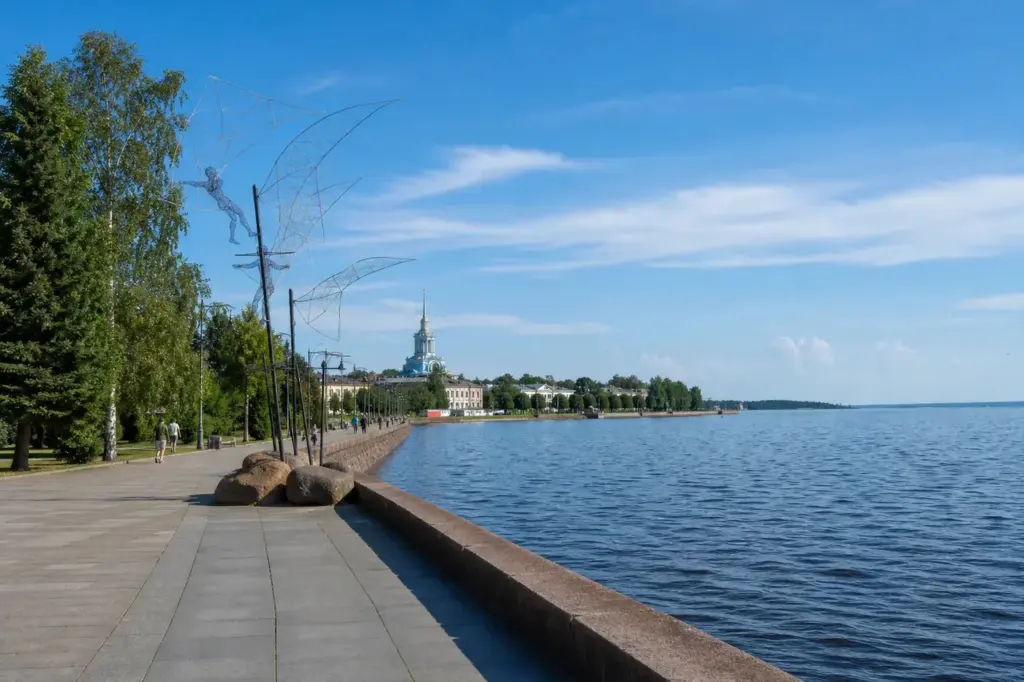
Petrozavodsk, the capital of the Republic of Karelia, stretches along the western shore of Lake Onega, Europe’s second-largest lake. Founded in 1703 by Peter the Great as an ironworks to supply cannons for the Baltic Fleet, the city sits 27 kilometers of waterfront with a population around 280,000.
Today Petrozavodsk is a cultural hub and the main departure point for visits to Kizhi Island, a UNESCO World Heritage site with one of the world’s most remarkable collections of wooden churches. The city itself blends neoclassical architecture from the 18th century—built after Catherine the Great granted it city status in 1777—with Soviet-era landmarks and a thriving contemporary arts scene.
Quick Facts
| Russian name | Петрозаводск |
|---|---|
| Built / opened | 1703 |
| Address | Petrozavodsk, Republic of Karelia, Russia Google MapsApple MapsYandex Maps2GIS |
| District | Arkhangelsk Oblast |
| Best time to visit | Late May through September is the ideal season. Summer brings long daylight (nearly 20 hours in June), mild temperatures and active cultural events. The embankment and outdoor attractions are at their best. Winter (November–March) is cold and snowy, with short daylight but a different aesthetic; museums and theaters remain open. Spring and autumn are cooler and less crowded. Weekday mornings tend to be quieter than weekends; mid-week visits avoid the busiest crowds. |
| Recommended duration | 2–3 days |
What Is (and Isn't) Part of a Visit to Petrozavodsk, Karelia?
| Part | Status | Notes |
|---|---|---|
| Petrozavodsk city itself | Included in the standard ticket | Open year-round. Main attractions—embankment, museums, churches, parks—are all publicly accessible without special passes. |
| Kizhi Island | Separate ticket or institution | Requires a separate ferry or hydrofoil ticket from Petrozavodsk embankment. UNESCO World Heritage site with open-air museum; plan a full day trip. |
| Besovets Airport | Separate ticket or institution | Located 16 km south of Petrozavodsk; used for flights in and out of the region, not part of city itself. |
| Karelia region (forests, lakes, rapids) | Outside / not part of it | Petrozavodsk is the base for accessing Karelia's wilderness and other attractions. Excursions require guides, vehicles, or organized tours. |
| Kivach Waterfall and Ruskeala Mountain Park | Separate ticket or institution | Popular day trips from Petrozavodsk; each requires separate transport (car, tour or minibus) and entrance fees. |
Why Visit Petrozavodsk, Karelia?
Petrozavodsk serves as your entry to one of Russia’s most distinctive regions. The city is a starting point for day trips to Kizhi Island and other natural attractions like Kivach Waterfall and Ruskeala Mountain Park. Walk the Onega Embankment at lakeside, a landscaped promenade with monuments and views across the water to Petrozavodsk Bay. The Karelian State Museum of Local Lore preserves the region’s indigenous cultures and history; the National Museum of the Republic of Karelia showcases regional art and archaeology.
The city itself repays exploration—its neoclassical center around Round Square, theaters and concert halls, and smaller museums devoted to maritime heritage, local crafts and traditional arts make it a genuine cultural destination, not merely a transit point.
How Petrozavodsk, Karelia Is Laid Out
The city extends north-south along the lake. The main street, Prospekt Lenina, descends from the railway station (at Vokzal Square in the north) down toward the water. A 20-minute walk from the station brings you to the Onega Embankment, the city’s focal point for waterfront strolls, monuments and ferry departures.
Round Square, the city’s neoclassical center redesigned under Catherine the Great, sits inland to the east. North of the embankment, Governor Park offers green space and views. Museums cluster near Round Square and along the embankment; theaters and concert halls occupy central locations. The western shore promenade is the easiest place to orient yourself—all routes lead down to it.
Highlights of Petrozavodsk, Karelia
Onega Embankment and Lake Promenade
The city's most recognizable feature is this landscaped waterfront walk along Lake Onega. The embankment stretches for miles and includes memorials, sculptures (including a Monument to Peter the Great), and wide views across the lake. From here you also see the departure piers for ferries and hydrofoils to Kizhi Island. The embankment is open year-round and best explored on foot; lakeside paths allow for unhurried walks and photo stops. This is where locals come to relax, and where you'll find the most animated street life.
Tip: Visit at sunrise or golden hour for the best light on the water. The embankment is busiest on sunny weekends; weekday mornings tend to be quieter.
Alexander Nevsky Cathedral
This Orthodox cathedral stands out for its distinctive golden domes. Built in the 19th century in the neoclassical style with Byzantine influences, it serves as both an active place of worship and a architectural landmark visible from many parts of the city center. The cathedral sits in the historic downtown area, walkable from Round Square and the embankment. Interior decoration includes traditional Orthodox iconography.
Tip: Cathedral hours vary; check locally before visiting. Photography inside may be restricted; ask permission of staff on arrival.
Karelian State Museum of Local Lore
Founded in 1871 by the provincial governor, this museum occupies a late 18th-century stone building that was the governor's house—itself a federal architectural monument. Exhibits focus on the indigenous Karelian, Vepsian and Russian cultures of the region, with displays of traditional dress, household objects, hunting and fishing tools, and ethnographic materials. The building and its setting convey the city's history as well as its contents. Allow 1–2 hours to see the core collections.
Tip: The museum is small enough to see in a morning visit. Label text is primarily in Russian; a guide (available separately) can help with context.
National Museum of the Republic of Karelia
Housed in the historic center, this museum covers the full span of the region's past, from prehistoric archaeology and geological specimens through Soviet times. Collections include ancient finds, ethnographic displays of traditional life, and contemporary art. The museum offers a comprehensive overview of who lived here and how, from Novgorodian iron-workers of the Middle Ages through modern Karelia. Plan 2–3 hours for a substantial visit.
Tip: Some exhibits change seasonally. The museum's layout can be confusing; staff at the entrance can suggest an efficient route through your areas of interest.
Sea Museum of the Polar Odyssey
This museum showcases maritime history and traditional wooden boat-building. Members of the Polar Odyssey Club, a shipwright collective, have built accurate replicas of historic vessels that successfully navigated multiple seas. The museum includes both indoor exhibits and full-scale boats on display that visitors can explore and touch. The enthusiasm of the staff and the hands-on approach make it memorable, even if the building itself is modest. Allow 1–2 hours.
Tip: The museum can be hard to find without directions; ask at your hotel or the tourist information office. Bringing a Russian speaker or using translation helps clarify the mariners' stories, which are the real draw.
Round Square and Neoclassical Center
In 1777, when Catherine the Great granted Petrozavodsk city status, a new neoclassical city center was designed around a circular plaza. The square itself and surrounding buildings remain the architectural heart of the city, with a mix of original structures and later additions. Walking tours of the center reveal late 18th- and 19th-century facades, some restored and some weathered. This area contrasts sharply with Soviet-era construction elsewhere in the city.
Tip: The square is best photographed in early morning or late afternoon light, when the facades are well-lit and crowds are minimal. Street cafés around the square offer places to rest.
Monument to Peter the Great
A prominent statue of the city's founder stands near the embankment, in close proximity to the harbor where ferries depart. The monument marks the historical origin point—Peter the Great envisioned the iron foundry that grew into a city. The location places the statue where it overlooks the very water that made the settlement valuable. It is a popular photo spot and a focal point for visitors arriving via the lake.
Tip: The best views of the statue and harbor are from the embankment east of the monument, where you can frame the water behind it.
Governor Park
This green space in the city center offers a respite from urban walking. Laid out with paths, benches and traditional Russian landscaping, it provides views across the lower city toward the lake and contains smaller monuments and sculptures. The park reflects the 18th-century urban planning that reshaped Petrozavodsk after it gained city status, and it remains a gathering place for locals. Best visited on dry, mild days; in winter it can be snow-covered and remote-feeling.
Tip: Morning hours tend to be quietest. Locals walk dogs and jog here; it's safe but less focused on tourism than the embankment.
Railway Station Building
The Stalinist-style railway station, completed in the Soviet era, is itself an architectural landmark worth a brief look. The building bears the city's name in both Russian Cyrillic and Karelian script (Petroskoi), a visual reminder of the region's indigenous language. The station serves as the transport hub connecting Petrozavodsk to Moscow, St. Petersburg and other Russian cities, and is a logical starting point when arriving by train.
Tip: If arriving by train, allow time to see the building's facade and interior before heading into the city. The station square itself is the beginning of the main street down to the embankment.
Atmosphere
Petrozavodsk feels like a small regional capital with surprising cultural energy. The city center has the ordered geometry of 18th-century Russian planning—wide streets, defined squares, visible water—but with the solid, straightforward architecture of the Soviet era rubbing shoulders with older neoclassical facades. The embankment is the beating heart, especially on summer evenings when locals stroll, families rest on benches, and the water catches long light.
The city is quieter than Moscow or St. Petersburg but not sleepy. You’ll hear Russian and local languages spoken. Traffic is manageable; most navigation is on foot or by local buses. Museums and galleries are modest in scale—personal, not overwhelming. Winter transforms the city into something starker and more contemplative, with snow deepening the contrast between the old stone buildings and the frozen lake expanse beyond.
History of Petrozavodsk, Karelia
Petrozavodsk was founded on September 11, 1703, when Prince Alexander Menshikov, acting on orders from Tsar Peter the Great, established a settlement called Petrovskaya Sloboda at the mouth of the Shuya River. The purpose was urgently practical: Peter needed a new source of cannons and anchors for his Baltic Fleet during the Great Northern War against Sweden (1700–1721). A foundry was built, and the settlement grew around it. The factory was first called Shuysky zavod (Factory at the Shuya River), then renamed Petrovsky zavod (Petrine Factory) within a decade.
By 1717, Petrovskaya Sloboda had become Karelia’s largest settlement, with roughly 3,500 inhabitants, a timber fortress, a covered market, and small palaces for the Tsar and his favorite, Menshikov. The wooden church of Saints Peter and Paul, rebuilt in 1772 and renovated in 1789, became the town’s best-known landmark. But Peter’s death and changing military priorities caused the settlement to decline. The foundry closed in 1734, leaving the city largely depopulated.
Recovery came in the reign of Catherine the Great. In 1773, Catherine ordered a new iron foundry built upstream on the Lososinka River, named Alexandrovsky after Alexander Nevsky, the region’s patron saint. It was designed to supply cannons for the Russo-Turkish Wars. More importantly, in 1777, Catherine’s municipal reforms incorporated Petrovskaya Sloboda as an official town and renamed it Petrozavodsk—literally “Peter’s Factory.” At the same time, a new neoclassical city center was planned, focused on a circular Round Square inspired by Enlightenment urbanism. By 1784, Petrozavodsk had grown large enough to become the administrative center of Karelia.
The 19th and early 20th centuries saw Petrozavodsk evolve from a military-industrial town into a cultural center. The city gained museums, theaters, schools and railways. By the Soviet era, the foundries had been replaced by engineering works, timber processing, and shipbuilding, transforming it into a diversified industrial city. Today, those old industries are in decline, but Petrozavodsk has repositioned itself as a cultural and tourist hub, with its neoclassical core and waterfront amenities now the main draws for visitors.
Legends and Myths about Petrozavodsk, Karelia
Peter the Great's Vision
Legend – historically unreliable. Local tradition holds that Peter the Great, standing on the shores of Lake Onega, envisioned a great city that would supply weapons for his new navy and open Russia to trade. Menshikov was dispatched to make it real. While the facts are straightforward—Peter did found the foundry—the romantic telling suggests a moment of imperial foresight, with Petrozavodsk as proof of Peter's genius for transforming Russia through will and strategic investment.
The Wooden Church That Burned
Disputed by historians. The Saints Peter and Paul Church, rebuilt and renovated through the 18th century, stood as the spiritual heart of Petrozavodsk for over two centuries. In October 1924, it was destroyed by fire, along with its original iconostasis. Local memory treats the loss as symbolic of the upheaval of the Soviet transition, a severing of the city's pre-revolutionary identity. No wooden church from that era survives in the city center today.
Catherine's Perfect Circle
Legend – historically unreliable. When Catherine the Great granted Petrozavodsk city status in 1777, she is said to have approved a plan for a perfect neoclassical city centered on a circular square, embodying Enlightenment ideals of rational urban design. The Round Square that still exists is held up as evidence of this ambitious vision, though in practice the city developed more messily than the plan allowed. The story illustrates how 18th-century Russian rulers saw city-building as a way to impose order and civilization on the frontier.
Tickets and Booking for Petrozavodsk, Karelia
Petrozavodsk is free to walk and explore. Individual museums charge separate entrance fees; ticket prices differ for Russian residents and foreign visitors. To visit museums, buy tickets at the museum entrance or check their official websites for advance booking options.
Ferry and hydrofoil tickets to Kizhi Island are sold at the pier on the embankment or through tour operators; advance booking is recommended in summer. Hydrofoil service operates seasonally (typically late May to early September) and is faster than ferry but weather-dependent.
Plan and Book
Suggested itineraries Petrozavodsk, Karelia
Half day (3–4 hours)
Start at the railway station or your accommodation and walk downhill to the Onega Embankment (20 minutes). Spend 1.5 hours exploring the embankment, viewing the Monument to Peter the Great and Petrozavodsk Bay. Then visit one museum—the Karelian State Museum of Local Lore is walkable from the embankment and can be done in 1–2 hours. Return to the embankment for a light meal at a café or continue walking along the waterfront.
Full day
Morning: Walk the embankment and visit the Monument to Peter the Great. Mid-morning: Explore Round Square and the Alexander Nevsky Cathedral, then visit the National Museum or Museum of Fine Arts (allow 1.5–2 hours for your chosen museum). Lunch at a central café. Afternoon: Visit the Sea Museum of the Polar Odyssey or Governor Park. Late afternoon: Return to the embankment for sunset views and an evening walk. Optional: Catch a performance at one of the city theaters if timing allows.
2–3 days
Day 1: Embankment, museums and Round Square as above. Day 2: Take a ferry or hydrofoil to Kizhi Island (full-day excursion). Day 3: Explore sites not yet visited (church interiors, Governor Park, smaller galleries, local craft shops). Optional day trips: Kivach Waterfall (1–2 hours by minibus) or guided nature walks in Karelia. Use remaining time for cafés, local restaurants and re-exploration of favorite spots.
How to Get to Petrozavodsk, Karelia
By rail: Petrozavodsk is served by long-distance trains from Moscow (about 12 hours) and St. Petersburg (about 5 hours). Trains arrive at the main railway station (Vokzal Square) in the city center. From the station, the city spreads downhill toward the lake; the embankment is a 20-minute walk southwest. Local buses and taxis are available if you prefer not to walk with luggage.
By air: Besovets Airport (PES), 16 km south, handles flights from Moscow and other Russian cities. Buses, shared minivans (marshrutka), and taxis connect the airport to downtown; journey time is 30–45 minutes depending on traffic.
Within the city: Most sights are walkable from the central embankment. Local buses and trams cover the city; tickets are inexpensive. Taxis and ride-sharing apps (Yandex Taxi, local services) are available and moderately priced. No metro system exists.
Accessibility
Petrozavodsk's city center is relatively compact and flat, with good sidewalk coverage. The embankment is paved and level, suitable for wheelchairs and pushchairs. Major museums are in downtown locations but may have uneven floors or stairs; contact them directly for accessibility details. Public transport (buses and trams) may have limited wheelchair access; taxis and ride-sharing services are more practical for visitors with mobility concerns. No dedicated accessible hotel information has been published; contact hotels directly to verify rooms and amenities.
Food Nearby
The embankment and Round Square area have cafés, pizzerias and casual restaurants. Local cuisine emphasizes fish from Lake Onega and traditional Karelian dishes like kalitki (pastries with rye and potato filling) and lohikeitto (salmon soup). Restaurants serve Russian and international food. Street vendors near the embankment sell snacks and drinks in summer. Supermarkets and bakeries throughout the city offer supplies for self-catering. Food quality and service vary; recommendations from your hotel staff are reliable.
What to Bring
Comfortable walking shoes are essential; the city is best explored on foot. In summer, bring sunscreen and light, breathable clothing; mosquitoes can be present near water. In winter (November–April), warm coat, hat, gloves and waterproof boots are necessary; daylight is limited to 4–5 hours at midwinter. Bags are permitted in museums; large items may need checking. Carry cash (Russian rubles) and a payment card; not all small venues accept cards.
Best Views and Photo Spots of Petrozavodsk, Karelia
Onega Embankment, looking across the bay at sunset
The lake stretches to the horizon with Petrozavodsk Bay in the middle distance. In summer, the water catches orange and pink light at sunset; in winter, the frozen surface and low sun create dramatic shadows. The Monument to Peter the Great stands silhouetted along the waterfront.
Best time: One hour before sunset, June–August for maximum daylight; September–May for lower sun angle and longer golden hour.
Round Square, early morning
The neoclassical buildings surrounding the circular plaza cast long shadows in early light. The perspective is orderly and geometric, showing how Catherine's urban planners intended the city to appear. Few people are present at this hour.
Best time: Dawn to mid-morning, any season. Overcast days even out the light and reduce harsh shadows.
Railway station facade, daytime
The Stalinist building is imposing and detailed, with inscriptions in Russian and Karelian. The square in front frames the building's grandeur and the street descending toward the water beyond.
Best time: Mid-morning or mid-afternoon, when light is even. Avoid direct overhead sun, which flattens the architectural details.
Alexander Nevsky Cathedral dome, framed by surrounding buildings
The golden dome is visible from several angles in the downtown area, best framed from side streets or the park. The contrast between the ornate dome and the rectilinear neoclassical buildings around it is striking.
Best time: Sunny midday, when the dome's gold finish reflects light. Avoid backlighting that hides detail.
Governor Park, tree-lined paths
The park paths are framed by birch and conifer trees, creating a sense of enclosure despite the city location. Benches and sculptures punctuate the view. In autumn, birch leaves turn yellow and gold.
Best time: Late afternoon in autumn for warm light and foliage color. Summer mornings for green freshness and no crowds.
Photography Rules
Photography is generally permitted outdoors and in museums unless signs indicate otherwise. Flash may be prohibited in some museum rooms to protect artworks; ask staff. Tripods may require permission in museums and public spaces. Drone flight is not permitted over the city. Photography of people should be done respectfully; ask permission if focusing on individuals.
Family Suitability
Petrozavodsk is family-friendly. The embankment is safe for walking and has open space for children. Museums are modest in scale and not overwhelming. The Karelian State Museum and National Museum have some interactive or hands-on elements. The Sea Museum of the Polar Odyssey appeals to older children interested in boats and maritime history. Summer offers outdoor space and recreation on the embankment. Strollers and pushchairs are manageable on paved routes; unpaved park paths may be rougher. Restaurants have family-friendly options. Winter activities (skating, sledding) depend on current conditions; check locally. Older children (10+) will find more to engage them than very young children.
Russia Vibes Tips
- Visit the embankment at different times of day. Early morning is peaceful and atmospheric; sunset brings locals out and creates dramatic light on the water. Evening walks offer a different sense of the city from daytime exploration.
- The city is small enough to navigate without a map, but asking at your hotel or a museum for a free city map helps orient yourself to less obvious sites and local cafés. Tourist information may be available at the railway station or central hotels.
- Do not assume all museums are open every day or during the hours listed online; Russian regional museums sometimes close for cleaning or staff events. Call or ask your hotel to confirm hours before planning a visit.
- Kizhi Island ferries are weather-dependent; in windy conditions, hydrofoil service may be cancelled and only slower ferries operate. Check conditions the day before if Kizhi is essential to your plans, and book ferry tickets early in summer.
- Learn a few Russian phrases or download a translation app. English is less widely spoken than in Moscow; locals are helpful but communication can be simpler with basic Russian or written text.
- The city has a September cultural festival and hosts regular theater and concert performances; check the schedules of the National Theater, Musical Theater and Philharmonic Orchestra if you visit in autumn or wish to attend an evening event.
Explore Nearby Petrozavodsk, Karelia
Browse more: More in Arkhangelsk Oblast · All Karelia · All Landmarks · All Sightseeing · All Sightseeing in Karelia
FAQ: Petrozavodsk, Karelia
Is Petrozavodsk a day trip from St. Petersburg?
Petrozavodsk can be visited as a long day trip (taking the 5-hour train early morning and returning late), but 2–3 days is more practical. Train service is regular and reliable; overnight accommodation gives you time to explore museums and take a separate day trip to Kizhi Island.
Can I visit Kizhi Island from Petrozavodsk?
Yes. Ferries and hydrofoils depart from the embankment pier. Journey time is 1–2 hours depending on the vessel. Kizhi Pogost, the main open-air museum, is a UNESCO World Heritage site with 22-domed wooden churches. Tickets and ferry times should be confirmed at the pier or through tour operators; services are seasonal and weather-dependent.
What is the local food I should try?
Kalitki are traditional Karelian pastries filled with rye and potato. Lohikeitto is a salmon and vegetable soup. Lake Onega fish (perch, pike, whitefish) appear in local restaurants. Karelian rye bread is dense and flavorful. Try these at local restaurants or markets. Traditional food connects you to the region's culinary heritage.
Do I need a guide to visit museums?
Guides are not required to enter museums, but staff-led tours (where available) provide context and stories. Most exhibits have labels in Russian; English labels are rare. A guide is especially helpful at the National Museum and archives if you want to understand the details. Ask at museum entrances or book through tour operators beforehand.
What is the best time to visit?
Late May through September offers mild weather, long daylight, and open water for ferries to Kizhi. Winter (November–March) is cold, snowy and atmospheric, with museums and theaters still open. Spring and autumn are quieter and cooler. Each season has appeal; choose based on your preference for crowds and activities.
How is Petrozavodsk different from Moscow or St. Petersburg?
Petrozavodsk is a small regional city, not a metropolis. Walking is the primary transport; there is no metro. Museums and theaters are local rather than world-famous, but intimate and focused. The city's identity is shaped by Karelia's forests, lakes and indigenous cultures, not imperial grandeur. It feels provincial, quieter and more authentically Russian than tourist-focused capitals.
Can I rent a car to explore Karelia from Petrozavodsk?
Car rentals are available in the city. Roads in the region are reasonable but varied; winter driving can be challenging. Independent travel is possible but organized tours may be easier for first-time visitors. Check road conditions and insurance requirements before renting; fuel availability outside main towns varies.
What languages are spoken in Petrozavodsk?
Russian is the primary language. Karelian, Vepsian and Finnish are indigenous languages still heard, especially among older residents and in cultural contexts. English is limited; basic Russian or a translation app helps with navigation and dining. Hotel and tour staff may speak some English.
Russia Vibes is a one-person project. A coffee keeps it going
How we research and update our guides
About this guide: AI assistance and accuracy
This guide is created with the help of AI and is based on official sources where available. Mistakes can still happen. Opening hours, prices, rules and other details are given to the best of our knowledge as of the date shown and can change without notice. It offers general recommendations only, not professional, legal or travel advice. Please confirm important details with the official source before you travel; you are responsible for your own plans and decisions.
Packing for this trip
* Affiliate link: as an Amazon Associate we earn from qualifying purchases at no extra cost to you.

Take this guide with you
Get a free PDF of this guide to print or read offline: key facts, tips and a map link on a few clean pages.
Report an issue on this page
Paying for your trip: please read
International sanctions affect payments between Russia and many other countries. In practice, cards issued in the EU, the UK, the US and several other countries often do not work in Russia, Russian cards usually do not work abroad, and some booking platforms, airlines and payment providers limit or suspend their services for Russia. The situation changes frequently.
We do not give legal or financial advice, and this site does not encourage anyone to break or circumvent sanctions. Whatever you plan, you are responsible for following the laws and regulations that apply to you, including those of your country of residence and citizenship.
Many travelers still organise their stay lawfully. It is worth asking your bank or payment provider what is currently permitted, contacting hotels, tour operators and carriers directly about the payment methods they accept, and checking which services are open to customers from your country. Clarify payment, cancellation and refund terms before you commit to a booking, and keep your plans flexible.
Partner links on this site may not be available in every country, and prices, availability and rules in our guides can differ from what you see when you book.