
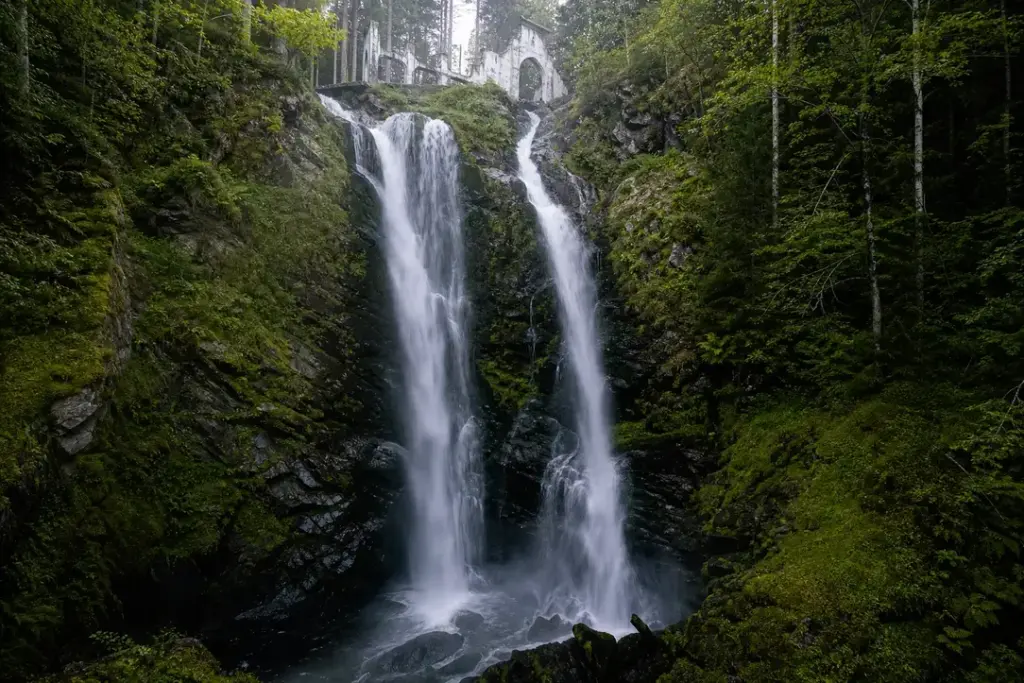
White Bridges Waterfall, known locally as Yukankoski, is one of Karelia‘s most striking natural features. The waterfall is 19 meters high, the tallest in southern Karelia, and splits into two arms as it cascades down moss-covered rocks on the Kulismajoki River. The name comes from the ruins of a white stone bridge visible at the site, a relic from earlier tourism efforts.
The waterfall lies deep in Karelian taiga, about 50 kilometers northwest of Sortavala. Reaching it requires patience and sturdy shoes—an unpaved road and a 40-minute forest walk separate you from the parking area—but the journey rewards you with one of the region’s most photographed natural scenes.
Quick Facts
| Russian name | Юканкоски |
|---|---|
| Address | Pitkyaranta District, Republic of Karelia Google MapsApple MapsYandex Maps2GIS |
| District | Sortavalsky |
| Admission | free |
| Best time to visit | Spring (April–June) brings peak water flow due to snowmelt; the waterfall is at its most powerful in May, though the path can be muddy and wet. Summer (July–August) offers easier walking conditions and longer daylight, though water levels drop and midday crowds peak. Autumn (September–October) provides the best light for photography and fewer visitors, but rain can make the path slippery.Winter (November–March) is challenging; snow blocks the path and ice forms on the rocks, making access dangerous without specialized equipment. Early morning visits in any season offer the best light and fewest people. |
What Is (and Isn't) Part of a Visit to White Bridges Waterfall, Karelia?
| Part | Status | Notes |
|---|---|---|
| White Bridges Waterfall main cascade | Included in the standard ticket | The primary double waterfall on the Kulismajoki River, free to visit. |
| Viewing areas and base access | Included in the standard ticket | Open areas for photography and observation at the top and base of the falls. |
| Bridge ruins | Included in the standard ticket | The deteriorated white stone bridge structure is part of the site and accessible. |
| Parking area facilities | Included in the standard ticket | A basic parking area with minimal facilities; a small shop and toilet are operated by the White Bridges complex. |
| Hiking trail to waterfall | Included in the standard ticket | The 40-minute forest path from parking to the falls is maintained but unmanicured; part of the visit. |
| Nearby Finnish farm ruins | Outside / not part of it | Ancient Finnish settlement ruins exist in the area but are not formally part of the waterfall site. |
| White Bridges recreation center (accommodation) | Separate ticket or institution | A separate facility near the parking area offering lodging; not included in waterfall visit. |
Why Visit White Bridges Waterfall, Karelia?
This waterfall matters for its raw natural drama. Two streams converge and plunge over ancient bedrock, creating a double cascade effect that is most powerful in spring when snowmelt feeds the Kulismajoki. Unlike managed attractions, White Bridges remains wild; the rocky terrain, the sound of falling water, and the surrounding birch and spruce forest feel genuinely remote.
The site sits on the traditional Karelian landscape that inspired Russian Romantic painters and writers. Photography here is exceptional, especially in early morning light or after rain when mist rises from the falls. The ruined bridge adds a human element to the scene, a tangible reminder of past visitors.
Highlights of White Bridges Waterfall, Karelia
The Double Cascade
The defining feature: two streams split the river and fall separately down the 19-meter drop before reuniting at the base. The rock walls on either side are coated in moss, ferns and lichen, creating a lush green frame. Most striking in May and June when snowmelt maximizes flow.
Tip: Stand at the base if conditions allow; the roar and spray are most intense here, and the scale of the falls becomes apparent from below.
White Stone Bridge Ruins
Remnants of a white stone bridge built in an earlier era of tourism to the falls. The structure sits near the top of the cascade, offering context to the waterfall's name and its history as a destination for regional visitors.
Tip: Photograph the ruins from the main viewing area for the best angle; the weathered stones contrast dramatically with the dark rock and white water.
Moss-Covered Bedrock
The entire cascade tumbles over ancient metamorphic bedrock slick with green and yellow moss, ferns and small plants. This living surface, refreshed by spray and moisture, creates the waterfall's characteristic lush appearance.
Tip: Approach the base carefully in wet conditions; the rocks are extremely slippery despite the vegetation.
Karelian Taiga Surroundings
Birch, spruce and pine forest encloses the site on three sides. The forest is typical of southern Karelia's boreal landscape, unchanged for centuries except for selective logging in nearby areas. Wildlife includes moose, lynx and various bird species, though encounters are rare.
Tip: The forest walk to the falls is part of the experience; listen for forest birds and watch for wild plants along the path.
Spring Flood Season
April through June, snowmelt from the surrounding region feeds the Kulismajoki. The waterfall reaches its maximum volume and power during these months, transforming into a roaring torrent.
Tip: Visit in May if possible; the water level is high but not yet at peak where paths become hazardous.
Atmosphere
The site feels isolated and slightly wild. The sound of falling water dominates—a deep roar that increases with proximity to the cascade. The air is cool and humid near the falls, often carrying mist and the smell of wet stone and forest soil.
Morning visits are quieter; a few groups and photographers arrive mid-morning. The path to the waterfall is unmanicured—rocks, roots and boggy patches mean you navigate like explorers rather than tourists on a marked trail. Lighting is best before noon when sun reaches the upper cascade; afternoon brings deeper shadows.
The overall feeling is of entering an untamed corner of Karelia where nature remains in control and human presence is temporary and small.
History of White Bridges Waterfall, Karelia
The Kulismajoki River and its falls have been part of the Karelian landscape for millennia. The region has been inhabited by indigenous Karelian people for centuries, though the waterfall itself was not a named landmark in historical records until the 19th century when Russian tourism began to expand into the remote Ladoga region.
The white stone bridge dates from the late 19th or early 20th century, built during a period when Russian travel writers and artists were rediscovering Karelia’s natural beauty. The bridge facilitated access for early tourists and served as a symbol of the region’s potential as a destination. It has since fallen into ruin, no longer maintained but still standing as evidence of that era.
For most of the 20th century, the waterfall remained known primarily to locals and a handful of adventurous hikers. Soviet-era tourism infrastructure focused on other sites, and the remote location kept White Bridges off most maps. In recent decades, improved road access to the region and growing interest in Karelia’s wilderness have brought increasing numbers of visitors, particularly photographers and outdoor enthusiasts.
Today the site is recognized as a regional hydrological natural monument, reflecting both its scenic value and its role in Karelia’s natural heritage.
Legends and Myths about White Bridges Waterfall, Karelia
The Emperor's Visit
Legend – historically unreliable. Local tradition holds that a Russian emperor or high noble visited the falls in the 19th century, prompting the construction of the white stone bridge to enable access. The story reflects the broader pattern of Russian imperial-era exploration of Karelia's natural sites. No documented evidence confirms which emperor or when, making this a regional legend rather than recorded history.
Tickets and Booking for White Bridges Waterfall, Karelia
White Bridges Waterfall is free to visit with no tickets or advance booking required. The site is open during daylight hours year-round, though winter access may be limited by snow and ice.
You must provide your own transport to the parking area, located about 50 kilometers from Sortavala via the A121 highway. A rental car is strongly recommended; the final 3 kilometers of road is in poor condition. From the parking area, allow 40–50 minutes for the forest walk to reach the falls.
A small facility at the parking area operated by the White Bridges complex offers basic amenities: a toilet, refreshments and local products. No formal visitor services exist at the waterfall itself.
Plan and Book
Suggested itineraries White Bridges Waterfall, Karelia
2 hours
Drive from Sortavala to the parking area (1 hour). Walk to the waterfall (40 minutes). View the cascade and bridge ruins, take photographs. Return walk (40 minutes).
Half day
Drive from Sortavala to parking (1 hour). Walk to the falls (40 minutes). Explore the base, upper viewing areas and surrounding forest. Picnic near the cascade. Return walk and drive (1.5 hours total).
Full day
Combine with nearby Kinerma village (ancient Karelian settlement, 30 km south). Start at Kinerma, visit the wooden church and local life. Drive to White Bridges (45 minutes). Spend 2–3 hours at the waterfall and surroundings. Return to Sortavala.
How to Get to White Bridges Waterfall, Karelia
By car: From Sortavala, drive north on the A121 highway for about 45 kilometers. At a rest area and sign marking km 320 of the highway, turn north onto a dirt road. After 1.7 kilometers at a fork, turn right. Follow a new graded road for 7 kilometers, then continue on the rough final section for another 3 kilometers to reach the parking area. Total drive time: 1–1.5 hours depending on road conditions.
Walking: From the parking area, follow the marked forest path for 40–50 minutes downhill through Karelian taiga to reach the waterfall. The path is rocky and may be boggy in spring; wear waterproof hiking boots.
No public transport: No buses or trains serve the trailhead. Car rental from Sortavala or Petrozavodsk is essential.
Accessibility
The site is not wheelchair accessible. The 40–50 minute forest path to the waterfall is unpaved, rocky and involves a consistent downhill slope with roots and wet sections. Visitors with reduced mobility or those using canes may find it difficult.The viewing area at the base of the falls is on slippery, moss-covered rock with no rails or safety barriers. Care is essential, especially in wet conditions or when water levels are high. The return walk is uphill and strenuous.
Food Nearby
No restaurants or cafes exist at the waterfall. A small shop at the parking area sells basic snacks and drinks. Bring a picnic or supplies from Sortavala (45 km away). Sortavala has restaurants, cafes and supermarkets including standard Russian and Karelian cuisine.
What to Bring
Waterproof hiking boots with good tread (the moss-covered rocks are slippery). Rain jacket and warm layers—the air near the falls is cool and humid even in summer. Insect repellent (mosquitoes can be heavy in spring and early summer). Drinking water and snacks or a picnic. Sunscreen and hat for sunny days. Dry bag for camera or phone if visiting during high-water season. In winter, microspikes or crampons for the icy path.
Best Views and Photo Spots of White Bridges Waterfall, Karelia
Base of the cascade
The full 19-meter drop framed by moss-covered rock walls and the converging streams. Mist and spray create atmospheric diffusion of the falls.
Best time: Early morning in spring when water volume is high and light is angled. Approach carefully as rocks are slippery.
Upper plateau overlooking the two arms
The split of the river into two streams before they fall; the white stone bridge ruins visible in the middle distance. Forest frames the cascade.
Best time: Mid-morning on clear days when shadows are minimal and the two water streams contrast against dark rock.
Bridge ruins close-up
The weathered white stone structure set against the falling water and darker bedrock, showing human presence against natural forces.
Best time: Later afternoon when side-lighting creates texture and shadows on the ruined stonework.
Forest path leading to falls
The birch, spruce and moss-covered boulders creating a moody approach; the forest itself as context for the wilderness setting.
Best time: Overcast days when soft light filters through the canopy; early morning for mist and wildlife.
Photography Rules
Photography is permitted and encouraged. The waterfall is highly photogenic at all hours, but morning light (before noon) is best when sun reaches the upper cascade. No drones, tripods or commercial equipment require special permission, though tripods can be difficult to position on the rocky terrain. Use a fast shutter speed to freeze the water motion; consider a polarizing filter to reduce glare from wet rocks. Mist from the falls may affect lens clarity near the base.
Family Suitability
The waterfall is suitable for families with older children (8+) who can manage a 40-minute hike with uneven terrain and climbing. The walk requires careful footing and is unsuitable for toddlers or very young children. Strollers cannot navigate the path.The site itself has no safety railings; supervise children closely at the base where rocks are slippery and the drop is significant. The cold, humid environment and constant mist can be uncomfortable for small children. Families should plan for the round-trip walk to take 2 hours including rest breaks.
Russia Vibes Tips
- Drive and walk early (7–8 am start) to avoid afternoon crowds and midday shadows. You'll have the site mostly to yourself and better light for photography.
- Do not attempt the walk in winter without microspikes or crampons; the moss-covered rocks become a skating rink when frozen, and rescue would be hours away.
- The final 3 km of access road is notoriously rough. A high-clearance vehicle is better than a sedan; some visitors park earlier and walk the additional distance.
- Combine with Kinerma village (1 hour south) on the same day for a full picture of Karelian life and landscape; both are within a regional driving loop.
- Pack out all rubbish; the site has minimal facilities and relies on visitors respecting the wilderness. Leave no trace.
- In spring, the path can be boggy; gaiters or waterproof pants prevent mud from entering boot tops during the muddy sections.
Explore Nearby White Bridges Waterfall, Karelia
Browse more: More in Sortavalsky · All Karelia · All Sightseeing · All Sightseeing in Karelia · All Viewpoints
FAQ: White Bridges Waterfall, Karelia
Is White Bridges Waterfall the tallest in Karelia?
No. It is 19 meters high, the tallest in southern Karelia, but Karelia has higher waterfalls in other regions. Kivach Falls, for example, is also in Karelia though at a similar height.
How long does it take to visit the waterfall?
Plan 2–3 hours round-trip including the 40-minute walk each way from the parking area and 30–45 minutes at the site for viewing and photography.
Is the access road passable in winter?
The road may be passable but is extremely hazardous in snow and ice, especially the final rough section. The forest path becomes icy and dangerous without proper equipment. Winter visits require experience and gear.
Do I need a guide to visit White Bridges?
No. The path is marked and relatively straightforward, though you must have your own transport. For first-time visitors unsure of navigation, a local guide can be arranged from Sortavala.
When is the waterfall most powerful?
May and June, when snowmelt feeds the Kulismajoki. Spring flood season produces the most dramatic cascade and heaviest mist.
Are there facilities at the waterfall?
No. The waterfall has no toilets, shops or services. Basic amenities (toilet, refreshments) exist at the parking area. Bring supplies from Sortavala.
Is the white stone bridge still standing?
Yes, but it is in ruins. The structure remains visible at the top of the cascade and is part of the historical appeal, though it is no longer functional or safe to cross.
Can I swim in the pool at the base of the falls?
The cold water and strong current make swimming unsafe. The rocks are slippery and the pool is shallow in most areas. Wading is possible in summer but not recommended.
Russia Vibes is a one-person project. A coffee keeps it going
How we research and update our guides
About this guide: AI assistance and accuracy
This guide is created with the help of AI and is based on official sources where available. Mistakes can still happen. Opening hours, prices, rules and other details are given to the best of our knowledge as of the date shown and can change without notice. It offers general recommendations only, not professional, legal or travel advice. Please confirm important details with the official source before you travel; you are responsible for your own plans and decisions.
Packing for this trip
* Affiliate link: as an Amazon Associate we earn from qualifying purchases at no extra cost to you.

Take this guide with you
Get a free PDF of this guide to print or read offline: key facts, tips and a map link on a few clean pages.
Report an issue on this page
Paying for your trip: please read
International sanctions affect payments between Russia and many other countries. In practice, cards issued in the EU, the UK, the US and several other countries often do not work in Russia, Russian cards usually do not work abroad, and some booking platforms, airlines and payment providers limit or suspend their services for Russia. The situation changes frequently.
We do not give legal or financial advice, and this site does not encourage anyone to break or circumvent sanctions. Whatever you plan, you are responsible for following the laws and regulations that apply to you, including those of your country of residence and citizenship.
Many travelers still organise their stay lawfully. It is worth asking your bank or payment provider what is currently permitted, contacting hotels, tour operators and carriers directly about the payment methods they accept, and checking which services are open to customers from your country. Clarify payment, cancellation and refund terms before you commit to a booking, and keep your plans flexible.
Partner links on this site may not be available in every country, and prices, availability and rules in our guides can differ from what you see when you book.