
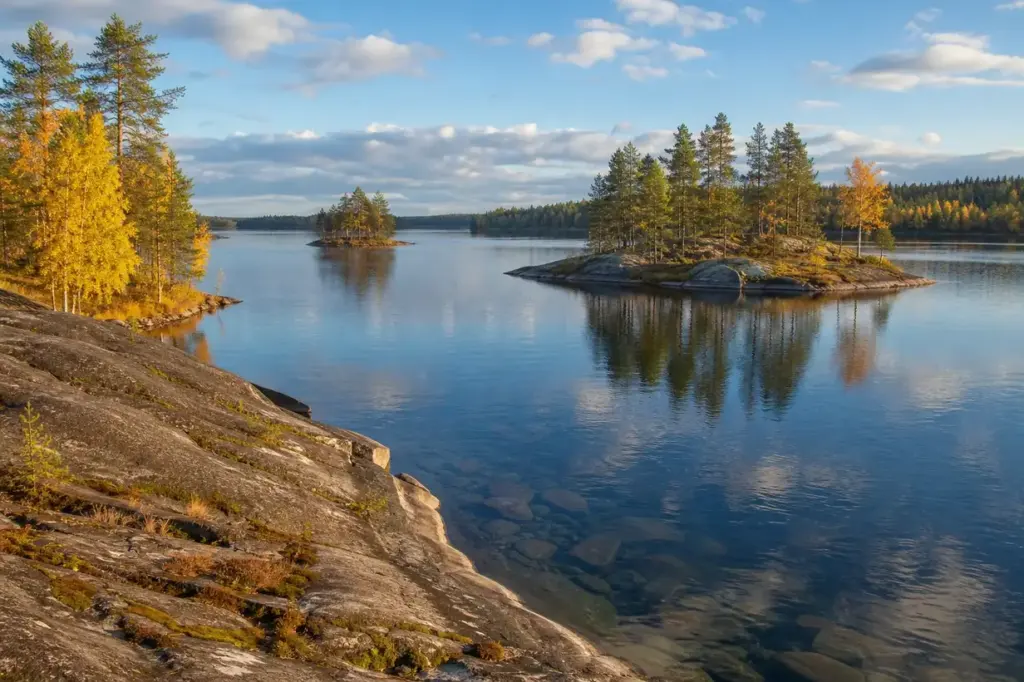
Karelia is a region of lakes, forests, granite shores and traditional wooden architecture in northwestern Russia. Between Lake Ladoga and the White Sea, visitors find island monasteries, historic villages, waterfalls and landscapes shaped by the last Ice Age. The regional capital, Petrozavodsk, stands on Lake Onega and provides a practical starting point for exploring the eastern and central parts of the republic.
A journey through Karelia is best organised around several geographical areas rather than a single city. Petrozavodsk is the main gateway to Kizhi Island and Kivach Waterfall, while Sortavala provides access to Ruskeala Mountain Park and the northern shores of Lake Ladoga. Farther north, forests, rivers and remote settlements lead towards the White Sea. The region rewards travellers who enjoy nature, traditional architecture, local culture and unhurried journeys, although distances, seasonal boat connections and changing weather require careful planning.
Quick Facts
| Russian name | Карелия |
|---|---|
| Best time to visit | Summer is the most convenient season for exploring Karelia's lakes, islands and forest landscapes. June through August generally offers long daylight hours, active boat excursions and suitable conditions for many outdoor activities. Weather can still change quickly, particularly on the larger lakes.
Early autumn is attractive for photography and forest walks. September often brings colourful foliage and a quieter atmosphere in some rural areas, although boat excursions may become less frequent as the season progresses. Winter offers snowy forests, frozen lakes and opportunities for guided cold-weather activities. Travel becomes more dependent on road conditions and suitable equipment. Spring is a transitional season, with melting snow, wet trails and changing water conditions. The best period ultimately depends on whether the main interest is island sightseeing, hiking, photography or winter landscapes. |
| Website | ticrk.ru |
Why Visit Karelia?
Karelia combines natural landscapes with cultural attractions that are unusual even within Russia. Kizhi Island preserves remarkable wooden churches and traditional rural buildings, while Valaam offers a monastery complex surrounded by the rocky islands of Lake Ladoga.
At Ruskeala Mountain Park, visitors can walk beside a flooded marble quarry, and Kivach Waterfall provides a convenient introduction to the region’s rivers and forest reserves.
Beyond the famous attractions are Karelian villages, lakeside settlements, archaeological sites and national parks. The region is particularly suitable for landscape photography, short nature walks, boat excursions and road trips. Travellers interested in local traditions can discover Karelian cuisine, wooden architecture and the cultural heritage associated with the Kalevala epic.
Highlights of Karelia
Kizhi Island and Its Wooden Churches
Kizhi Island in Lake Onega is home to the UNESCO-listed Kizhi Pogost, an extraordinary ensemble of wooden religious buildings. The Church of the Transfiguration, traditionally dated to 1714, is famous for its multiple wooden domes. Nearby stand the Church of the Intercession and a wooden bell tower. The wider Kizhi Open-Air Museum also preserves traditional houses, chapels and rural buildings collected from different parts of the region. Visitors should distinguish the UNESCO-listed church enclosure from the much larger museum territory. Access to interiors and additional exhibitions follows the museum's own arrangements.
Tip: Allow time to explore the traditional village buildings beyond the main church ensemble. They explain how people lived in the region, rather than showing only its monumental architecture.
Ruskeala Mountain Park
Ruskeala Mountain Park lies near Sortavala and occupies a former marble quarry whose steep stone walls now surround turquoise and green water. Marble extraction began here in the eighteenth century, and the site later developed into a major visitor attraction. Paths and viewpoints follow the quarry rim, allowing visitors to appreciate the contrast between pale stone, water and surrounding forest. The park also offers organised activities, including access to historic underground workings on a separately arranged excursion. The landscaped visitor area should not be confused with the surrounding village or nearby waterfalls.
Tip: Walk around the quarry before choosing extra activities. The changing viewpoints reveal the shape of the old excavation more effectively than staying near the main entrance.
Valaam Island and Monastery
Valaam is an island archipelago in northern Lake Ladoga, best known for the Valaam Monastery. The central monastic complex includes the Transfiguration Cathedral, while smaller religious buildings and hermitages stand in different parts of the surrounding islands. Forest, granite cliffs and sheltered bays form an important part of the setting. Travellers generally approach Valaam by passenger boat from Sortavala during the navigation season. Visitors should remember that the island is both a cultural attraction and an active religious community, where access to some buildings and areas may be restricted.
Tip: Choose an excursion according to the amount of walking it includes. Seeing the central monastery and exploring more distant island locations are different experiences.
Kivach Waterfall and Nature Reserve
Kivach Waterfall stands on the Suna River within the Kivach Nature Reserve, established in 1931. The waterfall descends over several rocky steps surrounded by northern forest. Its appearance changes with river conditions, but the exposed stone and rushing water provide a recognisable landscape in every season. The designated visitor area also introduces the protected natural environment of central Karelia. Kivach is commonly visited as a road excursion from Petrozavodsk and can be combined with other attractions in the Kondopoga area.
Tip: Use the established viewing paths and pay attention to the different levels of the cascade. The waterfall is easier to appreciate from several perspectives than from a single photograph stop.
Petrozavodsk and the Lake Onega Embankment
Petrozavodsk is the capital of the Republic of Karelia and the region's principal transport and cultural centre. Founded in 1703 around an industrial settlement associated with Peter the Great, the city developed along the western shore of Lake Onega. Its waterfront promenade is lined with public artworks and opens onto wide views across the lake. The National Museum of the Republic of Karelia and other cultural institutions provide an introduction to regional history. Petrozavodsk is also the main departure point for many summer excursions to Kizhi Island.
Tip: Explore the waterfront on foot, then visit a regional museum before travelling to Kizhi. The exhibits help place the island's wooden buildings within the wider history of Karelia.
Ladoga Skerries
The northern part of Lake Ladoga contains a complex landscape of rocky islands, narrow waterways, pine forests and exposed granite shorelines. Much of this environment is protected within Ladoga Skerries National Park. The scenery differs markedly from the broad open water farther south, with islands separated by channels and sheltered bays. Boat and kayak excursions can reveal the landscape from the water, while selected shore locations provide opportunities for short walks. Protected-area boundaries and visitor rules must be checked before arranging independent activities.
Tip: Choose a boat excursion that enters the smaller channels between islands. These sheltered waterways best reveal the distinctive character of the skerries.
Kinerma Traditional Village
Kinerma is a historic Karelian village known for its preserved wooden houses and traditional rural setting. A small chapel forms an important feature of the settlement, surrounded by timber buildings and a landscape of fields and forest. Unlike an open-air museum assembled from relocated structures, Kinerma is an inhabited village where historic architecture remains connected to everyday life. Visits can introduce Karelian building traditions, local customs and regional food, depending on the arrangements available. The village is especially rewarding for travellers interested in cultural heritage outside the larger tourist centres.
Tip: Arrange a local introduction rather than treating the village as a collection of photographic subjects. Respect private homes and gardens.
Paanajärvi National Park
Paanajärvi National Park occupies a remote area of northern Karelia near the Finnish border. Established in 1992, it protects forests, lakes, rivers and rugged upland landscapes. Lake Paanajärvi and the surrounding hills create scenery very different from the southern lake districts. The park offers designated visitor routes, but access requires advance organisation and compliance with its protected-area procedures. Because of its location and limited infrastructure, Paanajärvi is better suited to travellers planning a dedicated nature journey than to visitors seeking a spontaneous day trip.
Tip: Plan this park as a separate northern Karelia destination. Its remoteness makes combining it with the main southern attractions impractical during a short holiday.
White Sea Petroglyphs
Near Belomorsk, ancient rock carvings preserve scenes of hunting, boats, animals and human activity. These archaeological sites form part of the UNESCO World Heritage property Petroglyphs of Lake Onega and the White Sea, inscribed in 2021. The images provide rare evidence of prehistoric life and symbolic traditions in northern Europe. Some carvings are located on exposed rock surfaces that require careful observation to recognise. They belong to a different geographical group from the Lake Onega petroglyphs, so visitors should not assume that all sites can be reached during a single short excursion.
Tip: Visit under suitable natural lighting and consider a specialist guide. The carvings may be difficult to identify without someone familiar with their locations.
Atmosphere
Karelia feels closely connected to water. Lakes appear between dark forests, rivers cut through granite outcrops, and small settlements occupy clearings along the roads. In Petrozavodsk, the wide Lake Onega waterfront creates a more urban atmosphere, with promenades, cultural institutions and cafés.
Around Sortavala, granite hills and wooded islands dominate the landscape. Tourist activity concentrates around Ruskeala and boat departure points, while quieter roads lead through villages and forest.
Farther north, settlements become more widely separated and nature takes on a stronger presence. Summer brings long daylight hours and active waterways. Autumn changes the forests to yellow and orange, while winter covers lakeshores and woodland in snow. The experience depends greatly on season and location.
History of Karelia
Prehistoric settlement
The history of Karelia extends thousands of years into the past. Archaeological sites along Lake Onega and the White Sea preserve evidence of communities that lived by hunting, fishing and gathering. The region’s prehistoric rock carvings depict animals, boats and human figures, offering a record of life in the northern landscape long before written documents.
Over time, the development of settlements and trading routes connected Karelia with other areas around the Baltic and northern Russia. Its lakes and rivers acted as important transport corridors through otherwise difficult forest terrain.
Medieval Karelia
During the medieval period, Karelian communities developed distinct cultural traditions while maintaining contacts with neighbouring regions. Fishing, agriculture, hunting and trading were important activities. The waterways of Lake Ladoga and Lake Onega remained central to travel and settlement.
The spread of Orthodox Christianity contributed to the development of monasteries and religious buildings. Valaam became an important monastic centre, although the precise date of the monastery’s foundation remains uncertain. Religious communities also influenced traditional architecture and cultural practices.
Wooden architecture and rural life
Between the seventeenth and nineteenth centuries, wooden churches, chapels and farmhouses became distinctive features of Karelian settlements. Skilled carpenters developed complex building forms using locally available timber.
The present Church of the Transfiguration on Kizhi Island dates from 1714, while the Church of the Intercession was constructed during the eighteenth century. The buildings demonstrate the technical and artistic possibilities of traditional timber construction.
Rural communities preserved oral storytelling, music and craft traditions. The Finnish national epic Kalevala, first published in 1835 and expanded in 1849 by Elias Lönnrot, drew extensively on oral poetry recorded among Finnish and Karelian speakers. The epic remains an important cultural reference for the wider region.
The development of Petrozavodsk
Petrozavodsk originated in 1703 as a settlement associated with an ironworks established during the reign of Peter the Great. The industrial settlement expanded over the eighteenth century and became an administrative centre in 1777.
The development of industry, transport and urban institutions gradually distinguished Petrozavodsk from the surrounding rural districts. Meanwhile, many villages continued to depend on forestry, agriculture and local waterways.
Conservation and cultural heritage
During the twentieth century, growing attention was directed towards preserving Karelia’s distinctive natural and architectural heritage. Kivach Nature Reserve was established in 1931, while the Kizhi museum developed into a major centre for the conservation of northern wooden architecture.
In 1990, Kizhi Pogost became a UNESCO World Heritage Site, recognising the exceptional importance of its wooden church ensemble. Paanajärvi National Park was established in 1992 to protect northern forests and lake landscapes.
In 2021, the Petroglyphs of Lake Onega and the White Sea were also added to the UNESCO World Heritage List. Today, Karelia’s identity as a travel destination rests on this combination of archaeological heritage, wooden architecture, traditional culture and extensive natural landscapes.
Tickets and Booking for Karelia
Arriving in Karelia: Petrozavodsk is the main regional transport hub, with a railway station and Petrozavodsk Airport. Travellers arriving by train commonly use connections from Saint Petersburg or Moscow. From the railway station, the central districts and Lake Onega waterfront can be reached by local transport or taxi.
Sortavala is another important railway destination, particularly for travellers heading towards Ruskeala Mountain Park and Valaam. The town is accessible by rail from Saint Petersburg.
For regional sightseeing, arrange accommodation according to your planned excursions. Petrozavodsk is useful for Kizhi and central Karelia, while Sortavala serves the northern Ladoga area.
Island excursions depend on separate boat arrangements, and some protected natural areas require advance permission. Confirm current railway and flight services with the official transport operators and boat schedules with the relevant carriers before travelling.
How to Get to Karelia
From Saint Petersburg: Rail and road connections provide practical access to southern Karelia. Petrozavodsk and Sortavala are the most useful arrival points for first-time visitors, depending on the planned route.
From Moscow: Long-distance trains connect Moscow with Petrozavodsk. Air connections may also be available, depending on operating schedules.
By air: Petrozavodsk Airport serves the regional capital. Onward travel into the city is by road.
Within Karelia: Railways connect selected cities and towns, but many natural attractions require buses, taxis, rental vehicles or organised excursions. The region has no metro system.
By boat: Seasonal passenger services provide access to islands such as Kizhi and Valaam. Routes, departure points and weather conditions should be checked before planning a journey.
Remote national parks and northern districts may require specialist transport and additional preparation.
Accessibility
Accessibility varies widely across Karelia. Petrozavodsk offers the most practical urban base for travellers with limited mobility, although individual hotels, museums and transport services should be checked before booking.
Many natural attractions involve uneven paths, rocky surfaces, steps or unprepared ground. Ruskeala Mountain Park has developed visitor pathways, but particular routes and activities may have different accessibility limitations.
Island excursions introduce additional challenges, including boarding boats and moving along historic paths. Kizhi Island contains traditional buildings whose architectural features can restrict access. Travellers should contact the relevant museum or excursion operator for current arrangements.
Remote nature reserves and wilderness routes are generally more demanding than established urban attractions.
Food Nearby
Petrozavodsk and Sortavala have the widest selection of cafés and restaurants for visitors exploring Karelia. Smaller tourist settlements and accommodation providers may offer regional dishes, while remote areas have fewer dining options.
Karelian cuisine is closely associated with fish, rye, mushrooms, berries and traditional baking. Kalitki, small open-faced pastries commonly made with rye dough and savoury fillings, are particularly characteristic of the region. Visitors may also encounter fish soup, locally prepared freshwater fish and berry-based drinks or desserts.
Traditional village visits sometimes include opportunities to learn about regional cooking. Availability depends on local arrangements. For longer journeys through northern Karelia, carry food and drinking water rather than relying on frequent roadside restaurants.
What to Bring
Pack waterproof outerwear, comfortable walking shoes and an additional warm layer, even during summer. Weather around the lakes can feel cooler than expected, especially during boat journeys.
In forested areas, insect repellent and clothing that protects against ticks are important. Bring drinking water, sun protection and a basic first-aid kit for longer excursions.
Offline maps are useful because mobile coverage can become unreliable away from towns. A power bank and spare charging cable are practical additions for road trips.
Winter visitors need proper insulated footwear, warm gloves and clothing suitable for sustained exposure to cold temperatures. Follow the individual equipment and access rules of museums and protected natural areas.
Photography Rules
Photography is generally possible at public viewpoints and many outdoor attractions, but museums, monasteries and protected areas may impose restrictions. At Kizhi, the museum's visitor rules allow indoor photography without flash, subject to specific conditions. Professional filming requires separate arrangements. Drone use must comply with applicable aviation and local restrictions.
Family Suitability
Karelia is well suited to families when the itinerary focuses on accessible attractions and manageable travelling distances. Petrozavodsk, Ruskeala Mountain Park, Kivach Waterfall and selected lakeside walks can provide varied experiences without demanding wilderness travel.
Kizhi Island offers an educational introduction to traditional wooden architecture, although younger children may find long museum visits tiring. Boat journeys require suitable weather and careful supervision.
Strollers are useful in towns but less practical on forest paths and rocky shores. Families travelling with younger children should avoid overloading the itinerary with distant attractions and leave time for breaks between excursions.
Russia Vibes Tips
- Choose your regional base before building the sightseeing schedule. Petrozavodsk and Sortavala serve different sides of the main tourist area, and changing accommodation once can save substantial backtracking.
- Do not confuse Lake Onega with Lake Ladoga. Kizhi is associated with Lake Onega, while Valaam and the Ladoga Skerries belong to Lake Ladoga. They are not interchangeable boat excursions.
- For a first visit, combine one cultural attraction with one nature destination rather than filling every day with long road transfers. The regional landscapes are part of the experience.
- When visiting traditional villages, distinguish public heritage areas from private residential property. Historic settlements are living communities, not open-air exhibitions throughout.
- In summer, account for the unusually long daylight hours when planning photographs and evening activities. Sunset timing differs substantially from more southerly European destinations.
- Save local place names in Russian as well as English transliteration. Smaller settlements, piers and road junctions may appear differently across navigation services.
Explore Nearby Karelia
Browse more: All Cities · All Karelia · All Regions & Nature
FAQ: Karelia
Is Karelia a city or a region?
Karelia is a region, not a single city. The Republic of Karelia occupies part of northwestern Russia and includes lakes, forests, towns, villages and protected natural areas. Petrozavodsk is its capital and main urban gateway. Visitors normally explore the region through several destinations rather than staying in one central sightseeing district.
How many days do you need in Karelia?
A journey of five to seven days allows visitors to combine Petrozavodsk, Kizhi and selected natural attractions, or concentrate on the Sortavala and Lake Ladoga area. A longer trip provides more flexibility to explore both major lake districts. Remote northern destinations generally require their own travel days and should not be added casually to a short itinerary.
Can you visit Karelia without a car?
Yes. Trains provide access to Petrozavodsk and Sortavala, and organised excursions connect some of the best-known attractions. However, independent travel becomes less convenient outside the main towns. Visitors without a car should choose accommodation close to departure points and arrange excursions for destinations that lack practical public transport connections.
Is Kizhi Island the same as Valaam Island?
No. Kizhi is located in Lake Onega and is primarily known for its open-air museum of traditional wooden architecture. Valaam lies in Lake Ladoga and is associated with an active Orthodox monastery. Both are important cultural destinations, but they have different departure routes, visitor experiences and access arrangements.
Can you visit Karelia in winter?
Yes, although winter travel requires different planning from a summer journey. Towns and selected cultural attractions remain accessible, while snow and ice change the character of the landscape. Some boat services stop operating during the frozen season, and alternatives depend on local conditions. Remote forest routes should be approached with appropriate equipment and experienced local support.
Is Ruskeala Mountain Park close to Petrozavodsk?
Ruskeala Mountain Park lies near Sortavala in southwestern Karelia, not beside Petrozavodsk. It is more naturally combined with Sortavala and the northern Lake Ladoga area. Travellers based in Petrozavodsk should account for a significant road journey or consider changing accommodation rather than treating Ruskeala as a nearby city attraction.
Do you need a guide to explore Karelia?
A guide is not essential for established towns, major museums or many public visitor areas. However, guided excursions can be particularly useful for island trips, archaeological sites and remote natural landscapes. Protected areas may have route-specific requirements. Visitors planning independent wilderness travel should confirm access rules, weather conditions and available emergency communication beforehand.
What is the difference between Russian Karelia and Finnish Karelia?
Karelia is a historical and cultural geographical area extending across parts of present-day Russia and Finland. The Republic of Karelia is a Russian administrative region, while Finnish Karelia refers to areas within Finland. This guide focuses on destinations in the Russian republic. Travellers should distinguish the two when searching for accommodation, transport and visitor information.
Russia Vibes is a one-person project. A coffee keeps it going
How we research and update our guides
About this guide: AI assistance and accuracy
This guide is created with the help of AI and is based on official sources where available. Mistakes can still happen. Opening hours, prices, rules and other details are given to the best of our knowledge as of the date shown and can change without notice. It offers general recommendations only, not professional, legal or travel advice. Please confirm important details with the official source before you travel; you are responsible for your own plans and decisions.
Packing for this trip
* Affiliate link: as an Amazon Associate we earn from qualifying purchases at no extra cost to you.

Take this guide with you
Get a free PDF of this guide to print or read offline: key facts, tips and a map link on a few clean pages.
Report an issue on this page
Paying for your trip: please read
International sanctions affect payments between Russia and many other countries. In practice, cards issued in the EU, the UK, the US and several other countries often do not work in Russia, Russian cards usually do not work abroad, and some booking platforms, airlines and payment providers limit or suspend their services for Russia. The situation changes frequently.
We do not give legal or financial advice, and this site does not encourage anyone to break or circumvent sanctions. Whatever you plan, you are responsible for following the laws and regulations that apply to you, including those of your country of residence and citizenship.
Many travelers still organise their stay lawfully. It is worth asking your bank or payment provider what is currently permitted, contacting hotels, tour operators and carriers directly about the payment methods they accept, and checking which services are open to customers from your country. Clarify payment, cancellation and refund terms before you commit to a booking, and keep your plans flexible.
Partner links on this site may not be available in every country, and prices, availability and rules in our guides can differ from what you see when you book.