
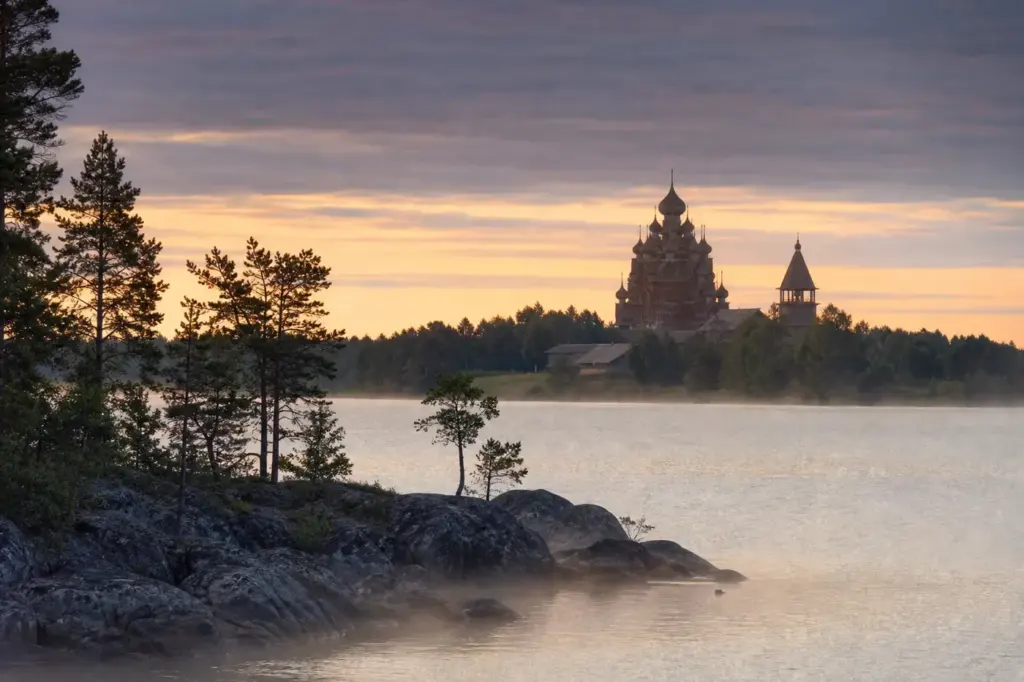
Lake Onega is the second-largest lake in Europe, located in the Karelian region of northwestern Russia, covering approximately 9,700 square kilometers. This vast northern freshwater body stretches 245 kilometers from north to south, with shores ranging from rocky and rugged in the north to sandy and marshy in the south. The lake is famous not for its size alone but for what lies on its islands—ancient wooden churches, petroglyphs, and remote monasteries that draw visitors seeking the Russia of centuries past.
There are about 1,650 islands on the lake, including Kizhi, which hosts a historical complex of 89 Orthodox churches and other wooden buildings. The northern shore is deeply indented with bays and peninsulas, while the central basin contains some of Europe’s deepest freshwater, reaching over 120 meters in places. Most visitors come for Kizhi Island and its UNESCO-listed wooden ensemble, though the lake itself—with its forested margins and island-studded expanse—is a destination for water travel, fishing, and slow exploration.
Quick Facts
| Russian name | Онежское озеро |
|---|---|
| Address | Google MapsApple MapsYandex Maps2GIS |
| District | Karelia |
| Best time to visit | The best time to visit Lake Onega is June through September. Summer (June–August) offers warm days, long daylight, and all transport and accommodation open. July and August are warmest but also busiest. September brings clear skies, cooler temperatures, and fewer tourists; forests turn gold and red.Spring (May) and early autumn (September–October) are shoulder seasons with variable weather. Winter (November–April) freezes the lake and closes most tourist infrastructure, though locals travel on the ice and winter landscapes offer stark beauty to those prepared for cold.Weekdays are quieter than weekends; visiting Kizhi on a weekday morning offers a more intimate experience than the midday boat crowds. |
| Recommended duration | 1–2 days minimum |
What Is (and Isn't) Part of a Visit to Lake Onega, Karelia?
| Part | Status | Notes |
|---|---|---|
| Lake Onega itself | Included in the standard ticket | The lake's water and islands are open to the public; access is by boat from Petrozavodsk or other towns on the shore. |
| Kizhi Pogost (Kizhi Island) | Separate ticket or institution | UNESCO World Heritage site; requires a separate ferry ticket and is operated as an independent museum. Full day commitment from Petrozavodsk. |
| Zaonezhye Peninsula | Included in the standard ticket | Publicly accessible by car and local ferries from Petrozavodsk; no special ticket required for the peninsula itself, though individual church visits may have small fees. |
| Muromsky Monastery (Dormition Monastery) | Separate ticket or institution | Active monastery on the eastern shore; access by private boat only. Visitors must arrange tours or hire boats separately; not part of standard tourist packages. |
| Onega Petroglyphs (East Coast) | Separate ticket or institution | Most accessible through organized boat tours from Petrozavodsk or the Zaonezhye Peninsula. Some sites are inaccessible without a guide. |
| Petrozavodsk | Outside / not part of it | The city on the western shore is the main hub; it is not part of the lake itself but a necessary base for lake visits. |
Why Visit Lake Onega, Karelia?
The Kizhi archipelago, declared a World Heritage Site by UNESCO, is located in the northern part of the lake and features a historic complex of 89 wooden Orthodox churches and other wooden buildings from the 15th to the 20th centuries and includes some 1,200 petroglyphs. This is the lake’s main draw: nowhere else can you see such a concentration of preserved wooden church architecture spanning five centuries.
The shores to the north and northwest are high and rocky, built of layered granite and covered with forest, while the southern shores are narrow, sandy, and often marshy or flooded. The lake itself is a working landscape—fishing is still practiced, and several towns dot the shoreline. For those seeking solitude, the hundreds of smaller islands and the water itself provide a sense of isolation found in few places in Europe.
Highlights of Lake Onega, Karelia
Kizhi Pogost Wooden Churches
The Church of the Transfiguration was built in 1714 on the site of an old one which was burnt by lightning, rising at 37 meters. The whole wooden frame was made without using a single nail: the church counts 22 domes arranged in tiers, creating an astonishing rhythmic effect. The Church of the Intercession of the Virgin was built in 1694 and rebuilt 70 years later, configured as a prolonged rectangle, 32 meters long and 8 meters wide with a height of 26 meters. Visit as an organized tour from the town of Petrozavodsk; Kizhi Pogost requires a separate ferry ticket and is a full day commitment.
Tip: Start your Kizhi visit early in the morning to avoid the midday boat crowds from the mainland.
Ancient Onega Petroglyphs
Some 1,200 petroglyphs (rock engravings) are located on the East coast, from the 2nd to the 4th millennium BC. These carvings depict game animals, hunters, and water spirits, marking sacred sites used by the pre-Christian inhabitants of Karelia. Most are not easily accessible without a guided boat tour, but some sites can be visited by boat from Petrozavodsk or through organized excursions to the Zaonezhye Peninsula.
Tip: Petroglyphs are best seen on overcast days when the light is flat; direct sun glare makes them harder to photograph and interpret.
Zaonezhye Peninsula
Zaonezhye is a geographic region on the northern shore of Lake Onega comprising the 12,000-square-kilometer Zaonezhsky Peninsula and nearby islands. This ancient forest landscape contains numerous small wooden churches, abandoned settlements, and traditional Karelian villages. The peninsula is accessible by car and ferry from Petrozavodsk and offers a slower pace of exploration than the island ferries.
Tip: Rent a car in Petrozavodsk if possible; the peninsula roads are rural and public transport is limited, but independent travel allows you to stop at small churches and villages.
Petrozavodsk Waterfront
Petrozavodsk, the capital of the Republic of Karelia, is situated on the western shore of Lake Onega. The city serves as the main hub for all lake visits and has grown as a small but cosmopolitan town with museums, cafés, and waterfront parks. The waterfront offers views across to the northern islands and is where most organized lake tours depart.
Tip: Base yourself in Petrozavodsk for at least one night; it's the only city on the lake with reliable hotels, restaurants, and tour operators.
Kondopoga Bay
Kondopozhskaya bay has a depth of up to 78 meters. This is one of the lake's major bays and the site of the industrial town of Kondopoga on the western shore. The bay offers deeper water and is a focus for fishing; the surrounding forests and inlets are popular for kayaking and water tourism.
Tip: Kondopoga is a working industrial town; most tourist visits are day trips from Petrozavodsk or stops on longer boat itineraries.
Muromsky Monastery
The Dormition Monastery on the cape Muromsky, on the eastern shore of the lake, was founded in 1350, closed in 1918 and revived in 1991. This ancient monastery is less famous than Kizhi but holds spiritual significance and offers a glimpse of monastic life on the remote lakeshore. Access is by private boat or organized tours; it is not accessible by road.
Tip: Visiting Muromsky requires arranging a private boat or joining a specialized monastic pilgrimage tour; standard tourist operators may not include it.
Atmosphere
Lake Onega feels timeless and still. The northern shore rises abruptly with rocky outcrops and deep bays, their waters reflecting dense forests of pine and birch. Summer is bright and cool—the lake never warms much, and even in July, the water demands respect. In autumn, the forests turn gold and red, and the light becomes slanted and clear. Winter freezes the lake solid from January to May, transforming it into a white landscape crossed by ice roads.
Petrozavodsk hums with city life and tour groups preparing for island excursions. Once on the water or at a remote island church, the sound drops away. Kizhi on a busy day fills with daytrippers, but at dawn or dusk, the wooden domes stand nearly alone. The Zaonezhye Peninsula is quieter still—small villages appear and disappear, churches stand among abandoned orchards, and the scale of human settlement shrinks to match the vast forest.
History of Lake Onega, Karelia
Lake Onega was created by glacial activity that scoured away rock and soil and left a large depression that filled up with water. After the ice retreated, the region became home to Karelian peoples. Petroglyphs located on the East coast date from the 2nd to the 4th millennium BC, marking sacred sites and hunting grounds of these early inhabitants.
In the medieval period, the lake lay on the edge of Russian territory. Kizhi Island, whose name originates from ‘island of games’, was located on the important 14th-century trade route from the town of Novgorod to the White Sea, and the settlement grew around the Spasskiy Church that was founded in the mid-16th century. In the 17th century, the island served as a defense post against Swedish and Polish invasions.
The wooden church tradition flourished in isolation. Remote communities built their own churches using local timber and traditional carpentry techniques passed through generations. The Church of the Transfiguration was built in 1714 on the site of the old one which was burnt by lightning. The Church of the Intercession of the Virgin was built in 1694 and rebuilt 70 years later. These structures were never meant to last centuries—wood rots and fire threatens—yet many survived, transformed into monuments through luck and periodic restoration.
Remote religious enclosures like Kizhi Pogost—pogost means enclosure—were established in the seventeenth century to serve communities of sparsely populated regions. The Dormition Monastery on the cape Muromsky, on the eastern shore of the lake, was founded in 1350, closed in 1918 and revived in 1991. The Soviet period saw many churches close or fall into ruin. Since the 1990s, restoration has accelerated, and in 1990, the entire architectural ensemble of the Kizhi Pogost was listed as a UNESCO World Heritage site.
Legends and Myths about Lake Onega, Karelia
The Crayfish-Shaped Lake
Legend – historically unreliable. The lake's outline appears similar to a giant crayfish because its northern banks contain numerous elongated bays. Local storytellers have adopted this geographical fact as part of the lake's character, and the comparison appears in guides and descriptions. Whether this shape was intentional in folklore or arose from literal observation remains unclear, but it is now accepted as part of how locals describe their lake.
Sacred Petroglyphs and Spirit Guardians
Disputed by historians. The ancient petroglyphs on the eastern shore depict not just animals and hunters but water spirits and guardians believed by early Karelian peoples to inhabit the lake. Local traditions speak of offerings left at sacred stone sites to ensure safe passage and good fishing. Whether these were literal religious practices or later inventions by collectors romanticizing the past is disputed among historians.
Tickets and Booking for Lake Onega, Karelia
Lake Onega itself is not ticketed; it is an open natural resource. However, access to specific destinations requires separate arrangements:
- Kizhi Island: Book ferry and museum admission through the Kizhi Pogost official website or tour operators in Petrozavodsk. Ferries typically run daily in summer and less frequently in shoulder seasons.
- Organized tours: Petrozavodsk has numerous tour companies offering lake excursions, island visits, and fishing trips. Book in advance during peak season (June–August).
- Private boat rental: Available in Petrozavodsk and some lakeside towns; rental companies can provide routes and advice on accessible sites.
- Zaonezhye Peninsula: Drive or take a ferry from Petrozavodsk; no tickets required for the peninsula, though individual attractions may charge small fees.
Check with Petrozavodsk tourist information for current ferry schedules and weather-dependent closures. Rates and concessions differ for Russian citizens. See the official Kizhi Pogost website (kizhi.karelia.ru) for all ticket categories and current pricing.
Plan and Book
Suggested itineraries Lake Onega, Karelia
Half day
Depart Petrozavodsk early morning on a ferry to Kizhi Island. Tour the Kizhi Pogost ensemble (Church of the Transfiguration, Church of the Intercession, bell tower, and adjacent wooden buildings) with a guide or audio guide. Return to Petrozavodsk by late afternoon. This is the standard introduction to Lake Onega.
Full day
Morning: Boat tour of Kizhi Island. Afternoon: Petrozavodsk waterfront walk, visit to the Museum of Fine Arts or local history museum. Evening: dinner with views over the lake. Alternatively, take an afternoon boat excursion to the Zaonezhye Peninsula or petroglyphs site if offered by local operators.
2–3 days
Day 1: Kizhi Island ferry and museum in the morning; Petrozavodsk in the afternoon. Day 2: Rent a car and explore Zaonezhye Peninsula; visit smaller wooden churches and villages. Day 3: Specialized boat tour to the East Coast petroglyphs or Muromsky Monastery (book in advance). Return to Petrozavodsk.
4–5 days
Multi-day boat tour of the lake visiting Kizhi, Zaonezhye, and remote northern islands. Includes stays in small villages or fishing lodges. Option to include the Muromsky Monastery and extended hiking or kayaking. Suitable for travelers with more time and flexibility; typically organized through tour operators.
How to Get to Lake Onega, Karelia
By Air: Fly to Petrozavodsk Airport (PEZ), 30 kilometers south of the city. Buses and taxis are available; journey to the city center takes 30–45 minutes.
By Train: Petrozavodsk Railway Station is a stop on routes from Moscow and Saint Petersburg. The journey from Moscow is approximately 20 hours; from Saint Petersburg, 10 hours. The station is in the city center near the waterfront.
By Car: Petrozavodsk is 400 kilometers northeast of Saint Petersburg via the M18 highway. The drive takes 5–6 hours. The city has parking and car rental agencies.
From Petrozavodsk to the Lake: The waterfront is within walking distance of the city center. Ferry terminals for Kizhi and other islands are located at the central pier. For Zaonezhye Peninsula, take a ferry or drive via the road across the peninsula (vehicle ferry available). Private boat rental and guided tours can be arranged from the central waterfront.
Accessibility
Lake Onega is challenging for travelers with mobility restrictions. Most sites are accessed by boat, which requires climbing stairs or steep gangways. Island churches have uneven stone and wooden floors, narrow doorways, and no elevators or wheelchair ramps. Zaonezhye Peninsula is road-accessible, but many small churches are reached by walking paths or dirt roads.Petrozavodsk city center is relatively flat and walkable, with some modern facilities, though Soviet-era infrastructure predominates. The waterfront promenade is paved and accessible. Discuss specific accessibility needs with tour operators in advance; some can arrange adapted boats or modified itineraries.
Food Nearby
Petrozavodsk has restaurants serving Russian, Karelian, and international cuisine. Look for local specialties like lake fish (pike-perch, whitefish), mushroom and berry dishes, and Karelian pasties (pirozhki). Cafés are available at Kizhi (limited menu, book ahead). On the Zaonezhye Peninsula and remote areas, options are scarce; bring snacks and water.
What to Bring
Waterproof jacket and warm layers (the lake stays cold year-round). Sturdy walking shoes with grip for uneven stone and wooden surfaces. Sun protection (UV index is high in summer despite cool temperatures). Insect repellent for June and July. A small day pack for boat excursions. Binoculars for birdwatching. Waterproof bag for cameras. If visiting in shoulder season or winter, thermal underwear and windproof outer layers are essential. Bag checks are routine at Kizhi; keep liquids and cameras accessible.
Best Views and Photo Spots of Lake Onega, Karelia
Kizhi Island, Church of the Transfiguration exterior
The church's 22 domes rising against the forest and water create the lake's most iconic image. Early morning or late evening light catches the weathered wood and casts long shadows from the domes.
Best time: Early morning (6–8 a.m.) or late evening (7–9 p.m.) in summer; overcast conditions reveal detail in the wood texture.
Petrozavodsk waterfront, looking north across the lake
The distant Zaonezhye Peninsula and northern islands create a layered landscape. City lights and the pier structure frame the view. Clear days show the forest line; overcast skies emphasize the water's expanse.
Best time: Golden hour (sunset in summer), or just after dawn for calm water and soft light.
Zaonezhye Peninsula, near small villages
Abandoned wooden houses, small chapels, and birch groves with water visible behind create intimate, melancholic scenes. Forest reflections in still water offer mirror-like compositions.
Best time: Late afternoon light; autumn colors (September) add depth to forest scenes.
Kizhi Island, bell tower and Church of the Intercession
The two buildings side by side, with the bell tower's simpler geometry contrasting the church's vertical rhythm. Water and boats in the foreground add context.
Best time: Midmorning (10 a.m.–12 p.m.) when light is high but not harsh; crowds are larger then but the light is clearer.
East Coast petroglyphs (if accessible via tour)
Stone carvings on weathered rock faces, with lichen and water marks adding context. Reflections in rock pools enhance compositions.
Best time: Overcast midday provides even, shadow-free light that makes petroglyphs visible; strong side lighting obscures detail.
Photography Rules
Photography is permitted throughout Lake Onega and on Kizhi Island. Tripods are allowed outdoors but not inside churches out of respect. Flash photography indoors may be restricted to protect artwork; check signage. The overcast skies typical of northern summers create flat, soft light ideal for landscape photography; try early morning or late evening for more dramatic lighting. Petroglyphs photograph best on overcast days. Drones are not permitted in protected areas or near settlements.
Family Suitability
Lake Onega and Kizhi Island are suitable for families with children old enough to manage boat travel and walking. The ferry to Kizhi (30–60 minutes each way) can be challenging for very young children or those prone to motion sickness. Once on the island, church interiors are cool, dim, and sometimes claustrophobic; children should be prepared for quiet, reverent spaces. Outdoor exploration of the island is manageable for ages 6+.Zaonezhye Peninsula is more family-friendly for drivers; small villages and beaches offer relaxation, though attractions are dispersed. Stroller access is very limited (unpaved roads dominate). The lake itself—calm in good weather, treacherous in storms—requires supervision of children near water. Petrozavodsk is a normal city with parks, playgrounds, and family restaurants. Bring snacks and entertainment for boat delays.
Russia Vibes Tips
- Book Kizhi ferries and organized tours at least one day in advance during peak season (July–August). Same-day tickets may not be available, and weather can cause cancellations. Ferries depart early (usually 7–9 a.m.), so plan to be at the pier 30 minutes early.
- The lake water remains cold (under 15°C even in August). If you fall overboard or plan to swim, be prepared. Official beaches exist in Petrozavodsk; lake swimming elsewhere is risky and discouraged by locals.
- Zaonezhye Peninsula roads are rural and rural. Fill your vehicle's fuel tank in Petrozavodsk before heading out. Mobile phone coverage is patchy; download offline maps. Small villages have few services; buy snacks in the city.
- Attend Kizhi in late afternoon (after 3 p.m.) if possible; most daytrippers depart by then, and you'll have the island almost to yourself for an hour or two before the last ferry. Overnight stays on Kizhi are not available to tourists, but this timing works well for a full-day visit.
- Bring extra cash in Petrozavodsk. Tour operators, small cafés, and village shops may not accept cards reliably. ATMs are in the city center but scarce on the islands and peninsula.
- The lake freezes January to May. Winter visits require specialized arrangements (icebreaker tours, ice fishing guides). Most tourism closes; do not attempt independent lake access in winter without local expertise.
Explore Nearby Lake Onega, Karelia
Browse more: More in Karelia · All Karelia · All Landmarks · All Sightseeing · All Sightseeing in Karelia
FAQ: Lake Onega, Karelia
Is Kizhi Island part of Lake Onega or a separate place?
Kizhi is an island in Lake Onega, located in the northern part of the lake. It is a separate destination with its own ferry, museum admission, and opening hours. Visiting Kizhi requires a separate boat trip and museum ticket; it is not included in general lake tourism.
How long does the ferry to Kizhi take?
The ferry from Petrozavodsk to Kizhi Island takes 30–60 minutes depending on weather and the boat type. Catamarans are faster (30–40 minutes); traditional ferries take longer. Return ferries operate in the afternoon. Check current schedules with operators in Petrozavodsk.
Can I visit the lake without a boat?
Yes. The Zaonezhye Peninsula on the northern shore is accessible by car via a ferry from Petrozavodsk. You can drive around and visit small wooden churches and villages without a boat. However, Kizhi Island and the petroglyphs require boat access.
Is Lake Onega safe for swimming?
The lake water is cold (under 15°C even in summer) and weather conditions can change rapidly. Official beaches in Petrozavodsk are safer. Swimming elsewhere is not recommended. Drowning is a real risk; wear a life jacket if aboard boats, especially in rough weather.
What are the Onega Petroglyphs?
Ancient rock carvings (1,200+) on the East coast of the lake, dating to the 2nd–4th millennium BC. They depict hunters, animals, and water spirits sacred to early Karelian peoples. Most are accessible only via organized boat tours; ask in Petrozavodsk for current offerings.
When is the best season to visit?
June through September is ideal. Summer (June–August) offers warm weather and all facilities open; July–August are busiest. September is quieter with clear skies and autumn colors. Winter (November–April) closes most tourism due to ice and cold. May and October are unpredictable.
Do I need a guide?
Kizhi Pogost is best visited with a guide or audio guide to understand the architecture and history. For Zaonezhye Peninsula driving, you don't need a guide, though a local can enhance the experience. Boat tours typically include informal guidance. Independent exploration is possible but less informative.
How much time should I spend at Lake Onega?
A half-day Kizhi visit is the minimum. A full day (Kizhi + Petrozavodsk) is common for tourists. 2–3 days allows Kizhi, Zaonezhye Peninsula exploration, and slower travel. 4+ days enables remote boat tours, monastery visits, and multi-day excursions for enthusiasts.
Russia Vibes is a one-person project. A coffee keeps it going
How we research and update our guides
About this guide: AI assistance and accuracy
This guide is created with the help of AI and is based on official sources where available. Mistakes can still happen. Opening hours, prices, rules and other details are given to the best of our knowledge as of the date shown and can change without notice. It offers general recommendations only, not professional, legal or travel advice. Please confirm important details with the official source before you travel; you are responsible for your own plans and decisions.
Packing for this trip
* Affiliate link: as an Amazon Associate we earn from qualifying purchases at no extra cost to you.

Take this guide with you
Get a free PDF of this guide to print or read offline: key facts, tips and a map link on a few clean pages.
Report an issue on this page
Paying for your trip: please read
International sanctions affect payments between Russia and many other countries. In practice, cards issued in the EU, the UK, the US and several other countries often do not work in Russia, Russian cards usually do not work abroad, and some booking platforms, airlines and payment providers limit or suspend their services for Russia. The situation changes frequently.
We do not give legal or financial advice, and this site does not encourage anyone to break or circumvent sanctions. Whatever you plan, you are responsible for following the laws and regulations that apply to you, including those of your country of residence and citizenship.
Many travelers still organise their stay lawfully. It is worth asking your bank or payment provider what is currently permitted, contacting hotels, tour operators and carriers directly about the payment methods they accept, and checking which services are open to customers from your country. Clarify payment, cancellation and refund terms before you commit to a booking, and keep your plans flexible.
Partner links on this site may not be available in every country, and prices, availability and rules in our guides can differ from what you see when you book.