
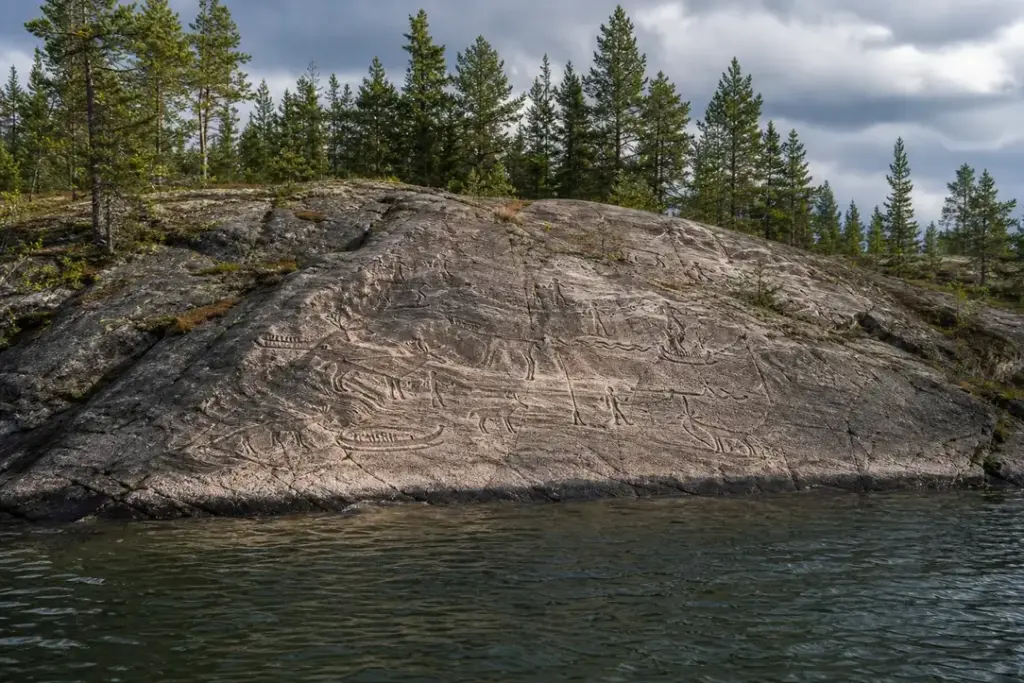
The White Sea Petroglyphs are part of a UNESCO World Heritage site located in the Republic of Karelia in northwest Russia. Scattered on islands of the Vyg River at the White Sea in the Belomorsky District, these 11 petroglyph sites contain over 3,400 figures.
The carvings primarily depict hunting and sailing scenes including their related equipment as well as animal and human footprints, offering a vivid window into the life of ancient northern sea hunters. Carved during the Neolithic period about six or seven thousand years ago, these images reveal both practical knowledge and the spiritual beliefs of Fennoscandia’s earliest inhabitants.
Current access notice: As of October 2026: The site is open year-round, though access may be affected by weather. A walking trail and parking area serve the main Zalavruga and Besovy Sledki sites. Check with local guides in Belomorsk for current conditions, particularly in winter when weather and daylight are limiting factors.
Quick Facts
| Russian name | Петроглифы Белого моря |
|---|---|
| Built / opened | c. 6000 BC |
| Address | Zalavruga, Vyg River, Belomorsky District, Republic of Karelia Google MapsApple MapsYandex Maps2GIS |
| District | Belomorsky |
| Admission | Free |
| Best time to visit | Summer (June to August) is the best season for visiting. During this period, the midnight sun provides extended daylight for exploring the petroglyphs, and weather is most stable. The boreal forest is accessible and trails are clear. Autumn (September) offers lower crowds and clearer light angles. Winter (November to April) is challenging due to short daylight hours, snow, and extreme cold. Spring can be muddy and wet. Weekdays are quieter than weekends. |
| Recommended duration | 2–4 hours |
What Is (and Isn't) Part of a Visit to White Sea Petroglyphs, Karelia?
| Part | Status | Notes |
|---|---|---|
| Zalavruga petroglyph panels | Included in the standard ticket | Main concentration of carvings accessible via walking trail from parking area. |
| Besovy Sledki petroglyph group | Included in the standard ticket | Linked to Zalavruga by a circular walking route; also accessible from parking area. |
| Island petroglyph sites (Shoyrukshin, Erpin Pudas, others) | Separate ticket or institution | Accessible only by boat; requires local guide or boat arrangement. Contact guides in Belomorsk. |
| Rock Art Centre in Petrozavodsk | Outside / not part of it | Museum in the capital city (400 km away) with exhibits on both White Sea and Lake Onega petroglyphs; separate visit required. |
| Lake Onega petroglyphs | Outside / not part of it | Separate UNESCO World Heritage site 300 km away in southeastern Karelia; requires different trip. |
Why Visit White Sea Petroglyphs, Karelia?
The site is one of the largest petroglyph complexes in Europe, showing an exceptional record of prehistoric hunting cultures. The largest concentration of petroglyphs is at Zalavruga with about 2,000 carvings, where you can see detailed narrative scenes of hunts and daily life.
The most sophisticated images are narrative compositions depicting hunts for sea animals (white whale and ringed seal), forest animals (reindeer, moose and bear) as well as water and upland fowl (geese and woodcocks). Many show hunters on skis or in boats, revealing seasonal hunting practices. The petroglyphs represent humanity’s earliest attempts to record and preserve stories on stone.
How White Sea Petroglyphs, Karelia Is Laid Out
The White Sea petroglyphs are spread across 11 sites on islands in the Vyg River delta near Belomorsk. Zalavruga contains the largest concentration of about 2,000 carvings, with additional significant groups on islands Shoyrukshin (over 500) and Erpin Pudas (over 200). A walking route links two main groups of rock art sites—Zalavruga and Besovy Sledki—into a single circular track making it accessible to visitors. The site has a car parking area, from which a forest trail leads to the petroglyphs.
Highlights of White Sea Petroglyphs, Karelia
Zalavruga Main Panel
The Zalavruga petroglyph group, with about 1 hectare of rock paintings and more than two thousand figures, was the main sacred center in the lower reaches of the Vyg river. This concentration shows the most elaborate narrative scenes of hunting expeditions, offering the richest visual record of Neolithic life. Look for the detailed hunting scenes showing hunters in boats and on skis pursuing animals.
Tip: Visit during summer when the light angles favor viewing the carved details; the midnight sun provides extended viewing hours in June.
Hunting Scenes and Seasonal Activity
The petroglyphs are clearly aligned towards hunting and depict the hunters themselves, as well as sailing boat scenes, hunting and labour equipment, and animal and human footprints. The scenes distinguish between summer hunts (shown with boats) and winter hunts (with skis), revealing sophisticated knowledge of seasonal rhythms. Individual panels show groups of hunters pursuing reindeer, seals, and whales.
Tip: Study the sequence of figures in a single scene to understand the narrative of a hunt—many panels read like storyboards of ancient events.
Animal and Footprint Motifs
The carvings include depictions of animal and human footprints, one of the most distinctive features of White Sea rock art. These tracks—both literal and from hunters or animals in motion—appear throughout the panels. Some figures, especially those of Onega, carry symbolic meanings related to solar and lunar imagery, suggesting spiritual beliefs intertwined with hunting practices.
Tip: Look for the tracks of ski-clad hunters pursuing reindeer—the stride patterns show realistic detail of movement uphill or across snow.
Marine Life Carvings
Many panels feature elaborate depictions of sea creatures—whales, seals, and beluga whales—often shown in hunting contexts with multiple hunters. These represent the crucial role of marine hunting in the Neolithic economy of the White Sea coast. The composition of boat scenes with multiple hunters reflects organized community hunts.
Tip: The island sites you can see from shore offer different perspectives; a water-level view of panels reveals details invisible from above.
Besovy Sledki Site
Besovy Sledki is another major rock art group linked by walking route to Zalavruga into a single circular track. The site was first opened in 1926 by writer and ethnographer A. Linevsky, who initially named it the poetic 'Besovy traces' or Devil's Footprints. The site contains distinct carvings and offers a less crowded alternative to Zalavruga.
Tip: Start at Besovy Sledki if you arrive early; the circular route then flows naturally to the larger Zalavruga group.
Staraya Zalavruga (Old Zalavruga)
The final stage of petroglyph development is represented by the giant mural of Staraya Zalavruga with giant expressive images of reindeer, total length of about 3 meters. This panel showcases the sophisticated artistic achievement of later Neolithic carvers and their ability to render large, dynamic animal forms.
Tip: This is the most photographed panel; visit early or during overcast conditions when shadows are less extreme.
Atmosphere
The petroglyphs form an open air museum of prehistoric rock carvings where you can see the first attempts of humans to express thoughts and feelings. The site sits on granite islands in the Vyg River delta, surrounded by boreal forest typical of northern Karelia. The landscape is quiet and often windswept, particularly in summer when polar daylight extends viewing hours into late evening. Few visitors venture to this remote location, creating a sense of discovery and isolation. The sound of water and forest surrounds you as you move between panels.
History of White Sea Petroglyphs, Karelia
The petroglyphs date as far back as the third and fourth millennium BC. The carvings were made during the Neolithic period, about 6–7 thousand years ago. They represent the visual record of sea-hunting and fishing communities who thrived along the White Sea coast.
The first petroglyph group, named Besovy Sledki (Devil’s Traces), was discovered in 1926 by writer and ethnographer A. Linevsky. In 1936, another major group was found at Zalavruga. That same year an expedition uncovered a huge area of 200 square meters completely covered with earth, which had perfectly preserved thousands of drawings underneath. Subsequent archaeological investigations throughout the 20th century revealed the full extent of the petroglyph complex.
Discoveries of new rock carvings continue to this day. The last discovery of previously unknown petroglyphs was made in 2005 on the Vyg River during a joint expedition of Karelian and British archaeologists.
In 2021, the petroglyphs of Lake Onega and the White Sea were awarded UNESCO World Heritage Site status on July 28th at the 44th UNESCO World Heritage Committee session. Following World Heritage designation, infrastructure development began, including a new walking route linking Zalavruga and Besovy Sledki into a single circular track, with plans for a bridge over Kisly Pudas brook.
Legends and Myths about White Sea Petroglyphs, Karelia
Devil's Footprints
Legend – historically unreliable. The Besovy Sledki site was initially named 'Besovy traces' or Devil's Footprints by its discoverer, writer A. Linevsky. Locals believe the petroglyphs depict representatives of evil spirits and have nicknamed the rock depicting humanoid figures 'Devil's Nose.' The poetic name reflects folk interpretations of the strange carved figures, though the actual depictions show hunters and animals.
Sacred Hunting Sanctuaries
Legend – historically unreliable. It is believed that places with petroglyphs were sanctuaries for the people that created them, where the indigenous inhabitants of Karelia prayed to their gods and, perhaps, offered sacrifices to them. The concentration of hunting scenes and animal depictions at Zalavruga, combined with their location on islands accessible by water, supports this interpretation of ritual or sacred significance.
Tickets and Booking for White Sea Petroglyphs, Karelia
It is relatively easy to reach the White Sea petroglyphs. They are located in a place called Zalavruga, not far from the White Sea coast and the town of Belomorsk. There is a sign by the road and a car parking, from which a forest trail goes to the petroglyphs. Entry to the main outdoor sites is free.
The local museum of Belomorsk and private guides arrange walking tours to the site of the petroglyphs. Hiring a local guide is recommended to understand the petroglyphs and navigate the trails safely. Tours can be arranged in Belomorsk. No advance booking is required for the open-air sites, but booking a guide in advance (through Belomorsk tourism office or hotels) is advisable, particularly in the shoulder seasons.
Plan and Book
Suggested itineraries White Sea Petroglyphs, Karelia
2 hours
Start at the parking area near Zalavruga. Walk the main trail to the largest concentration of petroglyphs and study the hunting scenes and animal depictions on the central rock panels. Return via the same route. This covers the most important carvings and the famous large-scale reindeer panel of Staraya Zalavruga.
3–4 hours
Visit the parking area and walk both the Zalavruga and Besovy Sledki sites via the circular route. This linked walking route connects the two major rock art groups into a single circular track, allowing comparison of different petroglyph styles and concentrations. Bring binoculars to examine distant island panels visible from shore.
Half day
In summer when daylight is extended, combine the main walking route with a boat tour to view petroglyphs on the island sites (Shoyrukshin, Erpin Pudas). This requires arranging a local boat guide. Return to Belomorsk for lunch and visit the local museum for context on the carvings before heading back.
How to Get to White Sea Petroglyphs, Karelia
The petroglyphs are located near the town of Belomorsk in the Belomorsky District of Karelia. The nearest city with air and rail connections is Petrozavodsk (about 400 km south). From Petrozavodsk, drive north toward Belomorsk (6–7 hours by car) or take a train. Belomorsk has limited transport connections; arrange transport with a local guide or car rental service.
The petroglyphs are located near the River Vyg and Belomorsk town. There is a sign by the road and a car parking area, from which a forest trail goes to the petroglyphs. If driving, the route from Belomorsk is well marked and takes about 30 minutes from the town center. Public transport in this region is limited; private transport or a hired guide is essential.
Accessibility
The outdoor petroglyph sites lack formal accessibility infrastructure. The terrain consists of forest trails and rocky shores with uneven surfaces. There are no wheelchair ramps, accessible toilets, or facilities at the main sites. Visitors with mobility issues should hire a local guide and plan shorter visits. Bring sturdy footwear suitable for rocky and potentially muddy terrain. No facilities are available at the sites; plan accordingly.
Food Nearby
Belomorsk, about 30 minutes away by car, has basic cafes and small restaurants serving Russian cuisine. Supplies are limited and prices higher than major cities. Bring packed food and water when visiting the petroglyphs, as no facilities are available at the site. Stock up in Belomorsk before heading to the petroglyphs.
What to Bring
Sturdy hiking boots with good grip for rocky and potentially muddy terrain. Waterproof jacket and layers for changeable northern weather. Binoculars to examine distant petroglyphs and observe details on high rocks. Camera with a good lens for detailed photography. Insect repellent (summer mosquitoes can be intense in boreal forests). Packed food and plenty of water. Sun protection: hat, sunscreen (summer sun can be strong despite cooler temperatures). Warm clothing even in summer, as northern Karelia is cool year-round.
Best Views and Photo Spots of White Sea Petroglyphs, Karelia
Staraya Zalavruga main panel
The 3-meter-long reindeer carving is the most dramatic petroglyphs on site. Captured at a low angle, the carved animal fills the frame with flowing lines suggesting movement. Early morning or late evening light catches the carved grooves.
Best time: Early morning (6–8 AM in summer) or 1–2 hours before sunset when the sun angle is low and reveals carved details through shadow.
Hunting scene panels with multiple figures
Complex compositions showing hunters and hunted animals in narrative sequences. Zoom in to capture individual figures and the relationships between them—boats, hunters on skis, prey animals.
Best time: Overcast days reveal carved details better than sunny conditions. Late afternoon provides soft, revealing light.
Besovy Sledki humanoid figures
Rectangular-headed humanoid forms that locals call Devil's Nose. These strange stylized figures stand out from the more naturalistic animal depictions and make striking portraits when photographed closeup.
Best time: Midday light when the sky is bright helps illuminate the carved depressions in the rock surface.
Island panels viewed from shore
Distant petroglyphs on Shoyrukshin and other islands are visible from the main shore trail. Using a telephoto lens, you can capture these panels in their landscape setting across the river or water.
Best time: Clear days with good visibility across the water. Late afternoon backlight can create atmospheric silhouettes.
Forest trail and landscape context
Wide-angle shots showing the boreal forest setting with granite outcrops and water in the background. These capture the environment in which hunters carved their records.
Best time: Golden hour (just after sunrise or before sunset) when forest light turns warm and atmospheric.
Photography Rules
Outdoor photography is permitted at the petroglyph sites. Bring a telephoto lens to capture details on high rocks and distant island panels from shore. The best light for photographing carved details is during overcast conditions or early morning/late evening when the sun angle creates shadows in the carved grooves, revealing detail. Avoid midday direct sun. Tripods are permitted for landscape photography.
Family Suitability
The petroglyphs are suitable for families with children aged 7 and older who can walk forest trails. The main walking route is about 2 km round trip with uneven terrain. Younger children may struggle with the rocky ground and lack of facilities. There are no strollers or pushchairs suitable for the terrain. The site holds genuine fascination for school-aged children interested in prehistory and ancient hunting cultures. No food, water, or toilet facilities exist on-site; plan accordingly. The remote location and lack of infrastructure make visits with very young children or elderly visitors challenging.
Russia Vibes Tips
- Hire a local guide from Belomorsk museum or hotel. Guides provide context for interpreting the petroglyphs and can point out details difficult to spot without training. This investment dramatically improves the experience.
- Bring binoculars and a telephoto lens. Many of the most interesting petroglyphs are on rocks several meters above ground level or on distant islands; binoculars let you examine them without needing to scramble up dangerous rocks.
- Visit early in your Karelia trip, not as an afterthought. If weather deteriorates, you'll have time to reschedule rather than miss the site entirely. Summer weather can change rapidly in the north.
- Study the hunting scenes in sequence to understand narratives. Many panels tell visual stories of seasons, animal behavior, and hunting techniques—reading them as a sequence (rather than isolated images) reveals the storytelling sophistication of Neolithic artists.
- Download images or get a field guide before arriving. Internet connectivity is poor in the Belomorsk region. Having reference images of the petroglyphs helps you identify and understand what you're seeing on site.
- Avoid the main summer tourist season (late July–early August) if possible. Crowds are light but can increase during Russian school holidays. Mid-June to early July is ideal—weather is stable and daylight is at its maximum.
Explore Nearby White Sea Petroglyphs, Karelia
Browse more: More in Belomorsky · All Karelia · All Landmarks · All Sightseeing · All Sightseeing in Karelia
FAQ: White Sea Petroglyphs, Karelia
Are the White Sea petroglyphs and Lake Onega petroglyphs the same site?
The Petroglyphs of Lake Onega and the White Sea are two separate component parts located 300 km from each other, both in the Republic of Karelia. Both are part of a single UNESCO World Heritage Site inscribed in 2021. They are distinct locations requiring separate visits.
How old are the petroglyphs?
The petroglyphs were carved during the Neolithic period about six or seven thousand years ago. They date as far back as the third and fourth millennium BC. This makes them among Europe's oldest rock art.
Is entry free?
Yes, entry to the outdoor petroglyph sites is free. However, hiring a local guide (recommended) costs extra. Contact the Belomorsk museum or local tourism office for guide rates and availability.
Can I reach the petroglyphs without a car?
The main Zalavruga and Besovy Sledki sites are accessible from a parking area via a forest walking trail. Public transport to Belomorsk is limited. Once in Belomorsk, you can arrange a guide with transport, or hire a taxi for the 30-minute drive to the parking area. Island sites require boat arrangement.
What do the petroglyphs depict?
The petroglyphs mostly consist of carvings depicting hunting and sailing scenes including their related equipment as well as animal and human footprints. Scenes show hunters pursuing reindeer, seals, whales, and other animals, with hunters depicted on skis or in boats depending on the season.
Is a guide necessary?
A guide is highly recommended. They provide archaeological context, point out details difficult to spot without training, and help you interpret the complex narratives in the petroglyph scenes. The Belomorsk museum arranges guides. Independent visits are possible but less rewarding.
What is the best time to visit?
Summer (June to August) offers extended daylight and the midnight sun, stable weather, and clear trails. June through early July avoids the peak August tourist season. Spring (May) is muddy. Winter (November–April) is very cold with short daylight hours.
Can I visit island petroglyphs?
Petroglyphs are also found on the islands of Erpin Pudas, Shoyrukshin, Bolshoy Malinin and others. Visiting these requires boat transport. Arrange with a local guide in Belomorsk who can coordinate water access. The main Zalavruga and Besovy Sledki sites are accessible on foot from the parking area.
Russia Vibes is a one-person project. A coffee keeps it going
How we research and update our guides
About this guide: AI assistance and accuracy
This guide is created with the help of AI and is based on official sources where available. Mistakes can still happen. Opening hours, prices, rules and other details are given to the best of our knowledge as of the date shown and can change without notice. It offers general recommendations only, not professional, legal or travel advice. Please confirm important details with the official source before you travel; you are responsible for your own plans and decisions.
Packing for this trip
* Affiliate link: as an Amazon Associate we earn from qualifying purchases at no extra cost to you.

Take this guide with you
Get a free PDF of this guide to print or read offline: key facts, tips and a map link on a few clean pages.
Report an issue on this page
Paying for your trip: please read
International sanctions affect payments between Russia and many other countries. In practice, cards issued in the EU, the UK, the US and several other countries often do not work in Russia, Russian cards usually do not work abroad, and some booking platforms, airlines and payment providers limit or suspend their services for Russia. The situation changes frequently.
We do not give legal or financial advice, and this site does not encourage anyone to break or circumvent sanctions. Whatever you plan, you are responsible for following the laws and regulations that apply to you, including those of your country of residence and citizenship.
Many travelers still organise their stay lawfully. It is worth asking your bank or payment provider what is currently permitted, contacting hotels, tour operators and carriers directly about the payment methods they accept, and checking which services are open to customers from your country. Clarify payment, cancellation and refund terms before you commit to a booking, and keep your plans flexible.
Partner links on this site may not be available in every country, and prices, availability and rules in our guides can differ from what you see when you book.