
Updated
Frunzensky is the heart of downtown Vladivostok, a lively neighborhood where the energy of the city pulses through its streets. The district takes its name from Mikhail Frunze, a Bolshevik revolutionary, and was established as an administrative area on January 4, 1936. Today, it remains the commercial and cultural center of Russia’s far eastern port city, blending historic architecture with modern commerce and entertainment.
For visitors, Frunzensky neighborhood offers convenient access to major attractions, restaurants, and nightlife. The district’s central location makes it an ideal base for exploring Vladivostok, with easy connections to museums, embankments, and the famous Railway Station terminus of the Trans-Siberian Railway.
Quick Facts
| Russian name | Фрунзенский |
|---|---|
| Address | Google MapsApple MapsYandex Maps2GISOpenStreetMap |
| District | Frunzensky |
| Best time to visit | Summer (June–August) offers the warmest weather and draws crowds to embankments and outdoor cafes. Spring (April–May) and autumn (September–October) provide comfortable temperatures and fewer tourists. Winters are cold and often dark, but the district's indoor attractions (restaurants, shops, museums) remain fully operational. For Trans-Siberian travelers, Frunzensky accommodates arrivals year-round; the railway station functions without seasonal variation. |
Why Visit Frunzensky, Vladivostok?
Frunzensky is where most travelers naturally congregate in Vladivostok. The district houses the city’s main railway station, a stunning architectural landmark and the endpoint of the Trans-Siberian Railway from Moscow. Beyond transit, the neighborhood offers exceptional dining concentrated along its streets, with seafood restaurants taking advantage of the city’s fresh Pacific catch. The area pulses with nightlife in the evenings, featuring bars and clubs. Walking routes connect to the embankments of Golden Horn Bay, where you can experience the maritime identity of the city firsthand.
Highlights of Frunzensky, Vladivostok
Vladivostok Railway Station
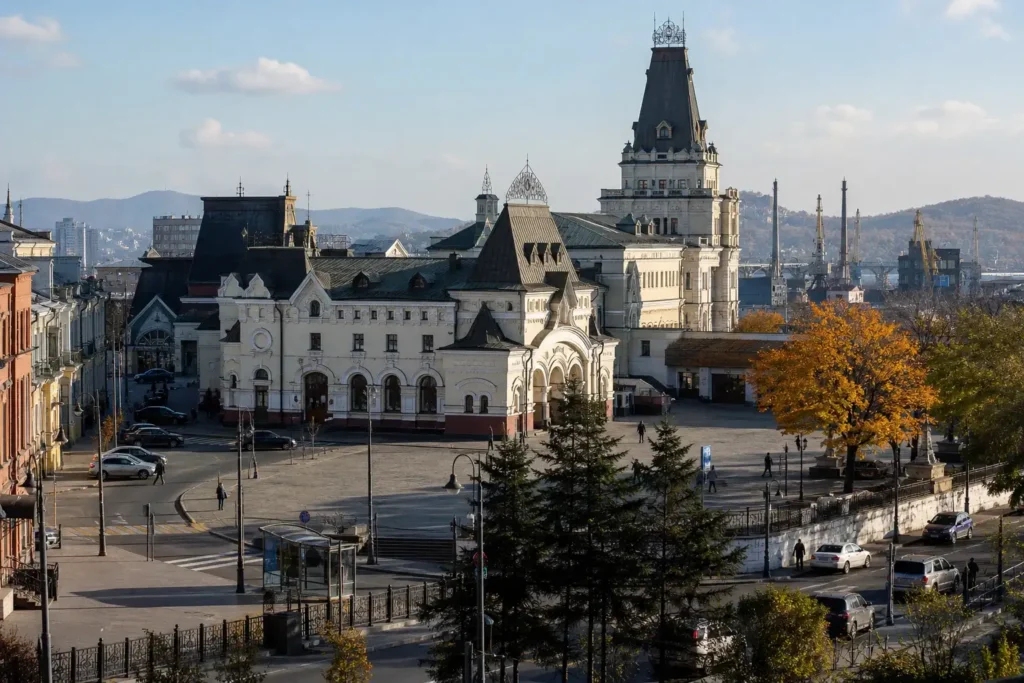
The grand terminus of the Trans-Siberian Railway, completed in 1893, stands as one of Vladivostok's most recognizable landmarks. Its imposing neo-Byzantine architecture, with ornate detailing and a striking tower, dominates Central Square. For many travelers, stepping off a train here marks the symbolic end of a weeklong journey across Russia. The building functions as both an active transport hub and a major historical monument, drawing photographers and history enthusiasts daily.
Tip: Arrive early to photograph the station facade in morning light before crowds gather. The square around it offers good vantage points from multiple angles.
Central Square (Ploshchad Bortsov za Vlast)
The civic heart of Frunzensky, Central Square features the city's principal monument and serves as the focal point for civic gatherings. The square connects directly to Vladivostok Railway Station and provides clear sightlines to downtown landmarks. Its open design makes it a natural gathering point and orientation marker for first-time visitors navigating the neighborhood. The architectural ensemble reflects the city's Soviet and post-Soviet development.
Tip: Visit in late afternoon when the square fills with locals and light angles improve for photography. Markets and shops line nearby streets.
Svetlanskaya Street
Named after the 1873 frigate Svetlana, this is Vladivostok's longest historical street and the primary commercial spine running through Frunzensky. The street preserves numerous memorial buildings and architectural styles from different periods of the city's development. It serves as the main pedestrian shopping corridor, lined with cafes, restaurants, and shops. Walking its length provides a quick social survey of contemporary Vladivostok life.
Tip: Svetlanskaya is best explored on foot. Stop at corner cafes for coffee or snacks rather than planning a specific destination—the street itself is the attraction.
Embankment of Sportivnaya Harbor (Sportivnaya Coastal Road)
The waterfront promenade along Sportivnaya Harbor offers relief from the urban grid and connects Frunzensky visually to the sea that defines Vladivostok. The harbor embankment features market stalls, seafood restaurants, and observation points overlooking fishing boats and naval vessels. Local life concentrates here: fishermen sell fresh catch, families walk in the evenings, and restaurants serve Pacific specialties. The embankment gives visitors the authentic maritime character of the city.
Tip: Visit the embankment in the late afternoon when fishermen return and restaurants light up. The market is most active in late morning.
Eagle's Nest Observation Point (Sopka Eagle's Nest)
Rising about 200 meters above downtown, Eagle's Nest Hill is the geographic and visual center of Vladivostok, accessible from Frunzensky via a funicular or a 400-step staircase. The extinct volcano, part of the Sikhote-Alin Mountain range, provides the city's most comprehensive panoramic views over Golden Horn Bay. A television tower and observation deck crown the summit. On clear days, visitors report seeing a rare optical phenomenon called the 'Broken Bow'—a shadow projected on clouds with colored halos.
Tip: Take the funicular (about 1.5 minutes) rather than stairs to preserve energy for exploration. Visit at sunset for the best light and to photograph the city grid below.
Atmosphere
Frunzensky pulses with urban energy, especially in the evening. By day, the district has the practical character of a working downtown—people crossing streets between shops, taxis moving through the grid, deliveries stacked outside restaurants. The railway station area thrums with the sounds of trains and arriving passengers. By evening, the neighborhood transforms as restaurants fill, bar crowds emerge, and neon signs reflect off wet pavement after rain.
The streets carry a distinctly Pacific character: fishmongers sell fresh squid and crab, Korean and Chinese restaurants sit alongside Russian establishments, and the sound of Russian mixed with Asian languages fills the air. Winter brings a chill that empties streets by late afternoon, while summer draws evening crowds to the embankment to escape the city’s close quarters.
History of Frunzensky, Vladivostok
Vladivostok itself was founded in 1860 as a Russian military settlement on the Pacific coast, and Frunzensky became the original civic center from which the city grew. The district’s formal establishment came on January 4, 1936, when Soviet administrative divisions reorganized Vladivostok into several districts, each named after revolutionary figures and historical concepts. Mikhail Frunze, the district’s namesake, was a prominent Bolshevik military leader and theorist who died in 1925—by 1936, his name symbolized Soviet revolutionary authority.
The Vladivostok Railway Station, completed in 1893, anchored Frunzensky’s development before the district’s formal creation. Its ornate architecture reflected the Imperial Russian government’s ambitions for this remote Pacific port, designating it as the Far Eastern terminus of Russia’s expanding railway network. When the Trans-Siberian Railway was completed in 1916, the station became the symbolic endpoint of the world’s longest railway line, cementing Frunzensky’s importance as the city’s principal gateway.
Throughout the Soviet period, Frunzensky consolidated its role as Vladivostok’s administrative and commercial center. The district hosted government offices, theaters, restaurants, and hotels—the infrastructure of Soviet civic life. The embankments underwent multiple reconstructions, particularly after World War II, as the Soviet navy’s Pacific Fleet expanded and the city’s military importance grew. Military installations and naval facilities historically occupied parts of the district’s waterfront, reflecting Vladivostok’s role as an important Pacific naval port.
After the Soviet collapse in 1991, Frunzensky underwent rapid commercialization. Shops, cafes, and restaurants multiplied along Svetlanskaya Street. The market economy brought Korean and Chinese businesses, reflecting geographic proximity and new trade routes. The neighborhood’s nightlife developed significantly in the 1990s and 2000s. Today, Frunzensky remains the city’s economic and social hub, though development has pushed newer commercial districts eastward to areas like Sovetsky and Leninsky.
How to Get to Frunzensky, Vladivostok
Frunzensky is Vladivostok’s most accessible district by public transport. By metro: Vladivostok has no metro system; the city relies on buses, trams, trolleybuses, and taxis. By Railway Station: All Trans-Siberian arrivals terminate at Vladivostok Railway Station in the heart of Frunzensky, placing you immediately in the district. By bus or taxi: From Vladivostok International Airport (about 40 km north), take bus or taxi services directly into Frunzensky; taxis are widely available. Walking: Once in the district, the main attractions are walkable. Svetlanskaya Street runs the length of the district as the primary north-south pedestrian spine. The railway station connects directly to Central Square; from there, the embankment is a 10–15 minute walk southward.
Accessibility
Vladivostok's Frunzensky district, like much of Russia's Far East, has limited dedicated accessibility infrastructure. The Railway Station is a multi-level building with stairs at its main entrance; ramps and elevators are not widely documented on the official station website. Central Square is largely flat and navigable. Svetlanskaya Street varies in surface conditions and has mixed curb ramps. The embankment promenade is generally flat and open. Taxis are plentiful and accept passengers with mobility needs. Information about accessible facilities is best confirmed with your accommodation or local assistance.
Food Nearby
Frunzensky has the city's highest concentration of restaurants and cafes. Seafood establishments line the Sportivnaya Harbor embankment, serving fresh Pacific fish, crab, and squid prepared in Russian, Korean, and Chinese styles. Svetlanskaya Street hosts a mix of casual cafes, Japanese restaurants, Korean barbecue venues, and bakeries. The Sportivnaya Market (also called Fish Market) is the largest market in Vladivostok, offering prepared fish, dried seafood, and fresh produce. Late-night options are common due to the district's nightlife. Budget options cluster around the railway station; upscale dining concentrates near the embankment.
What to Bring
In summer, bring sun protection, light clothing, and water. Vladivostok's maritime climate means winds off the bay, so a light jacket remains useful even in warm months. In winter (November–February), temperatures drop to around –10°C; insulated coats, hats, gloves, and waterproof boots are essential. The neighborhood's walking culture means comfortable shoes are vital year-round. Rain is common; an umbrella or rain jacket helps. No special items are required beyond what suits the season; the district is fully developed with standard urban amenities.
Best Views and Photo Spots of Frunzensky, Vladivostok
Vladivostok Railway Station exterior, Central Square
The ornate 1893 station building dominates from multiple angles. The neo-Byzantine architecture with its prominent tower frames especially well from the square's south side, where afternoon light illuminates the facade. Central Square's open geometry allows clear sightlines; early morning light from the east or late afternoon from the west provides ideal contrast.
Best time: Early morning (7–9 AM) for soft light and near-empty square, or late afternoon (4–6 PM) for warm side lighting. Midday creates harsh shadows across the ornate details.
Eagle's Nest observation deck, looking south over Golden Horn Bay
From the 200-meter summit, the view sweeps across downtown Frunzensky, the bay's curves, and mountains beyond. Downtown's grid pattern reads clearly. The panorama includes two major bridges (Zolotoy and Russky) in the distance. The TV tower and surrounding landscape provide context for the city's scale and geography.
Best time: Late afternoon (4–6 PM) for warm light across the water and city; sunset illuminates the bay's eastern shore. Clear days after rain offer the most contrast; avoid midday haze.
Sportivnaya Harbor embankment, looking north toward boats
The waterfront captures fishing boats, merchant vessels, and naval ships at their moorings. The working harbor conveys Vladivostok's maritime identity more authentically than manicured tourist areas. Markets, restaurants, and local activity provide human context. Mountains frame the background.
Best time: Late morning (10–11 AM) when fishermen return and market activity peaks; afternoon (3–5 PM) for warm light and sunset reflection on water. Early morning (6–7 AM) shows fewer crowds.
Svetlanskaya Street, mid-block looking north or south
The street's architecture shows layers of imperial, Soviet, and contemporary development in a single frame. Street-level shops and cafes convey the living commercial character. Morning and afternoon foot traffic provide human activity. The long perspective down the street reads as a defining urban spine.
Best time: Late morning (10–11 AM) for warm sidelight and moderate crowds; mid-afternoon (2–4 PM) when light flatters facades. Early morning and evening avoid harsh shadows but show fewer people.
Photography Rules
Photography is permitted throughout Frunzensky. Tripods may draw police attention if used on public streets without permission; use handheld cameras for street photography. Flash photography inside the Railway Station may attract staff attention but is not formally prohibited. Drones are restricted in urban areas near the port and military installations; verify regulations with local authorities before flying. Sunset from Eagle's Nest produces excellent light; photographing from the observation deck incurs no additional fees.
Family Suitability
Frunzensky works for families with school-age children or teens. The railway station, embankment walks, and Eagle's Nest appeal to children. Strollers navigate Central Square and the embankment but face uneven surfaces on some Svetlanskaya blocks. The district's high nightlife activity means evening crowds and noise; families with young children may find daytime visits more comfortable. The seafood market is visually stimulating but crowded. No particular hazards target children; standard urban vigilance applies.
Russia Vibes Tips
- Do not assume everything touristy in Vladivostok lies in Frunzensky. While the district is central, museums like the Primorsky State Art Gallery and major attractions like the S-56 Submarine Museum are located elsewhere. Clarify neighborhoods when booking accommodation or researching specific sights.
- The Railway Station area is busy with arriving and departing passengers, pickpockets, and taxi touts. Keep belongings secure in this zone. Legitimate taxis operate from official taxi stands; avoid unmarked cars. The district improves in safety and comfort one block away from the station.
- Svetlanskaya Street has the highest density of functioning shops and cafes but also the heaviest foot traffic. Side streets and the embankment offer quieter alternatives for the same attractions at a slower pace. Plan 30–45 minutes minimum to walk Svetlanskaya, not 10–15.
- The funicular to Eagle's Nest operates on a fixed schedule (typically 9 AM–6 PM or later, but verify locally). Plan accordingly; arriving near closing time means a shorter window at the top. The 400-step staircase is an alternative but requires 30–40 minutes of effort in any weather.
- Frunzensky's restaurant scene caters to locals, not tourists; English-language menus are common in central areas but less frequent on side streets. Menus with photographs help navigate language barriers. Prices are moderate; expensive establishments cluster near the embankment.
Explore Nearby Frunzensky, Vladivostok
Related guides
 KamInn Hotel, Vladivostok: Central Location, Free Breakfast and Parking
Main image: AI-generated illustration. It may not show the place exactly as it looks.
Browse more: More in Frunzensky · All Neighborhoods · All Neighborhoods · All Neighborhoods in Vladivostok · All Vladivostok
FAQ: Frunzensky, Vladivostok
Is Frunzensky safe for visitors?
Frunzensky is generally safe for tourists, particularly in daytime and along main streets like Svetlanskaya and the embankment. The Railway Station area concentrates pickpockets and taxi touts; keep valuables secure and use official taxis. Avoid isolated side streets late at night. Standard urban awareness applies. The district is more commercial than residential, so tourism infrastructure (shops, restaurants, hotels) is well-developed.
What is Frunzensky named after?
Frunzensky is named after Mikhail Frunze, a prominent Bolshevik military leader and theorist who died in 1925. The district was formally established on January 4, 1936, during Soviet administrative reorganization. The namesake reflected communist ideology; renaming efforts have occasionally been proposed since 1991 but have not succeeded.
Can I walk from the Railway Station to the embankment?
Yes. From Vladivostok Railway Station, walking south toward the harbor takes 10–15 minutes to reach Sportivnaya Harbor embankment. The route descends gradually. It's pedestrian-friendly, with shops and cafes en route. This walk is a standard first-time visitor experience.
Does Vladivostok have a metro system?
No. Vladivostok has no metro. The city uses buses, trams, trolleybuses, and taxis for public transport. Most Frunzensky attractions are within walking distance of each other; taxis are plentiful and affordable.
When does Eagle's Nest Hill observation deck close?
The observation deck is typically open 9 AM–6 PM or later, but hours vary seasonally. Check locally or ask your accommodation to confirm the current schedule before planning a visit, especially if you aim to visit near sunset.
Are restaurants open late in Frunzensky?
Yes. Due to the district's vibrant nightlife, many restaurants, cafes, and bars remain open until 11 PM, midnight, or later. Some close between 3–5 PM for afternoon breaks. Embankment establishments cater to evening crowds and often stay open late during summer.
Where is the city hall located?
City hall (Vladivostok administration) is located on Okeansky Prospekt 20, in Frunzensky District. It is not a major tourist attraction but is a recognizable landmark if you see it referenced.
Can I buy Trans-Siberian Railway tickets at the Vladivostok Station?
Yes, the railway station office sells tickets, but advance booking is recommended for long-distance routes. Online booking through Russian railways (RZD) websites or third-party platforms offers more flexibility and date options. Same-day tickets are available if space exists but are not guaranteed.
Russia Vibes is a one-person project. A coffee keeps it going
How we research and update our guides
About this guide: AI assistance and accuracy
This guide is created with the help of AI and is based on official sources where available. Mistakes can still happen. Opening hours, prices, rules and other details are given to the best of our knowledge as of the date shown and can change without notice. It offers general recommendations only, not professional, legal or travel advice. Please confirm important details with the official source before you travel; you are responsible for your own plans and decisions.

Take this guide with you
Get a free PDF of this guide to print or read offline: key facts, tips and a map link on a few clean pages.
Report an issue on this page
Paying for your trip: please read
International sanctions affect payments between Russia and many other countries. In practice, cards issued in the EU, the UK, the US and several other countries often do not work in Russia, Russian cards usually do not work abroad, and some booking platforms, airlines and payment providers limit or suspend their services for Russia. The situation changes frequently.
We do not give legal or financial advice, and this site does not encourage anyone to break or circumvent sanctions. Whatever you plan, you are responsible for following the laws and regulations that apply to you, including those of your country of residence and citizenship.
Many travelers still organise their stay lawfully. It is worth asking your bank or payment provider what is currently permitted, contacting hotels, tour operators and carriers directly about the payment methods they accept, and checking which services are open to customers from your country. Clarify payment, cancellation and refund terms before you commit to a booking, and keep your plans flexible.
Partner links on this site may not be available in every country, and prices, availability and rules in our guides can differ from what you see when you book.