
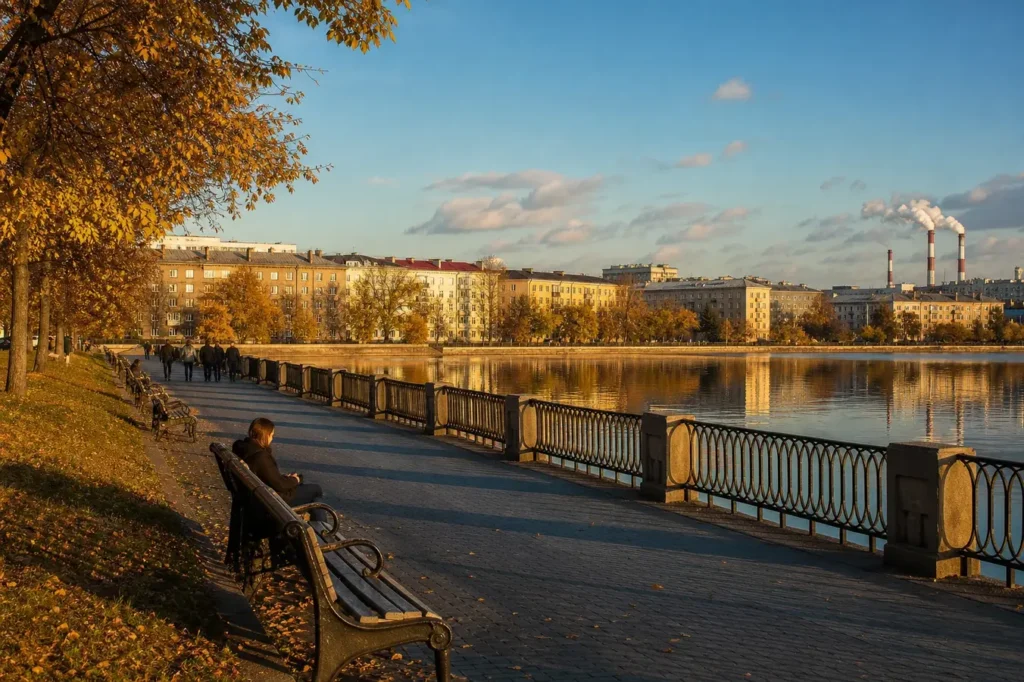
Verkh-Isetsky (Верх-Исетский) is one of Yekaterinburg‘s eight city districts, covering 240 square kilometers and home to over 240,000 residents as of 2021. Established as a formal district in 1919, it developed around heavy industry, particularly the Verkh-Isetsky Metallurgical Plant, which gave the neighborhood its character and name. The district spans from the Iset River in the south to residential and industrial areas in the north, making it substantially larger and more dispersed than central Yekaterinburg’s compact grid.
Visitors typically explore Verkh-Isetsky for its authentic Soviet atmosphere, industrial heritage sites, and local cultural venues rather than major tourist attractions. The neighborhood is less polished than downtown but far more representative of how most Yekaterinburg residents live and work.
Quick Facts
| Russian name | Верх-Исетский |
|---|---|
| Address | OpenStreetMap · Google Maps |
| District | Verkh-Isetsky |
| Metro | Ploshchad 1905 Goda (Red Line, Central district connections; ~15–20 min walk to Verkh-Isetsky central areas) Dinamo (Red Line, Eastern approach; ~10–15 min walk to riverside areas) |
| Best time to visit | Late spring (May–early June) and early autumn (September–early October) offer pleasant weather for walking the pond embankment and exploring streets without extreme heat or cold. Summer (July–August) can be warm and occasionally crowded with locals at the pond. Winter (December–February) transforms the pond into a skating venue and offers dramatic architectural photography with snow. Avoid mid-summer heat if you plan extensive walking. Weekdays are quieter than weekends for observing local life; Soviet-era streets are most atmospheric on quiet weekday mornings. |
What Is (and Isn't) Part of a Visit to Verkh-Isetsky, Yekaterinburg?
| Part | Status | Notes |
|---|---|---|
| Verkh-Isetsky Pond | Included in the standard ticket | Public embankments and parks around the pond are freely accessible year-round. |
| Center of Culture and Arts "Verkh-Isetsky" | Separate ticket or institution | Performances and events require separate tickets; check the venue's schedule for public programming. |
| Verkh-Isetsky Metallurgical Plant | Outside / not part of it | Active industrial facility; public access is restricted except for organized tours, which must be arranged in advance. |
| Public squares and streets | Included in the standard ticket | All streets and public squares in Verkh-Isetsky are freely accessible during normal hours. |
| Neighborhood museums and galleries | Separate ticket or institution | Small local museums and galleries exist; each charges separate admission; check current venues before visiting. |
Why Visit Verkh-Isetsky, Yekaterinburg?
Verkh-Isetsky rewards travelers seeking to understand Yekaterinburg beyond postcard landmarks. The district preserves Soviet-era urban planning and architecture intact, from monumental workers’ housing blocks to factory complexes that shaped the Urals’ industrial power. The Verkh-Isetsky Pond offers green space and views of the historic works, while cultural institutions like the Center of Culture and Arts serve neighborhood residents with theaters and exhibitions. History enthusiasts gain insight into Soviet working-class life; photographers find authentic street scenes and industrial geometry; those interested in local commerce and daily life can experience a genuine neighborhood rather than a tourist zone.
Highlights of Verkh-Isetsky, Yekaterinburg
Verkh-Isetsky Pond
A scenic artificial pond created by damming the Iset River, lined with parks and walkways. The pond reflects the historic metallurgical works on its banks and serves as a local gathering place in summer. The embankment offers views of the district's industrial heritage and access to picnic areas. In winter, locals skate on the frozen surface.
Tip: Visit in late spring or early autumn for the clearest reflections and most comfortable weather without summer crowds.
Center of Culture and Arts "Verkh-Isetsky"
A Palace of Culture (Dom Kultury) built in 1957 in Russian Neoclassical Revival style by architect Vladimir Yemelyanov, located on Subbotnikov Square. The building is a regional cultural heritage site and hosts theatrical performances, concerts, and local exhibitions. It exemplifies Soviet-era civic architecture designed as a cultural hub for factory workers.
Tip: Check the official schedule for performances; even if you don't attend, the exterior and surrounding square are architecturally significant examples of Soviet planning.
Verkh-Isetsky Metallurgical Plant Historic Complex
The massive industrial plant (now VIZ-Stal) that defined the district's economy and identity since the Soviet era. The works dominate the district's skyline and are visible from multiple vantage points. Now a regional cultural heritage site, the complex represents Ural industrial power. Active factory tours and public access vary; verify current status before visiting.
Tip: Best viewed from the pond embankment or public streets rather than attempting unauthorized entry. Photography from public areas captures the scale and architecture.
Soviet-Era Residential Architecture
The district is filled with five- to nine-story residential blocks (khruschyovkas and later designs) built from the 1950s onward to house factory workers. These form authentic Soviet streetscapes with courtyards, local shops, and a distinctive urban grid. The blocks vary in style and condition, documenting post-Stalin Soviet urban development.
Tip: Walk the quieter residential streets east and west of Zavodskaya Street to see courtyards and local street life without the main thoroughfare traffic.
Ploshchad 1905 Goda (1905 Square) Metro Station Connection
The nearest major metro station to downtown Verkh-Isetsky, this central hub opened in 1994 and serves as the main interchange for exploring the wider Yekaterinburg center. The station features red granite and is well-connected by public transport to the district's western edge.
Tip: From this metro station, take trams or buses north to reach Verkh-Isetsky's main attractions more quickly than walking.
Rainbow Park (Raduzhniy Park)
A public park in the district offering green space, play areas for families, and local recreational facilities. The park reflects Soviet and post-Soviet civic planning and is heavily used by neighborhood residents on weekends.
Tip: Better suited for locals and families than international sightseers; useful as a break point if exploring the district on foot.
Atmosphere
Verkh-Isetsky feels like stepping into Soviet urban life preserved and lived daily. The streets are lined with imposing residential blocks, aging but solid, with ground-floor shops and kiosks. Factory sirens still punctuate the air in some areas. The pace is slower and more residential than downtown; morning rush hours bring crowds to bus stops and the metro, while afternoons are quieter. Older men gather at benches in courtyards; mothers push strollers on sidewalks. Architecturally, everything speaks of postwar socialist planning: geometric precision, functional brutalism, and human scale despite the massive buildings. The pond area brings a lighter mood, especially in warm months, with locals walking, fishing, or simply sitting on embankments. English is less common than downtown; Russian-language signage dominates.
History of Verkh-Isetsky, Yekaterinburg
Verkh-Isetsky’s history is inseparable from industrial development. The Verkh-Isetsky Metallurgical Plant, established in the 19th century, began large-scale expansion under Soviet power. During the Soviet era, particularly from the 1920s onward, the district became a model workers’ settlement, with housing constructed to accommodate plant employees and their families.
The district was formally established as a city district in 1919, consolidating the settlement around the works. Heavy investment in housing and civic infrastructure followed, peaking in the 1950s–1970s, when the characteristic Soviet residential blocks rose to shape the landscape. The Center of Culture and Arts, completed in 1957, embodied Soviet ideology: a palace of culture for workers’ intellectual and artistic development.
During the Soviet period, Verkh-Isetsky was a prosperous industrial neighborhood, defining Yekaterinburg (then Sverdlovsk) as an Urals manufacturing powerhouse. The collapse of Soviet heavy industry in the 1990s affected the district economically, though the plant continues operating under new ownership as VIZ-Stal. The neighborhood remains socially intact with stable, multigenerational resident populations.
Today, Verkh-Isetsky is recognized for its architectural heritage and as a living example of Soviet urban planning. The district’s working-class character has been largely preserved rather than gentrified, making it valuable for historians, architects, and those studying Soviet urbanism.
Tickets and Booking for Verkh-Isetsky, Yekaterinburg
Verkh-Isetsky is a residential neighborhood; no entry ticket is required to visit public areas, streets, parks, and embankments. To attend performances at the Center of Culture and Arts or other venues, purchase tickets directly at the venue or through their official booking channels. Factory tours of the Verkh-Isetsky Metallurgical Plant must be arranged separately through the plant’s management and are not regularly available to casual visitors; confirm availability well in advance.
Suggested itineraries Verkh-Isetsky, Yekaterinburg
2–3 hours
Start at Ploshchad 1905 Goda metro station and take a tram or bus north to Zavodskaya Street. Walk the pond embankment for views of the metallurgical plant and Soviet-era housing. Visit the Center of Culture and Arts on Subbotnikov Square if a performance is scheduled. Return to central Yekaterinburg via metro or local transport.
Half day
Explore the Verkh-Isetsky Pond fully, walking its entire embankment (approximately 4–5 km) to see different angles of the plant and housing blocks. Stop at Rainbow Park or a local café for refreshment. Tour a main residential avenue to photograph Soviet architecture. End at the Center of Culture and Arts or a neighborhood restaurant for a local meal.
Full day
Spend the morning walking residential side streets and courtyards to observe authentic Soviet daily life. Picnic at the pond or eat at a local stolovaya (workers' café). Afternoon: visit the Center of Culture and Arts if programming permits, then explore different neighborhoods within the district by tram. Evening: return to central Yekaterinburg for dinner.
How to Get to Verkh-Isetsky, Yekaterinburg
By Metro: Verkh-Isetsky is served by the Red Line (Line 1) at Ploshchad 1905 Goda (downtown connection) and Dinamo (eastern entry). From central Yekaterinburg, take the metro north toward Uralmash and exit at either station. Ploshchad 1905 Goda is 15–20 minutes’ walk to central Verkh-Isetsky; Dinamo is closer for riverside areas (10–15 minutes).
By Bus or Tram: Multiple tram and bus lines serve the district. From downtown, board trams heading north on Vaynera Street (through Ploshchad 1905 Goda) to reach Verkh-Isetsky. Journey time: 15–25 minutes depending on destination within the district.
By Taxi or Ride-Share: Apps like Yandex.Taxi and Uber operate in Yekaterinburg. From central hotels, rides to the Verkh-Isetsky Pond or Center of Culture and Arts typically cost moderate fares and take 20–30 minutes depending on traffic.
Accessibility
Verkh-Isetsky is a neighborhood of Soviet-era buildings; most residential blocks lack elevators despite their height, creating accessibility challenges for those with mobility issues. The pond embankment has paved paths but may be uneven in places. The Center of Culture and Arts, as a civic building from 1957, may have limited wheelchair access; contact the venue directly. Local public transport (trams, buses, metro) has mixed accessibility; metro elevators are operational at most stations but not all. Curbs and pedestrian infrastructure are uneven by Western standards. Travelers with mobility concerns should plan carefully and use taxis for longer distances.
Food Nearby
Verkh-Isetsky has local cafés, stolovayas (worker cafeterias), and small restaurants but few venues catering specifically to international tourists. Zavodskaya Street and surrounding areas have traditional Russian fast food, pizza chains, and neighborhood eateries. Pelmeni shops, pirozhki stands, and tea cafés are common. Modern chains (Dodo Pizza, others) have locations throughout the district. For planned dining, ask your hotel for recommendations or use Yandex.Maps to search for current venues. Expect authentic, inexpensive meals rather than fine dining.
What to Bring
Comfortable walking shoes are essential; streets and embankments involve considerable pavement time. In summer, bring sun protection (hat, sunscreen) and water. In winter, prepare for snow and ice with appropriate footwear. A light jacket or layers suit spring and autumn. A camera is useful for architectural photography. Small cash is helpful for local cafés and vendors, though cards are increasingly accepted. A metro card (available at stations) simplifies transport.
Best Views and Photo Spots of Verkh-Isetsky, Yekaterinburg
Verkh-Isetsky Pond Embankment (south bank)
Panoramic views of the pond with the Verkh-Isetsky Metallurgical Plant silhouetted beyond. Residential blocks frame the background. Reflections of buildings mirror in calm water, creating symmetrical compositions. The industrial skyline contrasts with the natural water, illustrating the relationship between nature and Soviet industry.
Best time: Early morning (6–8 AM) for soft light and fewer people; late afternoon (5–7 PM) for golden hour reflection. Clear days are best for distant factory views.
Residential Courtyard (typical block off Zavodskaya Street)
Enclosed courtyards between Soviet housing blocks, with children's play areas, laundry lines, and benches. Narrow vertical composition framed by five- to nine-story buildings. Authentic daily Soviet urban life: mothers with strollers, people shopping, local commerce at ground level. Geometric shadows and pastel-colored facades.
Best time: Midday (10 AM–3 PM) for side-lighting of buildings and active street life. Weekday mornings show workers and school children.
Center of Culture and Arts Facade (Subbotnikov Square)
Monumental Russian Neoclassical Revival building (1957) with grand columns and neoclassical proportions. The square provides distance for full-frame composition. Symbolic of Soviet civic ambition and worker cultural aspirations. Symmetrical architectural detail.
Best time: Afternoon (2–5 PM) for frontal lighting of the facade; overcast days render the stonework evenly without harsh shadows.
Tram Stop or Street Scene (Zavodskaya Street)
Authentic urban scene: vintage trams, Soviet street furniture, ground-floor shops with Cyrillic signs, pedestrians in everyday clothes. Layered urban composition with multiple focal planes. Documents contemporary Russian daily life in a working-class context.
Best time: Weekday mornings (8–10 AM) for rush-hour activity and commuters; golden hour (late afternoon) for warm sidelighting.
Industrial Plant View from Bridge or Overpass
Elevated vantage of the Verkh-Isetsky Metallurgical Plant works: smokestacks, crane bridges, industrial geometry, and massive scale. Soviet-era infrastructure at landscape scale. Sense of industrial power and historical economic importance.
Best time: Clear weather for distant views; early morning or late afternoon for dramatic shadows and atmospheric effect from industrial steam or haze.
Photography Rules
Public photography is permitted throughout the neighborhood streets and parks. The pond embankment offers scenic views of industrial architecture and Soviet housing. Photographing the metallurgical plant from public streets is allowed, but do not attempt to enter the facility or photograph it from private property. Drones are not permitted in residential areas or near industrial sites. Tripods are acceptable on public embankments and parks but not on busy streets.
Family Suitability
Verkh-Isetsky is family-friendly for older children and adults interested in observing local life and architecture. The pond embankment is suitable for families with strollers and young children, offering parks and open spaces. However, the neighborhood is less geared toward international tourists and lacks dedicated family attractions like theme parks or children's museums. Public transport is functional but crowded during peak hours. Restaurants cater to local tastes; finding familiar international cuisine requires research. Schools are numerous, reflecting the family-oriented residential character. Soviet-era streets have limited English signage; parents should prepare children for a non-tourist environment and language barriers. Best suited for families aged 8+.
Russia Vibes Tips
- Visit on a weekday morning to observe authentic neighborhood life: workers commuting, elderly residents at bus stops, the tempo and rhythm of a real Soviet-era district. Weekends feel more recreational and less 'typical.'
- Bring small cash (rubles) for local cafés and kiosks; not all accept cards, especially small neighborhood establishments. ATMs are available throughout but vary in acceptance of foreign cards.
- Do not attempt to enter the Verkh-Isetsky Metallurgical Plant or photograph it from private property; it remains an active industrial site with restricted access. Public views from streets and the embankment are sufficient and legal.
- The pond is most beautiful in late spring and early autumn; summer heat and humidity can make walking uncomfortable, while winter ice may close some paths. Plan timing accordingly.
- Learn a few basic Russian words (spasibo = thank you; izvinite = excuse me) or use a translation app; English is rare in neighborhood venues, and locals appreciate the effort.
- If exploring with a camera, respect residents' privacy in courtyards and residential streets. Always ask before photographing people. Locals may be wary of foreigners photographing their living spaces; explain your interest in Soviet architecture and be courteous.
Where to Find Verkh-Isetsky, Yekaterinburg in Russia
More chains in Russia
 Downtown/City Center, Yekaterinburg
Main image: AI-generated illustration. It may not show the place exactly as it looks.
 Leninsky, Yekaterinburg
Main image: AI-generated illustration. It may not show the place exactly as it looks.
Related guides
 Emerald Hotel, Yekaterinburg: Central 3-Star Stay with Free Parking
Main image: AI-generated illustration. It may not show the place exactly as it looks.
 Yeltsin Center: Museum of Modern Russia and 1990s History
Main image: AI-generated illustration. It may not show the place exactly as it looks.
Browse more: More in Verkh-Isetsky · All Neighborhood · All Neighborhoods · All Neighborhoods in Yekaterinburg · All Yekaterinburg
FAQ: Verkh-Isetsky, Yekaterinburg
Is Verkh-Isetsky safe for visitors?
Yes. Verkh-Isetsky is a stable, predominantly working-class residential neighborhood with low crime against tourists. Standard city precautions apply: avoid valuables, be aware of surroundings at night, and use licensed taxis. The district is less touristy than downtown, so you may attract casual attention, but serious risk is minimal. Local residents are generally helpful.
Can I visit the Verkh-Isetsky Metallurgical Plant?
The plant (now VIZ-Stal) is an active industrial facility with restricted public access. Casual visiting is not permitted. Organized factory tours may be available through the plant's management or local tour operators; you must arrange these in advance and have valid documentation. Most visitors photograph it from public embankments and streets instead.
What is there to do in Verkh-Isetsky for just a few hours?
Walk the pond embankment (1–2 hours), visit the Center of Culture and Arts if a performance is scheduled, photograph Soviet architecture and residential courtyards, or grab a local meal. For a shorter visit, the pond alone provides 45–60 minutes of walking and scenic views without requiring extended commitment.
How do I get from downtown Yekaterinburg to Verkh-Isetsky?
From Ploshchad 1905 Goda metro station, take the metro toward Uralmash (Red Line) and exit at Ploshchad 1905 Goda station or Dinamo station, then walk north. Alternatively, take a tram or bus heading north from central streets. Journey time: 15–25 minutes by various methods. Taxis are also available.
What language is spoken in Verkh-Isetsky?
Russian is the primary language; English is far less common than in downtown tourist areas. Many older residents speak only Russian. Younger people may have some English. Translation apps are helpful; learning basic Russian phrases (hello, thank you, excuse me) improves interactions with locals.
Are there restaurants or cafés suitable for tourists?
Yes, but they are neighborhood establishments, not venues designed for international travelers. Expect traditional Russian food, affordable stolovayas (cafeterias), pelmeni shops, and pizza chains rather than fine dining or fusion cuisine. Menu signage is in Russian; translation apps help. Quality varies; ask locals or your hotel for recommendations.
What is the best time of day to visit Verkh-Isetsky?
Late morning to early afternoon (10 AM–4 PM) offers good light and active street life. Weekday mornings (8–10 AM) are best for observing authentic neighborhood activity. Avoid very early morning (before 7 AM) and late evening (after 7 PM), when streets are quieter and lighting is poor.
Can I use my phone and cards in Verkh-Isetsky?
Cell phone coverage is reliable. Mobile data is available from major Russian providers (Beeline, MTS, Megafon); international roaming depends on your carrier. Credit and debit cards are accepted at larger venues and chains but often not at small neighborhood cafés and kiosks. Carry small cash (rubles) for local purchases. ATMs are available throughout the district.
Russia Vibes is a one-person project. A coffee keeps it going
How we research and update our guides
About this guide: AI assistance and accuracy
This guide is created with the help of AI and is based on official sources where available. Mistakes can still happen. Opening hours, prices, rules and other details are given to the best of our knowledge as of the date shown and can change without notice. It offers general recommendations only, not professional, legal or travel advice. Please confirm important details with the official source before you travel; you are responsible for your own plans and decisions.

Take this guide with you
Get a free PDF of this guide to print or read offline: key facts, tips and a map link on a few clean pages.
Report an issue on this page
Paying for your trip: please read
International sanctions affect payments between Russia and many other countries. In practice, cards issued in the EU, the UK, the US and several other countries often do not work in Russia, Russian cards usually do not work abroad, and some booking platforms, airlines and payment providers limit or suspend their services for Russia. The situation changes frequently.
We do not give legal or financial advice, and this site does not encourage anyone to break or circumvent sanctions. Whatever you plan, you are responsible for following the laws and regulations that apply to you, including those of your country of residence and citizenship.
Many travelers still organise their stay lawfully. It is worth asking your bank or payment provider what is currently permitted, contacting hotels, tour operators and carriers directly about the payment methods they accept, and checking which services are open to customers from your country. Clarify payment, cancellation and refund terms before you commit to a booking, and keep your plans flexible.
Partner links on this site may not be available in every country, and prices, availability and rules in our guides can differ from what you see when you book.