
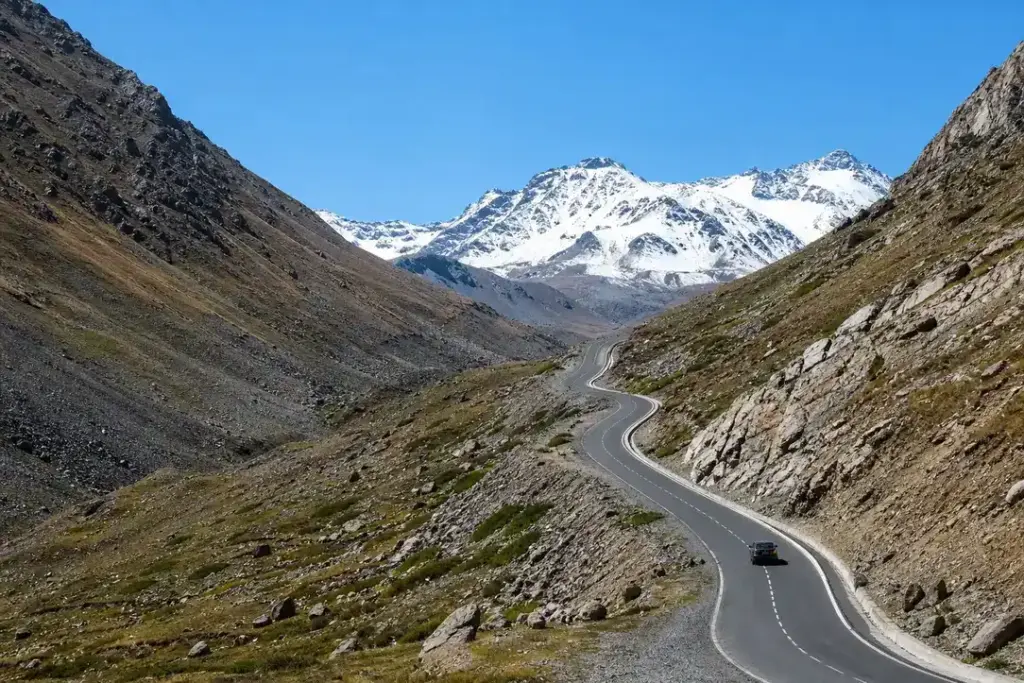
The federal highway R256 Chuysky Trakt, the oldest route from Siberia to Asia, starts in Novosibirsk and ends at the Russian border with Mongolia, passing through the territory of Novosibirsk Oblast, Altai Krai and the Altai Republic. The part from Biysk to Tashanta is traditionally referred to as the Chuya Highway or Chuysky Trakt, and this part of the road is 610 km long.
In 2014, National Geographic magazine included the Chuya Highway in its list of the 10 most beautiful highways in the world. The Chuya Highway is laid over the ranges of Altai Mountains along the rivers Katun and Chuya, over Seminsky and Chike-Taman mountain passes. The journey delivers an almost unbroken procession of landscapes: flat steppe plains gradually rising to high mountain valleys, alpine meadows, turquoise rivers, and snow-capped ridges.
Quick Facts
| Russian name | Чуйский тракт |
|---|---|
| Built / opened | 1935 |
| District | Altai Mountains |
| Best time to visit | Summer (June–August) offers the most reliable road conditions, longest daylight, and warmest temperatures, though this is peak tourist season. Autumn (September–October) brings crisp air, excellent visibility, and fewer vehicles; birch and aspen trees turn gold. Spring (May–June) is muddy at high elevations until late May but shows wildflower meadows. Winter (November–March) closes many high passes or makes them hazardous; only experienced winter drivers should attempt the route then.Weekdays are quieter than weekends. The road is typically open year-round but winter weather can cause temporary closures of passes. Check current road conditions before departure, especially in shoulder seasons. |
| Recommended duration | 2–3 days |
What Is (and Isn't) Part of a Visit to Chuysky Trakt, Altai Mountains?
| Part | Status | Notes |
|---|---|---|
| Chuysky Trakt (Biysk to Tashanta section) | Included in the standard ticket | The historic 610 km route from Biysk to the Mongolia border is the main attraction. |
| Full federal highway R256 (Novosibirsk to Mongolia border) | Outside / not part of it | The complete 968 km route includes flat plains north of Biysk; the scenic Altai section is Biysk southward. |
| Seminsky Pass | Included in the standard ticket | First major mountain pass at 1717 m; accessible by car with marked pull-off and monument. |
| Chike-Taman Pass | Included in the standard ticket | Second major pass at 1295 m; narrow gorge section with tight curves. |
| Rivers and viewpoints | Included in the standard ticket | Chuya–Katun confluence and other marked scenic spots are accessible from pull-offs along the highway. |
| Hiking trails from the road | Separate ticket or institution | Official trails to lakes, glaciers and peaks require separate planning, guides, and permits; not part of a car drive. |
| Chuysky Trakt Museum (Biysk) | Separate ticket or institution | Located in Biysk city centre, not on the highway; separate ticket required. |
Why Visit Chuysky Trakt, Altai Mountains?
The road follows the Katun and Chuya rivers and crosses Seminsky and Chike-Taman mountain passes. You will see Seminsky Pass at 1717 metres and Chike-Taman at 1295 metres. Along the way, rock formations, petroglyphs, and hidden lakes reward drivers who pause. The road itself is an achievement: since 2007, the highway has been completely paved. This is one of the few roads in the world where major tourism overlaps with genuine frontier trade—trucks heading to Mongolia share the asphalt with tour groups discovering Russia’s wildest landscape.
Highlights of Chuysky Trakt, Altai Mountains
Seminsky Pass
The most interesting section begins behind the village of Barangol at Seminsky Pass (1717 m) at the 583rd kilometer of the Chuysky Tract. This is the first major high-altitude crossing, with a monument marking the pass. On clear days, views stretch across multiple ridges. The pass marks the boundary between different climatic zones: larch forest below, alpine tundra above. Vehicles pull off regularly for photos; expect a 15-minute stop and bring layers.
Tip: Arrive early in the day when light is best and the mountain air clearest. The descent south from the pass is steep and narrow with tight hairpin turns; go slowly.
Chike-Taman Pass
The Chike-Taman Pass (1,295 m) at the 667th kilometer of the Chuysky Tract is one of the most picturesque corners. Unlike Seminsky, this pass cuts through a narrow gorge with sheer rock walls on both sides. The Chuysky Trakt passes through mountain sections considered difficult, such as the Chike-Taman gorge. The engineering is impressive: the road was carved through solid rock. Pull-offs offer views into the gorge and the valley opening below.
Tip: Heavy truck traffic uses this pass; watch for large vehicles taking wide lines on curves. The road is narrower here than at Seminsky, so drive with care.
Confluence of Chuya and Katun Rivers
The confluence of the Chuya and Katun rivers, two majestic rivers of Altai, is at the 712th kilometer of the Chuysky Tract. This is where the two turquoise-coloured rivers meet, often dramatically different in shade and flow. The spot is one of the most photographed on the route and is accessible from a marked pull-off. The Katun is particularly striking, with glacial silt giving it a bright aquamarine colour in summer.
Tip: The best light for photos is in late morning and early afternoon. Visit in July or August when river flow and colour are most vivid; spring melt creates murky water.
Altai Krai Foothills
Based on the terrain, the entire area through which the Chuysky Tract runs can be divided into flat, foothill, and mountainous. The journey north from Biysk to Gorno-Altaysk crosses gentle foothills covered in birch and aspen, with scattered villages and the sense of leaving the plains. This section, roughly the first 150 km from Biysk, is less dramatic than the high passes but shows the gradual landscape transition and is where many day-trip drivers stop before heading deeper into the mountains.
Tip: This section is excellent for photography if you visit in autumn, when birch trees turn gold and the light becomes golden. Stop in small villages to buy fresh berries and local honey.
Chuysky Trakt Museum
The Chuysky Tract Museum is located in Biysk, on the second floor of the natural history department of the V. Bianki Biysk Museum of Local History. The museum contains documents and photographs from the construction of the Chuysky Tract, a unique 3D model of the road, paintings, and dioramas. This is the starting point of many journeys and provides essential context for understanding the route's history and engineering.
Tip: Visit before driving the full route. It takes 45 minutes and costs little. The 3D model and historical photos make the drive more meaningful. The museum is in Biysk city centre.
Petroglyphs and Rock Art
Rock art sites along the route include the Petroglyphs of Kalbak-Tash ecosite. Several locations feature ancient carvings left by nomadic peoples who travelled these routes for millennia. These are typically marked by roadside signs and small pull-offs. The petroglyphs are best seen in low-angle morning or late-afternoon light.
Tip: Bring binoculars and a camera with a good zoom. Some petroglyphs are high up on rock faces and are difficult to photograph. Stop only at marked areas for safety.
Atmosphere
The road shifts personality hour by hour. Early morning shows empty valleys in soft light, with mist rising from the Katun. By midday, the road is busy with trucks grinding uphill, their gears roaring in the thin mountain air, while tour groups cluster at pull-offs. Late afternoon brings golden light that turns the rock faces amber and the turquoise rivers almost luminous. Summer brings dense traffic; spring offers solitude but mud at passes; autumn is crisp and clear with excellent visibility.
The road itself feels alive. At high passes, wind can be strong enough to push a car. In gorges, sound bounces off rock walls. Settlements are sparse—a few scattered houses, a shop, occasionally a cafe. Mobile signal comes and goes. The sense of crossing a genuine frontier (this is a major trade route to Mongolia) combines with the romantic notion of an ancient Silk Road highway. Drivers meet other travellers: locals, truck drivers, motorcyclists, and tour groups from across Russia and abroad.
History of Chuysky Trakt, Altai Mountains
Prior to modern times, the route was where the northern caravan tracks of the Great Silk Road passed. The caravans followed routes formed along the migration ways of wild animals. Before the modern Chuysky Trakt, the road was called the Mungalsky Trakt mentioned in thousand-year-old Chinese chronicles. Where the paved road runs now, there was an old pathway used by merchants and warriors since ancient times. In the early 19th century, this trade route played a vital role in trade between the Russian Empire and Mongolia.
Spring 1901 saw the start of construction of the Chuya Highway. However, the carriage way was erected only in the early 20th century. Work was halted and interrupted by revolution and civil war. Plans for a new road began in the early 20th century but were interrupted by the revolution and civil war in Russia. Construction resumed in the 1920s using the labor of prisoners and gulag inmates, and it was officially opened in 1935. On May 26, 1922, the Chuysky Tract received the status of a national road.
The dual highway was built in 1984 only. Since 2007, the highway has been completely paved. Modern improvements continue: the road is treated as a major engineering project in a permafrost and high-altitude environment, requiring specialized maintenance and seasonal road-weather adaptations.
Legends and Myths about Chuysky Trakt, Altai Mountains
Meeting of Waters
Legend – historically unreliable. Local legend holds that the turquoise Katun and the darker Chuya never truly mix where they meet, instead running side by side in two colours for a distance downstream. Visitors watch for this phenomenon, and indeed the waters do appear distinct for several kilometres. The effect is caused by differences in glacial silt load, not mystical separation.
Gulag Workers' Ghosts
Disputed by historians. The road was built largely by forced labour from Soviet prison camps in the 1930s. Local accounts claim that thousands died during construction—from falls, cold, and exhaustion. Some stories suggest workers were buried under sections of road. While construction did exact a terrible human cost and workers did perish, the specific claims of mass burial are disputed by historians.
Tickets and Booking for Chuysky Trakt, Altai Mountains
The Chuysky Trakt is a federal highway open to all vehicles with valid Russian registration and international documents. There are no tickets or tolls to drive the road itself. Visitors must ensure their vehicle is roadworthy and carry required documentation (international driving permit, vehicle registration, insurance valid in Russia). Fuel stations exist at intervals of 40–80 km; distances between villages increase in the high mountain sections. Most drivers complete the journey over 2–3 days, stopping overnight in small towns such as Gorno-Altaysk, Ust-Sema, Ongudai, or Kosh-Agach.
Plan and Book
Suggested itineraries Chuysky Trakt, Altai Mountains
Full route (2–3 days)
Day 1: Depart Novosibirsk early; drive to Gorno-Altaysk (400 km; 5–6 hours). Day 2: Gorno-Altaysk to Ongudai or Kosh-Agach (250 km; 4–5 hours), stopping at Seminsky and Chike-Taman passes and the Chuya–Katun confluence. Day 3: Continue to Tashanta at the Mongolia border (160 km; 2–3 hours) or return to Gorno-Altaysk. This pacing allows proper photo stops and acclimatisation to altitude.
Highlights only (1 day)
From Gorno-Altaysk, drive south to Ongudai via Seminsky and Chike-Taman passes (250 km; 5–6 hours with stops). Stop at the Chuysky Trakt Museum in Biysk before departure (30 min). Visit Seminsky Pass (30 min), Chike-Taman Pass (45 min), and the Chuya–Katun confluence (20 min). This is a long day but captures the most iconic sections.
Northern section (half-day excursion from Gorno-Altaysk)
From Gorno-Altaysk, drive north to Seminsky Pass and back (100 km return; 3–4 hours). This suits visitors with limited time and gives a taste of high-altitude driving and panoramic views without committing to a full southern journey.
How to Get to Chuysky Trakt, Altai Mountains
To drive the Chuysky Trakt you must have access to a car. International visitors should arrange a rental vehicle or hire a driver through a local tour operator.
- By air: Fly to Novosibirsk (Tolmachevo International Airport), then drive south. The journey from Novosibirsk to Gorno-Altaysk is 400 km (5–6 hours) on highway R52 (which becomes M52 and R256 closer to Altai).
- By train: The Trans-Siberian Railway serves Novosibirsk. From there, hire a car or take an onward flight to Gorno-Altaysk, which is the practical gateway to the Chuysky Trakt.
- Car rental: International driving permit and proof of insurance are mandatory. Vehicles must be registered and roadworthy. Winter tyres are required from November to April in mountain sections.
Accessibility
The Chuysky Trakt is a standard highway with no dedicated accessibility infrastructure. Roadside pull-offs vary: some are flat and easy to access; others are on slopes or unpaved. Gas stations and small cafes exist at intervals, though many are basic. Toilets are available at towns and some cafes but are often squat-style. The road itself is well-maintained asphalt, drivable in standard cars (no special vehicles needed). Drivers with mobility restrictions can enjoy high-altitude views from pull-offs nearest the road, though walking distances to some viewpoints can be significant. Mobile coverage is patchy in mountain sections; carry a paper map or offline GPS data.
Food Nearby
Small towns along the route—Gorno-Altaysk, Ust-Sema, Ongudai, Kosh-Agach—have basic cafes and shops selling packaged food, bread, and drinks. Gorno-Altaysk has proper restaurants. Bring snacks, water, and full fuel tank; options thin dramatically in the high mountain section between major towns. Some pull-offs have mobile food vendors in summer.
What to Bring
Pack warm clothing and rain gear even in summer; mountain weather changes rapidly. Sunscreen and hat are essential at high altitude. Bring a full tank of fuel for remote sections; gas stations are 40–100 km apart. Carry water and snacks. A paper map and offline GPS app are wise since mobile coverage is unreliable. In autumn and spring, carry chains or winter tyres. Binoculars aid petroglyph viewing. A jacket and hat should always be in the car; morning temperatures at passes can be near freezing even in July.
Best Views and Photo Spots of Chuysky Trakt, Altai Mountains
Seminsky Pass observation point
Panoramic vista across multiple ridges and valleys from 1717 m elevation. On clear days, the view extends south into the high Altai. The monument and parking area offer stable vantage points. Morning light is best; afternoon brings cloud.
Best time: Early morning or late afternoon; avoid midday glare. Clear days in September–October offer the sharpest visibility.
Chike-Taman Pass gorge viewpoint
Narrow rocky gorge framing the road descending southward, with sheer rock walls rising on both sides. The compression of the landscape creates a striking compositional frame. Stop at the marked pull-off on the north side descending south.
Best time: Late morning when light enters the gorge; afternoon shadow obscures the formation. Visit in clear weather for rock textures.
Chuya–Katun confluence pull-off
Two rivers of distinctly different colours meeting; the turquoise Katun and the murkier Chuya. The contrast is best in July–August when glacier melt is heaviest. Wide pull-off allows vehicles and composition of the confluence in the middle distance.
Best time: Mid-morning or mid-afternoon when light is high but not harsh. Summer (July–August) shows the most dramatic colour difference.
Altai Krai foothills, northern section (Biysk to Ust-Sema)
Golden birch and aspen forest rolling gradually upward into low mountains. Meadows dotted with wildflowers in summer. The landscape is pastoral and transitional rather than dramatic.
Best time: Autumn (September–early October) when birch trees turn brilliant gold; light becomes warm and diffuse, ideal for landscape photography.
Photography Rules
Photography is unrestricted on the highway and at pull-offs. Drones are not recommended due to unpredictable wind at high passes and proximity to the Mongolia border (a sensitive area). Use caution when standing near the road; traffic can be heavy and visibility in curves limited. Tripods are fine for landscape shots at pull-offs. The best light is early morning (6–8 am) and late afternoon (4–6 pm); midday sun washes out mountain detail.
Family Suitability
The Chuysky Trakt is a long-distance drive with few facilities in remote sections. Families with children aged 8 and up accustomed to car travel can manage the full route. Young children may struggle with the length and the high-altitude discomfort. Car sickness is common on the twisting mountain sections; take breaks frequently. The road is safe and well-maintained, but no special facilities (playgrounds, rest areas with activities) exist. Teenagers and active families enjoy the outdoor stops and mountain scenery. Plan for 2–3 days to avoid exhaustion. Strollers are impractical given the terrain and parking situations; toddlers should be managed on short walks only.
Russia Vibes Tips
- Start the journey with a full tank of fuel and current road condition information. Gas stations are sparse in the high mountains; running low creates stress. Download offline maps before leaving Novosibirsk or Gorno-Altaysk.
- The descents from high passes involve long, steep sections with many hairpin turns. Use low gears to avoid overheating brakes. Never rush; take 10–15 minutes to drive each pass safely. Tourist drivers often underestimate descent difficulty.
- Acclimatisation matters. Many drivers experience mild altitude sickness at 1700+ m. Arrive in Gorno-Altaysk a day early, rest, and ascend gradually. Stay hydrated and avoid alcohol.
- Truck traffic is heaviest in early morning and mid-morning. Consider starting early or midday to drive when trucks are fewer. On curves, heavy vehicles hog lanes; stay alert and give them space.
- Each section of the route reveals itself differently depending on light and weather. If you encounter cloud or rain at a pass, continue and view it from below; often the conditions clear within minutes. Conversely, return to a pass on a clearer day if time allows.
Explore Nearby Chuysky Trakt, Altai Mountains
Related guides
 Altai Mountains: Best Places, Scenic Routes and Travel Tips
Main image: AI-generated illustration. It may not show the place exactly as it looks.
 Lake Baikal: Where to Go, What to See and How to Visit
Main image: AI-generated illustration. It may not show the place exactly as it looks.
 Karakol Lakes: Alpine Lakes and Mountain Hiking in the Altai
Main image: AI-generated illustration. It may not show the place exactly as it looks.
Browse more: More in Altai Mountains · All Altai Mountains · All Landmarks · All Sightseeing · All Sightseeing in Altai Mountains
FAQ: Chuysky Trakt, Altai Mountains
Is the Chuysky Trakt drivable in a standard car?
Yes. The entire route is paved asphalt suitable for standard passenger vehicles. High-clearance or four-wheel-drive vehicles are not required. Ensure your vehicle is well-maintained and carry a spare tyre. Winter tyres are mandatory in winter months.
How long does the full drive take?
The scenic section from Biysk to the Mongolia border is 610 km and takes 8–10 hours of driving time. Most visitors break the journey into 2–3 days with stops at towns like Gorno-Altaysk, Ongudai, or Kosh-Agach.
Is a guide necessary?
No. The route is straightforward and well-marked. GPS or a paper map is sufficient. Guided tours are available through local operators in Gorno-Altaysk if you prefer structured stops and local commentary.
What is the altitude? Will I experience altitude sickness?
Seminsky Pass is at 1717 m and Chike-Taman Pass is at 1295 m. Mild altitude sickness can occur; symptoms include headache, fatigue, or mild nausea. These typically pass within a day. Ascend gradually and stay hydrated.
When is the road closed?
The road is rarely fully closed, but high passes can be impassable in winter due to snow and ice. Late November to April, check road conditions before departing. Spring and autumn can bring unpredictable weather; always have current information from local authorities.
Are there toilets and food on the route?
Yes, but sporadically. Small towns and cafes exist at 80–150 km intervals. Bring snacks and water. Gas station attendants sometimes sell drinks and simple food.
Is the Chuysky Trakt the same as the Trans-Siberian Railway?
No. The Chuysky Trakt is a highway; the Trans-Siberian Railway is a train route that connects Moscow to Vladivostok. They are completely separate.
Can I visit the Chuysky Trakt Museum without driving the road?
Yes. The Chuysky Tract Museum is located in Biysk, on the second floor of the natural history department of the V. Bianki Biysk Museum of Local History. Biysk is easily reached by car from Novosibirsk or by public transport.
Russia Vibes is a one-person project. A coffee keeps it going
How we research and update our guides
About this guide: AI assistance and accuracy
This guide is created with the help of AI and is based on official sources where available. Mistakes can still happen. Opening hours, prices, rules and other details are given to the best of our knowledge as of the date shown and can change without notice. It offers general recommendations only, not professional, legal or travel advice. Please confirm important details with the official source before you travel; you are responsible for your own plans and decisions.
Packing for this trip
* Affiliate link: as an Amazon Associate we earn from qualifying purchases at no extra cost to you.

Take this guide with you
Get a free PDF of this guide to print or read offline: key facts, tips and a map link on a few clean pages.
Report an issue on this page
Paying for your trip: please read
International sanctions affect payments between Russia and many other countries. In practice, cards issued in the EU, the UK, the US and several other countries often do not work in Russia, Russian cards usually do not work abroad, and some booking platforms, airlines and payment providers limit or suspend their services for Russia. The situation changes frequently.
We do not give legal or financial advice, and this site does not encourage anyone to break or circumvent sanctions. Whatever you plan, you are responsible for following the laws and regulations that apply to you, including those of your country of residence and citizenship.
Many travelers still organise their stay lawfully. It is worth asking your bank or payment provider what is currently permitted, contacting hotels, tour operators and carriers directly about the payment methods they accept, and checking which services are open to customers from your country. Clarify payment, cancellation and refund terms before you commit to a booking, and keep your plans flexible.
Partner links on this site may not be available in every country, and prices, availability and rules in our guides can differ from what you see when you book.