
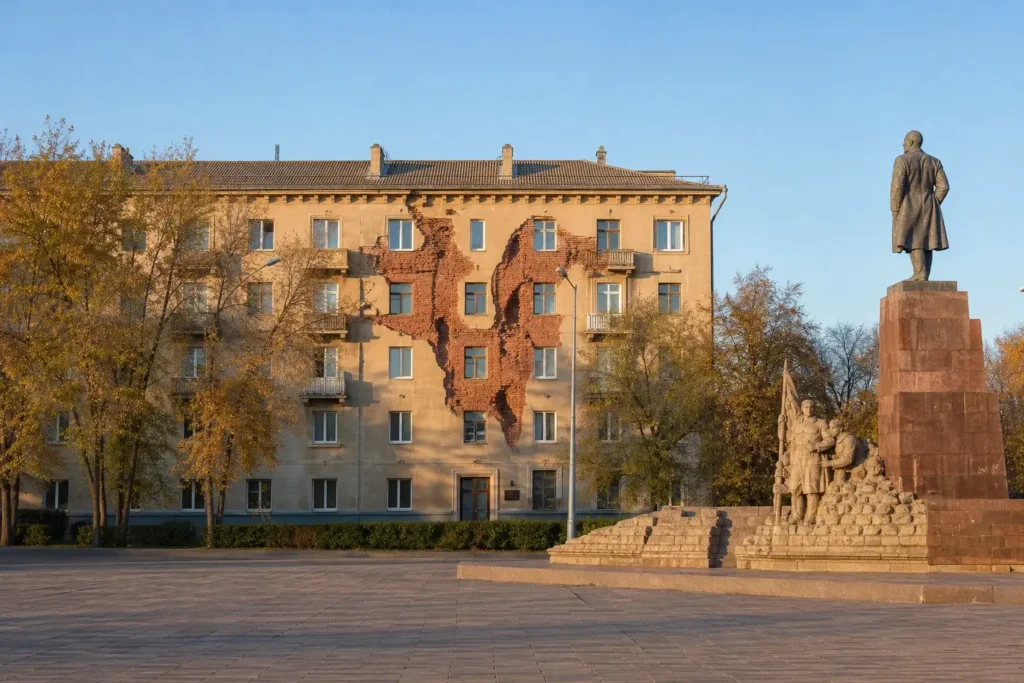
On the banks of river Volga in the heart of modern-day Volgograd, formerly Stalingrad, stands a four-story apartment building with a brick memorial attached to its front. This is the famous Pavlov’s House, named after Sergeant Yakov Pavlov, who led a small platoon of the Red Army against the superior German forces and defended this building for two months despite being vastly outnumbered.
The siege lasted from 27 September to 25 November 1942, during one of World War II’s bloodiest urban battles. Pavlov’s House became a symbol of the incredibly stubborn and dogged resistance of the Russian forces during the Battle of Stalingrad. Today, the building serves as a powerful open-air memorial to the siege, with its restored facade bearing witness to the brutal combat that transformed it into an icon of Soviet determination.
Quick Facts
| Russian name | Дом Павлова |
|---|---|
| Built / opened | 1934 |
| Architect(s) | Sergey Voloshinov |
| Address | улица Советская, 39, Волгоград, 400005 OpenStreetMap · Google Maps |
| District | Tsentralny District |
| Opening hours | Open 24 hours |
| Admission | free |
| Best time to visit | Spring (April–May) and autumn (September–October) offer pleasant weather and moderate crowds. Summer (June–August) brings warm weather but also more tourist traffic. Winter is cold but often clear, and crowds are minimal. September is historically significant as the month in which the siege began; visiting then offers additional resonance. Weekdays are quieter than weekends. Early morning and late afternoon provide the best light for photography and allow for a more contemplative visit. |
| Recommended duration | 30–45 minutes |
| Last updated | October 18, 2026 |
What Is (and Isn't) Part of a Visit to Pavlov's House, Volgograd?
| Part | Status | Notes |
|---|---|---|
| Exterior of Pavlov's House building | Included in the standard ticket | The building is accessible from the street 24 hours a day at no cost. You can view the exterior freely, including the commemorative brick memorial. |
| Interior of Pavlov's House | Outside / not part of it | The building remains residential apartment accommodation and is not open to visitors for interior tours. Only the outside can be viewed. |
| Lenin Square in front of the building | Included in the standard ticket | The square itself with monuments and memorials is accessible; it serves as the primary viewing point for the house. |
| Panorama Museum of the Battle of Stalingrad | Separate ticket or institution | Located nearby and related to Pavlov's House history, but requires a separate ticket and is a distinct institution with its own opening hours. |
| Gerhardt Mill (opposite the building) | Outside / not part of it | The ruined mill across the square is a separate site; it is often confused with Pavlov's House but is not part of the same attraction and has different access rules. |
| Commemorative plaque and brick installation | Included in the standard ticket | The memorial brick work and inscribed plaques on the building's river-facing side are part of the public view and accessible. |
Why Visit Pavlov's House, Volgograd?
Along with Mamayev Kurgan, Pavlov House became a symbol of stubborn resistance of the Russian soldiers during the Battle of Stalingrad. The east side of the building, the side facing the river, was rebuilt by original bricks collected after the battle. It serves as a memorial of the resistance on a place where Hitler’s war machine ground to a halt due to one man’s determination to take “not one step back.” The site offers concrete historical insight into urban warfare and the human costs of the Second World War, placing visitors directly on ground that shaped military history.
Highlights of Pavlov's House, Volgograd
The Building and Its Strategic Position
The house was a four-storey building in the center of Stalingrad, built perpendicular to the embankment of the river Volga and overseeing the "9th January Square", a large square named for Bloody Sunday. The strategic benefit of the house was that it defended a key section of the Volga bank. The tactical benefit of the house was its position on a cross-street, giving the defenders a 1 km line of sight to the north, south and west. The building is no longer residential; today it stands as a preserved monument with surrounding memorials.
Tip: Photograph the building from Lenin Square in front to capture the full facade with the commemorative brick installation. The contrast between the regular apartment windows and the reinforced defensive positions remains visible.
The Siege: 27 September to 25 November 1942
Around 25 soldiers from the Soviet Red Army's 42nd Guards Regiment held a fortified apartment amid a 60-day siege by the German Wehrmacht. The defenders, as well as the Soviet civilians who kept living in the basement all that time, held out during intensive fighting from 27 September to 25 November 1942, when they were relieved by the counter-attacking Soviet forces. The building changed hands multiple times during earlier fighting before becoming the focus of this famous siege.
Tip: The exact dates and narrative of the siege have been subject to historical debate; visit the nearby Panorama Museum for more detailed documentation and context.
Sergeant Yakov Pavlov and Command
Named after Sergeant Yakov Pavlov, who led a small platoon of the Red Army, the building became known by his name despite the building was originally captured by Pavlov, the commander of the position was Lieutenant Afanasiev. Pavlov became well-known after he and his small platoon held on for 59 days against a numerically superior enemy in an apartment building in Stalingrad. This has made the site forever associated with Pavlov's name in popular memory.
Tip: The naming controversy reflects how war history is remembered; historians note the attribution to Pavlov, though Afanasiev commanded most of the siege.
Defensive Fortifications and Adaptations
Pavlov ordered the building to be surrounded with four layers of barbed wire and minefields, and set up machine-gun posts in every available window facing the square. One wall was breached to improve internal communication. A trench was dug as a lifeline to the Soviet troops outside. The structure features four floors with thick brick walls and reinforced windows that once served as observation posts.
Tip: Look closely at the building's windows and walls; some remain reinforced or show evidence of fortification, though much has been restored to civilian use.
Restoration and the Commemorative Brick Installation
It was the first of the houses in Stalingrad restored after the war. Now on the facade of the house there is a brick installation, symbolizing the ruins of the house, which was installed in 1985. On one of its walls is inscribed the famous phrase: "We will rebuild you, Stalingrad!" This memorial on the river-facing side marks where the most intense fighting occurred.
Tip: The red brick memorial facing Lenin Square is the primary visual marker of the building's history; it was added decades after the war as an official Soviet memorial.
Common Confusion: Gerhardt Mill Opposite
Occasionally Gerharts Mill is mistakenly called Pavlov's House due to overall similarity. However Pavlov's House was later reconstructed, while Gerharts Mill was left in its original state of disrepair following heavy fighting during Battle of Stalingrad. The mill stands directly across the square and is much more visibly ruined; Pavlov's House has been returned to residential use, making it less obviously a war site.
Tip: Do not confuse the two buildings. Pavlov's House is the restored apartment building with the brick memorial facing the Volga. The shell-pocked ruin visible across the square is Gerhardt Mill, a separate site.
A Symbol of Soviet Resistance
The inability of the German blitzkrieg to make headway against such grinding and self-sacrificial attrition warfare made the failure to capture Pavlov's House (despite numerous attempts) stand out as a symbol of resistance against a vastly superior force. Pavlov's House became a symbol of the stubborn resistance of the Soviet Union in the Battle of Stalingrad, and in the Great Patriotic War in general. Its fame rests on the contrast between its modest size and the intensity of the fighting.
Tip: The house has been featured in numerous documentaries, books, and video games; it remains one of the most recognizable symbols of the Stalingrad battle internationally.
Atmosphere
Pavlov’s House today is a quiet, ordinary-looking apartment building in the urban center of Volgograd. The building has long since been rebuilt into an apartment building like many others in any Soviet city — but on one corner of the façade, facing the Flour Mill, is some red brick work depicting how the building might have looked at the end of the Battle. There is no barrier, no museum, and no crowds; visitors can approach it freely at any hour. The surrounding Lenin Square is open, with monuments and memorials scattered about. During the day, locals pass by without ceremony. The sense of history is tangible but understated—the real weight of what happened here comes from knowing the dates, the numbers, and the story, rather than from grand structures or theatrical presentation. The building remains residential, its windows ordinary, yet marked forever by red bricks and a marble plaque.
History of Pavlov's House, Volgograd
Before the outbreak of World War II both Pavlov’s and Zabolotny House was considered very prestigious and was reserved for high officials of factories. The building was built in 1934, designed by architect Sergey E. Voloshinov, who would die in an air raid in September 1942, just as the siege began.
In September 1942, the house was attacked by German soldiers, and a platoon of the Soviet 13th Guards Rifle Division was ordered to defend it. The siege lasted from 27 September to 25 November 1942 and eventually the Red Army managed to relieve it from the siege. The exact dates remain debated among historians; German archives do not support the claim for heavy fighting for the building, and Soviet military archives attach no particular importance to the house as a defensive structure. Nonetheless, the building became famous in Soviet propaganda and popular memory.
Around 25 soldiers from the Soviet Red Army’s 42nd Guards Regiment held a fortified apartment amid a 60-day siege by the German Wehrmacht. Each time German infantry or tanks tried to cross the square and to close in on the house, Pavlov’s men laid down a withering barrage of machine gun and AT rifle fire from the basement, the windows and from the roof top. While the building was originally captured by Pavlov, the commander of the position was Lieutenant Afanasiev.
It was amongst the first buildings in Stalingrad to be restored after the war, having received comparatively limited damage. When the sounds of battle faded, the house of Senior Sergeant Pavlov became the first building to be restored in Stalingrad. The rapid reconstruction was partly deliberate: Soviet authorities wanted to showcase the city’s recovery and the resilience of Stalingrad. Now on the facade of the house there is a brick installation, symbolizing the ruins of the house, which was installed in 1985. This memorial was added decades after the original reconstruction, as an official commemoration during the Soviet period.
Legends and Myths about Pavlov's House, Volgograd
The Ghost of Sergeant Pavlov
Legend – historically unreliable. Legend has it that Pavlov's spirit guards the building and that late-night visitors have reported hearing footsteps and the sounds of gunfire echoing inside, even though the building is now peacefully residential. Some accounts describe shadow figures moving through the windows at night.
The Hidden Tunnel to the Volga
Disputed by historians. Popular accounts claim that a secret tunnel connects Pavlov's House to the river, allowing defenders to escape or receive supplies undetected. While a trench was indeed dug, the exact extent and current existence of these tunnels remains disputed, and no modern underground passages have been verified.
An Entire Company Held the Building
Legend – historically unreliable. Some older Soviet narratives claimed that an entire company of 100+ men held the building, creating a myth larger than the actual historical record supports. Modern historians have clarified this was closer to a platoon of 25 soldiers, though reinforcements arrived during the siege.
Tickets and Booking for Pavlov's House, Volgograd
Pavlov’s House requires no ticket and no advance booking. Pavlov’s House itself does not charge an entrance fee since it can be viewed from the outside. The building and surrounding square are open 24 hours a day, seven days a week, and can be visited freely at any time. No registration or entrance control exists. The interior of the residential building is not accessible to tourists. If you wish to visit related museums or panorama exhibitions that provide historical context (such as the nearby Panorama Museum), those venues have separate admissions and booking requirements; check the official Volgograd tourism website or individual museum sites for their current hours and ticket policies.
Plan and Book
Suggested itineraries Pavlov's House, Volgograd
30 minutes
Walk around the exterior of the building, photograph the commemorative brick memorial on the river side, and read the inscriptions. View the building from multiple angles in Lenin Square to understand its position overlooking the 9th January Square. This is the minimum time needed to see what is publicly accessible.
45 minutes to 1 hour
Begin with a walk around the building, then spend time in Lenin Square examining the surrounding monuments. Cross to Gerhardt Mill opposite to contrast the two structures (the mill remains ruined, while Pavlov's House was reconstructed). Reflect on the street layout and tactical positioning. This gives more context to the building's role in the siege.
2–3 hours
Start at Pavlov's House and study the exterior and surroundings for 30 minutes. Walk to the nearby Panorama Museum for a deeper understanding of the battle's history and context (requires separate ticket). Return to Pavlov's House with this knowledge to appreciate its significance more fully. This offers the most complete picture of the site's importance in the Battle of Stalingrad.
How to Get to Pavlov's House, Volgograd
Pavlov’s House is located at ulitsa Sovetskaya, 39, in central Volgograd. On one side of Pavlov House is Lenin Avenue, on the other side – Gergardt Mill. Volgograd has a compact city-center metro system, though direct metro access to the house is limited. Visitors arriving by train at Volgograd-1 Railway Station can take a taxi or marshrutka (shared minibus) to the city center, or walk if staying nearby (the center is about 1.5 km from the station). If driving, use GPS to navigate to Sovetskaya Street in the Tsentralny District. Once in the central district, the building is easy to find near Lenin Square. Parking is available in the surrounding streets, though spots can be limited during peak tourist season.
Accessibility
Pavlov's House is entirely outdoors with street-level access from multiple directions. There are no barriers, stairs, or special requirements to view the exterior. The surrounding Lenin Square has paths suitable for wheelchairs and strollers. No facilities such as benches, restrooms, or shade are provided at the site itself; nearby cafes and public services are scattered throughout the central district. As an open-air memorial with no interior access, the site poses no mobility challenges for those able to walk around city streets.
Food Nearby
Volgograd's central district has cafes, restaurants, and shops scattered along the main streets near Lenin Square and Nevsky Street. Options range from casual fast food to sit-down restaurants offering Russian and international cuisine. Specific venues change seasonally, so check current listings for current operating status. Convenience stores and small shops are abundant in the area for quick purchases of snacks and water.
What to Bring
Comfortable walking shoes are essential, as you will be standing on city streets and possibly walking to nearby sites. Bring water and sun protection in summer; the square offers minimal shade. In winter, warm clothing is necessary. A camera is worthwhile given the historical significance and the composition of the building and square. A guidebook or smartphone with offline maps helps with navigation and context.
Best Views and Photo Spots of Pavlov's House, Volgograd
Lenin Square, facing the building from the south
This is the primary viewpoint. The four-story apartment building with its ordinary residential windows is framed by the square. The red brick memorial installation on the river side is visible from this angle, and the surrounding monuments provide context.
Best time: Late afternoon for warm, angled light that highlights the building's texture and the memorial brickwork. The lower sun angle also creates shadow depth.
North side of the building, facing Gerhardt Mill
This angle shows the building's relationship to the mill across the square. The contrast between Pavlov's House (restored) and the ruined mill is stark and powerful, illustrating the different fates of the two structures.
Best time: Morning light, which illuminates the building's front while the mill remains partially shadowed, emphasizing the contrast.
River embankment or Volga viewpoint (if accessible)
From the river side, the building's position overlooking the Volga and the 9th January Square becomes clear. This perspective illustrates the strategic importance of the location.
Best time: Late afternoon, when the Volga's water reflects golden light and the building is backlit, creating dramatic depth.
Close-up of the commemorative brick installation
The red brick memorial on the building's river-facing side shows how the house might have looked at the end of the siege. Photographs of this detail capture the specific commemoration of the battle.
Best time: Overcast days, which provide even light without harsh shadows that obscure the brick detail.
Evening view with lighting on the monuments
At dusk, if the surrounding monuments are lit, the building and square take on a solemn, memorial atmosphere. The transition to evening light casts the scene in reflective tones.
Best time: Just after sunset, when the sky retains some color and artificial lighting in the square begins to activate.
Photography Rules
Photography is permitted freely around the exterior of Pavlov's House and in Lenin Square. No tripods, drones, or professional equipment require special permission for casual sightseeing photography. The best light for photography is morning or late afternoon when the building's memorial brick work is illuminated. The commemorative plaque and inscriptions photograph well from close range.
Family Suitability
Pavlov's House is suitable for families with children old enough to understand and respect a war memorial (roughly age 8+). The site is outdoors, requires no special tickets, and poses no safety hazards. However, there are no facilities such as playgrounds, restrooms, or dedicated children's areas. The historical significance may be emotionally heavy for younger children; older teens and adults will better appreciate the context. Stroller access is fine around the square itself, though uneven pavement in places requires care. A parent or educator should be prepared to explain the historical meaning of the site to make the visit meaningful for children.
Russia Vibes Tips
- Don't confuse Pavlov's House with Gerhardt Mill across the square. Gerhardt Mill is visibly ruined and shell-pocked; Pavlov's House was fully reconstructed after the war and looks like a normal apartment building. The red brick memorial on Pavlov's House (facing the Volga) is the key marker of what you're looking at.
- Visit the Panorama Museum nearby if you want to understand the siege in depth. The house itself offers no interpretation or museum experience—it is purely an external memorial. The Panorama provides essential context and historical documentation.
- Go early in the morning or late in the day to avoid crowds and get the best light for photography. The square can be busy with tour groups around midday.
- There are no restrooms, benches, or water fountains at Pavlov's House itself. Bring water and plan to rest elsewhere in the central district.
- The interior of the building is not accessible; it remains residential apartments. You can only view the exterior and the surrounding square. Do not attempt to enter the building.
- Winter visits are quieter and often cheaper for accommodation, but the site is equally meaningful in any season. September has historical resonance as the month the siege began.
Explore Nearby Pavlov's House, Volgograd
Sights near Pavlov's House, Volgograd
 Gerhardt's Mill, Volgograd – about 50 m away (~1 min walk) · typical visit: 30–45 minutesOpen 24 hours
Main image: AI-generated illustration. It may not show the place exactly as it looks.
 Volgograd Panorama Museum, Volgogradabout 50 m away (~1 min walk) · typical visit: 2–3 hours
Main image: AI-generated illustration. It may not show the place exactly as it looks.
 Central Embankment, Volgograd – about 1.0 km away (~17 min walk) · typical visit: 1–2 hoursOpen 24 hours
Main image: AI-generated illustration. It may not show the place exactly as it looks.
 Volgograd Railway Station, Volgograd – about 1.4 km away (~24 min walk) · typical visit: 30 minutesOpen daily 00:00–23:59
Main image: AI-generated illustration. It may not show the place exactly as it looks.
 Mamayev Kurgan, Volgograd – about 3.0 km away · typical visit: 3–4 hoursOpen daily 09:00–18:00
Main image: AI-generated illustration. It may not show the place exactly as it looks.
Related guides
 Palkin, Saint Petersburg: Historic Russian Fine Dining7 min on foot from Mayakovskaya metro, Open daily 12:00–23:00
Main image: AI-generated illustration. It may not show the place exactly as it looks.
 Gogol, Saint Petersburg: Russian Cuisine and Dining Guide1 min on foot from Admiralteyskaya metro, Open daily 12:00–23:00
Main image: AI-generated illustration. It may not show the place exactly as it looks.
 Katyusha, Saint Petersburg: Russian Food and Dining Guide4 min on foot from Nevsky Prospekt metro
Main image: AI-generated illustration. It may not show the place exactly as it looks.
 Anichkov Bridge Pier, Saint Petersburg: Fontanka Boat Trips
Main image: AI-generated illustration. It may not show the place exactly as it looks.
 Palace Pier, Saint Petersburg: Boat Trips on the Neva
Main image: AI-generated illustration. It may not show the place exactly as it looks.
Browse more: More in Tsentralny District · All Sightseeing · All Sightseeing in Volgograd · All Soviet Russia · All Volgograd
FAQ: Pavlov's House, Volgograd
Can I go inside Pavlov's House?
No. Pavlov's House is a residential apartment building occupied by residents. The interior is not open to tourists. You can only view the exterior of the building and the surrounding memorial area from the street.
Is there a museum at Pavlov's House?
Pavlov's House itself has no museum or indoor exhibits. However, the nearby Panorama Museum of the Battle of Stalingrad provides detailed historical information, artifacts, and context about the siege and the role of Pavlov's House. They are separate institutions with separate tickets.
How long does it take to visit Pavlov's House?
To view the exterior and understand the site: 30 to 45 minutes. If you also visit the Panorama Museum for deeper context: 2 to 3 hours total.
Does Pavlov's House charge an entrance fee?
No. Pavlov's House is free to visit. It is an open-air memorial with no tickets, no registration, and no barriers. You can view it at any time, day or night.
What is the difference between Pavlov's House and Gerhardt Mill?
Pavlov's House was reconstructed after the war and now looks like a normal apartment building with a red brick memorial on one side. Gerhardt Mill, directly across the square, remains partially ruined as it was after the battle. Both were defended, but they are separate sites with different histories and appearances.
Is Pavlov's House only for history buffs, or can families visit?
Families with children can visit, though the site has no special facilities or interpretation. The historical meaning is best appreciated by older children and adults who understand the significance of the Battle of Stalingrad. Younger children may find it less engaging without explanation.
Can I photograph Pavlov's House?
Yes. Photography is freely permitted around the exterior and in the surrounding square. No special permits are required for personal use. Tripods and drones are not restricted for casual sightseeing, but use common sense and respect the memorial nature of the site.
When was the siege of Pavlov's House?
The siege lasted from 27 September to 25 November 1942, a period of about 60 days, during the Battle of Stalingrad in World War II. Historians debate the exact starting date, with some sources citing 23 September.
Russia Vibes is a one-person project. A coffee keeps it going
Last updated: October 18, 2026.
How we research and update our guides
About this guide: AI assistance and accuracy
This guide is created with the help of AI and is based on official sources where available. Mistakes can still happen. Opening hours, prices, rules and other details are given to the best of our knowledge as of the date shown and can change without notice. It offers general recommendations only, not professional, legal or travel advice. Please confirm important details with the official source before you travel; you are responsible for your own plans and decisions.
International sanctions affect payments between Russia and many other countries. In practice, cards issued in the EU, the UK, the US and several other countries often do not work in Russia, Russian cards usually do not work abroad, and some booking platforms, airlines and payment providers limit or suspend their services for Russia. The situation changes frequently. We do not give legal or financial advice, and this site does not encourage anyone to break or circumvent sanctions. Whatever you plan, you are responsible for following the laws and regulations that apply to you, including those of your country of residence and citizenship. Many travelers still organise their stay lawfully. It is worth asking your bank or payment provider what is currently permitted, contacting hotels, tour operators and carriers directly about the payment methods they accept, and checking which services are open to customers from your country. Clarify payment, cancellation and refund terms before you commit to a booking, and keep your plans flexible. Partner links on this site may not be available in every country, and prices, availability and rules in our guides can differ from what you see when you book.Paying for your trip: please read
Report an issue on this page

Take this guide with you
Get a free PDF of this guide to print or read offline: key facts, tips and a map link on a few clean pages.