
Last updated
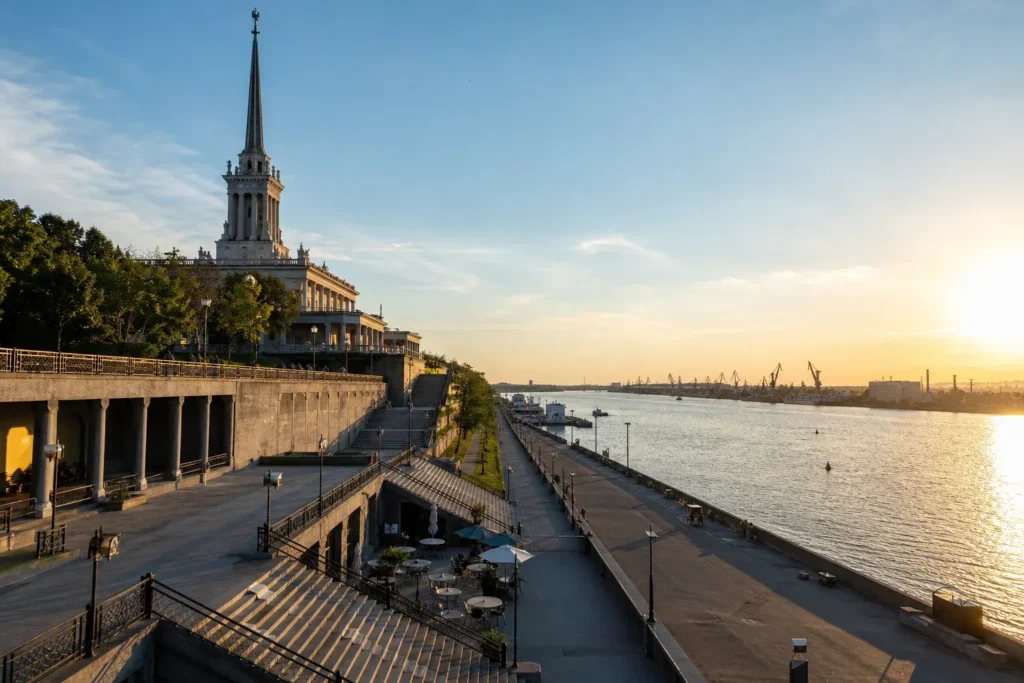
The Volgograd River Station is the largest river passenger terminal in Europe, roughly 300 metres long with a maximum height of 47 metres. Situated on the western Volga riverbank at the heart of the city’s embankment promenade, it serves as both a functional transport hub for river cruises and a social centre where locals and visitors gather. The port is a giant passenger terminal that receives several dozen cruise ships and other passenger vessels daily.
The central embankment stretches for more than 3 km from Volgograd River Station to the Volgograd Bridge, making the station an accessible gateway to one of Russia’s most historically significant cities. Beyond its transport function, the station building incorporates shops, restaurants, and cultural facilities that reflect its dual role as a modern recreation and commerce hub.
Quick Facts
| Russian name | Волгоградский речной вокзал |
|---|---|
| Type | River pier / station |
| Built / opened | 1938 |
| Address | ул. Набережная 62-й Армии, д. 2, Волгоград, 400048, Россия OpenStreetMap · Google Maps |
| District | Tsentralny |
| Metro | Pionerskaya (Metrótram Line 1, At the embankment level; descend central stairs to reach the station) |
| Admission | free |
| Best time to visit | Late spring through early autumn (May–September) offers the warmest weather, longest daylight, and most frequent cruise departures. July and August are peak season with the fullest schedules but also the most crowded conditions. June and September are pleasant and less congested. Winter months (November–February) see reduced or suspended river operations due to ice. Visiting on a weekday morning or mid-afternoon generally means shorter queues for tickets. |
| Recommended duration | 1–2 hours |
| Last updated | October 18, 2026 |
How to Get to and from Volgograd River Station, Volgograd
| Option | Duration | Price | Notes |
|---|---|---|---|
| River cruises to the Volga dam and downstream | 1–2 hours | ₽ | Short scenic excursions offering views of the Volga Hydroelectric Station, industrial banks, and the floodplain. Departures typically in late morning and mid-afternoon during warm months. Refreshments available onboard. Book at the terminal ticket window or at one of the affiliated tour operators nearby. |
| Multi-day Volga cruises (Moscow–Astrakhan, Rostov–Moscow) | Several days to 2 weeks | ₽₽₽ | Cruise services operate to Astrakhan and Samara, with regular ferry services to Nikolayevsk. These are booked well in advance through cruise operators, not at the station. The station serves as the embarkation point. Check major cruise operators' websites for schedules and availability. |
| Local water taxis and ferries | Varies | ₽ | Some local shuttle services may operate to nearby Volga locations during peak season. Information at the ticket counter or from staff at the dock. Frequency and destinations vary seasonally. |
₽ budget · ₽₽ moderate · ₽₽₽ upscale · ₽₽₽₽ splurge. Price levels are estimates compared with typical prices for visitors.
Why Visit Volgograd River Station, Volgograd?
The river station is your departure point for scenic cruises along the Volga, offering views of the city’s industrial heritage, riverbanks, and the Volga Hydroelectric Station dam downstream. It anchors Volgograd’s central embankment, which connects major war memorials and museums. The building itself is architecturally distinctive—its dramatic cantilever design and massive proportions make it unmistakable from the Volga or the promenade above.
The station features a central concert hall with 1,000 seats, and houses restaurants, cafés and entertainment venues, making it as much a cultural gathering place as a transport facility. Arriving by river cruise offers an unusual perspective on Volgograd’s WWII history and cityscape.
Highlights of Volgograd River Station, Volgograd
The Distinctive Silhouette
The station's most recognizable feature is its "puck"—the building's maximum height of 47 metres, visible from across the Volga. The cantilever design creates an imposing, futuristic form that contrasts sharply with traditional riverfront architecture. From water level or from the upper embankment promenade, the structure's scale and geometry dominate the view.
Tip: Best viewed from the water during a river cruise, or from the upper embankment terrace for a full perspective of its massing.
Concert Hall and Philharmonic Venue
A concert hall with 1,000 seats features a Rieger-Kloss organ built in 1983. Unlike most river stations, Volgograd's includes this cultural facility, hosting performances and events. The hall adds to the station's role as a civic gathering place.
Tip: Check for evening performances or concerts; local and touring ensembles perform here regularly. Inquire at ticket counters for the current program.
River Cruise Departures to the Volga Dam
Cruise ships depart to Astrakhan to the south and Samara to the north, with regular ferry services to Nikolayevsk. The scenic route downstream toward the Volga Hydroelectric Station dam offers panoramic views of the river, industrial banks, and the engineering marvel of the dam itself. Typical cruises range from 1–2 hours to multi-day voyages.
Tip: Book tickets directly at the terminal or through affiliated operators. Short afternoon excursions are usually available without advance booking during summer and early autumn.
Arrival by River Cruise
The station is the docking point for long-distance Volga cruises running from Moscow to Astrakhan or from Rostov-on-Don northward. Passengers experience Volgograd's WWII monuments—the Flour Mill ruins and The Motherland Calls statue—from the unique vantage of the river. The approach gives context to the city's wartime role and geographic isolation on the steppe.
Tip: If arriving by cruise, plan at least 2–3 hours to explore the embankment and central museums after disembarking, as cruise ships often dock for a full day.
Central Embankment Promenade Access
The embankment connects directly to the River Station via central stairs. The promenade features cafés, fountains, and walkways, with easy access to nearby attractions including war memorials and museums. The upper and lower terraces offer different perspectives on the Volga and city.
Tip: The lower terrace is cooler and quieter; the upper terrace offers better views toward the central Volgograd monuments and the opposite bank.
Shopping and Food Venues
The station includes restaurants, cafés, and shops. Beyond transport, the building functions as a modern retail and dining hub. Vendors offer snacks, souvenirs, and traditional Russian fare. Dining options range from casual to sit-down service.
Tip: Prices are higher than street-level venues; bring water and snacks if budget-conscious. The cafés near the upper embankment exit often offer better value and quieter settings.
Atmosphere
The station’s vast hall echoes with announcements and the murmur of crowds preparing to board or having just arrived. Morning departures are busiest; afternoons quieter. The modernist interior, all soaring ceilings and broad floors, can feel both imposing and slightly cold. Retail vendors and restaurant staff create a working commercial energy.
On summer afternoons and weekends, the embankment promenade outside fills with families strolling, couples resting on benches, and elderly locals enjoying the shade. River breezes and the sound of water provide a counterpoint to the city’s traffic and industry inland. The station anchors this public life—locals pass through between the city and embankment, and travelers move between ship and shore.
Views from the embankment level take in the Volga’s width, industrial banks, and occasionally freight barges or smaller vessels. On clear days, the opposite bank’s floodplain forests are visible upstream. The whole scene carries the atmosphere of a working river port animated by leisure and commerce.
History of Volgograd River Station, Volgograd
After the 1917 revolution, the river fleet was nationalized and new structures were created to facilitate water transport. From 1918 to 1923, the port belonged to district water transport management. In 1934, three Volga shipping companies were formed.
A passenger station finally opened in Volgograd in 1938. The building was constructed as a flagship Soviet transport facility reflecting Stalin-era ideals of monumental public architecture. Its dramatic cantilever form and massive scale reflected Soviet architectural ambitions of the interwar period.
The station survived the Battle of Stalingrad (1942–43) and subsequent Soviet reconstruction. In the Soviet era, it served primarily as a functional transport hub, though its concert hall and cultural amenities reflected Soviet policy of integrating art and public life into civic infrastructure.
From the late 1990s onward, the station transformed into a mixed-use entertainment and retail complex, a pattern typical of Russian provincial stations. Volgograd’s river port, while currently serving as a dated, multi-purpose entertainment complex, has plans to partner with neighboring ports in developing new large-capacity terminals and modernization projects. Today it balances historic significance with contemporary commercial demands.
Tickets and Payment at Volgograd River Station, Volgograd
Tickets for short cruises are sold at the terminal’s main ticket window, usually open during daylight hours and for an hour before departures. Same-day tickets are typically available for short excursions unless the cruise is full. Bring your passport for Russian citizens; foreigners may be asked to show ID.
For multi-day cruises, book through major international or Russian cruise operators (such as VODOHOD) weeks in advance. Itineraries and availability vary by season. Check the operator’s official website for current offerings.
Payment and entry: Cash (rubles) and card payment are usually accepted at ticket windows. Boarding is typically announced 30–60 minutes before departure. Arrive at least 20 minutes early for security checks and boarding. Passengers are directed to the dock via clearly marked gates.
Rates for Russian citizens may differ. See the operator’s official website or ask at the terminal for all categories and current pricing. Rules and schedules change seasonally and may vary by operator.
Flights, Transfers and Planning
How to Get to Volgograd River Station, Volgograd
By metrótram: Take Metrótram Line 1 toward Krasnooktyabrskaya. Get off at Pionerskaya station. From the station, ascend the stairs and follow signs downward to the embankment level and the River Station entrance. The walk takes about 8–10 minutes.
By foot from central Volgograd: The station sits at the heart of the central embankment promenade, accessible from Lenin Square and the surrounding city center via any path leading downhill to the embankment level. Walking from Krasnaya Square takes about 15–20 minutes.
By taxi: Give the driver “Речной вокзал” (Rechnoy vokzal) or the address: ул. Набережная 62-й Армии, д. 2. The station is unmistakable from the embankment; the driver will drop you at the main entrance.
Accessibility
The station's main hall is at ground level with wide doors and accessible entrances from the embankment promenade. Ticket counters are on the ground floor. However, embarkation onto river vessels may require steps or narrow gangways depending on water level and vessel type—inquire in advance if mobility assistance is needed. The metrótram station (Pionerskaya) has stairs; no confirmed elevator at platform level.
Food Nearby
The station itself contains restaurants and cafés serving standard Russian fare, snacks, and beverages. The embankment promenade immediately outside has additional cafés and food kiosks, many with outdoor seating. Restaurants and street food vendors are numerous along the central embankment within a 5–10 minute walk in either direction. Quality and pricing vary; embankment venues tend to be mid-range or casual; station cafés are pricier.
What to Bring
In warm months (May–September), bring sun protection (hat, sunscreen, sunglasses) and water. For river cruises, bring a light jacket even in summer, as river breezes are cool. In autumn and spring, warmer layers are essential. Comfortable walking shoes are necessary for embankment exploration. Cameras and binoculars enhance observation of river views and architecture. No special restrictions on bags; standard security screening applies.
Photography Rules
Photography is generally unrestricted in the main public halls and embankment areas. Tripods are not prohibited but should not obstruct passenger flow. No flash photography restrictions inside the concert hall unless a performance is underway. Outdoor embankment and river views offer excellent photo opportunities, especially during golden hour (late afternoon). Be respectful when photographing other passengers.
Family Suitability
The station is family-friendly. Parents can navigate the spacious halls with strollers, though uneven embankment terrain may challenge wheeled equipment. Short river cruises (1–2 hours) are suitable for children from age 5 onward; longer multi-day cruises are manageable for all ages with adequate planning. The embankment promenade offers shaded rest areas and relatively safe walking. Cafés and restaurants cater to families. The concert hall sometimes hosts children's performances. No specific age restrictions for station access.
Russia Vibes Tips
- Cruise operators sometimes maintain separate ticket offices on the embankment nearby (for instance on Engels Boulevard). These independent operators occasionally offer lower prices than the main station ticket window for the same excursion. Scout the embankment before buying at the terminal.
- The embankment's upper terrace connects to the nearby Museum of the Battle of Stalingrad and The Motherland Calls war memorial. Walk uphill from the station to combine a river cruise with WWII heritage sites in one visit.
- Visit in the late morning (around 10:00–11:00 AM) to catch departures of excursion cruises without arriving too early. Boarding procedures begin 30–40 minutes before scheduled departure.
- The station is busier on weekends and Russian public holidays. Weekday visits offer shorter queues and quieter embankment atmosphere.
- The river can be muddy and fast-flowing in early spring (April–May) due to snowmelt; water levels and navigation conditions change. Check conditions before booking if visiting in late spring.
- The concert hall (Volgograd Philharmonic) occasionally hosts free or low-cost evening performances. Ask staff if anything is scheduled during your visit.
Explore Nearby Volgograd River Station, Volgograd
Sights near Volgograd River Station, Volgograd
 Mamayev Kurgan, Volgograd – about 5.0 km away · typical visit: 3–4 hoursOpen daily 09:00–18:00
Main image: AI-generated illustration. It may not show the place exactly as it looks.
 Central Embankment, Volgograd – about 1.0 km away (~17 min walk) · typical visit: 1–2 hoursOpen 24 hours
Main image: AI-generated illustration. It may not show the place exactly as it looks.
 Volgograd Railway Station, Volgograd – about 1.5 km away (~24 min walk) · typical visit: 30 minutesOpen daily 00:00–23:59
Main image: AI-generated illustration. It may not show the place exactly as it looks.
 Volgograd Planetarium, Volgograd – about 1.7 km away (~28 min walk) · typical visit: 1–2 hoursOpen daily 10:00–18:00
Main image: AI-generated illustration. It may not show the place exactly as it looks.
Train stations and river piers near Volgograd River Station, Volgograd
 Volgograd Metrotram, Volgogradabout 1.5 km away (~24 min walk)
Main image: AI-generated illustration. It may not show the place exactly as it looks.
 Volgograd Bus Station, Volgogradabout 1.8 km away (~30 min walk)
Main image: AI-generated illustration. It may not show the place exactly as it looks.
Restaurants and cafes near Volgograd River Station, Volgograd
 Restaurant Marusya, Volgogradabout 600 m away (~10 min walk)
Main image: AI-generated illustration. It may not show the place exactly as it looks.
 Denver Burgers, Volgogradabout 750 m away (~12 min walk)
Main image: AI-generated illustration. It may not show the place exactly as it looks.
Hotels near Volgograd River Station, Volgograd
 Hostel Centre, Volgogradabout 700 m away (~11 min walk)
Main image: AI-generated illustration. It may not show the place exactly as it looks.
 Intourist Hotel, Volgogradabout 1.1 km away (~18 min walk)
Main image: AI-generated illustration. It may not show the place exactly as it looks.
Related guides
 Cosmos Volgograd Hotel: Central Base for Stalingrad Sights
Main image: AI-generated illustration. It may not show the place exactly as it looks.
 Hilton Garden Inn Volgograd: Modern Comfort Near Historic Landmarks
Main image: AI-generated illustration. It may not show the place exactly as it looks.
 Bamberg: German Brewery and Food in Central VolgogradOpen daily 11:00–23:00
Main image: AI-generated illustration. It may not show the place exactly as it looks.
 Voronka: Volgograd’s Best Coffee, Wine, and All-Day Breakfast Café
Main image: AI-generated illustration. It may not show the place exactly as it looks.
Browse more: More in Tsentralny · All Airports & Transport · All Airports & Transport in Volgograd · All River Piers and Stations · All Volgograd
FAQ: Volgograd River Station, Volgograd
Is the river station the same as Volgograd Railway Station?
No. The River Station (Речной вокзал) is a separate transport hub on the Volga embankment for river cruises and boats. Volgograd Railway Station is a railway station 2–3 km inland. Both are major transport hubs but serve different modes of transport.
Can I just walk around the river station without boarding a cruise?
Yes. The station's main hall is open to the public and free to enter. You can browse shops, visit cafés, and observe the riverside activity without purchasing a cruise ticket. However, access to the dock and vessel boarding requires a valid ticket.
What is there to see on a river cruise from the station?
Short cruises typically pass the ruins of the Flour Mill (Gerhardt's Mill), a WWII landmark, and offer views of The Motherland Calls war memorial and the city skyline from the water. Longer cruises head downstream toward the Volga Hydroelectric Station dam, offering industrial and landscape perspectives unavailable from shore.
How do I get tickets for a multi-day Volga cruise?
Multi-day cruises are booked through cruise operators (such as VODOHOD or international agencies), not directly at the station. Book online or by phone weeks in advance, especially for July–August sailings. The station serves as the embarkation point where you board after purchasing tickets elsewhere.
Is the station accessible by public transport?
Yes. Metrótram Line 1 stops at Pionerskaya, about 8–10 minutes' walk down to the embankment and station. Buses also stop near the upper embankment level. From central Volgograd, walking downhill to the embankment is also practical.
What facilities are in the station building?
The station includes a ticket office, waiting areas, restaurants, cafés, shops, and a concert hall (Volgograd Philharmonic). Restrooms and basic services are available. It functions as both a transport hub and a public gathering and entertainment space.
When is the best time to visit?
May–September offers the warmest weather and most active cruise schedules. June and September are less crowded than July–August. Winter (November–February) sees reduced operations and potential ice on the river. Weekday mornings are less busy than weekends.
Can children go on river cruises?
Yes. Short excursion cruises are suitable for children from about age 5 onward. Multi-day cruises are manageable for families with planning. No specific age restrictions exist, though young children should be supervised near water. Onboard safety regulations apply.
Russia Vibes is a one-person project. A coffee keeps it going
How we research and update our guides
About this guide: AI assistance and accuracy
This guide is created with the help of AI and is based on official sources where available. Mistakes can still happen. Opening hours, prices, rules and other details are given to the best of our knowledge as of the date shown and can change without notice. It offers general recommendations only, not professional, legal or travel advice. Please confirm important details with the official source before you travel; you are responsible for your own plans and decisions.
International sanctions affect payments between Russia and many other countries. In practice, cards issued in the EU, the UK, the US and several other countries often do not work in Russia, Russian cards usually do not work abroad, and some booking platforms, airlines and payment providers limit or suspend their services for Russia. The situation changes frequently. We do not give legal or financial advice, and this site does not encourage anyone to break or circumvent sanctions. Whatever you plan, you are responsible for following the laws and regulations that apply to you, including those of your country of residence and citizenship. Many travelers still organise their stay lawfully. It is worth asking your bank or payment provider what is currently permitted, contacting hotels, tour operators and carriers directly about the payment methods they accept, and checking which services are open to customers from your country. Clarify payment, cancellation and refund terms before you commit to a booking, and keep your plans flexible. Partner links on this site may not be available in every country, and prices, availability and rules in our guides can differ from what you see when you book.Paying for your trip: please read
Report an issue on this page

Take this guide with you
Get a free PDF of this guide to print or read offline: key facts, tips and a map link on a few clean pages.