
Last updated
Old Sarepta preserves a rare slice of 18th-century life in the Russian provinces. This open-air museum complex, now part of Volgograd‘s Krasnoarmeysky District, showcases the architectural and cultural legacy of the Volga Germans—settlers who arrived when Catherine the Great sought to expand agricultural production and colonize southern Russia. The museum occupies buildings that survived the devastating Battle of Stalingrad in 1942–1943, making it a physical link to both colonial and Soviet history.
Walking through Old Sarepta offers insight into how a religious community built an entire functioning settlement from scratch, complete with infrastructure that was advanced for its time. The wooden and stone buildings, arranged around courtyards, reveal daily life, craftsmanship and the technical achievements of these German-speaking pioneers.
Quick Facts
| Russian name | Старая Сарепта |
|---|---|
| Distance from the nearest major city | 1,200 km |
| Travel time from the nearest major city | 18–24 hours |
| Built / opened | 1990 |
| Address | Улица Талманна (Thälmann Street), Волгоград, Россия OpenStreetMap · Google Maps |
| Opening hours | Mon-Sun 09:00-12:30; 13:00-17:30 |
| Admission | ₽ for adults, free for children under 12 |
| Best time to visit | Spring (April–May) and autumn (September–October) offer mild temperatures and lower humidity, making walking the grounds comfortable. Summer (June–August) brings heat and occasional crowds of families on vacation. Winter is possible but cold, and some buildings may be less hospitable to linger in without adequate heating. Weekday afternoons (1–4 PM) are noticeably quieter than weekends and mornings. Early spring and autumn also provide the best light for photography. |
| Recommended duration | 2–3 hours |
| Last updated | October 18, 2026 |
What Is (and Isn't) Part of a Visit to Old Sarepta, Volgograd?
| Part | Status | Notes |
|---|---|---|
| Open-air museum buildings and grounds | Included in the standard ticket | All preserved structures, the cemetery and outdoor spaces are included in the standard admission ticket. |
| Interior access to residential and workshop buildings | Included in the standard ticket | Most buildings are open and furnished to display period interiors. Some spaces may be closed seasonally or for maintenance. |
| The Moravian Church interior | Included in the standard ticket | Entry is generally included, though the church may have restricted access on certain occasions or require a staff member to unlock it. |
| Exhibition hall with artifacts and displays | Included in the standard ticket | The indoor museum space with textiles, documents and household items is included in standard admission. |
| Cemetery and memorial sites | Included in the standard ticket | Access to the cemetery grounds and grave sites is included; a guide can explain inscriptions and historical significance. |
| Audio guide or printed materials in English | Separate ticket or institution | English-language audio guides or detailed printed materials may incur an extra fee or may not be available; ask at the ticket office. |
| Guided tour (English-speaking) | Separate ticket or institution | Hiring a Russian-speaking guide is typically included or costs a small extra fee; English-speaking guides may need advance booking and an additional charge. |
| Nearby Sarpa River beaches or local restaurants outside the museum complex | Outside / not part of it | The museum itself does not include food service. Small cafes and shops exist in the surrounding district but are outside the museum gates. |
How to Get from the nearest major city to Old Sarepta, Volgograd
| Option | Duration | Price | Notes |
|---|---|---|---|
| Local train (Prigorodny train) from Volgograd Central Station to Sarepta Station | 45 minutes to 1 hour | ₽ | Frequent commuter trains run throughout the day. The Sarepta station is a 2-minute walk from the museum. Buy tickets at Volgograd Central Station or aboard. Most convenient and affordable option for independent travelers. |
| Marshrutka (shared minibus) from Volgograd city center to Sarepta District | 1–1.5 hours depending on traffic | ₽ | Minibuses depart from various stops in central Volgograd. Ask locals or your accommodation for the nearest departure point. Schedules are less frequent than trains but offer flexibility. Cost is comparable to or slightly higher than train fare. |
| Taxi or ride-hailing car from Volgograd city center | 30–40 minutes depending on traffic | ₽₽ | Most direct option; allows flexible departure and return times. Use Yandex.Taxi or local taxi apps. Negotiate or confirm the fare beforehand with traditional taxis. Best for groups or when carrying heavy bags. |
| Guided tour from Volgograd hotel or tour operator | 4–5 hours including transport and guided walk | ₽₽–₽₽₽ | Hotels in Volgograd can often arrange a guide and transport. Tours typically include museum entrance and a Russian-speaking guide. Book at least a day in advance. English-speaking guides may need advance notice. |
₽ budget · ₽₽ moderate · ₽₽₽ upscale · ₽₽₽₽ splurge. Price levels are estimates compared with typical prices for visitors.
Why Visit Old Sarepta, Volgograd?
Old Sarepta stands out because it captures a specific moment in Russian history when German religious communities shaped southern steppe development. The settlement’s survival through World War II made it one of the last intact German colonial ensembles in Russia. The museum reveals how the Moravian Brethren—a Protestant denomination—organized work, worship and daily life according to their religious principles. For those interested in Russian social history, German heritage in Russia, or 18th-century colonial settlement patterns, the site offers concrete, walkable evidence rather than abstract narratives.
Highlights of Old Sarepta, Volgograd
The Moravian Church
The heart of the settlement, this church building reflects the Moravian Brethren's religious priorities and architectural style. Built in the late 18th century, it remains largely intact and gives visitors a sense of worship practice and community gathering. The church's simple, functional design contrasts with the ornate Russian Orthodox cathedrals visitors may have seen elsewhere. The interior still conveys the spiritual purpose that drove the entire settlement's establishment and organization.
Tip: The church often has a caretaker on site; knock and ask if the interior is accessible, as visiting hours sometimes allow entry.
Printed Cotton Workshop Building
This restored workshop building showcases one of Sarepta's major industries—producing dyed and patterned cotton fabrics called sarepta goods, or sareptovka. The Brethren used innovative dyeing techniques and developed a reputation for high-quality textiles sold across Russia. The building displays original equipment, finished fabrics and details of the production process. This enterprise made Sarepta financially independent and attracted merchants from beyond the settlement.
Tip: Ask a guide about the specific dye recipes and plant sources the Brethren used; these technical details reveal the community's botanical and chemical knowledge.
Living Quarters and Community Housing
Several restored residential buildings show how different classes within the community lived—from communal dormitories for unmarried workers to family homes for master craftspeople. Rooms are furnished simply with period pieces, demonstrating how much space was allotted per person and how decoration reflected religious simplicity. The contrast between different housing types reveals the settlement's internal hierarchy despite its egalitarian religious ideology.
Tip: Look for details like the small windows, thick walls and heating systems adapted to the harsh steppe climate—these design choices tell stories of practical adaptation.
Water Supply and Infrastructure
Old Sarepta built Russia's first public water distribution network as early as 1766, decades before similar systems appeared in Saint Petersburg or Moscow. This network of pumps, pipes and storage tanks moved water from wells or the nearby Sarpa River to different buildings. The engineering achievement demonstrates how technically advanced the community was and how they solved practical challenges of the steppe environment. Some original infrastructure elements remain visible.
Tip: Walk the grounds and look for old brick wells and pump houses—guides can point out the remnants of this historic network.
Cemetery and Memorial Sites
The settlement cemetery contains graves of community members spanning more than two centuries. Headstones in German and Russian document the names, dates and occupations of residents. The cemetery reveals demographic patterns—infant mortality, disease outbreaks, the effects of war—and shows how the community commemorated its dead. Some monuments were destroyed or vandalized during Soviet times but efforts have been made to restore them.
Tip: Visit the cemetery on a quieter afternoon; the rows of graves create a contemplative atmosphere and offer perspective on settlement life spans.
Museum Shop and Exhibition Halls
The museum's indoor exhibition space displays artifacts, documents, photographs and crafts from Sarepta's history—handmade textiles, tools, household items and written records. Exhibits explain the Moravian Brethren's religious practices, their relationships with surrounding Russian and Tatar communities, and the settlement's role in the broader Volga German diaspora. A small shop sells books, postcards and reproductions of historical items.
Tip: Ask for English-language exhibition materials; some materials may have limited translation, but museum staff can often provide summaries of key exhibits.
Atmosphere
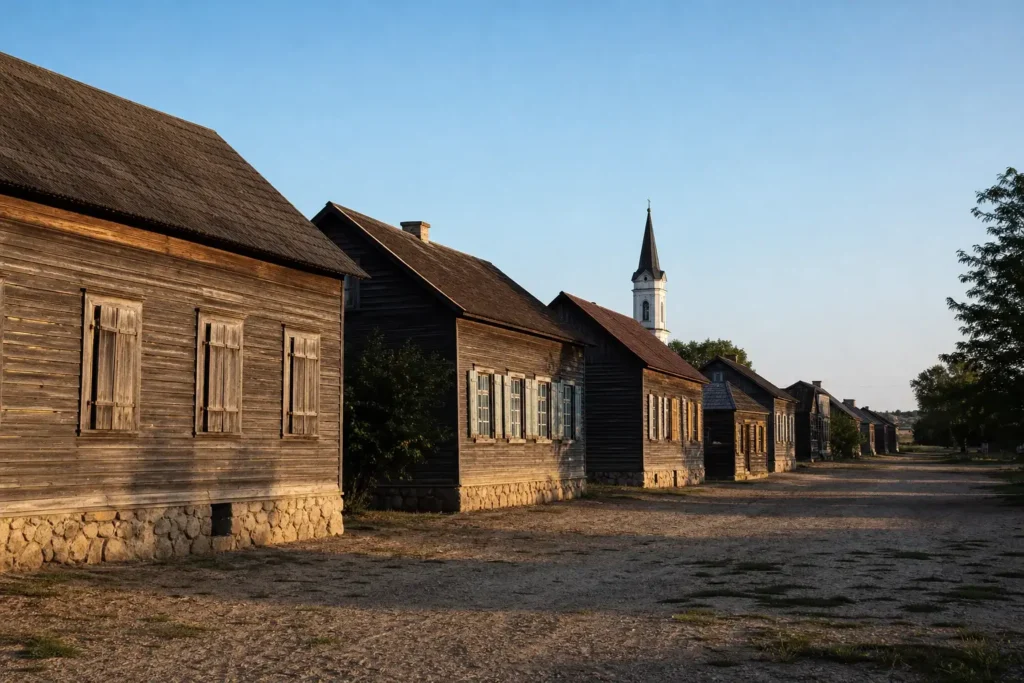
Old Sarepta feels like stepping backward into a quieter, more orderly world. The preserved wooden buildings with their simple geometry and uniform styling create an almost sculptural streetscape, especially when light rakes across the weathered facades. The museum is rarely crowded; on weekday afternoons (especially 1–4 PM), you may be nearly alone. This solitude allows time to absorb the physical space without distraction. Birdsong, wind through the buildings and the occasional voices of guides or locals break the silence. The spiritual and practical purpose behind every structure remains palpable—nothing is ornamental or haphazard. Visiting in spring or autumn intensifies the contemplative mood, with changing light and a emptier feeling than summer.
History of Old Sarepta, Volgograd
Foundation and Early Years (1765–1800s)
Sarepta was founded in 1765 by the Moravian Brethren, a Protestant religious community with a reputation for discipline, craftsmanship and self-sufficiency. Catherine the Great had issued a manifesto inviting foreign settlers to colonize southern Russian steppe lands, partly to expand agricultural production and partly to create a buffer against raids by Kalmyk, Kazakh and Tatar tribes. The Moravian Brethren, already experienced in establishing closed religious communities elsewhere in Europe, saw an opportunity to build a new settlement following their strict principles. They named it Sarepta after the biblical city, drawing the name from the nearby Sarpa River, which flows into the Volga.
The community organized itself with characteristic Moravian thoroughness. Religious life centered on the church; economic activity focused on agriculture, animal husbandry and craft production. By the late 1700s, Sarepta had developed a major textile industry, producing cotton fabrics known as sarepta goods (sareptovka) that gained renown across Russia for quality and design. The Brethren pioneered Russia’s first public water distribution network around 1766—a pumped system that carried water from wells to different parts of the settlement, a marvel of engineering for the time.
Development and Integration (1800s–1917)
Through the 19th century, Sarepta grew and prospered. The textile industry expanded; merchants from beyond the settlement came to trade. The population included not only German-speaking Brethren but also Russian workers, servants and craftspeople. Relations with surrounding Russian and Tatar communities were generally peaceful, though religious differences occasionally created tension. In 1920, after the Russian Revolution and during the early Soviet period, the settlement was renamed Krasnoarmeysk (Red Army Town) to erase its German and religious associations. By 1931, it had become administratively absorbed into Volgograd (then Stalingrad) as a district.
World War II and Survival
Between August 1942 and February 1943, Volgograd (Stalingrad) endured one of the deadliest battles of World War II. Most of the city was flattened by bombing and street fighting. Against considerable odds, many of Sarepta’s 18th-century buildings survived, likely because they lay in a less strategically contested zone. After the war, Soviet authorities recognized their historical and architectural value. Restoration efforts began, though the community itself—the living Moravian tradition and German cultural life—had effectively ended decades earlier. Soviet-era restorations respected the original structures while incorporating Soviet interpretive frameworks.
Museum Era (1990–Present)
In 1990, shortly after the fall of the Soviet Union, Old Sarepta was formally designated the Old Sarepta Museum of History and Ethnography, an open-air museum complex. This status allowed for systematic conservation and public education about both the Moravian Brethren’s heritage and the Volga German diaspora. Restoration work has continued, mixing original materials and reconstruction based on historical records and archaeological evidence. The museum now interprets the site not only as a religious settlement but as a window into 18th-century colonial development, German-Russian relations and the resilience of cultural memory.
Tickets and Booking for Old Sarepta, Volgograd
| Ticket | Price | Includes |
|---|---|---|
| Adult admission | ₽ | Entry to all museum buildings, grounds, cemetery and indoor exhibition halls. |
| Child or student admission | ₽ | Same access as adult ticket; rates differ for Russian citizens, so international visitors should confirm the exact price at the ticket office. |
| Children under 12 | Free | Free entry; no separate ticket needed. |
₽ budget · ₽₽ moderate · ₽₽₽ upscale · ₽₽₽₽ splurge. Price levels are estimates compared with typical prices for visitors.
Tickets are purchased on-site at the museum entrance. No online booking system is widely available for international visitors, so arrive during operating hours. The museum is open Monday through Sunday, 9:00 AM to 12:30 PM and 1:00 PM to 5:30 PM, with a lunch break. Weekday afternoons (1–4 PM) are typically quieter. English-language guides are not always available; book through your Volgograd hotel or contact the museum in advance if you need English interpretation. Russian citizens and certain concessions receive lower rates. For the most current ticket options and any group discounts, visit the official Volgograd tourism website or call ahead to confirm hours and availability.
Plan and Book
Suggested itineraries Old Sarepta, Volgograd
Half day (4 hours on site, plus travel)
Arrive at Sarepta Station by morning train. Walk to the museum entrance (2 minutes). Buy tickets and pick up a map. Begin with the exhibition hall to understand the settlement's history. Then walk the grounds, viewing residential buildings and the church. Visit the cemetery. Return to Sarepta Station by mid-afternoon train. Total travel and visit time: approximately 5–6 hours.
Full day (6–8 hours on site, plus travel)
Arrive early morning via train or taxi. Spend the first hour in the exhibition hall. Systematically walk through residential and workshop buildings, taking time to read descriptions. Attend or speak with a guide if available. Explore the cemetery and perimeter grounds. Have lunch at a nearby cafe outside the museum (ask staff for recommendations). Return in mid-afternoon for a second pass through any buildings you missed. Depart late afternoon. This pace allows lingering and absorption without rushing.
Day trip by car or arranged tour (7–8 hours including transport)
Depart Volgograd by taxi or tour at 9:00 AM. Arrive by 9:30–10:00 AM. Spend 4–5 hours on site with a guide, visiting all major buildings, the exhibition hall and cemetery. Have lunch at a nearby restaurant (guide or driver can suggest). Depart for Volgograd by 3:00–4:00 PM. Arrive back in the city by 4:30–5:00 PM.
How to Get to Old Sarepta, Volgograd
By train (most convenient)
From Volgograd Central Station (Vokzal), take a Prigorodny (suburban) train toward Sarepta. Trains depart regularly throughout the day, with schedules posted at the station. The journey takes 45 minutes to 1 hour. Get off at Sarepta Station. Exit the station and turn left along Thalmann Street; the museum entrance is a 2-minute walk. Purchase train tickets at the station ticket office or aboard the train.
By marshrutka (shared minibus)
Minibuses depart from central Volgograd toward Sarepta District and Krasnoarmeysk. Ask your hotel or a local for the nearest marshrutka stop. Journey time is 1–1.5 hours depending on traffic and stops. Request the driver to drop you near Old Sarepta Museum or Thalmann Street.
By taxi or ride-hailing
Use Yandex.Taxi, Uber, or call a traditional taxi from your hotel. The journey from central Volgograd takes 30–40 minutes. Confirm the destination: Old Sarepta Museum, Thalmann Street, Krasnoarmeysky District, Volgograd.
Parking
If driving, parking is available near the museum entrance. Street parking and informal lots are common in the area. The district is easily navigable on foot once you arrive.
Accessibility
The museum is not fully wheelchair accessible. The grounds consist of uneven, packed earth and gravel paths between buildings. Most buildings have steps at their entrances and narrow interior doorways. Some lower-level rooms are accessible without significant stairs. Restroom facilities are available near the entrance and exhibition hall, but details on their design and accessibility are not confirmed on the official site. Visitors with limited mobility may need assistance navigating between buildings. Contact the museum in advance if you have specific accessibility needs; staff may be able to arrange assistance or suggest which buildings are easiest to access.
Food Nearby
The museum does not operate a cafe or restaurant on site. Small cafes, tea houses and informal food shops exist in the surrounding Sarepta District and near the train station, but these are outside the museum complex. Common options include simple Russian fare, pastries, tea and soft drinks. Ask staff at the museum entrance or your taxi driver for nearby recommendations. Most visitors eat before arriving or bring snacks. The district's location on the outskirts of Volgograd means dining options are more limited than in the city center.
What to Bring
Comfortable walking shoes are essential; the grounds are uneven dirt and gravel. Bring water, especially in summer—shade is limited and heat can be intense on the steppe. A light jacket or shawl is useful for shade and cooler early mornings or evenings. In spring and autumn, temperatures vary; layering is wise. Sun protection (hat, sunscreen) is important. A camera or phone for photos. Insect repellent in summer. If you plan an extended visit, pack snacks or arrange lunch beforehand. A small notebook helps with note-taking during a guide or self-guided tour. Bags are permitted; the museum has no strict bag rules, though use common sense with very large or bulky items.
Best Views and Photo Spots of Old Sarepta, Volgograd
The Moravian Church façade and entrance
The simple, symmetrical wooden church building with its bell tower set against an open steppe backdrop creates a striking architectural photograph. The contrast between the restrained European design and the vast Russian landscape behind it emphasizes the community's foreign origin and isolation.
Best time: Early morning or late afternoon light rakes across the façade, highlighting its weathered wood grain. Spring or autumn for clearer skies and softer light.
Street view down Thalmann Street with residential buildings on either side
A row of preserved wooden residential buildings creates a vanishing perspective reminiscent of 18th-century colonial street scenes. The uniform building styles, street width and lack of modern infrastructure convey the feeling of stepping backward in time.
Best time: Mid-morning or mid-afternoon; early spring or autumn for atmospheric light without harsh shadows.
The cemetery rows with original gravestones
Rows of weathered headstones in German and Russian, some leaning or cracked, create a poignant and atmospheric scene. The cemetery's solitude and the visible passage of time in the markers offer deep historical mood.
Best time: Overcast days or late afternoon for a contemplative mood. Spring when low vegetation is fresh; autumn when colors soften.
Workshop building exterior with period details
Close-up views of restored workshop buildings reveal craftsmanship in wood construction, window placement and original hardware. These details anchor the photograph in historical authenticity and craft tradition.
Best time: Late afternoon raking light emphasizes texture and details of the wooden façade and doors.
Photography Rules
Photography is generally permitted throughout the grounds and in most buildings for personal use. Tripods and professional filming may require permission; ask staff. Flash photography inside certain fragile buildings or the church may be discouraged. Drones are not permitted. No special commercial or media rights are granted for free admission photography. Respect any signage prohibiting photography in specific rooms or exhibition areas.
Family Suitability
Old Sarepta is suitable for families with children aged 7 and older who can walk at a moderate pace and tolerate some historical context without constant narration. The open grounds allow children to move freely, and the low-key, quiet atmosphere is less overwhelming than large urban museums. Younger children (under 7) may lose interest without a structured guide; parents should be prepared to explain buildings and history in simple terms. Stroller access is limited—the uneven, unpaved grounds make wheels difficult to maneuver. Shade is minimal, so summer visits require extra planning for water and sun protection. The cemetery and some building interiors may feel slow or somber for very young children. Facilities include restrooms but limited food options. Best suited for families with an interest in history and a tolerance for quieter, slower-paced exploration.
Russia Vibes Tips
- Visit on a weekday afternoon (1–4 PM) if possible. Museum traffic is sparse at these times, giving you peaceful access to buildings and the grounds without crowding. The lunch break (12:30–1:00 PM) also means the museum briefly empties.
- Bring or buy a detailed map at the entrance and spend the first 15 minutes orienting yourself to the layout. The grounds can feel disorienting initially; knowing which building is which saves time and prevents backtracking.
- Ask staff or your guide which buildings have open interiors on the day of your visit. Some structures may be closed seasonally or for restoration; knowing this upfront prevents disappointment.
- The cemetery is often overlooked but contains some of the richest stories—gravestones record names, death dates, occupations and family relationships. Spending 20–30 minutes here pays historical dividends and offers solitude.
- Do not rely solely on the museum for meals. Eat a light breakfast or lunch beforehand or bring snacks. The surrounding district has limited food options, and the museum has none.
- If you cannot secure an English guide, ask at the ticket office for a printed guide or fact sheet in English. Museum staff may provide one or point you to information online before your visit.
Explore Nearby Old Sarepta, Volgograd
Browse more: All Day Trips · All Day Trips in Volgograd · All Museums · All Volgograd
FAQ: Old Sarepta, Volgograd
What exactly is Old Sarepta—a village, a museum, or something else?
Old Sarepta is both a historical district of Volgograd (formerly called Krasnoarmeysk) and an open-air museum. The district was founded in 1765 as a closed religious settlement by the Moravian Brethren. Today, the museum preserves about 20–30 18th-century buildings within the district. Modern residential buildings and streets now surround the museum complex, so you're visiting a heritage site within a living urban area, not an isolated village.
Who were the Moravian Brethren, and why did they settle in Volgograd?
The Moravian Brethren are a Protestant religious denomination known for strict discipline, communal organization and self-sufficiency. Catherine the Great invited foreign settlers to colonize the southern Russian steppe in the 1760s. The Brethren accepted and founded Sarepta in 1765. They developed the settlement into a prosperous community, becoming famous for textile production. The community gradually lost its religious distinctiveness during the Soviet era.
How long should I spend at Old Sarepta?
A typical visit takes 2–3 hours on site. This allows time to walk all buildings, view the exhibition hall and cemetery, and absorb the atmosphere without rushing. A more leisurely visit, especially with a guide, can extend to 4–5 hours. Travel time from central Volgograd adds 45 minutes to 2 hours depending on your transport choice.
Is Old Sarepta closed on any particular days?
The museum is open Monday through Sunday, 9:00 AM to 12:30 PM and 1:00 PM to 5:30 PM. There is a lunch break from 12:30 to 1:00 PM. Specific holidays may cause closures; call ahead or check the official Volgograd tourism site to confirm before your visit.
Are there English-language guides or materials?
English guides are not guaranteed and may need advance booking through your hotel or the museum. Printed materials in English may be limited; ask at the ticket office. Staff can sometimes provide basic explanations in Russian or simple English. Self-guided exploration with a map is possible, though historical context is lost without interpretation.
Can I take photographs?
Yes, personal photography is permitted throughout the grounds and buildings. Tripods and professional filming require permission. Flash is discouraged inside fragile buildings and the church. Drones are not permitted. Respect any signage prohibiting photography in specific areas.
Is Old Sarepta worth visiting if I have only a few hours in Volgograd?
Yes, if you have at least 4–5 hours available (including travel). A half-day visit allows a meaningful walk through the major buildings and cemetery. If you have only 2–3 hours total, the travel time reduces the value; prioritize instead major Volgograd attractions like the Mamayev Kurgan memorial or Volga riverfront museums.
What should I eat before or after visiting Old Sarepta?
The museum has no cafe or restaurant. Eat a meal or pack snacks beforehand. Small cafes exist in the nearby Sarepta District, but these are outside the museum and offer limited menus. Consider dining in central Volgograd before taking the train out, or bring a light lunch to enjoy near the museum entrance.
Russia Vibes is a one-person project. A coffee keeps it going
How we research and update our guides
About this guide: AI assistance and accuracy
This guide is created with the help of AI and is based on official sources where available. Mistakes can still happen. Opening hours, prices, rules and other details are given to the best of our knowledge as of the date shown and can change without notice. It offers general recommendations only, not professional, legal or travel advice. Please confirm important details with the official source before you travel; you are responsible for your own plans and decisions.
International sanctions affect payments between Russia and many other countries. In practice, cards issued in the EU, the UK, the US and several other countries often do not work in Russia, Russian cards usually do not work abroad, and some booking platforms, airlines and payment providers limit or suspend their services for Russia. The situation changes frequently. We do not give legal or financial advice, and this site does not encourage anyone to break or circumvent sanctions. Whatever you plan, you are responsible for following the laws and regulations that apply to you, including those of your country of residence and citizenship. Many travelers still organise their stay lawfully. It is worth asking your bank or payment provider what is currently permitted, contacting hotels, tour operators and carriers directly about the payment methods they accept, and checking which services are open to customers from your country. Clarify payment, cancellation and refund terms before you commit to a booking, and keep your plans flexible. Partner links on this site may not be available in every country, and prices, availability and rules in our guides can differ from what you see when you book.Paying for your trip: please read
Report an issue on this page

Take this guide with you
Get a free PDF of this guide to print or read offline: key facts, tips and a map link on a few clean pages.