
Last updated
This itinerary is for history buffs and WWII enthusiasts seeking to understand the Battle of Stalingrad—one of the most significant and brutal confrontations of World War II. The pacing is deliberate: you will spend time absorbing the scale of each site rather than rushing between locations.
Over three days, you will walk the memorial complexes on Mamaev Kurgan, experience the monumental panorama canvas in the heart of the city, visit museums dedicated to the German surrender and Soviet defence, and see preserved ruins that bear witness to the battle’s devastation. By the end, you’ll understand not just the military strategy but the human cost of this turning point in the war.
At a glance: Day 1: Mamaev Kurgan memorial complex with the Motherland statue and museum. Day 2: Battle of Stalingrad Panorama Museum and the preserved mill ruins. Day 3: Memory Museum (Pamyat) and walking tour of central Volgograd's battle landmarks.
Day 1: Mamaev Kurgan Memorial Complex
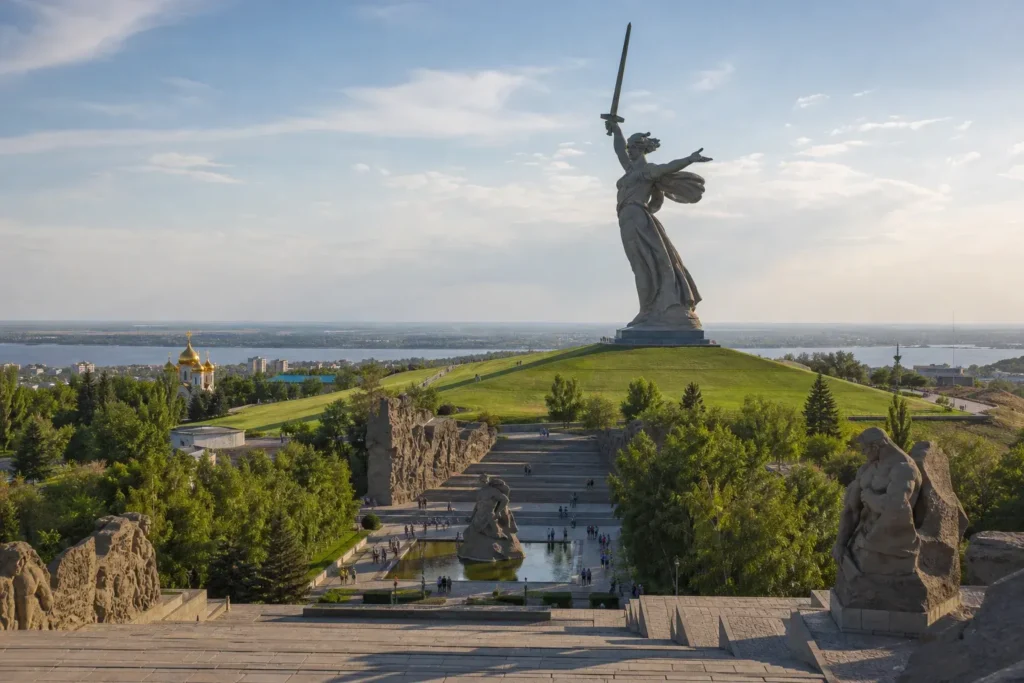
Begin at the dominant height that was the fiercest battleground in the city. Explore the massive memorial complex built after the war, centred on the 82-meter Motherland statue. The site includes a museum, monuments to fallen defenders, burial sites, and a changing-of-the-guard ceremony. Allow time to walk the grounds and absorb the scale of the complex. This is a full day's immersion into Soviet memorial architecture and the spiritual centre of Volgograd's remembrance.
- Mamaev Kurgan entrance – Base of the hill; museum and monument access, plan 4–5 hours (4–5 hours)
- The Motherland Calls statue – 82-meter concrete sculpture with stainless-steel sword blade; ascend stairs for city views (1 hour)
- Cemetery and Pantheon – Mass graves of over 35,000 defenders; Hall of Sorrow; eternal flame and changing-of-the-guard ceremony (hourly) (1.5 hours)
- Museum on Mamaev Kurgan – Small museum at base documenting the battle's fighting on this hill (1 hour)
- Church of All Saints and Chapel – Built on the complex in the 1990s; quiet reflection space (30 minutes)
Tip: Start early in the morning to avoid crowds. Wear comfortable shoes for the 200+ steps and steep paths. The viewing platform near the top offers the best vantage point for understanding the hill's strategic importance. Check current opening times on the official memorial website; extended hours apply on Victory Day (May 9).
Day 2: Panorama Museum and Mill Ruins
Visit the architectural centrepiece of Volgograd's war remembrance. The massive 2,000-square-metre panorama painting dominates the experience, depicting the battle as seen from Mamaev Kurgan. The museum spans eight exhibition halls with over 4,000 artefacts—weapons, uniforms, letters, personal belongings of Soviet and German soldiers, photographs and documents. The building was constructed in 1982 on the site where Soviet forces landed in September 1942. Adjacent stands the preserved ruin of a 1903 mill, destroyed in the battle and left unrepaired as a monument.
- Battle of Stalingrad Panorama Museum – Ulitsa Marshala Chuykova 47; ticket office closes 30 minutes before museum closes (2–3 hours)
- Exhibition halls and dioramas – First level: eight halls with military artefacts, documents, uniforms, personal items; four dioramas showing combat scenes (1.5–2 hours)
- Circular panorama (second level) – 360-degree canvas 'The Defeat of Nazi Troops at Stalingrad'; immersive viewing platform in the centre (30–45 minutes)
- Grudinin Mill (Gerhardt Mill) ruins – Five-storey brick structure; exterior viewing only (interior closed for safety); visible from museum courtyard and riverside promenade (30 minutes)
Tip: Visit Tuesday to Friday or Sunday to avoid Saturday crowds; the museum closes at 6 p.m. on these days except Saturdays (8 p.m.). Thursday opening is reduced from 1 p.m. in winter, 10 a.m. in spring–autumn. Closed Mondays. The panorama is best experienced in the afternoon when light enters from different angles. Allow extra time if you read the detailed exhibit labels. Photography inside requires a separate permit.
Day 3: Memory Museum and City Landmarks
Explore the smaller Memory Museum (Pamyat) in the basement of a former department store—the exact location where Field Marshal Paulus surrendered on 31 January 1943. This museum offers a different perspective, focusing on German military experiences and artefacts. Spend the afternoon walking central Volgograd's key battle sites: Pavlov's House (held by Soviet defenders for months), tank turrets marking the limits of German advance, and the Volga embankment where the city made its final stand.
- Memory Museum (Pamyat) – Ploshchad Pavshih Bortsov (Fallen Soldiers Square) 2; basement entrance; small but detailed (45 minutes to 1 hour)
- Pavlov's House – 9-storey apartment building on the square; exterior only, heavily restored; held by Soviet troops for two months (20 minutes)
- Tank turrets on Ploshchad Pavshih Bortsov – Concrete pillars topped with gun turrets; mark the deepest German penetration into the city (15 minutes)
- Volga Embankment promenade – Walking path along the river offering views of the opposite bank; site of desperate final-phase fighting (1 hour)
- Central Volgograd street walk – Navigate Ulitsa Lenina and central streets to see Soviet-era monuments and rebuilt city centre (1 hour)
Tip: The Memory Museum is small and can be crowded during peak hours; visit early morning or late afternoon. The basement location can feel confined and carries emotional weight—budget time to process. Pavlov's House exterior is best photographed from the square; it is heavily restored and no longer shows original damage. The tank turrets are freely accessible outdoor monuments. Wear layers; the Volga embankment can be windy and cool even in summer.
Russia Vibes Tips
- Guided tours vs. self-guided: While the major sites are accessible without a guide, hiring a local historian or war specialist for at least one day will deepen your understanding of tactical details and soldier experiences. Many tour operators in Volgograd offer half-day and full-day battle-site tours.
- Language barrier: Exhibition labels in the Panorama Museum are primarily in Russian, with limited English translations. Downloading a museum audio guide or using a translation app will help you engage more fully with the artefacts. Staff rarely speak English.
- Emotional intensity: These sites carry profound historical and spiritual weight. Personal belongings, photographs of the dead, and detailed accounts of suffering can be emotionally taxing. Take breaks, step outside when needed, and do not rush through exhibits.
- Timing around Victory Day (May 9): Volgograd's commemorations are intense on this date, with extended hours, ceremonies, and large crowds at Mamaev Kurgan. If you seek a quieter, more reflective experience, avoid the first week of May. If you wish to witness collective remembrance, plan specifically for May 9.
- Combine with older history: The former Museum of Defence of Tsaritsyn on Gogol Street covers the Russian Civil War and early Soviet history of the city. It is separate from the WWII-focused museums but provides context for understanding Volgograd's strategic importance.
- Photography and reverence: While photography is allowed at most sites, always be respectful. At Mamaev Kurgan cemetery and during ceremonies, place-specific rules apply. Always avoid photographing grieving relatives or during formal commemorations without permission.
Explore Nearby Stalingrad Battle Sites Deep Dive, Volgograd
Browse more: All Itineraries · All Itineraries in Volgograd · All Themed Routes · All Volgograd
FAQ
Do I need to buy separate tickets for Mamaev Kurgan and the Panorama Museum?
Yes. The outdoor Mamaev Kurgan complex (statue, monuments, cemetery, pantheon) is part of one site with a single entrance fee. The Panorama Museum is a separate institution with its own ticket, located in the city centre near the Volga. Both are part of the broader State Historical and Memorial Preserve but operate independently.
Is admission to Mamaev Kurgan free?
No. There is an entrance fee. The outdoor areas (monuments, viewing platforms, cemetery) and the small museum are accessed with a single ticket purchased at the entrance. Children under 16 and certain groups may receive discounts or free entry; check current rates on the official website.
Can I visit these sites on a Monday?
The Panorama Museum is closed on Mondays. Mamaev Kurgan and the Memory Museum are typically open daily. If you are planning a Monday visit, focus on the outdoor memorial complex and Memory Museum; plan your Panorama Museum visit for Tuesday–Sunday.
How much time should I spend at each main site?
Mamaev Kurgan: 3–5 hours including walking, monuments, and small museum. Panorama Museum: 2–3 hours for a thorough experience of all eight halls and the panorama. Memory Museum: 45 minutes to 1 hour. Allow additional time for walking between sites and city landmarks.
Are the sites wheelchair accessible?
Mamaev Kurgan involves steep terrain, stairs (200+), and uneven paths, making full access challenging. The base monument and certain sections are accessible via ramps. The Panorama Museum has elevator access to both levels. Memory Museum is in a basement. Check the official websites before visiting if accessibility is essential for your group.
Can I skip the Panorama Museum if I visit Mamaev Kurgan?
The two sites offer different experiences. Mamaev Kurgan focuses on the Soviet memorial and the fierce fighting on that strategic hill. The Panorama Museum provides the broader military and civilian context, weapons, artefacts, and the monumental panorama painting. Ideally, visit both; if time is limited, prioritize the Panorama Museum for context, then Mamaev Kurgan for the emotional impact.
Is a guide necessary?
No, but highly recommended. Sites are accessible without a guide, though exhibition labels are mainly in Russian. A local historian or guide can explain tactical decisions, personal stories, and details that enrich the experience significantly. Tours are bookable through hotels or local tour operators.
When is the best time to visit these sites?
Spring (April–May) and autumn (September–October) offer comfortable weather and manageable crowds. Avoid early May if you seek quiet reflection (Victory Day crowds are large). Winter is possible but can be cold and windy, particularly on exposed hilltops. Summer is warm but very crowded at major sites.
Russia Vibes is a one-person project. A coffee keeps it going
How we research and update our guides
About this guide: AI assistance and accuracy
This guide is created with the help of AI and is based on official sources where available. Mistakes can still happen. Opening hours, prices, rules and other details are given to the best of our knowledge as of the date shown and can change without notice. It offers general recommendations only, not professional, legal or travel advice. Please confirm important details with the official source before you travel; you are responsible for your own plans and decisions.
International sanctions affect payments between Russia and many other countries. In practice, cards issued in the EU, the UK, the US and several other countries often do not work in Russia, Russian cards usually do not work abroad, and some booking platforms, airlines and payment providers limit or suspend their services for Russia. The situation changes frequently. We do not give legal or financial advice, and this site does not encourage anyone to break or circumvent sanctions. Whatever you plan, you are responsible for following the laws and regulations that apply to you, including those of your country of residence and citizenship. Many travelers still organise their stay lawfully. It is worth asking your bank or payment provider what is currently permitted, contacting hotels, tour operators and carriers directly about the payment methods they accept, and checking which services are open to customers from your country. Clarify payment, cancellation and refund terms before you commit to a booking, and keep your plans flexible. Partner links on this site may not be available in every country, and prices, availability and rules in our guides can differ from what you see when you book.Paying for your trip: please read
Report an issue on this page

Take this guide with you
Get a free PDF of this guide to print or read offline: key facts, tips and a map link on a few clean pages.