
Updated
Victory Day, celebrated on May 9 each year, is the most significant national holiday in Russia. It commemorates the Soviet Union‘s victory over Nazi Germany in World War II, with the date marking Germany’s surrender in 1945. In Vladivostok, as throughout Russia, the day brings together civilians and military personnel for solemn ceremonies, parades, and public celebrations.
For visitors, Victory Day offers a rare glimpse into Russian patriotic tradition and collective memory. The holiday reveals how deeply the Great Patriotic War shapes national identity and how communities across the vast country, from Moscow to the Pacific coast, mark the same moment with similar rituals and respect.
Quick Facts
| Russian name | День Победы |
|---|---|
| Type | Holiday / observance |
| When | Every year on May 9 |
| Next occurrence | May 9 (same date every year) |
| Typical duration | 1 day |
| Public holiday | Yes, a non-working day in Russia |
| District | Vladivostok |
| Admission | free |
| Best time to visit | Victory Day occurs on May 9 every year. Late spring in Vladivostok means cool but increasingly pleasant weather, typically 12–15°C (54–59°F). Rain is possible but not guaranteed. The main events and parades concentrate in the early morning, roughly from 7 AM to 10 AM. Crowds are largest at these times at official ceremony locations. Afternoon and evening events vary by year but may include concerts, performances, and fireworks, drawing different crowds. Visitors interested in the core ceremonial experience should plan for early morning; those preferring festive celebrations should check the specific program for evening events. |
Dates, programs and prices change from year to year. Always check the official website for the current edition.
Why Visit Victory Day, Vladivostok?
Victory Day shows Russia at its most communal and historically conscious. The ceremonies and parades reflect genuine emotion rather than spectacle alone. Vladivostok’s celebrations take on particular significance as a Pacific port city whose role in the war and post-war history differs from Moscow or Saint Petersburg.
Witnessing the holiday reveals how Russians understand their 20th century and their place in it. Veterans are honored publicly, families gather, and the narrative of sacrifice and resilience permeates the day. For international visitors, it illustrates a crucial aspect of Russian culture and historical consciousness that shapes contemporary attitudes and identity.
How Victory Day, Vladivostok Is Celebrated
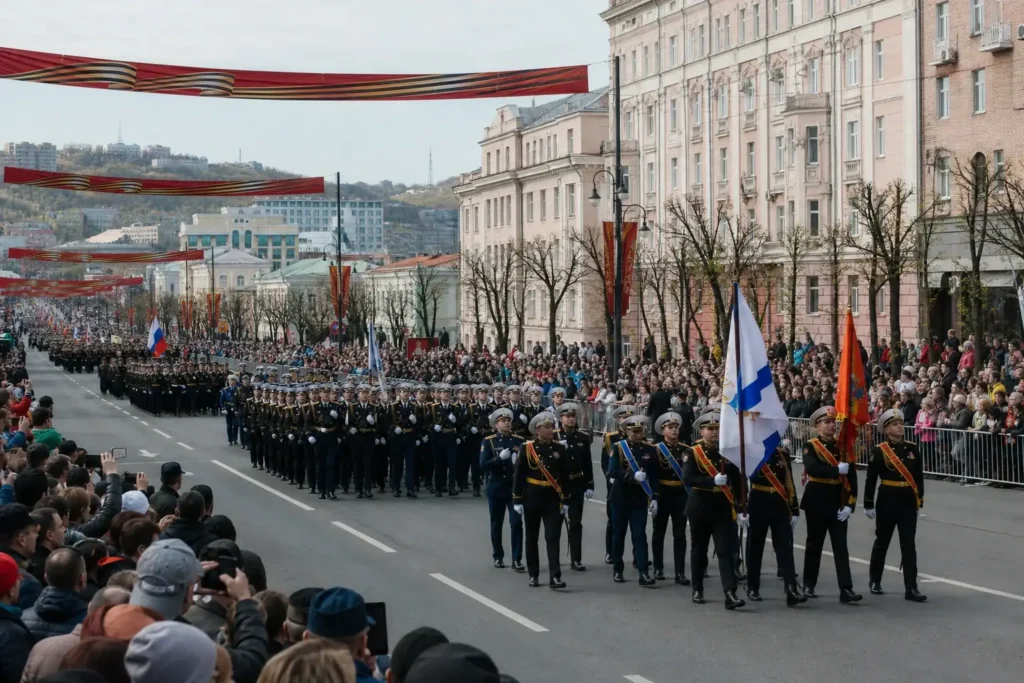
Victory Day in Vladivostok begins early in the morning with military parades featuring uniformed servicemembers, military vehicles, and historical weaponry. Civic ceremonies at war memorials and monuments draw large crowds. The most important gathering typically occurs at central city squares and public spaces dedicated to war remembrance.
Families visit graves of deceased relatives and relatives of war veterans. Wreaths and flowers are laid at monuments. Throughout the day, the public wears orange and black St. George ribbon symbols associated with the holiday. Evening celebrations may include fireworks, concerts, and cultural performances in parks and public squares. Schools and institutions hold commemorative events. The atmosphere mixes solemnity during official ceremonies with more festive celebration as the day progresses.
What It Means for Your Visit
Victory Day is a public holiday throughout Russia, meaning most government offices, banks, and some shops close. However, major attractions, restaurants, and services typically remain open, often with special programs or holiday hours.
Public transport operates on a holiday schedule, which may mean reduced frequency but continued service. Parades and official ceremonies occupy major city squares and streets early in the morning, potentially causing temporary street closures and traffic disruptions. These are typically announced in advance locally.
Crowds gather at war memorials, museums related to military history, and central public spaces throughout the day. Popular parks and gathering points become congested by mid-morning. Visitors planning outdoor activities should account for crowds and possible noise from celebrations, parades, and fireworks in the evening.
The holiday atmosphere means the city takes on a different character than normal days—more flags, official decorations, and visible military or official personnel. For visitors, this provides authentic cultural immersion but requires flexibility in planning outdoor activities and transport routes.
Atmosphere
The mood of Victory Day blends solemnity with collective pride. Morning ceremonies are dignified and reverential, with military marches and official speeches. Veterans appear in full uniform or with medals, treated with visible respect by crowds. The public gathers in significant numbers at war memorials and central squares.
As the day progresses, the tone shifts. Families gather in parks for informal celebrations and shared meals. Music plays from outdoor speakers and stages. By evening, a festive atmosphere emerges with concerts, performances, and fireworks, yet without losing the underlying current of remembrance.
In Vladivostok specifically, the vast number of participants reflects the city’s strategic military history and the presence of active military installations and personnel. The Pacific setting, combined with the scale of public participation, creates a distinctive regional character while following the national pattern.
History of Victory Day, Vladivostok
Victory Day marks May 9, 1945, when Nazi Germany signed the Instrument of Surrender in Berlin, ending World War II in Europe. The Soviet Union played a major role in the defeat of Nazi Germany on the Eastern Front during the Second World War. The conflict caused extensive military and civilian losses, with approximately 27 million Soviet citizens dying during the war.
During the Soviet era, May 9 was established as a national holiday with military parades and commemorative ceremonies. The holiday carried immense weight as the defining sacrifice of the Soviet state. After the Soviet Union collapsed in 1991, Russia maintained the tradition, transforming it into a symbol of Russian national identity and historical memory.
The war itself, known in Russia and former Soviet republics as the Great Patriotic War (1941–1945), remains the most significant historical event in Russian consciousness. It shapes attitudes toward foreign policy, national strength, and collective identity. Every Russian family typically lost relatives in the conflict.
Vladivostok, as a major military and naval hub on the Pacific, played a strategic role in the war and post-war period. The city’s Victory Day celebrations reflect this military heritage. The holiday observance connects the Far Eastern city to the broader narrative of Soviet sacrifice and Russian national pride.
Tickets and Booking for Victory Day, Vladivostok
Victory Day is a free public observance. No tickets or advance booking are required for parades and ceremonies that occur in public spaces such as squares and streets. These events are open to all.
Details about specific events, parade routes, ceremony locations, times, and special programs vary each year and are announced by city authorities and local media weeks in advance. Visitors should check local tourism websites, the city administration site, or local news sources closer to May 9 for the current year’s schedule.
Some cultural institutions may offer special exhibitions or programs related to the war theme; these may have separate admission fees announced in advance. Most official ceremonies and street events have no cost.
How to Get to Victory Day, Vladivostok
Victory Day events occur at multiple locations throughout Vladivostok, depending on the year’s program. The main gatherings and parades typically take place in central city squares and along major streets, easily accessible by public transport and on foot from central districts.
Use Vladivostok’s public transport (buses, trams, trolleybuses) to reach central gathering points. Taxis and ride-hailing services operate throughout the day, though they may be busier than usual due to crowds. Walking is practical for reaching city-center venues from nearby accommodation. Specific venue locations and metro/transport access vary each year based on the official program.
Food Nearby
Vladivostok's central districts where Victory Day events occur have numerous restaurants, cafes, and food vendors. However, hours may be affected by the holiday, and popular venues may be crowded. It is advisable to plan meals before or after peak celebration times.
Street food vendors may set up in parks and public gathering spaces during the day. Packed snacks are practical given the extended public celebrations and outdoor nature of many events.
What to Bring
Comfortable walking shoes are essential due to crowds and the distance covered moving between gathering points. A light jacket is advisable for cool morning temperatures in May. Bring water and snacks, as facilities can become crowded. A camera is practical for photography. Arrive early at ceremony locations to secure viewing positions, particularly for parades.
Photography Rules
Photography is generally permitted at public parades and outdoor ceremonies; however, respect the solemn nature of official military ceremonies. Avoid obstructing views for others or interfering with official proceedings. Individual officials or military personnel may request that you not photograph them; comply respectfully. Check with event organizers if photographing formal ceremonies or restricted areas.
Family Suitability
Victory Day is family-oriented in Russia, with children present at ceremonies and public celebrations. The atmosphere blends reverence with public festivity. Morning parades are suitable for families with older children who can understand the historical context and respect the solemn ceremonies.
Young children may find extended morning ceremonies long or overwhelming due to crowds and noise. Afternoon and evening celebrations in parks are more relaxed and child-friendly. Stroller access depends on specific venue crowds; major streets typically accommodate strollers, though navigating crowded ceremony areas may be challenging.
Russia Vibes Tips
- Arrive very early at ceremony locations—an hour or more before official parade start times—to secure good viewing positions. Crowds build rapidly and some vantage points fill completely.
- Wear or carry the orange-and-black St. George ribbon (available at shops and kiosks) to show respect for the holiday. It is a symbolic gesture that connects you to the day's significance and is worn by many participants.
- Use public transport during peak morning hours when personal vehicle traffic is restricted or diverted due to parades. Taxis may be harder to find; plan to walk from the nearest available drop-off point.
- Check the specific program and venue list a week before visiting. Locations, times, and events vary each year, and announcements often come only 1–2 weeks in advance from city authorities.
- Avoid attempting to drive through central areas during morning parade hours; streets are cordoned off and traffic is heavily restricted. Plan to park in advance in peripheral areas and walk.
Explore Nearby Victory Day, Vladivostok
Related guides
 Primorsky Monsoon Festival: Vladivostok’s Waterfront Cultural Celebration
Main image: AI-generated illustration. It may not show the place exactly as it looks.
 Peter the Great Gulf Cup: Russia’s Premier Offshore Sailing Regatta
Main image: AI-generated illustration. It may not show the place exactly as it looks.
 International King Crab Festival, Vladivostok: Fresh Crab and Harvest Celebration
Main image: AI-generated illustration. It may not show the place exactly as it looks.
 Eastern Economic Forum: Vladivostok’s International Business Summit
Main image: AI-generated illustration. It may not show the place exactly as it looks.
 Tiger Day, Vladivostok: Celebrate the Endangered Amur Tiger
Main image: AI-generated illustration. It may not show the place exactly as it looks.
Browse more: More in Vladivostok · All Events & Holidays · All Events & Holidays in Vladivostok · All Observance & Festival · All Vladivostok
FAQ: Victory Day, Vladivostok
Is Victory Day a public holiday in Russia?
Yes, May 9 is a public holiday throughout Russia, a non-working day for most government and office employees. However, many shops, restaurants, and attractions remain open with holiday hours.
What does Victory Day commemorate?
Victory Day marks May 9, 1945, when Nazi Germany surrendered to the Soviet Union and Allied forces, ending World War II in Europe. In Russia, the war is called the Great Patriotic War (1941–1945).
Do I need tickets or advance booking for Victory Day events?
No. Public parades, ceremonies, and street celebrations are free and open to all. No advance registration or tickets are required. Some museums may offer special exhibitions with separate admission.
What time do Victory Day celebrations start in Vladivostok?
Official parades and military ceremonies typically begin in early morning, around 7–9 AM. The specific start time and venue details vary each year and are announced in advance by local authorities. Check local sources closer to the date.
What is the St. George ribbon and why do people wear it on Victory Day?
The orange-and-black St. George ribbon is a symbol associated with Russia's military and Victory Day. Wearing or displaying it is a traditional way to show respect for the holiday and honor veterans. It became popular after 2005 and is now a widespread symbol of the day.
Will shops and restaurants be open on Victory Day?
Many will be open but with modified holiday hours. Government offices and banks typically close. Check ahead with specific venues, as hours vary. Central restaurants and attractions are usually operational.
Can I see military vehicles and weaponry at Victory Day celebrations?
Yes. Military parades typically feature uniformed servicemembers, tanks, armored vehicles, and historical military equipment. The scale and specific content of parades vary by year and location.
Is it appropriate for foreign visitors to attend Victory Day events?
Yes. Victory Day events are public celebrations and are open to all. Visitors are welcome to observe ceremonies and parades. Dress respectfully and show reverence during official ceremonies.
Russia Vibes is a one-person project. A coffee keeps it going
How we research and update our guides
About this guide: AI assistance and accuracy
This guide is created with the help of AI and is based on official sources where available. Mistakes can still happen. Opening hours, prices, rules and other details are given to the best of our knowledge as of the date shown and can change without notice. It offers general recommendations only, not professional, legal or travel advice. Please confirm important details with the official source before you travel; you are responsible for your own plans and decisions.

Take this guide with you
Get a free PDF of this guide to print or read offline: key facts, tips and a map link on a few clean pages.
Report an issue on this page
Paying for your trip: please read
International sanctions affect payments between Russia and many other countries. In practice, cards issued in the EU, the UK, the US and several other countries often do not work in Russia, Russian cards usually do not work abroad, and some booking platforms, airlines and payment providers limit or suspend their services for Russia. The situation changes frequently.
We do not give legal or financial advice, and this site does not encourage anyone to break or circumvent sanctions. Whatever you plan, you are responsible for following the laws and regulations that apply to you, including those of your country of residence and citizenship.
Many travelers still organise their stay lawfully. It is worth asking your bank or payment provider what is currently permitted, contacting hotels, tour operators and carriers directly about the payment methods they accept, and checking which services are open to customers from your country. Clarify payment, cancellation and refund terms before you commit to a booking, and keep your plans flexible.
Partner links on this site may not be available in every country, and prices, availability and rules in our guides can differ from what you see when you book.