
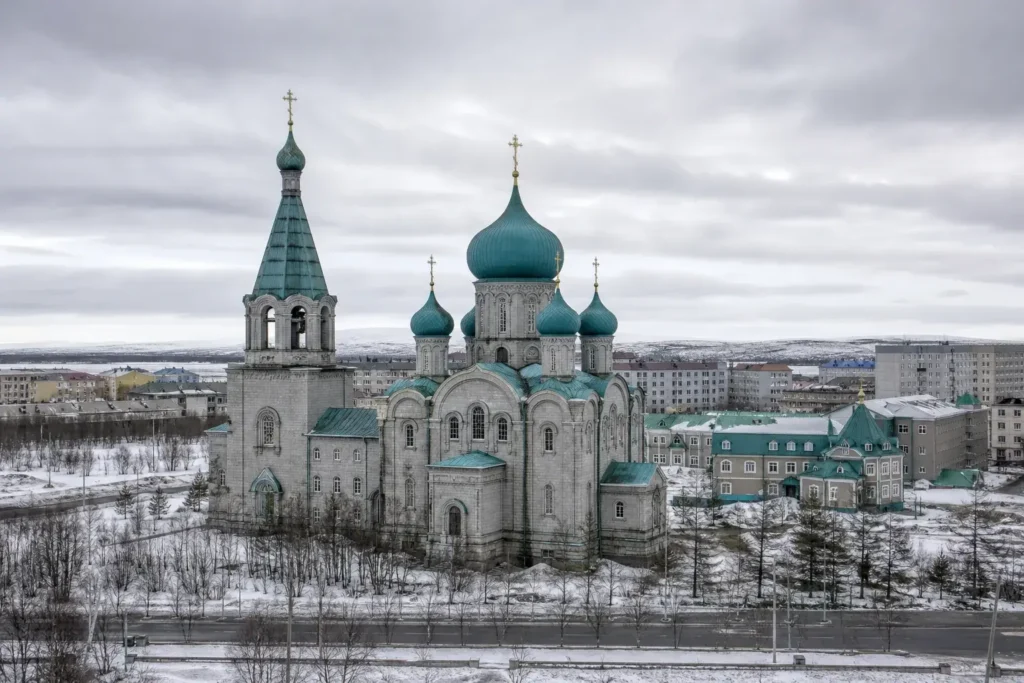
The Cathedral of St. Nicholas the Wonderworker, built in 1986, marks the beginning of the revival of Orthodoxy in Murmansk, as the first Orthodox church built after 1917. Located on Zelenaya Street in the northern reaches of the city, St. Nicholas Cathedral is the seat of the Murmansk Diocese and one of the Arctic’s most significant Orthodox monuments.
The cathedral complex includes St. Nicholas Cathedral, a temple in honor of St. Tryphon of Pechenga (the enlightener of the Kola Peninsula), the chapel of the icon of the Mother of God “Spreader of the Loaves,” and several administrative buildings. The structures have an unusual, rather austere appearance, built of gray brick and covered with green and blue roof slopes and domes.
Quick Facts
| Russian name | Свято-Никольский кафедральный собор |
|---|---|
| Built / opened | 1986 |
| Address | ул. Зелёная, 11, Мурманск, 183010 Google MapsApple MapsYandex Maps2GISOpenStreetMap |
| District | Murmansk |
| Opening hours | Daily 08:00-20:00 |
| Admission | free |
| Best time to visit | Spring (May–June) and early autumn (September) offer the mildest weather and easier access. Summer (June–July) has long daylight hours—valuable in the far north for photography. Winter (November–February) brings Arctic darkness; if visiting then, expect daylight only a few hours daily. The cathedral's green and blue domes appear particularly striking against clear Arctic skies, which occur more often in winter but require bundling warmly and navigating icy roads. |
| Recommended duration | 45 minutes to 1 hour |
| Website | murman-mu-1.cerkov.ru |
What Is (and Isn't) Part of a Visit to St. Nicholas Cathedral, Murmansk?
| Part | Status | Notes |
|---|---|---|
| St. Nicholas Cathedral (main church) | Included in the standard ticket | The principal cathedral and main focus of a visit; part of the cathedral complex. |
| Church of St. Tryphon of Pechenga | Included in the standard ticket | Companion church built 1989; part of the cathedral complex and included in the visit. |
| Chapel of the Icon of the Mother of God "Spreader of the Loaves" | Included in the standard ticket | Small chapel within the cathedral complex; accessible but modest in scale. |
| Administrative and residential buildings | Outside / not part of it | Part of the complex but not open to visitors; staff and clergy offices. |
| Worship services and private religious functions | Included in the standard ticket | The cathedral is an active place of worship; visitors should respectfully attend services if they wish. |
| Nearby monuments (e.g., Naval Monuments Museum) | Separate ticket or institution | Other Murmansk attractions are separate sites with their own access rules. |
Why Visit St. Nicholas Cathedral, Murmansk?
St. Nicholas Cathedral represents an important chapter in Arctic Orthodoxy. For a long time Murmansk had no churches; the first one was closed in 1924. This cathedral embodies the religious revival of Murmansk and the Kola Peninsula after decades without active Orthodox worship. The interior contains impressive murals and a gold-decorated sanctuary that contrast with the exterior’s austere Arctic style. Visitors can observe a living place of worship central to the spiritual life of Murmansk’s Orthodox community, making it a meaningful destination for those interested in Russian religious history and contemporary Arctic culture.
How St. Nicholas Cathedral, Murmansk Is Laid Out
The complex consists of St. Nicholas Cathedral, the Church of Tryphon of Pechenga, the Chapel of the Icon of the Mother of God “The Contestant of Breads”, several administrative buildings, and several residential buildings. This is a whole complex built between 1986 and 1989. The cathedral is the central and primary building in the complex. The Church of Tryphon of Pechenga stands nearby as a companion temple honoring the enlightener of the Kola Peninsula. Enter from Zelenaya Street on the western side of the complex. The austere brick structures are arranged in an ensemble, with the cathedral as the focal point.
Highlights of St. Nicholas Cathedral, Murmansk
Main Cathedral Hall
For the millennium of Christianity in Russia, permission was granted to renew the Svyato-Nikolskaya Church. A new stone church, built around the existing one, was consecrated in 1986. Inside, gold-painted surfaces and decorative murals fill the sanctuary. The interior murals are rendered in a traditional Orthodox style. The cathedral occupies an important administrative role as the cathedral of the Murmansk Diocese.
Tip: The interior is best viewed during the day when natural light enters through the windows. Respect the active worship space; services occur regularly.
Church of Saint Tryphon of Pechenga
The complex includes the Church of Tryphon of Pechenga, honoring St. Tryphon, the enlightener of the Kola Peninsula. A new Church of St. Trifon Pechengsky was built nearby in 1989; together they form the Svyato-Nikolskiy Cathedral. This companion church honors the Orthodox missionary who brought Christianity to the Arctic north.
Tip: Both churches share the cathedral complex; enter the courtyard to see both buildings and appreciate the ensemble design.
Chapel of the Icon of the Mother of God
The complex includes the chapel of the icon of the Mother of God "Spreader of the Loaves". This small chapel completes the spiritual complex dedicated to various Orthodox traditions and protections.
Tip: The chapel is modest in scale; you may need to ask staff where to locate it within the complex.
Exterior Arctic Style
The buildings have an unusual, rather austere and ascetic appearance, built of gray brick and covered with green and blue slopes of roofs and domes. The appearance and roughness of the silhouettes reflect the typical features of the buildings inherent in that time. The walls were built of silicate bricks. The design represents Soviet-era Orthodox architecture adapted to Arctic conditions.
Tip: The exterior is best photographed in daylight from the street approach to capture the distinctive dome colors against the northern sky.
Atmosphere
St. Nicholas Cathedral presents a quiet, spiritual atmosphere reflecting both Arctic severity and Orthodox tradition. The small church is located about 3km from the centre and you need to go on some relatively minor roads without footpaths to get there. The grounds are orderly and peaceful, with few crowds outside service times. The gray brick exterior and distinctive green-blue domes create a striking silhouette against Murmansk’s often cloudy northern skies. Inside, the gold sanctuary and traditional murals create a warm contrast to the austere surroundings. Active worship occurs regularly; visitors may hear singing or bells announcing services. The nearby residential and administrative buildings give the complex an integrated community character rather than a tourist attraction feel.
History of St. Nicholas Cathedral, Murmansk
City status was granted to the new settlement on October 4, 1916. On the same day, St. Nicholas Cathedral was consecrated in honor of Nicholas the Wonderworker, the patron saint of seafarers. Initially called Romanov-na-Murmane, the name was changed to Murmansk after the February Revolution in 1917.
For a long time Murmansk had no churches; the first one was closed in 1924. When Soviet power came to the Kola Peninsula, the temple was closed in 1924. A gym and a dormitory for seasonal workers were set up in the church premises.
The period when the city was left without a single church lasted until the end of the Great Patriotic War. After the end of the war, in 1945, the Murmansk Orthodox community sent an appeal to Bishop Leonty (Smirnov) of Arkhangelsk and Kholmogorsk with a request to send a priest to Murmansk. After World War II a small wooden house on the outskirts was converted into a church dedicated to Saint Nicholas. In 1946 it was consecrated and the first religious procession took place.
For the millennium of Christianity in Russia, permission was granted to renew the Svyato-Nikolskaya Church. A new stone church, built around the existing one, was consecrated in 1986. The temples of this complex were the first large-scale temples built in Russia since the 1917 revolution. The complex was completed between 1986 and 1989. Today, the cathedral belongs to the Murmansk diocese and is its main temple.
Legends and Myths about St. Nicholas Cathedral, Murmansk
The Frozen Port That Needed Its Saint
Legend – historically unreliable. Nicholas the Wonderworker, patron saint of seafarers and travelers, was chosen as the guardian of Russia's Arctic port. On the very day Murmansk was founded in 1916, the cathedral was consecrated in his name—as if blessing the city's existence before it fully formed. This dedication proved prophetic, for the city would face decades of hardship, war, and spiritual drought before Orthodox worship returned.
Decades of Silence and Resurrection
For nearly 50 years, from 1924 until 1946, no Orthodox church functioned in Murmansk—a total absence of religious life across the founding of the Soviet state and the devastation of World War II. When post-war worshippers finally converted a simple wooden house into a sanctuary, it marked not merely the opening of a church but the resurrection of an entire spiritual community thought lost.
Tickets and Booking for St. Nicholas Cathedral, Murmansk
St. Nicholas Cathedral is free to enter. There is no ticket office or advance booking required. The cathedral is an active Orthodox church, not a museum, so access follows worship schedules rather than set visitor hours. Dress respectfully: women should wear headscarves or head coverings, and modest clothing is appropriate for both men and women. If you wish to participate in or observe a liturgical service, check with local sources or the cathedral directly for service times, which typically follow the Orthodox calendar.
Plan and Book
Suggested itineraries St. Nicholas Cathedral, Murmansk
45 minutes
Arrive by taxi or local transport on Zelenaya Street. Enter the complex and spend 15 minutes viewing the exterior of all three main buildings to appreciate the Arctic architectural style. Spend 20–25 minutes inside the main cathedral observing the interior murals, iconostasis, and sanctuary decoration. Exit through the courtyard to photograph the distinctive domes. No guides are necessary for this brief visit.
1–1.5 hours
Begin with the exterior walk-through to understand the complex layout and architecture. Enter the main cathedral and spend 20–30 minutes exploring the interior carefully, reading any available information. Visit the Church of St. Tryphon of Pechenga (10–15 minutes). If accessible, visit the Chapel of the Icon of the Mother of God (5–10 minutes). Conclude with photography or reflection in the courtyard (10 minutes).
Half day (2–3 hours)
Combine the cathedral complex visit with nearby Murmansk attractions. Spend 1.5 hours at St. Nicholas Cathedral following the 1–1.5 hour itinerary. Then visit nearby sites such as the Sailor's Monument or other northern Murmansk landmarks within walking distance or a short taxi ride. Eat lunch at a café or restaurant in the central Murmansk area before or after. This creates a more complete Arctic culture experience.
How to Get to St. Nicholas Cathedral, Murmansk
St. Nicholas Cathedral is located at Zelenaya Street, 11, about 3 km north of central Murmansk. By taxi or ride-share: Ask for “Svyato-Nikolsky katedralny sobor na Zelenoy ulitse” (St. Nicholas Cathedral on Zelenaya Street). The address is well known to local drivers. Travel time from central Murmansk is 10–15 minutes depending on traffic.
By public transport: Murmansk has local buses and minibuses (marshrutkas). Take any northbound bus or marshrutka toward the Zelenaya Street area; ask the driver to let you know when to exit. The final walk may be on minor roads without sidewalks, especially in winter.
On foot from central Murmansk: The walk is approximately 45 minutes to 1 hour from downtown, primarily on main roads. Winter conditions (snow, ice, darkness) make this challenging and not recommended for most visitors.
Accessibility
Specific information about wheelchair access and accessible facilities is not published on the official sources. The cathedral is located 3 km from central Murmansk with access by taxi recommended. The courtyard and approach are relatively flat, but the final approach on Zelenaya Street may have uneven surfaces. Visitors with mobility concerns should arrive by taxi directly to the site. Inside the cathedral, steps may exist; contact the cathedral directly (phone +7 815 225-08-16 or +7 908 607-92-98) to confirm accessibility details before visiting.
Food Nearby
The cathedral is located in a residential area away from central Murmansk's main restaurants and cafés. Small local shops and occasional kiosks may exist nearby, but most dining options require returning to central Murmansk or traveling by taxi. Plan to eat before or after visiting the cathedral complex. The journey by taxi takes only 10–15 minutes back to downtown Murmansk, where restaurants, cafés, and supermarkets are plentiful.
What to Bring
Bring comfortable walking shoes (winter boots if visiting in cold months). Daylight is limited in autumn, winter, and early spring; visit during midday if possible. Women should bring a headscarf or head covering to wear inside the cathedral as a sign of respect. A camera is useful for photographing the distinctive domes and architecture. Winter visitors need warm coat, gloves, hat, and weatherproof outerwear; the walk from parking to the entrance can be exposed and cold. A small notepad helps record observations about the historical details.
Best Views and Photo Spots of St. Nicholas Cathedral, Murmansk
Cathedral entrance courtyard
View of all three main buildings (cathedral, Church of St. Tryphon, chapel) arranged in an ensemble. The gray brick walls and distinctive green and blue domes create a striking composition against the sky.
Best time: Midday for even lighting; overcast Arctic days still provide good diffuse light for architectural photography.
Zelenaya Street approach
Frontal view of the main cathedral's domes framed by surrounding buildings. The iconic gold cross atop the dome is clearly visible from this angle.
Best time: Early morning or late afternoon when side-lighting emphasizes the dome shapes and colors.
From the northern edge of the complex
Broader perspective showing all cathedral buildings and the surrounding residential area, placing the shrine in its Arctic urban context.
Best time: Clear days (infrequent in northern regions) when the sky provides color contrast; winter scenes with snow add visual interest.
Photography Rules
Exterior photography is permitted and encouraged; the distinctive green and blue domes are photogenic. Interior photography may be restricted during active services. Flash photography is not permitted inside. Tripods and drones are not permitted on the cathedral grounds. Ask staff before photographing inside if services are not in progress. The best light for exterior shots is midday during clear weather.
Family Suitability
St. Nicholas Cathedral is suitable for families with children old enough to observe and respect an active worship space (approximately ages 8 and older). The visit is short (under 1 hour), indoor, and protected from Arctic weather. Young children may find the quiet interior and strict behavior expectations challenging. The exterior can be explored safely; the courtyard is traffic-free. Stroller access to the interior may be difficult due to potential steps and narrow spaces. Parents should prepare children to wear respectful clothing (no shorts or tank tops) and explain the Orthodox religious context. The removal of shoes or the need for head coverings can be explained as cultural respect. Overall, it is a manageable cultural experience for families but not specifically designed as a child-friendly attraction.
Russia Vibes Tips
- Arrive mid-morning or early afternoon to maximize available daylight, especially in autumn and winter when Arctic darkness arrives by 3–4 pm. Plan accordingly and do not arrive near sunset unless visiting in midsummer.
- Call ahead to confirm service times and visitor access. The cathedral is a functioning Orthodox church, not a tourist museum, so worship schedules and special ceremonies may occasionally restrict general access.
- Wear a head covering (women) and modest clothing before entering. Many Orthodox churches in Russia require headscarves for women; bringing or purchasing one prevents embarrassment or denial of entry.
- Do not expect extensive signage, guided tours, or printed materials in English. The cathedral is primarily a worshipping community space. Come for the spiritual and architectural experience, not curated tourism.
- Budget for a taxi both ways (approximately 30–60 minutes round-trip travel time including wait). The cathedral's location 3 km from the city center makes independent travel by public transit challenging for first-time visitors unfamiliar with Murmansk.
Explore Nearby St. Nicholas Cathedral, Murmansk
Related guides
 Murmansk Regional Drama Theater: Arctic Culture on Lenin Avenue
Main image: AI-generated illustration. It may not show the place exactly as it looks.
 Bridge Across Kola Bay: Arctic Engineering and Gateway Views
Main image: AI-generated illustration. It may not show the place exactly as it looks.
 Kola Bay: The Ice-Free Arctic Fjord Sheltering Murmansk
Main image: AI-generated illustration. It may not show the place exactly as it looks.
 Church of the Savior on Waters: Arctic Shrine and Sailors’ Memorial
Main image: AI-generated illustration. It may not show the place exactly as it looks.
 Murmansk Regional Museum of Local Lore: Arctic History and Indigenous Culture
Main image: AI-generated illustration. It may not show the place exactly as it looks.
Browse more: More in Murmansk · All Churches · All Murmansk · All Sightseeing · All Sightseeing in Murmansk
FAQ: St. Nicholas Cathedral, Murmansk
Is entry free?
Yes, entry is completely free. St. Nicholas Cathedral is an active Orthodox church, not a paid museum. Donations are welcome but entirely voluntary.
What are the opening hours?
The cathedral follows Orthodox liturgical schedules rather than fixed visitor hours. Services occur regularly, typically including morning and evening worship on major days. Contact the cathedral directly (+7 815 225-08-16) to confirm specific service times and visitor access windows.
Is the cathedral part of a larger religious complex?
Yes. The St. Nicholas Cathedral complex includes the Church of St. Tryphon of Pechenga (built 1989) and the Chapel of the Icon of the Mother of God "Spreader of the Loaves," plus administrative buildings. All are part of one integrated spiritual center; entry to the complex is free.
Is a guide necessary?
No. The cathedral is compact and can be self-visited in under 1 hour. English-language guides are not readily available. If you want historical context, read about the cathedral before visiting or speak with staff if they are available.
What should I wear?
Dress modestly: no shorts, sleeveless shirts, or revealing clothing. Women should bring or wear a headscarf or head covering inside the cathedral as a sign of respect in Orthodox tradition. Men should remove hats indoors.
Can I take photographs?
Exterior photography is permitted and encouraged. Interior photography is usually allowed outside of active services, but ask staff first. Flash, tripods, and drones are not permitted.
How do I get there from central Murmansk?
The cathedral is 3 km north on Zelenaya Street. A taxi ride from downtown takes 10–15 minutes. Public bus or marshrutka (minibus) access is possible but less convenient for unfamiliar visitors. Walking from the center takes approximately 45 minutes.
Is this the original cathedral founded in 1916?
No. The original cathedral was never fully built; a temporary wooden church was consecrated in 1916. It was closed in 1924 during the Soviet era. The current stone cathedral was built in 1986, around the remains of the wartime wooden church (1946), making this the modern incarnation of Murmansk's Orthodox revival.
Russia Vibes is a one-person project. A coffee keeps it going
How we research and update our guides
About this guide: AI assistance and accuracy
This guide is created with the help of AI and is based on official sources where available. Mistakes can still happen. Opening hours, prices, rules and other details are given to the best of our knowledge as of the date shown and can change without notice. It offers general recommendations only, not professional, legal or travel advice. Please confirm important details with the official source before you travel; you are responsible for your own plans and decisions.

Take this guide with you
Get a free PDF of this guide to print or read offline: key facts, tips and a map link on a few clean pages.
Report an issue on this page
Paying for your trip: please read
International sanctions affect payments between Russia and many other countries. In practice, cards issued in the EU, the UK, the US and several other countries often do not work in Russia, Russian cards usually do not work abroad, and some booking platforms, airlines and payment providers limit or suspend their services for Russia. The situation changes frequently.
We do not give legal or financial advice, and this site does not encourage anyone to break or circumvent sanctions. Whatever you plan, you are responsible for following the laws and regulations that apply to you, including those of your country of residence and citizenship.
Many travelers still organise their stay lawfully. It is worth asking your bank or payment provider what is currently permitted, contacting hotels, tour operators and carriers directly about the payment methods they accept, and checking which services are open to customers from your country. Clarify payment, cancellation and refund terms before you commit to a booking, and keep your plans flexible.
Partner links on this site may not be available in every country, and prices, availability and rules in our guides can differ from what you see when you book.