
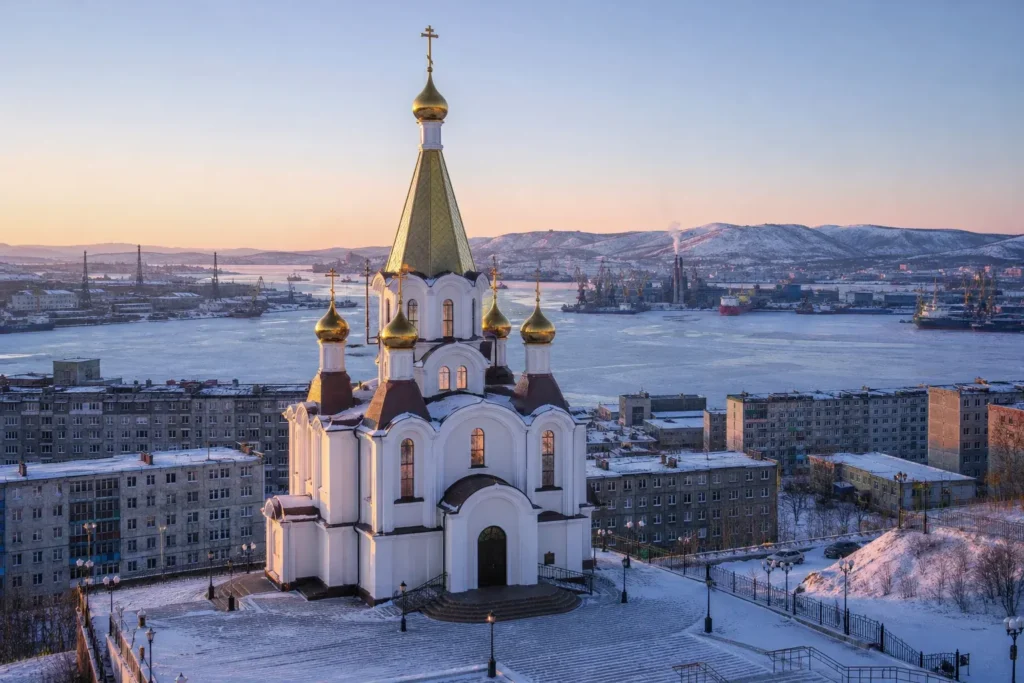
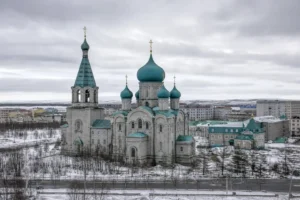
The Church of the Savior on Waters is a classic single-apse church built in the style of old Russian churches. Built in 2002 from private donations, its white form is visible from many points in the city and, from the front door, there is a wonderful view of the port and the city below.
It is part of the memorial complex in memory of sailors who died in peacetime. The church got its name from the icon of Christ walking on the waters. The church is small and intimate, with an attached bell tower overlooking the harbor.
Quick Facts
| Russian name | Храм Спаса на Водах |
|---|---|
| Built / opened | 2002 |
| Address | Проспект Героев-Североморцев, 1, Мурманск OpenStreetMap · Google Maps |
| District | Murmansk |
| Opening hours | Mon-Sun 08:00-20:00 |
| Admission | free |
| Best time to visit | The church is open year-round. Daylight conditions vary dramatically by season. In summer (June–August), near-continuous daylight allows viewing at almost any hour, though the Arctic sun creates long shadow angles that can complicate photography. In winter (December–February), darkness falls by mid-afternoon, so visit in late morning or early afternoon for any natural light.Clear weather brings out the contrast between the white church and dark surroundings. Spring (April–May) and autumn (September–October) offer moderate conditions and more manageable travel. Visit on weekdays for fewer visitors; weekends and Orthodox holidays draw local worshippers. |
| Recommended duration | 1–2 hours |
| Website | spasnavodah.su |
What Is (and Isn't) Part of a Visit to Church of the Savior on Waters, Murmansk?
| Part | Status | Notes |
|---|---|---|
| Church interior and icons | Included in the standard ticket | Free entry to the church during opening hours; visitors may light candles. |
| Memorial complex outside | Included in the standard ticket | Free access to the worship cross and memorial plaques on the grounds surrounding the church. |
| Bell tower | Not open to visitors | The bell tower is architectural; not open to visitors for climbing or entry. |
| Sailors' Memorial Lighthouse | Separate ticket or institution | Located nearby below the church; a separate site operated as part of the broader memorial complex. |
| Alyosha Monument (Defenders of the Soviet Arctic) | Outside / not part of it | Often confused with this church; located on a separate hill at least 20 minutes' walk away. |
Why Visit Church of the Savior on Waters, Murmansk?
This intimate Orthodox shrine honors those lost at sea and offers quiet contemplation in a striking hilltop setting. The onion domes are covered in gold leaf and the outside is painted white so this church stands out from the grey buildings surrounding it. The church has many icons that fishermen, sailors and their loved ones can pray to. For example, Christ walking on the waters, the apostles in a boat, St. Tryphon of Pechenga and Varlaam of Keretsk – the protector of the Kola North and sailors, the faces of St. Andrew the First-Called and the righteous admiral Feodor Ushakov.
Highlights of Church of the Savior on Waters, Murmansk
Golden Domes and White Exterior
The onion domes are covered in gold leaf and the outside is painted white, making the church instantly recognizable from many points across Murmansk. Built on a slope above Kola Bay, the bright structure stands in striking contrast to the surrounding Soviet-era gray apartment blocks. The positioning high on the hill gives it prominence in the Arctic landscape.
Tip: Arrive in daylight to fully appreciate how the gilded domes catch the light and stand out against the gray cityscape.
Iconostasis and Interior Icons
The entrance is simple but the inside has a beautiful iconostasis and the walls all round are covered in icons. Icons include Christ walking on the waters, the apostles in a boat, St. Tryphon of Pechenga and Varlaam of Keretsk, St. Andrew the First-Called and the righteous admiral Feodor Ushakov. The icons represent sailors, saints of the North, and defenders of Arctic seas.
Tip: Photography is not permitted inside; take time to study the icons carefully rather than trying to capture them.
Memorial Complex for Lost Sailors
It is part of the memorial complex in memory of sailors who died in peacetime. A worship cross and memorial plaque stand near the church, marking the site as a place of remembrance. The memorial honors those lost in Arctic waters and maritime disasters.
Tip: Visit the memorial area outside the church to read the plaques and understand the historic context of this sacred site.
Views Over Kola Bay and Harbor
From the church platform, you look directly down onto Murmansk's port and harbor. The church is situated on the picturesque banks of the Kola Bay, offering stunning views of the surrounding area. The vista encompasses the working port, the city sprawl, and the bay beyond, framing Murmansk's identity as an Arctic port city.
Tip: Come on a clear day for the best views; Arctic weather can obscure distant vistas. Morning or early evening light is most photogenic.
Sign Language Services
A distinctive feature of the house of God is the services with sign language translation for the deaf. There is also a Sunday school at the church. The parish actively serves the broader Murmansk community, not just hearing worshippers.
Tip: If you're interested in accessing services, contact the church ahead; Sunday services are a good time to observe local spiritual life.
Nearby Sailors' Memorial Lighthouse
Just below the church site stands a distinctive lighthouse-shaped memorial dedicated to those lost at sea. This 35-meter structure is Murmansk's most recognizable memorial and complements the church above it. Together, they form a coherent sacred and commemorative landscape.
Tip: Allow time to explore the memorial monument; many visitors combine the two sites in a single visit.
Atmosphere
The walls are covered with icons of saints and incense is burned. Some elderly women are lighting candles and immersed into deep prayers and almost seeking physical contact to the icons and other objects. The interior is serene and contemplative, filled with the smell of burning candles and the soft glow of votive lights before the icons. The space feels intimate despite its religious formality.
Visitors speak quietly; the acoustics amplify even whispered voices. The white walls and abundant icons create a luminous, almost ethereal quality. During visiting hours, a handful of worshippers and tourists typically share the space. The church feels genuinely active—not a museum—with local believers coming to pray, light candles, and leave offerings.
History of Church of the Savior on Waters, Murmansk
Spas-na-Vodakh was consecrated before City Day, on October 3, 2002. Construction took place on a hillside above Kola Bay, positioned to overlook the port and harbor. Built from private donations, its white form is visible from many points in the city.
It became the third stone church in Murmansk after the St. Nicholas and Vladimir churches. The timing of construction—just over 80 years after Murmansk’s founding in 1916—reflected a post-Soviet revival of Orthodox faith in the Arctic region. The construction of the temple on the hill was timed to coincide with the 85th anniversary of Murmansk.
The Church of the Savior on the Waters is a classic single-apse church built in the style of old Russian churches. A bell tower was built nearby. The architectural choice to echo pre-Soviet Russian church design expressed cultural restoration rather than modernist aesthetics. Built in classical ancient Russian style, it very much resembles the Church of the Intercession on the Nerl.
The location within a memorial complex for sailors lost in peacetime gave the church immediate spiritual significance. Rather than serving as a parish church for a neighborhood, it was conceived as a shrine—a place of remembrance and prayer for Arctic maritime losses. This distinguished it from conventional parish churches and connected it to Murmansk’s core identity as a port and naval city.
Tickets and Booking for Church of the Savior on Waters, Murmansk
The Church of the Savior on Waters is free to enter during advertised hours. Opening hours are Monday through Sunday, 8:00 AM to 8:00 PM. No advance booking is required for general visits.
Visitors may light candles as an offering (small donations expected). Photography is not permitted inside the church. Respectful dress is expected; women often cover their heads with scarves inside Orthodox churches, though this is not strictly enforced for visitors.
For special services, memorial prayers, or group visits, contact the parish office directly at +7 (8152) 43-87-83 or visit the official website at spasnavodah.su. Services include sign language translation for the deaf.
Plan and Book
Suggested itineraries Church of the Savior on Waters, Murmansk
1 hour
Enter the church, spend 15–20 minutes viewing the icons and lighting a candle if desired. Step outside to the memorial area and read the plaques. Walk around the church platform to take in the views over Kola Bay and the harbor from different angles. Exit via the main entrance.
2 hours
Combine the Church of the Savior on Waters with the Sailors' Memorial Lighthouse below. Start at the church for 45 minutes, then descend to explore the lighthouse memorial structure and read its inscriptions (45 minutes). Return to the church area for final views and reflection (30 minutes).
How to Get to Church of the Savior on Waters, Murmansk
By taxi or car: The church is located on Geroev Severomortsev Avenue (Героев-Североморцев), several kilometers north of central Murmansk. Most visitors take a taxi from the city center; the journey takes 10–15 minutes depending on traffic.
By bus: Local bus routes serve the northern districts. Ask hotel staff or locals for the nearest stop; service can be infrequent in winter.
Walking: If you are at the nearby Sailors’ Memorial Lighthouse or in the surrounding residential neighborhoods, the church is walkable but involves climbing a steep hill. From the lighthouse memorial, allow 10–15 minutes uphill to reach the church.
From city center: The walk from central Murmansk is 3–4 kilometers; in Arctic cold and darkness (winter months), taxi or bus is strongly recommended rather than walking.
Accessibility
The church sits on a hillside with stepped access up a slope. There is no wheelchair ramp at the main entrance; visitors with mobility limitations will find the climb difficult or impossible. The interior is small and narrow, making wheelchair navigation impractical.Stairs lead up from the parking area to the church entrance. Once inside, the space is compact, and standing room is limited when services are held or candles are being lit. No accessible restrooms are available on site.Visitors with limited mobility should contact the church office in advance at +7 (8152) 43-87-83 to discuss individual needs and possible assistance.
Food Nearby
The church is located in a residential and administrative district of Murmansk, several kilometers from the city center where restaurants concentrate. No cafés or food vendors operate immediately adjacent to the church.The nearest dining options are scattered in the surrounding neighborhoods and require a short drive or bus journey back toward the center. Plan to eat before or after visiting the church rather than expecting food services on site. Bring water or a light snack if you plan to spend extended time at the memorial complex.
What to Bring
Bring warm, layered clothing year-round; Arctic winds are strong even in relatively mild seasons. In winter (October–April), waterproof insulated coat, hat, gloves, and boots are essential. The open hilltop location offers no shelter from wind and weather.A scarf or headscarf is customary (though not obligatory) for women entering Orthodox churches; a simple lightweight scarf tucked into a jacket works. Bring a flashlight or headlamp if visiting in late autumn through early spring, as daylight is limited and the path can be dark.No bags are restricted, but be respectful of the sacred space. Candles are usually available inside; small donations are expected if lighting one.
Best Views and Photo Spots of Church of the Savior on Waters, Murmansk
Church platform overlooking Kola Bay
From the main entrance or the platform beside the church, the full harbor and port of Murmansk spreads out below. The white church with golden domes dominates the foreground, while gray Soviet apartment blocks and the industrial port fill the middle distance. The bay and distant landscape extend beyond.
Best time: Late morning or early afternoon in spring and autumn for soft, clear light. Summer's near-continuous daylight is too bright; winter darkness comes by 3 PM, leaving only a narrow window at midday.
Domes from the southeast side of the church
Walking around to the side and rear of the church reveals the golden domes in profile against the gray Arctic sky. This angle emphasizes the contrast between the bright domes and the darker landscape.
Best time: Clear-sky days; overcast conditions flatten the image. Afternoon light from the west brings out the dome detail.
Church and memorial complex together
Stepping back from the immediate church area allows you to frame both the white church structure and the memorial plaques and cross on the lower terrace in a single shot, capturing the sacred and commemorative dimensions.
Best time: Any clear weather; the spatial relationship between the structures is clearest in open daylight without shadows.
Church against the Arctic sky
Shooting the church from ground level against a clear blue Arctic sky emphasizes the stark whiteness of the walls and the gleam of the golden domes. Rare clear days produce vivid color contrast.
Best time: June–August when skies are clearer; noon to mid-afternoon sun position is highest and clearest.
Photography Rules
Photography is not permitted inside the church interior. Exterior photography of the building, grounds, and memorial complex is welcome. No drone flight restrictions are explicitly published, but drones should not be flown near active worship spaces or over the memorial. Tripods are not restricted for exterior shots but should not obstruct pathways or worshippers entering the church.
Family Suitability
The Church of the Savior on Waters is suitable for older children and adults interested in Orthodox architecture and history. The interior is small, quiet, and reverent; young children (under age 7–8) may find it restrictive and may struggle with the climbing entrance on the hillside.The exterior memorial area is accessible and open, allowing children to move more freely. The views from the platform can captivate family members interested in the port and landscape. In winter, Arctic cold and darkness make the journey challenging for very young children.Strollers are not practical due to stairs and narrow pathways. Best suited to families with school-age children who can walk the hill and respect a place of worship.
Russia Vibes Tips
- Dress warmly and allow extra time for the steep, sometimes icy climb to the entrance, especially in winter months. The hillside is exposed and windy; wind chill can be severe.
- Combine this visit with the Sailors' Memorial Lighthouse below it; they form a coherent memorial landscape and are easily accessible together. The lighthouse offers a different perspective and complements the church experience.
- Do not confuse this church with the Alyosha Monument (Defenders of the Soviet Arctic statue) on another hilltop. They are different sites at least 20 minutes' walk apart; locals can direct you if needed.
- If you want to attend a service (weekends are typical for Orthodox communities), call ahead to confirm times; services may vary seasonally or for major feasts, and sign language interpretation is available if needed.
- Visit on a clear day if possible; fog and overcast weather are common in Murmansk, and the views and photography are far superior in daylight and good visibility.
- Arrive in late morning through early afternoon to maximize daylight; in winter, useful light disappears quickly after 2 PM.
Explore Nearby Church of the Savior on Waters, Murmansk
Related guides
 Murmansk Regional Drama Theater: Arctic Culture on Lenin Avenue
Main image: AI-generated illustration. It may not show the place exactly as it looks.
 Bridge Across Kola Bay: Arctic Engineering and Gateway Views
Main image: AI-generated illustration. It may not show the place exactly as it looks.
 Kola Bay: The Ice-Free Arctic Fjord Sheltering Murmansk
Main image: AI-generated illustration. It may not show the place exactly as it looks.
 St. Nicholas Cathedral, Murmansk: Arctic Orthodox Shrine and Religious Revival
Main image: AI-generated illustration. It may not show the place exactly as it looks.
 Murmansk Regional Museum of Local Lore: Arctic History and Indigenous Culture
Main image: AI-generated illustration. It may not show the place exactly as it looks.
Browse more: More in Murmansk · All Churches · All Murmansk · All Sightseeing · All Sightseeing in Murmansk
FAQ: Church of the Savior on Waters, Murmansk
Is the church really free to enter?
Yes, entry is completely free. You may light candles as a devotional act (small donations are customary but not required). No ticket is needed to enter during opening hours.
Can I take photos inside the church?
No, photography is not permitted inside the church interior. You are welcome to photograph the exterior, the church platform, and the memorial complex outside. This is a standard rule in active Orthodox churches out of respect for worshippers and the sacred space.
How far is it from the city center of Murmansk?
The church is located several kilometers north of central Murmansk on Geroev Severomortsev Avenue. By taxi, the journey is 10–15 minutes depending on traffic. Walking from the center is possible but takes 30–45 minutes and is not recommended in winter.
What is the connection to sailors and the sea?
The church is part of a memorial complex honoring sailors and those lost at sea in peacetime. Murmansk is an Arctic port city, and the church's icons include many sailor-saints and maritime protectors. The location overlooking the harbor emphasizes this connection.
Is this church different from the Alyosha Monument?
Yes, completely different sites. Alyosha is a 35-meter statue of a Red Army soldier on another hilltop. The Church of the Savior on Waters is a small Orthodox church. They are separate monuments located at least 20 minutes' walk apart; do not confuse them.
What should I wear inside the church?
Respectful, modest clothing is expected. Women often cover their heads with a scarf inside Orthodox churches (though this is not strictly enforced for visitors). Remove hats indoors. No specific dress code is enforced for visitors, but dressing respectfully shows courtesy to worshippers.
Are there services open to visitors?
Yes, the church holds regular services, particularly on weekends and Orthodox feast days. Sign language interpretation is provided. If you wish to attend, contact the church office at +7 (8152) 43-87-83 to confirm times and ask any questions.
How long should I plan to spend here?
Plan 1–2 hours. Spend 20–30 minutes inside viewing the icons, 15–20 minutes on the memorial and platform, and the remainder on views and reflection. If you combine it with the nearby Sailors' Memorial Lighthouse, allow 2–3 hours total.
Russia Vibes is a one-person project. A coffee keeps it going
How we research and update our guides
About this guide: AI assistance and accuracy
This guide is created with the help of AI and is based on official sources where available. Mistakes can still happen. Opening hours, prices, rules and other details are given to the best of our knowledge as of the date shown and can change without notice. It offers general recommendations only, not professional, legal or travel advice. Please confirm important details with the official source before you travel; you are responsible for your own plans and decisions.

Take this guide with you
Get a free PDF of this guide to print or read offline: key facts, tips and a map link on a few clean pages.
Report an issue on this page
Paying for your trip: please read
International sanctions affect payments between Russia and many other countries. In practice, cards issued in the EU, the UK, the US and several other countries often do not work in Russia, Russian cards usually do not work abroad, and some booking platforms, airlines and payment providers limit or suspend their services for Russia. The situation changes frequently.
We do not give legal or financial advice, and this site does not encourage anyone to break or circumvent sanctions. Whatever you plan, you are responsible for following the laws and regulations that apply to you, including those of your country of residence and citizenship.
Many travelers still organise their stay lawfully. It is worth asking your bank or payment provider what is currently permitted, contacting hotels, tour operators and carriers directly about the payment methods they accept, and checking which services are open to customers from your country. Clarify payment, cancellation and refund terms before you commit to a booking, and keep your plans flexible.
Partner links on this site may not be available in every country, and prices, availability and rules in our guides can differ from what you see when you book.