
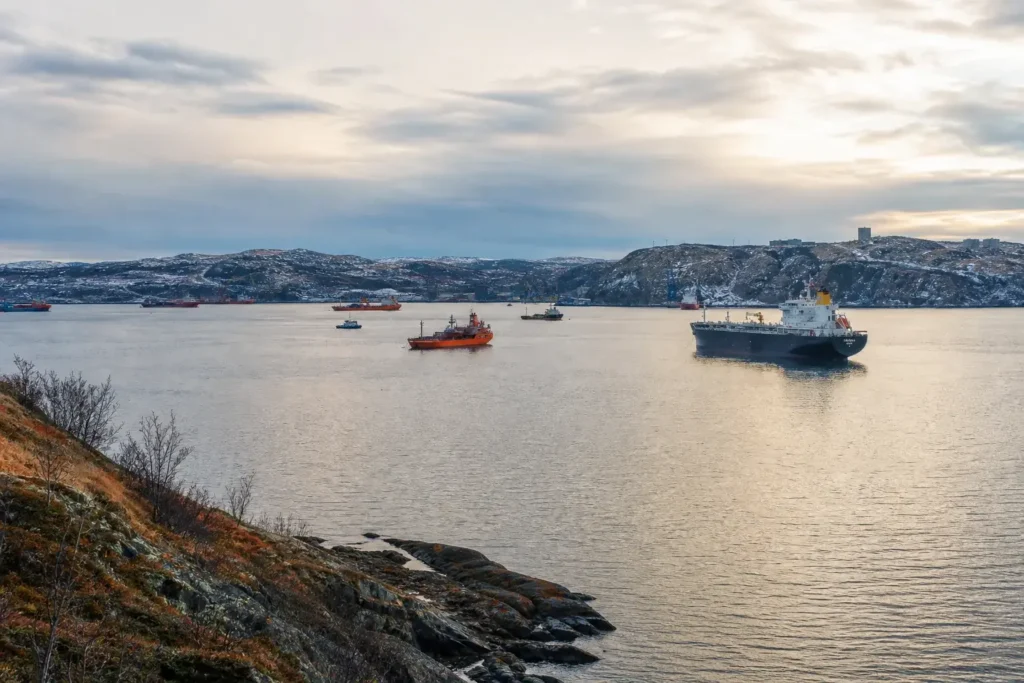
Kola Bay, also known as Murmansk Fjord, is a 57-kilometre-long inlet that penetrates from the Barents Sea into the Kola Peninsula in northwestern Russia. The fjord is relatively narrow, widening from about 4 kilometres at its mouth to around 7 kilometres across at its widest, with a depth of 200 to 300 metres. Murmansk, the world’s largest city north of the Arctic Circle, sits on the eastern shore halfway along the bay’s length.
The bay’s existence as an ice-free harbour despite its Arctic location determines Murmansk’s entire purpose as a port city. Warmed by the North Atlantic Drift (the continuation of the Gulf Stream), the waters remain navigable year-round, making it Russia’s principal Arctic port and naval base.
Quick Facts
| Russian name | Кольский залив |
|---|---|
| Address | OpenStreetMap · Google Maps |
| District | Murmansk |
| Admission | free |
| Best time to visit | Summer (June to August) offers the longest daylight and the most accessible views of the bay. The low Arctic sun creates dramatic shadows on rocky shores. However, weather remains unpredictable and often cloudy.Winter (December to February) brings deep darkness (only a few hours of twilight around midday) but also the possibility of northern lights reflecting on the ice-free bay waters, creating spectacular views. Clear winter nights are rare but memorable. Winter temperatures drop to -20°C or lower, so appropriate clothing is essential.Spring and autumn are brief transitional seasons with variable conditions. Spring is particularly wet and muddy.Midweek visits are generally quieter than weekends. The bay is active with military and port traffic daily, so there is always visual interest. |
| Recommended duration | 2–3 hours |
What Is (and Isn't) Part of a Visit to Kola Bay, Murmansk?
| Part | Status | Notes |
|---|---|---|
| Kola Bay itself (the fjord and waters) | Included in the standard ticket | Publicly visible from embankments and hillsides; not a ticketed venue. Water access restricted except through organized tours and boat operators. |
| Alyosha monument and viewing areas north of Murmansk | Separate ticket or institution | Separate admission charged. Located on a hill overlooking the bay, a 10–15 minute drive north of the city centre; accessible by public transport. |
| Waiting Woman (Zhdyushchaya) statue | Separate ticket or institution | Separate landmark with viewing areas near the bay; located in the Oktyabrsky district. Free access to the viewpoint itself; small museum may charge admission. |
| Port of Murmansk facilities and shipyards | Not open to visitors | Active port and military area; civilian access prohibited except on authorized guided maritime tours. |
| Severomorsk (closed military city) | Outside / not part of it | Located on the northern eastern shore of the bay but is a closed military city; civilian tourists cannot enter without special permits. |
| Central Embankment of Murmansk | Included in the standard ticket | Walk along the central waterfront to see the bay, port activity, and ships. Public access, free. |
Why Visit Kola Bay, Murmansk?
Kola Bay offers a remarkable Arctic landscape and a window into how geography shaped human settlement at the edge of the habitable world. The steep, rocky western shore contrasts sharply with the flatter eastern coastline. From hillsides overlooking the bay—particularly from the Alyosha monument and the Waiting Woman statue north of the city centre—you can see the full scale of the fjord stretching toward the Barents Sea, often with naval and commercial ships anchored within.
The bay itself is not a conventional sightseeing destination with facilities; visitors experience it mainly as a backdrop to Murmansk and as context for understanding why this city exists so far north. Ice fishing, northern lights viewing, and maritime history are the main activities centred around the bay.
Highlights of Kola Bay, Murmansk
The Fjord Landscape
At 57 kilometres long and up to 300 metres deep, Kola Bay is a geological formation carved by ancient glaciers. Its narrow entrance (about 4 kilometres wide) widens into a deep fjord with rocky northern and western shores rising steeply, while the southern reaches flatten near Murmansk. The bay's distinctive shape resembles a Japanese map. Walking or driving around the city's northern edges reveals the full scale of this natural feature.
Tip: View the bay from the hills north of Murmansk for the best perspective of its entire length; the Alyosha monument offers views but charge modest admission.
Ice-Free Arctic Harbour
Unlike most Arctic waters, Kola Bay remains unfrozen year-round due to the warm North Atlantic Current flowing northeastward from the Gulf Stream. This phenomenon, caused by the Coriolis effect and ocean circulation patterns, makes Murmansk's natural harbour unique among Arctic ports. The bay's ice-free status enabled Murmansk to become Russia's largest Arctic seaport when it was founded in 1916 and remains critical to Russian Arctic operations.
Tip: Winter is when the bay's ice-free character is most visibly remarkable; even when surrounding areas freeze, the bay remains open water.
The Northern Shore
The northern and western shores are steep and heavily rocky, quite different from the flatter eastern side where Murmansk stands. These rocky cliffs and hillsides, typically barren or sparsely vegetated, frame the fjord dramatically. The southern parts of the bay are indented by smaller bays and dotted with islands. The Kola and Tuloma rivers flow into the southern reaches of the bay.
Tip: The contrasts between shore types are most visible from water, but hillside walks north of Murmansk offer terrestrial views of the rocky coastline across the bay.
World War II Arctic Convoys
During World War II, Kola Bay served as the destination for the Arctic convoys, the dangerous supply runs from Britain and North America to the Soviet Union carrying weapons, supplies, and fuel. The bay provided relative shelter and an ice-free anchorage for these slow-moving merchant ships, which were hunted by German aircraft, submarines, and surface raiders. This history remains central to Murmansk's identity and several local memorials.
Tip: The Regional Museum and Regional Studies Museum in Murmansk contain detailed exhibits on the Arctic convoy history and the bay's role during WWII.
Naval and Port Activity
Kola Bay hosts a significant Russian naval presence, with warships and submarines often visible. The port of Murmansk handles enormous volumes of cargo; commercial container ships, tankers, and supply vessels share the bay with military vessels. The closed city of Severomorsk, home to Russia's Northern Fleet submarines, sits on the eastern shore further north. This remains an active, working fjord, not a scenic reserve.
Tip: Naval and commercial vessel watching from the embankment is common; the Port of Murmansk and Severomorsk are not accessible to civilians, but their activity is visible from public areas.
Tidal Currents and Fishing
The bay has significant tidal currents and dynamic water conditions that support both commercial and traditional ice fishing. Local knowledge of these currents and seasonal fish migrations (particularly herring and cod) was essential to early settlement and remains important. In winter, when ice forms on inland lakes around Murmansk, locals fish in these connected waters near the bay.
Tip: Organized ice fishing experiences are available in winter through tour operators; local food markets in Murmansk often sell fresh bay fish and seafood.
Atmosphere
Kola Bay is primarily an industrial and military working landscape rather than a nature reserve or recreation zone. In summer, the long daylight reveals grey-green waters and rocky shores under often overcast Arctic skies. Ships of all sizes—from fishing vessels to icebreakers and nuclear submarines—move constantly through the bay. The atmosphere is one of strategic importance and isolation, not leisure.
In winter, the Arctic darkness transforms the bay into a more ethereal environment. Despite the ice-free status, seasonal ice can form on adjacent lakes, and the low sun angles during the brief daylight hours create dramatic shadows on the rocky shores. Weather is frequently harsh, with strong winds coming off the Barents Sea and temperatures often far below freezing. The bay is the dominant visual feature of Murmansk; from almost any elevated vantage point in the city, it frames the northern horizon.
History of Kola Bay, Murmansk
Kola Bay has been known to Russian explorers and traders since at least the medieval period. The bay’s name derives from the Kola River (Кола in Russian) which flows into it, and historically from the settlement of Kola that grew on its shores south of present-day Murmansk. The Sami people, indigenous to the Kola Peninsula, lived around its shores long before Russian arrival.
The bay’s strategic importance became apparent during World War I when Russia needed an ice-free Arctic port to receive military supplies from Allied nations. In 1915, a railway was constructed from Petrozavodsk to the Murman Coast specifically to reach this ice-free harbour. The terminus station on the bay was initially called Murman Station; a port, naval base, and adjacent settlement were rapidly established. The settlement, initially called Romanov-on-Murman, was soon renamed Murmansk and quickly surpassed the older nearby towns of Kola and Alexandrovsk in size and importance.
During World War II, Kola Bay became the terminus for the Arctic convoys (1941–1945), the perilous supply runs from Britain and North America to the Soviet Union. Hundreds of merchant vessels made the dangerous journey across the Barents Sea to reach the bay, bringing weapons, fuel, and supplies to help the Soviet war effort against Nazi Germany. The bay provided the only ice-free Soviet port accessible from the Atlantic, making it indispensable. The convoys suffered heavy losses to German aircraft, submarines, and surface vessels, and many ships were sunk before reaching the bay. The convoys’ significance in the history of the Eastern Front and British-Soviet cooperation remains deeply embedded in Murmansk’s identity.
After World War II, Kola Bay became the primary base for the Soviet Northern Fleet and its submarine force, particularly nuclear-armed submarines. This military function has remained central ever since. The closed city of Severomorsk, established north of Murmansk on the eastern shore, became the fleet’s main headquarters. The bay was heavily polluted during the Soviet era by military and industrial activity; environmental remediation has been partial and ongoing. Today, the bay remains one of Russia’s most strategically important and militarily active Arctic waterways.
Legends and Myths about Kola Bay, Murmansk
The Gulf Stream's Warm Breath
Legend – historically unreliable. Local legend holds that Kola Bay remains ice-free because the Gulf Stream carries warm breath from the tropics, whispering across the Atlantic to protect Murmansk. Schoolchildren throughout Russia learn that the Barents Sea does not freeze, making it geographically anomalous. The true explanation involves ocean currents and the Coriolis effect, but the poetic idea of tropical warmth reaching the Arctic captured popular imagination during Soviet times.
Tickets and Booking for Kola Bay, Murmansk
Kola Bay itself is not ticketed; viewing is free from public embankments, roads, and hillsides throughout Murmansk. The bay is visible from numerous points in the city without any booking or admission required.
For dedicated viewing experiences, visitors may visit the Alyosha monument (separate admission) or book private or group boat tours through Murmansk tourism operators. These tours often depart from the Central Embankment or private marinas. Booking in advance is recommended, especially in summer, as tour availability varies by season.
Access to the port’s active docks is restricted to port workers and authorized tour groups. Some maritime history tours include views of port facilities from designated vantage points.
Plan and Book
Suggested itineraries Kola Bay, Murmansk
2 hours
Walk the Central Embankment of Murmansk from Five Corners Square northward, observing bay views, port activity, and waterfront monuments. Then ascend a hillside (such as via the pathway toward Semyonovskaya Lake) for an elevated view of the bay's full width and the rocky northern shore. End at a café with bay views.
Half day
Start at the Alyosha monument (north of the city centre; 15 minutes by transport) for panoramic bay views. Descend to explore the embankment and port areas. Visit the Regional Museum to understand the bay's role in Arctic convoys and WWII. Conclude with a walk around the Waiting Woman statue area for sunset views over the water (in summer, or dramatic afternoon light in winter).
Full day
Arrange a boat tour departing in the morning to see the bay from the water, including views of both rocky and flat shores, port facilities, and the mouth of the bay toward the Barents Sea. Return by midday. Spend afternoon at the Alyosha monument and embankment. Visit the Regional Studies Museum in the late afternoon, then dine at a waterfront restaurant with bay views as light fades (or, in summer, enjoy the midnight sun reflection on the water).
How to Get to Kola Bay, Murmansk
Kola Bay spans across Murmansk and extends northward. Most viewing points are within or near Murmansk city limits.
- From Murmansk railway station: The station is located in the city centre, one block downhill from Five Corners Square on Ulitsa Kominterna. From here, walk downhill 5–10 minutes toward the Central Embankment to reach bay views.
- Central Embankment: The main waterfront promenade runs along the bay and is accessible by any central tram or bus. It is a pleasant walk of 15–20 minutes from Five Corners Square.
- Alyosha monument: Located north of the city centre on a hill. Take northbound trolleybus lines 2, 3, or 4 to the Gagarina stop, then walk uphill, or take a taxi (5–10 minutes from the centre).
- For boat tours: Tours depart from the Central Embankment or private marinas. Confirm departure points and times with tour operators when booking.
Accessibility
Kola Bay viewing is accessible from multiple public areas. The Central Embankment of Murmansk is paved and flat, suitable for wheelchair users and those with limited mobility. Sections have benches for rest.The Alyosha monument is reached via a steep uphill path; elevator or ramp access should be confirmed on site or with the monument's official information. Some hillside viewpoints involve uneven terrain and steps.Boat tours vary in accessibility; confirm vessel layout and boarding procedures with operators beforehand, as many tour boats have narrow gangways and steps.
Food Nearby
Murmansk's waterfront and central districts have numerous restaurants and cafés with views of Kola Bay. Options range from casual cafés to sit-down restaurants serving Russian, Scandinavian, and international cuisine. Several establishments on or near the Central Embankment offer bay views while dining. Fish and seafood from the Barents Sea are common on menus, often featuring cod, herring, and snow crab.Local food markets (such as the central market near the railway station) sell fresh fish, smoked salmon, and other Barents Sea products. These make excellent meal components if preparing food yourself.
What to Bring
Warm, windproof outerwear is essential year-round; the bay and surrounding hills are fully exposed to Barents Sea winds. In winter, bring heavy insulation, a hat, gloves, and hand warmers. In summer (June to August), bring a lighter windbreaker and waterproof jacket for rain. Comfortable walking shoes are necessary for embankment walks and hillside paths. Binoculars are useful for observing ships and distant shore features. A camera with a wide-angle lens captures bay vistas well. Bring sunscreen in summer; the low Arctic sun reflecting off water intensifies exposure. No bag searches or restrictions are standard for bay-viewing areas, but security rules apply if visiting museums or enclosed venues nearby.
Best Views and Photo Spots of Kola Bay, Murmansk
Central Embankment, Murmansk
Wide waterfront views of the bay with port activity, ships, and the rocky northern shore in the background. Reflections work well on calm days. Summer offers long light; winter offers dramatic low-sun angles.
Best time: Late afternoon in summer for golden light; midday in winter when daylight is brief but intense. Calm days (no wind) are best for reflections.
Alyosha Monument viewing platform
Panoramic view of Kola Bay stretching toward the Barents Sea, the full fjord width, city lights at dusk, and surrounding landscape. The monument itself is a striking silhouette.
Best time: Sunset in summer (midnight sun period, very late evening); early afternoon in winter. Clearer days offer the furthest views.
Semyonovskaya Lake hillside north of city centre
Bay views framed by forest and hillside terrain; less crowded than embankment spots. The contrast between the lake and the bay beyond creates compositional depth.
Best time: Early morning in summer for mist effects; golden hour (late afternoon) year-round.
Waiting Woman (Zhdyushchaya) statue area
Coastal views with the statue in the foreground overlooking the bay. The monument, a woman looking toward the sea, creates a human-scale focal point for seascapes.
Best time: Golden hour in any season; winter at midday for clarity and interesting shadows.
Photography Rules
Photography is unrestricted in public areas around the bay. Drones are not permitted without special authorization from Russian aviation authorities. Tripods are allowed on embankments and public paths. Flash photography is not necessary outdoors and should be avoided when observing wildlife or in low-light conditions. Military vessels and port facilities should not be photographed closely, as active military and strategic areas are sensitive; exercise discretion and do not photograph submarines or military personnel.
Family Suitability
Kola Bay viewing is generally suitable for families with children of all ages. Embankment walks are flat, paved, and safe with manageable distances. Young children enjoy watching ships and port activity. Stroller access is good on the Central Embankment but may be difficult on hillside paths leading to viewpoints.Climbing to the Alyosha monument or other elevated viewpoints requires moderate physical fitness; older children (ages 7+) typically manage this comfortably. The Waiting Woman area is more accessible for families with toddlers.Bay views from vehicle windows are possible if walking is limited; many family-friendly restaurants and cafés have window seating overlooking the bay. Winter conditions are harsh for very young children; appropriate Arctic clothing is essential.
Russia Vibes Tips
- Visit in both summer and winter if possible to see how the bay changes. Summer's extended daylight and calm weather contrast dramatically with winter's darkness and northern lights. The ice-free status is most striking in the depth of winter.
- Use Google Maps or Yandex Maps offline before visiting; cellular signal is sometimes unreliable in outlying hillside areas north of the city.
- The best ship-watching occurs near dawn and dusk when traffic increases. Binoculars reveal ship types and nationalities; many vessels are Russian Navy, civilian cargo ships, or Arctic icebreakers.
- Plan embankment walks for midday in winter when daylight is available; attempting to reach viewpoints in early morning or late afternoon is difficult due to deep darkness.
- Bring extra batteries for cameras and phones in winter; cold drains battery charge rapidly. Keep devices close to your body to maintain function.
Explore Nearby Kola Bay, Murmansk
Related guides
 Museum + cultural half-day, Murmansk: Sami heritage and Arctic WWII history
Main image: AI-generated illustration. It may not show the place exactly as it looks.
 Murmansk Seaport Passenger Terminal: Cruise Gateway and Arctic Port
Main image: AI-generated illustration. It may not show the place exactly as it looks.
 Murmansk Bus Station: Getting Around the Arctic Region
Main image: AI-generated illustration. It may not show the place exactly as it looks.
 Murmansk Railway Station: Arctic Gateway and Soviet Landmark
Main image: AI-generated illustration. It may not show the place exactly as it looks.
 Murmansk Airport: How to Get to the City
Main image: AI-generated illustration. It may not show the place exactly as it looks.
Browse more: More in Murmansk · All Landmarks · All Murmansk · All Sightseeing · All Sightseeing in Murmansk
FAQ: Kola Bay, Murmansk
Why does Kola Bay not freeze in winter?
The bay is warmed by the North Atlantic Current (a continuation of the Gulf Stream), which flows northeastward toward the Kola Peninsula. This current prevents ice formation despite Arctic temperatures and latitude. The phenomenon is a major reason Murmansk exists as a year-round port.
Can visitors take boat tours on Kola Bay?
Yes. Private tour operators in Murmansk offer boat tours departing from the Central Embankment or private marinas. These range from short trips to longer Arctic expeditions. Booking in advance is recommended, especially in summer. Tour availability and routes vary seasonally.
Is the bay visible without special tickets or tours?
Yes, completely. The bay is visible free from the Central Embankment, city streets, and hillsides throughout Murmansk. Viewing from public areas requires no admission. Only specialized activities (boat tours, monument visits) involve fees.
Can visitors enter the Port of Murmansk or Severomorsk?
No. The active port is off-limits to civilians except on authorized guided tours. Severomorsk is a closed military city and inaccessible without special permits. Port activity is visible from designated public viewing areas.
What is the best season to visit for photography?
Summer offers long light and stable weather, ideal for wide panoramic shots. Winter provides dramatic low-sun angles and potential for northern lights reflections on the ice-free water, if conditions permit. Both seasons offer distinct visual opportunities.
How does the bay relate to Murmansk's history?
The ice-free bay was the entire reason Murmansk was founded in 1916 to serve as an Arctic port. During World War II, it became the destination for the Arctic convoys, which supplied the Soviet Union with weapons and supplies from Britain and North America, sustaining the Soviet war effort.
Are there facilities or amenities at the bay itself?
The bay has no dedicated recreational facilities at its shores. Murmansk's embankment has cafés, restaurants, and benches. Facilities (restrooms, food vendors, information) are in the city centre, not along the water itself.
Is the northern lights visible from Kola Bay?
Yes. In winter, Murmansk's position within the Arctic zone allows for northern lights viewing. Clear, dark nights are the best for seeing them. The ice-free bay water can reflect aurora colours, creating striking photographic opportunities. Organised northern lights tours are available through local operators.
Russia Vibes is a one-person project. A coffee keeps it going
How we research and update our guides
About this guide: AI assistance and accuracy
This guide is created with the help of AI and is based on official sources where available. Mistakes can still happen. Opening hours, prices, rules and other details are given to the best of our knowledge as of the date shown and can change without notice. It offers general recommendations only, not professional, legal or travel advice. Please confirm important details with the official source before you travel; you are responsible for your own plans and decisions.

Take this guide with you
Get a free PDF of this guide to print or read offline: key facts, tips and a map link on a few clean pages.
Report an issue on this page
Paying for your trip: please read
International sanctions affect payments between Russia and many other countries. In practice, cards issued in the EU, the UK, the US and several other countries often do not work in Russia, Russian cards usually do not work abroad, and some booking platforms, airlines and payment providers limit or suspend their services for Russia. The situation changes frequently.
We do not give legal or financial advice, and this site does not encourage anyone to break or circumvent sanctions. Whatever you plan, you are responsible for following the laws and regulations that apply to you, including those of your country of residence and citizenship.
Many travelers still organise their stay lawfully. It is worth asking your bank or payment provider what is currently permitted, contacting hotels, tour operators and carriers directly about the payment methods they accept, and checking which services are open to customers from your country. Clarify payment, cancellation and refund terms before you commit to a booking, and keep your plans flexible.
Partner links on this site may not be available in every country, and prices, availability and rules in our guides can differ from what you see when you book.