
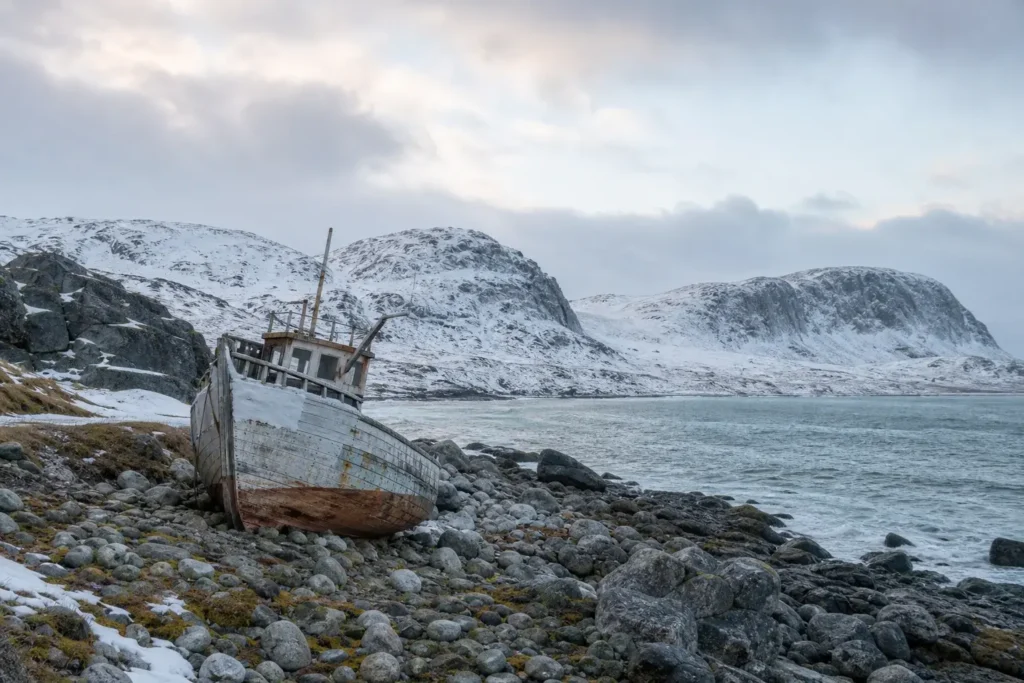
The village of Teriberka is situated in the north-west part of Russia, on the coast of the Arctic Ocean at a distance of 120 km from Murmansk city. This remote fishing settlement has transformed from obscurity into one of Russia’s most distinctive Arctic destinations, offering unfiltered access to the edge of the world.
The village stands on the shore of Kola Bay, immediately beyond which are the waters of the Barents Sea and the Arctic Ocean. The village gained international fame after being featured in the 2014 film Leviathan, which highlighted its stark beauty. What draws visitors is not polished infrastructure but raw Arctic character: a collection of abandoned and decaying wooden boats, a ship’s graveyard on the west bank of the estuary of the Teriberka River, and the rare opportunity to experience European Russia’s most accessible Arctic wilderness.
Quick Facts
| Russian name | Териберка |
|---|---|
| Distance from the nearest major city | approximately 2,100 km |
| Travel time from the nearest major city | 3–4 hours by flight to Murmansk, then 2–3 hours by car to Teriberka |
| Address | Kolsky District, Murmansk Oblast, Russia Google MapsApple MapsYandex Maps2GISOpenStreetMap |
| Admission | free |
| Best time to visit | Winter (November–February): See the northern lights on clear nights. The landscape becomes white and stark. Extreme cold (−20°C to −30°C) and potential road closures require commitment. This is peak season for aurora chasers.Shoulder seasons (September–October, March–April): Fewer tourists, less extreme weather than deep winter, yet occasional northern lights are still possible in September and early October. Road conditions stabilize. Autumn colors on tundra are subtle but present.Summer (June–August): Polar day brings uninterrupted daylight from the end of May to late July. Midnight sun offers continuous golden light for photography. Whales and seabirds are active. Weather is milder but still cool (5°C–15°C), and wind can be strong. Tourists are more numerous.Crowds: Teriberka remains small and never overcrowded. Winter attracts aurora seekers; summer draws photographers and nature lovers. July–August and December–February are busiest. Late September–early October and April–May are quietest and offer good value and solitude. |
| Recommended duration | 8–10 hours (including travel) |
What Is (and Isn't) Part of a Visit to Teriberka, Murmansk?
| Part | Status | Notes |
|---|---|---|
| Old Teriberka settlement (Staraya Teriberka) | Included in the standard ticket | The historic village core with abandoned buildings, Tikhvin Church, and scattered wooden structures. Freely accessible; open to exploration. |
| Lodeynoye (new Teriberka) | Included in the standard ticket | Modern settlement part where tourism facilities are concentrated: guesthouses, restaurants, shops. Public access to all exterior areas and beaches. |
| Ship Graveyard | Included in the standard ticket | Collection of abandoned and decaying wooden boats on the west bank of the estuary. No entry fee; accessible by foot from Lodeynoye. |
| Teriberka Waterfall (Batareisky Falls) | Included in the standard ticket | Where the Teriberka River meets the Barents Sea. Free to visit; accessible on foot, though terrain is rocky and sometimes icy. |
| Dragon Eggs Beach | Included in the standard ticket | Distinctive stone beach. Free access; no facilities or infrastructure. |
| Barents Sea Coast | Included in the standard ticket | Open coastline accessible by foot. Free exploration; respect private property and active fishing areas. |
| Tikhvin Church | Included in the standard ticket | Historic Orthodox church. Built by the end of the 19th century. Exterior always visible; interior access depends on service times and priest discretion. |
| Boat trips and sea excursions | Separate ticket or institution | Whale watching and Arctic fishing trips available through local operators. Require separate booking and payment. |
| Husky and reindeer farm | Separate ticket or institution | Animal experiences operate separately from the main village. Advance booking often required. |
| Guided tours | Separate ticket or institution | Organized excursions available through Murmansk tour operators. Separate from day visit; typically book and pay in advance. |
How to Get from the nearest major city to Teriberka, Murmansk
| Option | Duration | Price | Notes |
|---|---|---|---|
| Bus from Murmansk (Bus No. 241) | 2–2.5 hours | ₽ | Bus No. 241 runs from Murmansk four days a week. The road is mostly paved but can be difficult in poor weather. Winter and spring closures are possible due to snow and ice. Travel is slow but economical, and you experience the tundra landscape at ground level. |
| Shared taxi from Murmansk | 2–3 hours | ₽₽ | Private drivers and tour operators offer shared taxi services departing Murmansk daily. Faster and more flexible than the bus. A one-way cab ride costs about RUB 5,000 (converted to price level). Conditions: road can close in severe weather. |
| Guided day tour from Murmansk | 8–10 hours total (including travel and 4–6 hours on site) | ₽₽₽ | Organized excursions include hotel pickup, guide, and return. Tours typically run 8–9 hours with cost around 5,500 rubles (converted to price level). Guides provide context, arrange logistics, and ensure you see key sites. Best option for first-time visitors unfamiliar with Arctic conditions. |
| Private car rental | 2–3 hours each way | ₽₽ | Rent a vehicle in Murmansk and drive independently. The road is almost completely paved but can be difficult to traverse in poor weather. Requires confidence driving in Arctic conditions, especially in winter. Offers maximum flexibility but demands self-reliance. |
₽ budget · ₽₽ moderate · ₽₽₽ upscale · ₽₽₽₽ splurge. Price levels are estimates compared with typical prices for visitors.
Why Visit Teriberka, Murmansk?
This is the only village where you can comfortably get close to the Arctic Ocean in the European part of Russia by road. Tourists come here for the breathtaking Arctic nature, whale watching and the picturesque ship graveyard, as well as the northern lights in winter. The journey itself crosses Arctic tundra, a landscape utterly foreign to most visitors.
The ocean around Teriberka never freezes due to the effects of the Gulf Stream, which provides a great contrast for photos with the deep blue sea and snowy hills. Waterfalls formed by the Teriberka River at its confluence with the Barents Sea freeze, creating otherworldly coastal formations. In both summer and winter, the village offers the rare experience of standing at the edge of a borderless Arctic seascape.
Highlights of Teriberka, Murmansk
Ship Graveyard
A collection of abandoned and decaying wooden boats on the west bank of the estuary of the Teriberka River. Rusted metal hulls and skeletal wooden frames lie scattered across rocky shores, remnants of the industrial fishing era. The ships photograph spectacularly in Arctic light, especially with snow cover or during golden hour, and serve as a stark symbol of Teriberka's fading past as a major fishery.
Tip: The ship graveyard is located in the newer part of the settlement, Lodeynoye. Visit in late afternoon for dramatic side-lighting across the metal and wood. Wear sturdy boots; the terrain is rocky and uneven.
Teriberka Waterfall
Waterfalls formed by the Teriberka River at its confluence with the Barents Sea freeze. The most famous is Batareisky Falls, which plunges directly toward the Arctic Ocean. In winter, ice formations cascade down the cliffs in abstract patterns; in summer, meltwater roars into the sea. It is one of Teriberka's most photographed features and remains accessible from the main settlement.
Tip: Approach carefully on wet rocks. The waterfall is best photographed from a distance with the Arctic backdrop; do not attempt to climb directly to the base, especially in winter when ice makes surfaces treacherous.
Dragon Eggs Beach (Stone Eggs)
A distinctive stretch of coastline covered in smooth, round stones in shades of grey and ochre, resembling enormous eggs scattered across the shore. The beach extends toward the Barents Sea, offering an unusual textural contrast to sand and ordinary pebbles. It has become one of Teriberka's most recognisable photography locations, particularly striking under the midnight sun in summer or during Arctic twilight.
Tip: Visit the beach from Lodeynoye village, where tour guides typically bring visitors. The rocks are smooth and slippery when wet; wear footwear with grip. The beach's charm depends on light and weather rather than infrastructure, so conditions matter more than time of day.
Barents Sea Coast
To feel the vastness of the ocean. This is literally the end of the earth: the village stands on the shore of Kola Bay, immediately beyond which are the waters of the Barents Sea and the Arctic Ocean. The open horizon, cold wind, and sense of remoteness define the emotional experience. The ocean never freezes due to the effects of the Gulf Stream, which provides a great contrast for photos with the deep blue sea and snowy hills.
Tip: Bring warm, windproof clothing even on clear days; Arctic winds carry raw cold. The coast is accessible and relatively safe for walking, but never enter the water. Respect the sea's power: conditions can change rapidly.
Old Teriberka Settlement
Teriberka consists of two parts, called Staraya Teriberka and Lodeynoye. The old part (Staraya Teriberka) shows the earlier fishing village character: weathered wooden structures, remnants of Soviet-era buildings, and a quiet that contrasts sharply with the newer tourist infrastructure. Walking here reveals the arc of settlement history—from active community to near-abandonment to contemporary revival.
Tip: Respect private property; many buildings remain residential. Do not photograph residents without permission. The old settlement conveys atmosphere best when explored slowly on foot, not rushed as a photo stop.
Tikhvin Church and Orthodox Chapel
By the end of the 19th century, a church, a lighthouse, and a weather station had been built in Teriberka. These historical structures mark the village's spiritual and administrative core. The church stands as a visual anchor and one of the few surviving symbols of pre-Soviet life in this remote place.
Tip: The church may not always be open to visitors. Respect it as a functioning place of worship. Photography inside is typically not permitted; check locally. The exterior is the main visual element for most visitors.
Tundra Landscape
The road passes through Arctic tundra, a vast treeless area of Northern Russia with severe climate throughout the year. The journey to Teriberka traverses genuine subarctic terrain—treeless rolling hills, sparse vegetation, and uninterrupted horizons. This landscape defines much of the psychological impact of a Teriberka visit, creating the sense of reaching the world's edge.
Tip: The 130-km drive from Murmansk offers constant scenery changes. If traveling by bus, sit on the right side for better views toward the Barents Sea as you approach the coast. In winter, the snow-covered tundra is particularly striking.
Weather Station and Lighthouse
By the end of the 19th century, a church, a lighthouse, and a weather station had been built. The weather station was the first one to be constructed anywhere along the entire Murmansk coast. It is still standing today. These structures survive as working monuments to Teriberka's historical importance as a fishing and meteorological hub.
Tip: The weather station may be visible from a distance but is not typically open to tourists. The lighthouse, though no longer actively used, can sometimes be seen from the coast. These are best appreciated as part of the settlement's historical silhouette rather than formal stops.
Atmosphere
Teriberka feels like the end of something rather than the beginning—a place where land terminates and the infinite Arctic begins. The light is extraordinary and disorienting. From the end of May to late July, the polar day brings uninterrupted daylight, yet it is a cold, pale light, not warm. In winter, darkness descends early, and on clear nights the thin Arctic air makes stars exceptional.
The human presence is scattered. Weathered wooden houses cluster near the harbor; some show recent renovation, signs of tourism economy. Others remain abandoned, paint peeling, windows empty. Less than a thousand people live in the village, so streets often feel empty, amplifying the sense of isolation. There is a good sandy beach in the village, which is used by locals and by Murmansk residents in warm weather, but in most seasons visitors have the shore to themselves.
Silence dominates. Wind sound carries differently here; waves crash with unusual clarity; bird calls stand out sharply. Human noise—vehicles, voices—travels far and stands out. The constant awareness of the vast sea beyond creates a meditative, slightly sobering mood. This is not a cheerful destination but a confrontational one: you come to feel something specific, not to be entertained.
History of Teriberka, Murmansk
Teriberka was first mentioned circa 1523 when eyewitnesses from that time period confirmed the appearance of permanent Russian settlers. However, sustained settlement came later. According to other sources, it was founded in the 1860s—the decade when the Murman coast was actively being settled. During this period, the Murmansk coast shifted from seasonal hunting and fishing camps to permanent communities supported by Russian state interest in Arctic resources.
By the end of the 19th century, a church, a lighthouse, and a weather station had been built. This weather station was the first one to be constructed anywhere along the entire Murmansk coast. These structures reflect Teriberka’s growing importance as both an administrative and scientific center. At the beginning of the 20th century, the village’s fishing industry began to develop rapidly. Cod and sharks were the main catch, and there was a fish factory together with a shop run by Norwegians.
At the beginning of the twentieth century, a collective farm was created and named Murmanets. It consisted of a dairy farm and a herd of reindeer. A shipyard in the village of Lyudeyny provided additional employment. Teriberka flourished as a diversified community, not dependent on fishing alone. Before World War II, Teriberka was doing so well that some of its fishermen and farm workers went to the Exhibition of Achievements of National Economy in Moscow in recognition of their achievements.
In the 1920s, Teriberka received the status of a district center. Oblivion began after Teriberka was transferred under the jurisdiction of Severomorsk in the 1960s. Coastal fishing began to lose its attractiveness in front of the ocean, and many enterprises were abolished. Soviet central planning and industrial consolidation elsewhere emptied the village of its strategic importance. What remained was routine subsistence fishing and slow depopulation.
In 2009 the small fishing settlement of Teriberka lost its status as a closed settlement. It was only possible to get here by boat or helicopter until 1984 when a rough road was completed. The removal of border restrictions in 2009 opened the village to foreign tourism for the first time. Interest in the village and its sights grew after it became the filming location for Andrey Zvyagintsev’s film Leviathan in 2014, which won the Best Screenplay award at the Cannes Film Festival. The film thrust Teriberka into global consciousness, and tourism has steadily increased since.
Tickets and Booking for Teriberka, Murmansk
Teriberka itself has no admission fee; the entire settlement and coastline are freely accessible. However, organized elements require advance arrangement.
Getting there: Book tickets in advance for Bus No. 241 through the Murmansk bus station, as it runs only four days a week. Private taxis and shared minivans can typically be arranged on shorter notice through hotels or tourist agencies in Murmansk. Guided day tours should be booked 1–2 days ahead to confirm departure.
Lodging and food: Guesthouses, hostels, and restaurants in Teriberka operate year-round but may have limited capacity in shoulder seasons. Book accommodation in advance, especially in winter (northern lights season) and summer (midnight sun). Most visitors make Teriberka a day trip from Murmansk, staying overnight in the city.
Important: In winter and spring the program may be changed due to the closure of the road to Teriberka village due to complicated weather conditions. Check road and weather conditions before travel, especially October–May. No special visa or entry permit is required, but carry your passport.
Plan and Book
Suggested itineraries Teriberka, Murmansk
4 hours on site (with 5 hours travel)
Depart Murmansk early morning by bus or shared taxi. Arrive midday. Walk through the old settlement (Staraya Teriberka) for 1 hour, visit the Tikhvin Church from outside (20 minutes), then proceed to Lodeynoye. Spend 1.5 hours at Dragon Eggs Beach and the Barents Sea coast. Return to Murmansk by late afternoon or early evening bus.
Full day (8–10 hours including travel)
Join a guided tour or self-drive. Depart Murmansk 09:00. Arrive Teriberka 11:30–12:00. Explore Lodeynoye, visit the Ship Graveyard (1 hour). See Dragon Eggs Beach and Teriberka Waterfall (1.5 hours). Walk the old settlement in late afternoon. Depart Teriberka 17:00, return to Murmansk 19:00–20:00. This pace allows unhurried exploration without rushing.
Two days (overnight stay)
Day 1: Arrive Teriberka in afternoon, settle into guesthouse, explore old and new settlements at leisure. Day 2: Early sunrise (in summer) or predawn (in winter for northern lights), visit key sites without time pressure. Book a boat trip or coastal walk with a local guide. Afternoon departure or stay another night depending on conditions and interest.
How to Get to Teriberka, Murmansk
From Murmansk city center: Teriberka is at a distance of 120 km from Murmansk city, approximately 3.5 to 4 hours by car. Part of the 130-kilometre-long drive follows a dirt road in the warm part of the year and an ice road during the winter.
- By bus: Murmansk central bus station operates Bus No. 241 to Teriberka, departing four times per week on a fixed schedule. Journey time is 2–2.5 hours. Tickets are inexpensive and can be purchased at the station or through the station website; buy 1–2 days in advance to confirm availability.
- By shared taxi: Private drivers and minibus operators gather at Murmansk bus station and central taxi stands, offering same-day departures when enough passengers book. Journey time 2–3 hours. Negotiable rates; expect moderate cost.
- By private car: Rent a vehicle in Murmansk (city center or airport). Road conditions vary by season: summer has paved sections and gravel; winter requires snow tires or chains and experienced Arctic driving. Do not attempt in severe weather without local knowledge.
- By tour guide: Book through a Murmansk tourism agency for a guided day excursion with hotel pickup. Most convenient for first-time visitors. Operators collect clients from hotels 08:00–09:00.
Within Teriberka: The settlement is compact and walkable on foot. Most attractions lie within 1–2 km of each other. The old and new parts (Staraya Teriberka and Lodeynoye) are separated by about 3 km; local guides help or informal shuttle services operate during busy season.
Accessibility
Teriberka offers basic accessibility but with Arctic challenges. The settlement has no formal disabled access infrastructure (ramps, elevators, accessible toilets). Most attractions require outdoor walking on uneven terrain: rocky beaches, tundra paths, and sometimes slippery surfaces.In winter, snow and ice make wheeled mobility extremely difficult. Summer offers better conditions but still uneven ground. There are no wheelchair-accessible buses; taxis and private vehicles can accommodate wheelchairs with prior notice.Guesthouses and basic restaurants exist but vary in accessibility. Some are in older wooden buildings with stairs and narrow doorways. More modern accommodations (Hotel Ter, Kovcheg-51) may have better facilities; confirm with operators before booking.Visitors with mobility limitations should arrange a private car or guide service rather than public transit, and discuss specific needs with operators in advance. The Arctic weather poses an additional barrier: reduced mobility in extreme cold is a genuine safety concern.
Food Nearby
Teriberka has limited but growing food options. Over the past ten years, hotels, camp sites, and two restaurants have been opened. These establishments are concentrated in the newer Lodeynoye settlement and serve basic Arctic cuisine: fish, seafood (crab, salmon), and traditional Russian soups.Most guesthouses provide meals as part of their booking, or can prepare simple food if asked. A small shop in the old settlement stocks basic supplies but is not a restaurant.Visiting restaurants serve local fish and game; expect simple, hearty food rather than diverse menus. Hours can be irregular and depend on tourist flow. It is prudent to eat in Murmansk before departure or to arrange meals through your accommodation. If self-catering, bring non-perishable supplies from Murmansk, as options are limited.
What to Bring
Clothing (critical): Always bring warm waterproof clothing and comfortable shoes with you, even when travelling in summer. Ideally, pack thermal underwear, warm socks and a raincoat. In winter, bring a warm down jacket, insulated trousers, high winter boots, thermal underwear, a warm hat and mittens.Summer specific: The polar day begins in late May and ends in late July. Those new to such conditions should also bring a sleeping mask if staying overnight.General essentials: Waterproof bag or case for electronics (sea spray, moisture). Sunscreen and sunglasses (light reflects off snow and sea). Binoculars for bird and whale watching. Camera with extra batteries (cold drains them faster). Enough cash (Murmansk); card payments are unreliable in the village.Security and bags: Carry your passport always; a simple daypack is sufficient for day visits. No special security restrictions; use common sense around the sea and uneven terrain.
Best Views and Photo Spots of Teriberka, Murmansk
Dragon Eggs Beach at sunset (summer) or golden hour (any season)
Foreground of smooth grey stones, middle distance of Barents Sea horizon, sky colored by Arctic light. In summer the light turns amber and pink; in winter it is pale but dramatic. The stones' texture and the sea's color create strong visual contrast.
Best time: Sunset in summer (20:00–23:00). In winter or shoulder seasons, late morning or early afternoon sun rakes across the stones with side-lighting. Clear days are essential.
Teriberka Waterfall with ocean backdrop
Cascade of water falling toward the Barents Sea, with ice formations in winter or white water spray in summer. Frame the waterfall to show both the falling water and open sea horizon to convey the drama of water meeting ocean.
Best time: Spring (April–May) offers melt-swollen water and contrasting snow. Winter ice formations are unique. Midday sun eliminates shadows and shows detail; late afternoon backlighting can silhouette falling water.
Ship Graveyard, overview from elevated position
Rusted and wooden ship hulls arranged across rocky shore, with Barents Sea and sky behind. Multiple vessels at different angles create compositional depth. The industrial decay and Arctic emptiness combine in one frame.
Best time: Overcast days minimize harsh shadows and emphasize the grey tones of rust and stone. Golden hour adds warmth to the metal. Winter snow on the hulls adds texture.
Old Teriberka settlement silhouette
Weathered wooden buildings, Tikhvin Church steeple, against the Barents Sea or sky. The architecture frames the Arctic landscape beyond. This is the human-versus-wilderness composition.
Best time: Golden hour in any season. Winter twilight (brief daylight) creates striking silhouettes. Summer midnight sun creates an ethereal, blue-grey light.
Northern lights over settlement or coast (winter)
Aurora bands in green, pink, or purple arching over dark landscape. Include foreground (buildings or snow-covered rocks) to give scale and context. Avoid too much black sky; incorporate terrain.
Best time: December–February, midnight–04:00 on clear nights with minimal moon. Clear, dark skies are essential; forecast solar activity and local weather carefully.
Tundra landscape en route from Murmansk
Wide, treeless horizon with subtle rolling terrain, sparse vegetation, and vast sky. The monotone palette emphasizes distance and isolation. Include a vehicle or road element for scale.
Best time: Golden hour emphasizes the tundra's color. Winter snow transforms it into an abstract white landscape. Summer green is muted but present. Avoid midday harsh light.
Photography Rules
Teriberka is a photographer's destination. No drone restrictions are officially published, but respect privacy, avoid military-related structures, and use judgment around settlements. Tripods are permitted on public land. Flash is not typically an issue outdoors; indoors (church) ask permission first.Sunrise and sunset provide dramatic light; in summer, golden hour extends all evening. Winter midnight or dawn light is particularly distinctive. The landscape rewards patience: weather, sea state, and ice conditions change the scene constantly.Respect residents and do not photograph people without consent. The ship graveyard, Dragon Eggs Beach, and Barents Sea coast are the main visual subjects; each benefits from different times of day and seasons.
Family Suitability
Teriberka suits families with older children (8+) who can tolerate long travel, extreme cold, and outdoor walking on uneven terrain. The Arctic environment is striking but unforgiving; toddlers and very small children face practical challenges: harsh weather, long hours confined to vehicles, and limited shelter.Beaches are rocky, not sandy; stroller use is impossible. The ship graveyard and waterfalls are fascinating but require supervision and sure footing. Long days of travel (5+ hours driving round trip) exhaust small children.Summer polar day is easier for families than winter darkness and cold. Midnight sun allows flexible scheduling and outdoor play. Winter requires extreme preparation, specialized clothing, and short exposure periods for young children.Guesthouses lack extensive family amenities (playgrounds, kids' clubs). Food options are limited and slow. Families considering Teriberka should expect an adventure trip, not a resort experience, and should prepare children (and themselves) psychologically for the remote, raw Arctic environment.
Russia Vibes Tips
- Book a guided tour for your first visit, even if you are an experienced traveler. The road conditions, weather, and logistics are unfamiliar to most visitors. A guide ensures you do not miss key sites, explains historical context, and provides safety in Arctic conditions. Guides also know current access (some sites close in bad weather) and can speak to locals for current events or stories.
- Visit the ship graveyard and Dragon Eggs Beach in Lodeynoye first, then explore the old settlement. This order keeps you on more established paths and saves the oldest, more atmospheric part for last when light is often best. It also means you end your visit in a contemplative rather than a touristy frame of mind.
- Bring more warm clothing than you think you need. Even experienced Arctic travelers underestimate wind chill and moisture. Layering is critical: thermal underwear, fleece or wool middle layers, then waterproof outer shell. Numb hands and face end visits early. Invest in high-quality gloves and a balaclava, not store-bought essentials.
- In winter, confirm the road to Teriberka is open before your journey. Unexpectedly harsh weather can force closures. Check with the Murmansk tour agencies or police traffic reports (ГИБДД) the morning of travel. Cancellation is frustrating but safer than being trapped by snow.
- Time your arrival to maximize daylight (summer) or catch golden light (any season). In summer, aim to arrive by 12:00 to have afternoon and evening light. In winter, arrive by 10:00 or 11:00 to catch midday brightness before afternoon dusk. Summer travel times are flexible; winter timing is critical.
- Respect the indigenous Sami heritage of the land. Teriberka sits on Kola Peninsula traditionally inhabited by Sami peoples. While the village itself is now Russian, many geographical and cultural references belong to Sami history. Learn a bit about Sami culture before visiting; it deepens understanding of the landscape and local identity beyond Soviet-era settlement narratives.
Explore Nearby Teriberka, Murmansk
Related guides
 Murmansk: Arctic Port, Northern Lights and the Lenin Icebreaker
Main image: AI-generated illustration. It may not show the place exactly as it looks.
Browse more: All Day Trips · All Day Trips in Murmansk · All Hidden Russia · All Murmansk
FAQ: Teriberka, Murmansk
Is Teriberka safe to visit?
Teriberka is safe in terms of crime; it is a small, quiet community with minimal theft or violence. The hazards are environmental: extreme cold, sudden weather changes, rough seas, and icy terrain. Visitors must use judgment, dress properly, and not take risks (do not enter the water, do not venture on unstable ice). Guided tours provide additional safety oversight. In winter, road closures are the main practical risk.
Do I need special permits or visas to visit Teriberka?
No special permits are required. Carry your regular Russian visa and passport. Teriberka lost its closed-zone status in 2009, so foreign tourists are now freely permitted. A standard tourist visa is sufficient. No military or strategic sensitivity applies to visitor access.
What is the best season to see the northern lights in Teriberka?
Late September through early March offers the best chances, with December–February having the longest dark nights. However, northern lights require clear skies, minimal light pollution (Teriberka has none), and solar activity. A week-long stay increases odds significantly; a single night is unreliable. Winter weather and road closures are trade-offs to consider.
Can I see whales in Teriberka?
Yes. Whale watching excursions operate from Teriberka, particularly in summer and early autumn. Local operators arrange boat trips into the Barents Sea to spot fin whales, humpbacks, and other Arctic species. These require separate booking and depend on weather and sea conditions. Prices vary; book through guesthouses or Murmansk agencies.
Is Teriberka worth a day trip, or should I stay overnight?
A day trip is feasible and realistic: 5–6 hours travel round trip plus 4–5 hours on site. You will see the main sights without rushing. Overnight stays allow leisurely exploration, better light for photography (sunrise/sunset), potential northern lights viewing, and less fatigue. Choose day trip if time is limited; choose overnight if possible for a deeper experience.
What did the film Leviathan actually film in Teriberka?
Director Andrey Zvyagintsev shot the 2014 film Leviathan in and around Teriberka over several weeks. Key scenes were filmed at the old settlement, ship graveyard, and Barents Sea coast. The film depicts Teriberka as a grim, decaying place—which was relatively accurate at that time. It has since become a tourism draw, and locals have mixed feelings about the film's legacy.
Are there restaurants and accommodations in Teriberka itself?
Yes, basic ones. Several small guesthouses, eco-hostels, and hotels have opened in recent years, including Kovcheg-51 and Hotel Ter. Food is available through guesthouse meals or small restaurants. Options are limited and prices are moderate to upscale relative to rural Russia. Most visitors stay in Murmansk and day-trip, or book accommodation well in advance.
What happens if the road to Teriberka closes due to weather?
In winter and spring, heavy snow or ice can close the 130 km road temporarily. When closed, no travel is possible; tours are cancelled and rescheduled. Check road status the morning of travel with Murmansk tourism agencies or local traffic police. Flexibility is essential: book midweek so you have backup dates. Summer closures are rare.
Russia Vibes is a one-person project. A coffee keeps it going
How we research and update our guides
About this guide: AI assistance and accuracy
This guide is created with the help of AI and is based on official sources where available. Mistakes can still happen. Opening hours, prices, rules and other details are given to the best of our knowledge as of the date shown and can change without notice. It offers general recommendations only, not professional, legal or travel advice. Please confirm important details with the official source before you travel; you are responsible for your own plans and decisions.

Take this guide with you
Get a free PDF of this guide to print or read offline: key facts, tips and a map link on a few clean pages.
Report an issue on this page
Paying for your trip: please read
International sanctions affect payments between Russia and many other countries. In practice, cards issued in the EU, the UK, the US and several other countries often do not work in Russia, Russian cards usually do not work abroad, and some booking platforms, airlines and payment providers limit or suspend their services for Russia. The situation changes frequently.
We do not give legal or financial advice, and this site does not encourage anyone to break or circumvent sanctions. Whatever you plan, you are responsible for following the laws and regulations that apply to you, including those of your country of residence and citizenship.
Many travelers still organise their stay lawfully. It is worth asking your bank or payment provider what is currently permitted, contacting hotels, tour operators and carriers directly about the payment methods they accept, and checking which services are open to customers from your country. Clarify payment, cancellation and refund terms before you commit to a booking, and keep your plans flexible.
Partner links on this site may not be available in every country, and prices, availability and rules in our guides can differ from what you see when you book.