
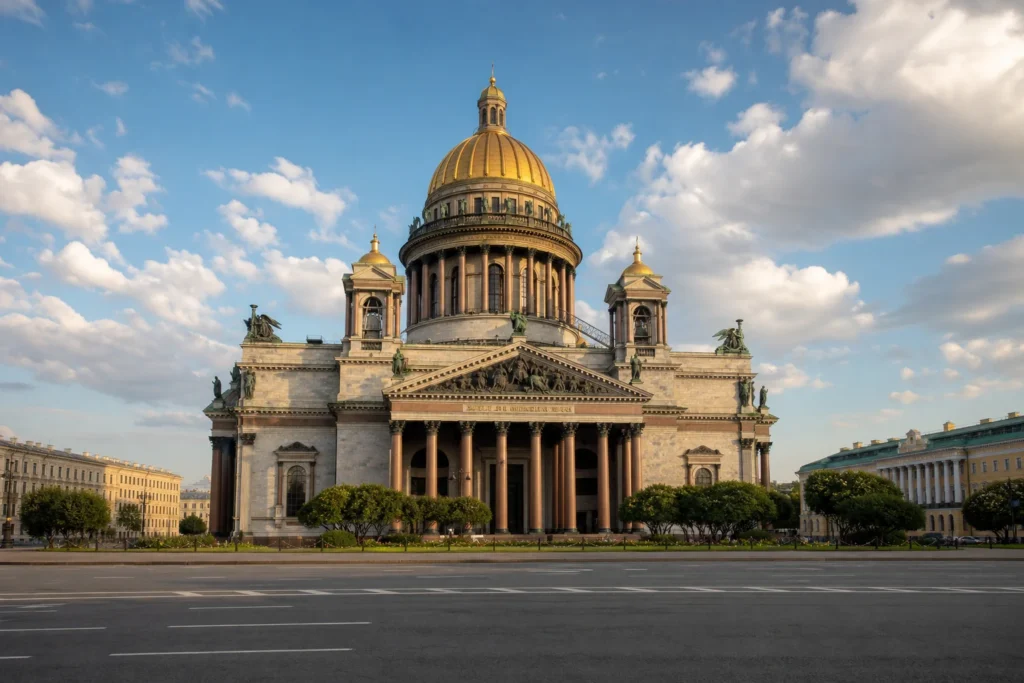
Saint Isaac’s Cathedral, Saint Petersburg is a monumental nineteenth-century cathedral on Saint Isaac’s Square in the Admiralteysky District. Its enormous gilded dome rises above granite columns, sculpted pediments and marble-covered walls. Built between 1818 and 1858 under French-born architect Auguste de Montferrand, it remains one of the defining architectural landmarks of central Saint Petersburg.
Inside, the contrast is striking: red and grey stone, green malachite columns, blue lapis lazuli, gilded sculpture and religious paintings fill an immense interior. Visitors can examine the cathedral’s artwork and architectural details or climb to the outdoor colonnade for views across the historic city. These are distinct experiences, so it is worth deciding whether you want the interior, the panorama or both. The cathedral also remains a place of Orthodox worship, adding a living religious function to its role as a museum.
Current access notice: As of October 2026: The basement memorial exhibition To Remember has special access arrangements from October 5, 2026, through April 30, 2027. Visits are limited to advance-booked groups from eligible public institutions and veterans' associations. Ordinary individual sightseeing access is not offered under these arrangements. The exhibition is restricted to visitors older than 12.
Quick Facts
| Russian name | Исаакиевский собор |
|---|---|
| Built / opened | 1858 |
| Architect(s) | Auguste de Montferrand |
| Address | Санкт-Петербург, Исаакиевская площадь, 4, лит. А OpenStreetMap · Google Maps |
| District | Admiralteysky |
| Metro | Admiralteyskaya (Line 5 – Frunzensko-Primorskaya Line, Exit to Malaya Morskaya Street; approximately 10 minutes on foot to Saint Isaac's Square.) |
| Opening hours | Cathedral museum: 10:00–18:00, closed Wednesdays and January 1. Ticket office and regular admission close at 17:30.
Colonnade: 10:00–18:00. Open daily from May through September. From October through April, closed on the third Wednesday of each month and January 1. Seasonal evening visits from May through September: 18:00–21:30, with admission until 21:00. The cathedral remains closed on Wednesdays; the evening colonnade normally operates daily. Museum opening arrangements can change during school holidays, public holidays and special events. (as of October 2026 – check the official site) |
| Admission | Cathedral interior: ₽₽. Young visitors aged 7–18: ₽. Children under 7: free.
Colonnade observation deck: ₽₽, with separate admission. Seasonal evening visits: ₽₽ for each attraction. Specific free-admission and concession categories exist, but not all apply to the colonnade or evening programs. (as of October 2026 – check the official site) |
| Best time to visit | Late spring through early autumn is particularly suitable for combining the interior with the outdoor colonnade. Longer daylight hours provide more flexibility for viewing the surrounding city, while summer evening access offers a different atmosphere.
For the panoramic walkway, clear weather matters more than the season. Low cloud, haze, rain and strong wind can reduce visibility or affect access. The cathedral interior can be visited throughout the year and provides a substantial indoor sightseeing experience during cold or wet weather. Winter also brings a different exterior appearance, with the pale stone and golden dome contrasting against the darker seasonal sky. If you prefer a quieter experience, weekday visits outside major holiday periods may be more comfortable, although precise crowd patterns cannot be guaranteed. |
| Recommended duration | 1.5–2 hours for the cathedral interior; allow another 45–60 minutes for the colonnade. |
| Website | cathedral.ru |
| Last updated | October 15, 2026 |
What Is (and Isn't) Part of a Visit to Saint Isaac's Cathedral, Saint Petersburg?
| Part | Status | Notes |
|---|---|---|
| Main cathedral interior | Included in the standard ticket | Standard museum admission covers the principal visitor areas of the cathedral interior. |
| Main iconostasis and interior artwork | Included in the standard ticket | The paintings, mosaics, sculptures and iconostasis are viewed as part of the regular interior visit. |
| Central dome viewed from below | Included in the standard ticket | Visitors can admire the painted dome and its decorative details from the main interior. |
| Colonnade observation deck | Separate ticket or institution | The outdoor panoramic walkway requires its own admission and is not included in the cathedral interior ticket. |
| Main sanctuary behind the iconostasis | Not open to visitors | The sanctuary is a religious area and is not an ordinary visitor gallery. |
| To Remember basement memorial | Not open to visitors | Ordinary individual visitors cannot enter under the current special-group access arrangements. |
| Saint Isaac's Square | Outside / not part of it | The public square surrounding the cathedral is not part of the paid museum visit. |
| Bronze Horseman and Senate Square | Outside / not part of it | These nearby historic landmarks are separate from the cathedral museum. |
| Church of the Savior on Spilled Blood | Separate ticket or institution | It is another monument operated by the same museum institution, with its own admission. |
| Mariinsky Palace | Outside / not part of it | The building facing Saint Isaac's Square belongs to a different institution and is not part of the cathedral visit. |
Why Visit Saint Isaac's Cathedral, Saint Petersburg?
Saint Isaac’s Cathedral offers an unusually clear encounter with the architecture and artistic ambitions of imperial Saint Petersburg. The building was designed on a scale that becomes apparent before you enter: vast granite columns stand beneath sculpted pediments, while the central dome rises over the surrounding squares.
The interior rewards close attention. Look for the monumental iconostasis with malachite and lapis lazuli columns, the stained-glass image of the risen Christ and the painted dome above the central space. These details bring together Russian academic painting, sculpture and decorative stonework in a single architectural setting.
The colonnade adds another perspective. From above, visitors can understand how the cathedral relates to the Admiralty, the Neva and the surrounding historic streets.
How Saint Isaac's Cathedral, Saint Petersburg Is Laid Out
The cathedral occupies a large, almost square building between Saint Isaac’s Square and Senate Square. Its four monumental porticoes face the surrounding streets and public spaces. The golden central dome rises above smaller corner domes, making the building recognizable from different directions.
Inside, massive supports divide the interior into a central nave and side aisles. The main dome dominates the middle of the building. Looking east, visitors see the principal iconostasis and sanctuary, while religious paintings, mosaics and sculpture cover the walls and vaults.
The outdoor colonnade runs around the drum beneath the main dome. It is reached by a separate staircase route rather than by walking through an ordinary doorway from the main museum floor.
There is also a basement memorial exhibition devoted to the museum workers who protected artworks during the Siege of Leningrad. This is not part of a normal individual sightseeing visit under the current access arrangements.
A sensible visit begins with the exterior, continues through the main interior and finishes with the panoramic viewpoint if you intend to climb.
Highlights of Saint Isaac's Cathedral, Saint Petersburg
The Monumental Granite Porticoes
Four classical porticoes establish the cathedral's imposing exterior. Their enormous granite columns were quarried near Vyborg and transported to Saint Petersburg by water before being raised into position using elaborate lifting equipment. The first column was erected in 1828, before the main walls were completed. From the square, notice how the columns frame the entrances and support triangular pediments filled with sculpture. Their scale is easier to appreciate when viewed from the open space around the building rather than from immediately beneath them.
Tip: Walk around more than one side of the cathedral. The changing relationship between the porticoes and the central dome reveals how the building was designed.
The Gilded Central Dome
The cathedral's golden dome is supported by an ambitious nineteenth-century metal structure, developed when large-scale iron construction was still technically demanding. Its gilded surface makes the building visible above much of the surrounding historic architecture. Smaller domes and bell towers reinforce the composition without competing with the central cupola. When standing in Saint Isaac's Square, look at the way the dome rises from a ring of columns above the massive stone body of the cathedral. This arrangement makes the building appear taller and lighter than its monumental lower walls suggest.
Tip: For an exterior photograph, move back into the square so the dome and the full width of the façade appear together.
The Vast Cathedral Interior
Stepping inside reveals a space designed around monumental supports, polished stone and high vaulted ceilings. Marble covers much of the interior, while gilded details and bronze sculpture emphasize the architectural divisions. The central space rises beneath the main dome, drawing attention upward from the floor to the painted vault. The scale is different from a smaller parish church: the artwork forms part of the overall architectural design rather than appearing as separate decorative objects. Begin near the central nave and look around before approaching individual paintings or religious images.
Tip: Pause in the central space before moving toward the altar. It provides a useful perspective on the relationship between the columns, vaults and dome.
The Malachite and Lapis Lazuli Iconostasis
The principal iconostasis stands at the eastern end of the cathedral and separates the main worship space from the sanctuary. Its tall green malachite columns are among the most recognizable features of the interior. Blue lapis lazuli columns, gilded details and religious images introduce contrasting colors. The iconostasis is arranged as a monumental architectural structure rather than a small screen. Look carefully at the different stone surfaces: the deep green and blue materials stand out against the surrounding marble and gold. The sanctuary beyond is a religious space, not an ordinary museum gallery.
Tip: View the iconostasis from farther back before approaching it. The full composition is easier to understand from the center of the nave.
The Stained-Glass Risen Christ
Behind the main altar is a stained-glass image of the risen Christ, an unusual feature in the design of a Russian Orthodox cathedral of this period. The image became part of the nineteenth-century decorative program and reflects the influence of Western European church art. When the central sanctuary is visible, its illuminated colors form a strong contrast with the stone columns and gilded ornament of the iconostasis. Unlike the surrounding mosaics, the image depends on light passing through colored glass. Visibility can vary according to the position of the altar doors.
Tip: Look through the central opening of the iconostasis when it is visible. Do not assume the stained glass will be equally clear from every position.
The Painted Dome and Silver Dove
The main dome contains Karl Bryullov's monumental painting of the Virgin Mary surrounded by saints, created during the cathedral's nineteenth-century decoration. Around the painted composition are architectural details, windows and sculpted figures. Higher above, a silver-covered dove symbolizes the Holy Spirit and completes the central arrangement. The dove was removed during the period when the cathedral displayed a Foucault pendulum and later returned to its historical position. From the floor, the figure appears small despite its substantial size, emphasizing the extraordinary height of the interior.
Tip: Stand beneath the central dome and look upward gradually, from the surrounding windows to the painting and the dove at its center.
Mosaics and Religious Sculpture
Saint Isaac's Cathedral contains both religious paintings and mosaics, and they can look surprisingly similar from a distance. During the nineteenth century, mosaic production was developed partly because the cathedral's interior conditions made painted surfaces difficult to preserve. Colored glass pieces were arranged to reproduce religious images with lasting color and detail. Monumental sculpture also appears throughout the interior, particularly around the vaults and dome. Instead of examining every image, compare a mosaic with a nearby painting to understand how their surfaces respond differently to the available light.
Tip: Move slightly to one side when studying a mosaic. Changing the viewing angle can make the individual colored pieces easier to distinguish.
The Colonnade Observation Deck
An outdoor walkway surrounds the drum of the cathedral's main dome, above the surrounding streets. The viewing level provides a broad panorama of central Saint Petersburg, including the Admiralty area and the cityscape toward the Neva. The public route involves climbing a substantial number of steps through narrow stairways. Unlike an enclosed observation room, the walkway is exposed to the weather, and wind and visibility affect the experience. The viewpoint is a separate attraction from the main cathedral interior, with its own ticket and operating arrangements.
Tip: Choose a clear day for the panorama. When visibility is poor, the height alone does not guarantee useful views across the city.
The To Remember Siege Memorial
A memorial exhibition in the cathedral's basement tells the story of museum employees who safeguarded artworks during the Siege of Leningrad. The cathedral became a protected storage location for collections from the city and its surrounding palace museums. The exhibition uses photographs, documents and reconstructed storage settings to explain the conditions in which museum workers preserved these objects. Its setting beneath the grand cathedral interior creates a powerful contrast with the building's imperial architecture. Access is currently limited to qualifying pre-arranged groups rather than ordinary individual visitors.
Tip: Do not plan the basement memorial as an automatic addition to a cathedral visit. Its special access arrangements are described in the current notice.
Atmosphere
Saint Isaac’s Cathedral feels different depending on where you stand. Outside, the building is dominated by granite, pale stone and the golden dome, with the wide square providing space to appreciate its proportions. The surrounding streets and public spaces remain part of everyday central Saint Petersburg.
Inside, the atmosphere changes. Footsteps and quiet conversations carry through the immense interior, while natural and artificial light pick out the colored stone, gilding and painted surfaces. Visitors often pause beneath the central dome or stand back to understand the scale of the iconostasis.
The colonnade offers a contrasting experience: open air, wind and a panorama of the city’s roofs, streets and waterways. Religious services give the interior an additional purpose beyond sightseeing, and visitors should remain considerate of worshippers.
History of Saint Isaac's Cathedral, Saint Petersburg
The first Saint Isaac’s Church was connected directly with Peter the Great. The church was dedicated to Saint Isaac of Dalmatia, whose feast day coincided with the ruler’s birthday. The earliest church was consecrated in 1707 in a converted wooden building near the Admiralty. Peter married Catherine there in 1712.
A more permanent stone church followed. Peter laid its foundation stone in 1717, and Georg Johann Mattarnovi prepared the design. The building stood closer to the Neva, near the present Bronze Horseman. Problems with unstable ground damaged the structure, and it was dismantled in 1763.
Catherine II commissioned another church in 1768, this time following a design by Antonio Rinaldi. Construction continued into the reign of Paul I, when Vincenzo Brenna completed a simplified version of the original project. The resulting building was widely considered unsuitable for its prominent position in the imperial capital.
Competitions for a replacement were announced in 1809 and 1813. Emperor Alexander I eventually approved the scheme of French-born architect Auguste de Montferrand. Construction of the present cathedral began in 1818 and continued for four decades.
The project presented enormous engineering challenges. Workers developed a foundation supported by thousands of piles and constructed elaborate machinery to raise granite columns. The first portico column was installed in 1828. The columns were erected before the main walls, reversing the usual building sequence. A temporary railway was constructed in 1837 to move marble from the Neva toward the building site.
During the 1840s, the interior decoration became an equally ambitious undertaking. Karl Bryullov worked on the great dome painting from 1843 to 1847. Other artists and sculptors contributed religious scenes and monumental figures. Following developments in mosaic production, work on replacing selected paintings with mosaics began in 1851.
The cathedral was completed and consecrated in 1858. It became a major cathedral of imperial Saint Petersburg. Montferrand died shortly after the inauguration, ending a career closely associated with the city’s monumental architecture.
The twentieth century brought a radical change of function. After the revolutionary period, the cathedral was transferred to museum use. In 1931, an anti-religious museum opened inside, marked by a public demonstration of a Foucault pendulum suspended beneath the dome. The pendulum was used to demonstrate the rotation of the Earth.
During the Siege of Leningrad, the cathedral sheltered valuable museum collections that could not be evacuated from the city and nearby palaces. In 1941, its golden domes were covered with protective grey paint. Museum workers guarded the stored objects through exceptionally difficult conditions.
After the war, conservation and restoration continued. The Foucault pendulum remained a prominent museum exhibit until 1986, and the silver dove eventually returned to the main dome. Religious services resumed regularly following an agreement between the museum and the Orthodox Church in 2002.
A basement memorial exhibition opened in 2004 to commemorate the museum workers who preserved cultural heritage during the siege. The cathedral continues to function as a museum and a place of worship, reflecting the different chapters of its history.
Legends and Myths about Saint Isaac's Cathedral, Saint Petersburg
Montferrand's Predicted Death
Legend – historically unreliable. A long-standing story claims that a fortune-teller predicted architect Auguste de Montferrand would die as soon as Saint Isaac's Cathedral was completed. According to the legend, he deliberately prolonged construction to delay his fate. Montferrand did die shortly after the cathedral's inauguration in 1858, but this coincidence does not establish the truth of the prophecy or the claim that he intentionally delayed the project. The long construction period is explained by the building's considerable technical complexity.
The Scaffolding and the Romanov Dynasty
Legend – historically unreliable. Another story connected the fate of the Romanov dynasty with the scaffolding surrounding the cathedral. According to the legend, the monarchy would fall once the last scaffolding was removed. Later storytellers connected the removal of construction structures with the abdication of Nicholas II. The story is folklore rather than a historical explanation of the Russian Revolution. It reflects how the cathedral became associated with wider anxieties about the empire and its future.
Tickets and Booking for Saint Isaac's Cathedral, Saint Petersburg
| Ticket | Price | Includes |
|---|---|---|
| Standard cathedral admission | ₽₽ | Admission to the main cathedral museum interior, including its permanent architectural and artistic features. |
| Young visitors aged 7–18 | ₽ | Reduced admission to the main cathedral interior for the stated age group. |
| Children under 7 | Free | Free admission to the main cathedral interior for eligible young children. |
| Colonnade admission | ₽₽ | Access to the outdoor panoramic walkway around the main dome, using the public staircase route. |
| Seasonal evening cathedral admission | ₽₽ | An evening visit to the cathedral interior during the museum's seasonal evening program. |
| Seasonal evening colonnade admission | ₽₽ | An evening visit to the outdoor panoramic walkway during the seasonal evening opening period. |
₽ budget · ₽₽ moderate · ₽₽₽ upscale · ₽₽₽₽ splurge. Price levels are estimates compared with typical prices for visitors.
Buy official tickets through the museum’s online ticket service at tickets.cathedral.ru or at the museum’s ticket offices and self-service terminals. Standard cathedral admission and the colonnade are separate products. Select the attraction you actually want to visit.
The online system displays available dates and ticket categories. A fixed advance-release period could not be confirmed, so a date that is not displayed should not automatically be treated as sold out. Check again closer to your visit.
Electronic tickets are validated using their barcodes at the entrance. The museum also sells same-day admission through its on-site facilities, subject to availability.
Reduced and free-admission categories require supporting documents, and concession tickets are handled at the museum ticket office. Keep identification available when claiming an eligible category. Follow the signs for the cathedral museum entrance or the separate colonnade route; accessible entry assistance is provided through the designated ramp entrances.
Rates for Russian citizens and concession categories may differ. Consult the official ticket information on cathedral.ru for the complete conditions.
Plan and Book
Suggested itineraries Saint Isaac's Cathedral, Saint Petersburg
45 minutes
Begin outside on Saint Isaac's Square and examine the southern façade and granite portico. Enter the cathedral and take in the central interior before approaching the iconostasis. Look upward toward the painted dome and finish by comparing the mosaics with the surrounding religious paintings. This is a compact visit focused on the building's main artistic and architectural features.
1.5 hours
Start with a short walk around the cathedral to compare its porticoes and dome from different sides. Inside, move through the central nave, examine the iconostasis and stained-glass image, and spend time beneath the painted dome. Finish with the decorative sculpture and mosaics. This pace allows time to appreciate the building without treating the interior as a series of quick photographs.
2.5 hours
Explore the cathedral exterior and main interior first. Pay particular attention to the green and blue stone columns, the stained glass and the painted dome. Afterwards, follow the separate route to the colonnade and climb to the panoramic walkway. Allow time to identify the Admiralty area, surrounding squares and the cityscape toward the Neva before descending.
Half day
Begin at Saint Isaac's Cathedral with a careful examination of the architecture and interior artwork. Continue to the colonnade for the panorama if the weather is suitable. After leaving the cathedral, explore Saint Isaac's Square, walk toward Alexander Garden and continue to Senate Square and the Bronze Horseman. This combines the cathedral with nearby outdoor landmarks without adding another museum visit.
How to Get to Saint Isaac's Cathedral, Saint Petersburg
By Metro: Take Line 5, the Frunzensko-Primorskaya Line, to Admiralteyskaya. Leave the station onto Malaya Morskaya Street and walk toward Saint Isaac’s Square. The route takes approximately ten minutes, and the cathedral’s gilded dome provides a clear landmark.
From the city center: If you are already near the Admiralty or the western part of Nevsky Prospekt, walking is a practical option. Follow the surrounding streets toward Saint Isaac’s Square rather than making an unnecessary Metro journey.
By surface transport: The museum identifies buses 3, 22 and 27 and trolleybuses 5 and 22 as serving the area. Check the current route and the stop nearest the square.
By taxi: Use the Russian address of the cathedral. Ask to be dropped near Saint Isaac’s Square and complete the final approach on foot.
Accessibility
The museum has ramps at the northern and southern façades, assistance call points and lifting platforms for visitors with reduced mobility. Staff can help visitors use the accessible entrances and equipment.
The public colonnade route involves a substantial staircase and is not wheelchair accessible in the ordinary way. A separate accessible viewing platform at a lower level has been developed using a specialist lift and platform. However, the museum's accessibility and excursion pages give conflicting information about the current operation of this special program, including a temporary suspension notice. Confirm availability directly before planning to use it.
The museum also provides assistance for visitors with visual impairments, including adapted educational materials and orientation equipment.
Food Nearby
The streets surrounding Saint Isaac's Square offer places to look for cafés, restaurants and refreshments. Malaya Morskaya Street is a practical area to consider when approaching from Admiralteyskaya Metro station.
For a meal after sightseeing, the surrounding central streets provide alternatives to returning immediately to the Metro. Visitors can combine a café stop with a walk toward the Admiralty or the nearby historic squares.
No individual restaurant has been verified for this article, so specific venues are not recommended here. Check the location and current arrangements of a restaurant before making it part of your itinerary.
What to Bring
Bring comfortable walking shoes suitable for the stone surroundings and the amount of walking you plan. If visiting the colonnade, choose footwear with good grip for the stairs.
An extra layer is useful for the outdoor viewpoint, especially when the weather is windy or cool. During winter, wear suitable outer clothing for the walk between the Metro and the cathedral.
A phone or camera is useful for the exterior and panorama, and a saved copy of the Russian address can help with navigation. Travel with only the belongings you need and follow the museum's instructions concerning bags and restricted items.
Best Views and Photo Spots of Saint Isaac's Cathedral, Saint Petersburg
Saint Isaac's Square
The southern side of the square provides room to frame the monumental façade, granite columns and gilded central dome together. The open space makes it easier to appreciate the cathedral's proportions than a photograph taken directly beside the building.
Best time: Daylight with clear visibility; soft morning or late-afternoon light can help reveal the façade's details.
Alexander Garden
The garden beside the Admiralty offers a different perspective on the cathedral's dome and upper architecture. Trees and paths provide foreground elements, allowing the building to appear as part of the surrounding historic city rather than as an isolated monument.
Best time: Spring through autumn for garden foregrounds; winter for a clearer view through bare trees.
Senate Square
From the area near the Bronze Horseman, the cathedral can be seen in relation to the public square and nearby historic architecture. This perspective is useful for showing how the building fits into the imperial city center.
Best time: A clear morning or late afternoon when the surrounding buildings and open square are evenly visible.
Malaya Morskaya Street Approach
Approaching Saint Isaac's Square along Malaya Morskaya Street creates a street-level composition with the cathedral's dome appearing beyond the surrounding buildings. It works particularly well for showing the transition from the ordinary city streets to the monumental square.
Best time: Daylight, preferably when the street is less busy with pedestrians and vehicles.
The Cathedral Colonnade
The elevated walkway provides views across central Saint Petersburg, including the Admiralty area and the landscape toward the Neva. From this perspective, the city's streets, waterways and historic buildings become easier to understand as a connected urban setting.
Best time: Clear weather with good visibility; seasonal evening access offers changing light over the city.
Photography Rules
Amateur photography and video recording are permitted on the colonnade without a tripod or additional lighting. Follow museum signs and staff instructions concerning photography inside the cathedral, especially during religious services. Do not use drones around the building without checking the applicable restrictions and obtaining any required permissions.
Family Suitability
Saint Isaac's Cathedral can be a rewarding visit for families, particularly children interested in large buildings, colorful interiors and unusual architectural details. The vast dome, green malachite columns and stained-glass image provide recognizable things to look for without requiring detailed knowledge of religious history.
The main interior is more suitable for families with younger children than the ordinary colonnade staircase. The latter requires sustained stair climbing and may be tiring for smaller visitors. Families using strollers should ask staff about the accessible entrance and lifting equipment.
A shorter interior visit may be more comfortable for young children, while older children may appreciate the building's engineering and historical stories.
Russia Vibes Tips
- Look at the cathedral from the open square before entering. The relationship between the porticoes and the dome is much easier to understand from a distance.
- Inside, compare the textures of the materials instead of concentrating only on the religious images. Stone, mosaic, gilded metal and painting create different visual effects.
- When viewing the central dome, move your gaze from the lower arches upward. This reveals how the architecture leads toward Bryullov's painting and the silver dove.
- Do not mistake the ordinary public colonnade for the accessible viewing platform. They are different routes with different physical access arrangements.
- Consider visiting Alexander Garden after the cathedral. The change from monumental interior to garden paths provides a useful contrast without requiring a long journey.
- If your main interest is the architectural exterior, make time for more than the southern façade. The building's appearance changes considerably as you move around it.
Explore Nearby Saint Isaac's Cathedral, Saint Petersburg
Sights near Saint Isaac's Cathedral, Saint Petersburg
 Yusupov Palace, Saint Petersburg – about 750 m away (~12 min walk) · typical visit: 1.5–2 hours for a standard palace route; approximately 2.5–3 hours for a comprehensive visit including the Rasputin exhibition.
Main image: AI-generated illustration. It may not show the place exactly as it looks.
 Central Naval Museum, Saint Petersburgabout 750 m away (~12 min walk) · typical visit: 2–3 hours
Main image: AI-generated illustration. It may not show the place exactly as it looks.
 Palace Bridge, Saint Petersburg – about 800 m away (~13 min walk) · typical visit: 30–45 minutes; allow 1.5–2 hours if you wait for the night raising
Main image: AI-generated illustration. It may not show the place exactly as it looks.
 Kunstkamera, Saint Petersburgabout 850 m away (~14 min walk) · typical visit: 2 hours
Main image: AI-generated illustration. It may not show the place exactly as it looks.
 New Holland Island, Saint Petersburgabout 1.0 km away (~17 min walk) · typical visit: 1.5–2 hours
Main image: AI-generated illustration. It may not show the place exactly as it looks.
 Spit of Vasilyevsky Island, Saint Petersburgabout 1.1 km away (~18 min walk) · typical visit: 1–2 hours, plus time for any museum
Main image: AI-generated illustration. It may not show the place exactly as it looks.
Metro stations near Saint Isaac's Cathedral, Saint Petersburg
 Admiralteyskaya Metro Station, Saint Petersburgabout 550 m away (~9 min walk)
Main image: AI-generated illustration. It may not show the place exactly as it looks.
 Spasskaya Metro Station, Saint Petersburgabout 1.0 km away (~17 min walk)
Main image: AI-generated illustration. It may not show the place exactly as it looks.
 Sadovaya Metro Station, Saint Petersburgabout 1.0 km away (~17 min walk)
Main image: AI-generated illustration. It may not show the place exactly as it looks.
Train stations and river piers near Saint Isaac's Cathedral, Saint Petersburg
 Rumyantsev Descent Pier, Saint Petersburgabout 800 m away (~13 min walk)
Main image: AI-generated illustration. It may not show the place exactly as it looks.
 Vitebsky Railway Station, Saint Petersburgabout 2.0 km away (~32 min walk)
Main image: AI-generated illustration. It may not show the place exactly as it looks.
Related guides
 Best White Nights Experiences, Saint Petersburg: 10 Night Highlights
Main image: AI-generated illustration. It may not show the place exactly as it looks.
 Best Restaurants, Saint Petersburg: 10 Places to Eat Well
Main image: AI-generated illustration. It may not show the place exactly as it looks.
 Best Bridges and Drawbridge Viewing Spots, Saint Petersburg: 9 Picks
Main image: AI-generated illustration. It may not show the place exactly as it looks.
 English Embankment Pier, Saint Petersburg: Quiet Neva Boat Trips
Main image: AI-generated illustration. It may not show the place exactly as it looks.
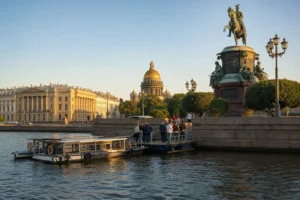 Senate Pier, Saint Petersburg: Boat Trips by the Bronze Horseman
Main image: AI-generated illustration. It may not show the place exactly as it looks.
Browse more: More in Admiralteysky · All Churches · All Saint Petersburg · All Sightseeing · All Sightseeing in Saint Petersburg
FAQ: Saint Isaac's Cathedral, Saint Petersburg
Is Saint Isaac's Cathedral still a working church?
Yes. Saint Isaac's Cathedral functions as a museum and also hosts Orthodox religious services. This combination explains why the interior includes both museum visitors and worshippers. The museum and parish activities have different purposes, so a normal sightseeing visit should not be confused with participation in a religious service.
Is the colonnade included in the cathedral ticket?
No. The public colonnade is a separately ticketed attraction from the cathedral interior. Visitors who want both experiences should choose the appropriate admission for each. The main museum ticket does not automatically provide access to the outdoor viewpoint.
How difficult is the climb to the colonnade?
The ordinary visitor route involves a substantial staircase, including narrow sections. Visitors should be comfortable climbing and descending many steps without relying on an ordinary passenger lift. The separate accessibility program is not the same as the standard public staircase route.
Can I visit the cathedral without climbing the colonnade?
Yes. The cathedral interior is an independent attraction and contains the principal paintings, mosaics, monumental columns and religious artwork. You can appreciate the architecture from the main floor without climbing to the outdoor viewpoint. This is a reasonable choice if you have limited time or prefer to avoid stairs.
Can I visit the basement memorial exhibition?
The To Remember memorial has special arrangements rather than ordinary individual visitor access. Under the current rules, admission is limited to qualifying pre-arranged groups. The access notice explains the relevant restriction, while the museum provides further information about the memorial and its history.
How far in advance should I buy tickets?
The museum offers online tickets, but a permanent advance-release period could not be verified. Check the dates displayed by the official booking system for your intended visit. A date that is not yet offered does not necessarily mean that every place has been sold.
Do I need a guided tour to understand the cathedral?
Not necessarily. Visitors can appreciate the main architecture, iconostasis, mosaics and paintings independently. A guided explanation can be useful if you want more detail about the construction techniques, religious imagery or relationship between the building and imperial Saint Petersburg. The most important features are also recognizable without specialist knowledge.
Is Saint Isaac's Cathedral the same as the Church of the Savior on Spilled Blood?
No. They are different historic churches in Saint Petersburg with distinct architecture and locations. Saint Isaac's Cathedral is the large neoclassical building with a dominant golden dome on Saint Isaac's Square. The Church of the Savior on Spilled Blood is a separate monument administered by the same museum institution.
Russia Vibes is a one-person project. A coffee keeps it going
Last updated: October 15, 2026. Found an error or something out of date? Report it and we will check and fix it.
How we research and update our guides
About this guide: AI assistance and accuracy
This guide is created with the help of AI and is based on official sources where available. Mistakes can still happen. Opening hours, prices, rules and other details are given to the best of our knowledge as of the date shown and can change without notice. It offers general recommendations only, not professional, legal or travel advice. Please confirm important details with the official source before you travel; you are responsible for your own plans and decisions.
International sanctions affect payments between Russia and many other countries. In practice, cards issued in the EU, the UK, the US and several other countries often do not work in Russia, Russian cards usually do not work abroad, and some booking platforms, airlines and payment providers limit or suspend their services for Russia. The situation changes frequently. We do not give legal or financial advice, and this site does not encourage anyone to break or circumvent sanctions. Whatever you plan, you are responsible for following the laws and regulations that apply to you, including those of your country of residence and citizenship. Many travelers still organise their stay lawfully. It is worth asking your bank or payment provider what is currently permitted, contacting hotels, tour operators and carriers directly about the payment methods they accept, and checking which services are open to customers from your country. Clarify payment, cancellation and refund terms before you commit to a booking, and keep your plans flexible. Partner links on this site may not be available in every country, and prices, availability and rules in our guides can differ from what you see when you book.Paying for your trip: please read

Take this guide with you
Get a free PDF of this guide to print or read offline: key facts, tips and a map link on a few clean pages.