
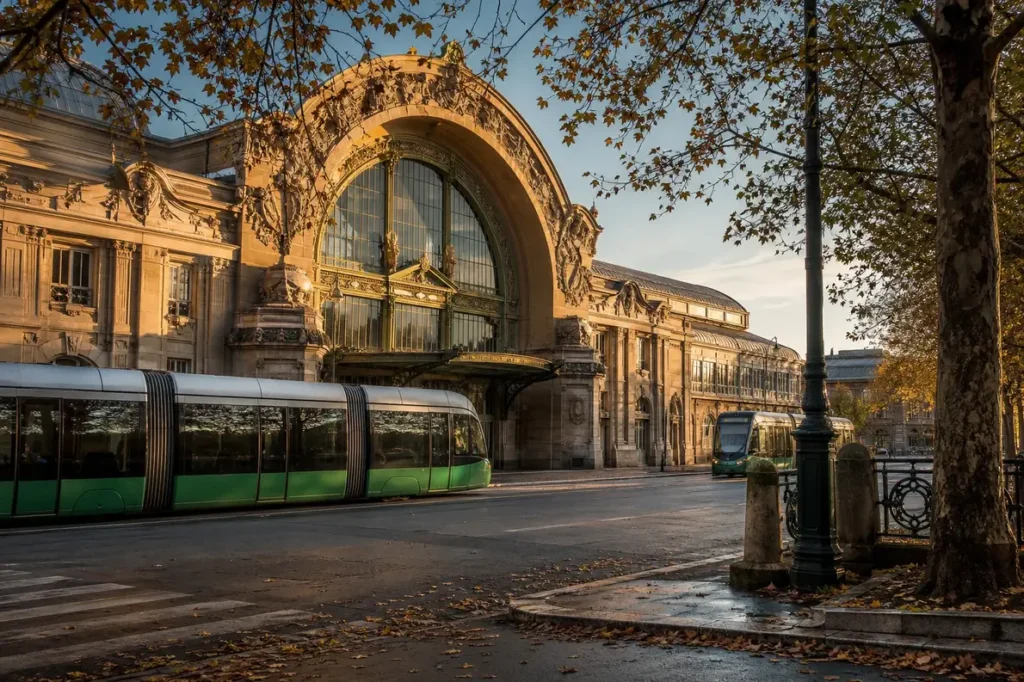
Vitebsky Railway Station on Zagorodny Prospekt began as the Tsarskoselsky terminus of the first railway in Russia, which opened on 30 October 1837 and ran to Tsarskoye Selo and Pavlovsk. The present building dates from 1902 to 1904, designed by Stanislav Brzhozovsky, and it is the most decorative station in the city, an Art Nouveau hall with a high metal dome.
Today Vitebsky Railway Station is best known to visitors as the departure point for suburban trains to Pushkin and Pavlovsk, whose palaces and parks are popular day trips, and for trains to Veliky Novgorod and to Belarus and the south-west. It is a short walk from Pushkinskaya and Zvenigorodskaya metro stations, which both connect to it, and from the Nevsky Prospekt area.
Quick Facts
| Russian name | Витебский вокзал |
|---|---|
| Type | Railway station |
| Built / opened | 1837 |
| Architect(s) | Stanislav Brzhozovsky (present building, 1902–1904, with engineer Sima Minash) |
| Address | Санкт-Петербург, Загородный проспект, 52 OpenStreetMap · Google Maps |
| District | Tsentralny District |
| Metro | Pushkinskaya (Line 1, the metro lobby stands by the station; Zvenigorodskaya is linked by a foot tunnel) Zvenigorodskaya (Line 5, transfer tunnel to Pushkinskaya, with a lobby in the Zvenigorodsky shopping complex) |
| Opening hours | The station building serves passengers around the clock in line with the train timetable, but ticket offices, left luggage and the shops keep their own hours. Check your train and the services you need before an early or late journey (as of October 2026 – check the official site of Russian Railways). |
| Admission | Free to enter the public halls; you pay only for your train ticket and any extras such as left luggage. |
| Best time to visit | The station works in every season, and suburban trains run throughout the day. For the calmest look at the hall, choose midday. The weekday morning and evening rush fills the halls, and summer weekends are crowded with day-trippers heading to Pushkin and Pavlovsk. |
| Recommended duration | 30 minutes to 1 hour, plus your train |
| Website | rzd.ru |
| Last updated | October 16, 2026 |
How to Get to and from Vitebsky Railway Station, Saint Petersburg
| Option | Duration | Price | Notes |
|---|---|---|---|
| Metro from Pushkinskaya or Zvenigorodskaya | A few minutes to the Nevsky Prospekt area | ₽ | Recommended. Pushkinskaya on Line 1 and Zvenigorodskaya on Line 5 are linked to the station and to each other by a foot tunnel. Line 1 runs to Vladimirskaya and Ploshchad Vosstaniya, and Line 5 runs to Sadovaya and Obvodny Kanal. |
| Walk to Nevsky Prospekt | About 20 to 25 minutes | Free | Best with light luggage and good weather. Walk north along the streets towards Nevsky Prospekt; check a map for the route. |
| Tram, bus or minibus | Varies | ₽ | Several city routes stop on Zagorodny Prospekt in front of the station. Check a map for the line that suits your hotel. |
| Official taxi or taxi app | 10 to 20 minutes to most central hotels | ₽₽ | The most comfortable option with luggage or at night. Use an official service or app, and ignore drivers who approach you in the hall. |
| Suburban train to Pushkin or Pavlovsk | About 30 to 40 minutes | ₽ | Trains leave from this station for Tsarskoye Selo (Pushkin) and Pavlovsk throughout the day. From the stations you need a bus or taxi for the palaces; check the timetable on the day. |
₽ budget · ₽₽ moderate · ₽₽₽ upscale · ₽₽₽₽ splurge. Price levels are estimates compared with typical prices for visitors.
Why Visit Vitebsky Railway Station, Saint Petersburg?
The station is worth a look in its own right: it is the oldest railway site in Russia, and its hall and facade are among the best Art Nouveau interiors in the city. A replica of the first train is on show inside, and the old imperial pavilion stands beside the platforms.
It is also the practical starting point for day trips to Pushkin, home of the Catherine Palace, and to Pavlovsk, which has its own palace and park. You pay only for a train ticket, and 30 minutes is enough to see the hall before you board.
Highlights of Vitebsky Railway Station, Saint Petersburg
The Art Nouveau hall
The present station was built in 1902 to 1904, designed by the architect Stanislav Brzhozovsky with the engineer Sima Minash, in the Art Nouveau style. The main hall rises to more than twenty metres and is crowned with a metal dome.
Panels in the halls show scenes from the history of the Tsarskoye Selo railway, the Peter and Paul Fortress and the port of Odessa.
Tip: Stand in the middle of the main hall and look up; the dome and the metal work are the main attraction.
The first railway in Russia
The Tsarskoye Selo railway, opened on 30 October 1837, was the first public railway in Russia. A small wooden building served as the first station, on the site where Pushkinskaya metro station now stands. A stone building by Konstantin Thon followed in 1849 to 1852.
The station later took its present name from the line to Vitebsk.
Tip: Look for the plaques and panels about the first line; they are easy to miss if you head straight for the platforms.
A replica of the first train
A replica of the first Russian train, the one that left for the imperial residence at Tsarskoye Selo, is on permanent display in the modern station. It is a small exhibit but a good reminder of what the line meant in 1837.
The exact location inside the building should be confirmed on site.
Tip: Ask staff or look at the signs; the replica is not on the main route to the platforms.
The Imperial Pavilion
On the side of the Vvedensky Canal stands the Imperial Pavilion, built beside the station for the imperial line. Trains of the imperial family and of foreign delegations left from here.
It is not open as a public sight in the same way as the main hall, so check the official information before you plan a visit.
Tip: Walk round to the canal side of the station if you want to see the pavilion from outside.
A station without a square
Unlike the other terminals, Vitebsky has no station square in front of it. Its main facade faces Zagorodny Prospekt directly, so the entrance feels like a doorway onto a city street.
In front of the station stands a monument to the Russian Guard of the Great War, unveiled on 1 August 2014, dedicated to the soldiers who left for the front from this station.
Tip: Cross Zagorodny Prospekt to see the full facade; it does not fit into the frame from the doors.
Trains to Pushkin and Pavlovsk
Suburban trains from Vitebsky run to the Tsarskoye Selo station in Pushkin, about 23 kilometres from the terminus, and to Pavlovsk, about 26 kilometres. Both are popular day trips for the palaces and parks. Other trains run to Veliky Novgorod and to Belarus and the south-west.
From the Pushkin station you need a bus or a taxi to reach the Catherine Palace.
Tip: Check the destination on the board; the same platform area serves trains to several towns.
Atmosphere
The main hall is tall and echoing, with a metal dome overhead and the constant sound of announcements, suitcase wheels and the shuffle of commuters. The decoration is lighter and more playful than in the other termini, with curves, metal work and historic panels along the walls.
It is busiest in the morning and early evening, when suburban commuters and day-trippers to Pushkin and Pavlovsk fill the halls, and calm in the middle of the day. Outside, Zagorodny Prospekt is a busy street with trams and buses, and the Vvedensky Canal side is quieter.
History of Vitebsky Railway Station, Saint Petersburg
The Tsarskoye Selo railway was built in 1836 and 1837 as the first public railway in Russia, running from Saint Petersburg to the imperial residence at Tsarskoye Selo and on to Pavlovsk. The first train, hauled by a steam locomotive, left on 30 October 1837 and reached Tsarskoye Selo in about 35 minutes.
The first station was a small wooden building on the site where Pushkinskaya metro station now stands. Between 1849 and 1852 it was replaced by a stone building, designed by Konstantin Thon, the architect of the Moskovsky station and of several of Moscow’s landmarks.
At the beginning of the twentieth century the old building was no longer enough. In 1902 to 1904 the architect Stanislav Brzhozovsky, with the engineer Sima Minash, built the present station in the Art Nouveau style, with a main hall more than twenty metres high under a metal dome. The imperial family had its own pavilion beside the station, on the Vvedensky Canal side, from which trains left for Tsarskoye Selo.
The station was later renamed Vitebsky after the railway to Vitebsk, which runs from here. Long-distance trains from Vitebsky served Belarus, Ukraine, Moldova and central Europe, while suburban trains kept up the old link to Pushkin and Pavlovsk.
In 1956 a lobby of the new metro station, Pushkinskaya, was built beside the station, and the station gave its first name, Vitebsky Vokzal, to the metro stop. In 2008 Zvenigorodskaya opened and was joined to Pushkinskaya by a foot tunnel, which added a second metro link.
Before the city’s 300th anniversary in 2003, the station’s interior and Art Nouveau decoration were carefully restored. On 1 August 2014, the hundredth anniversary of Russia’s entry into the First World War, a monument to the Russian Guard of the Great War was unveiled in front of the station.
Today Vitebsky is a working terminus with trains to Pushkin, Pavlovsk, Veliky Novgorod and other destinations, and a station that visitors often use on a day trip to the palaces.
Tickets and Payment at Vitebsky Railway Station, Saint Petersburg
Train tickets are sold by Russian Railways. Buy them online on the official site or in the mobile app, or at the ticket offices and machines in the station. Long-distance tickets are tied to a passenger’s identity document, so use your passport details exactly as written in your passport; suburban trains to Pushkin and Pavlovsk use simpler tickets.
- Online: the official site and app sell tickets for long-distance trains; availability opens well in advance.
- At the station: ticket offices and machines work for same-day travel; suburban tickets are also sold at machines on the platform side.
- Payment: whether a foreign bank card works varies, and the sanctions rules of your own country may restrict the use of Russian payment services, so check this yourself before you travel.
- Taxis: use an official service or app, and ignore drivers who approach you in the hall; unofficial drivers have a record of overcharging foreign visitors.
Rates for Russian citizens and concession categories differ. The official ticket page is on rzd.ru.
Flights, Transfers and Planning
Search flightsOpen in Yandex Maps
Advertisement: these are partner links. If you book or buy through them, we may earn a commission at no extra cost to you.
How to Get to Vitebsky Railway Station, Saint Petersburg
By metro: take Line 1 to Pushkinskaya, between Vladimirskaya and Tekhnologichesky Institut, or Line 5 to Zvenigorodskaya, between Sadovaya and Obvodny Kanal. Both stations are connected to each other by a foot tunnel, and the Pushkinskaya lobby is beside the station.
On foot: the station is on Zagorodny Prospekt, about a 20-minute walk from Nevsky Prospekt. The main facade faces the street, and there is no station square.
By road: taxis drop you at the facade; allow extra time at rush hour, when Zagorodny Prospekt is congested. Trams, buses and minibuses stop outside.
Accessibility
A station rebuilt and restored over the years is expected to have ramps, lifts and assistance services for passengers with reduced mobility, but specific details were not confirmed for this article. Request assistance from Russian Railways before your journey, and ask the station staff on arrival. The metro links include long escalators and a foot tunnel with stairs, so a taxi may be easier with a wheelchair.
Food Nearby
The station has cafes, bakeries and kiosks, but the names and tenants change, so look at the signs on the day. Outside, Zagorodny Prospekt and the streets towards Vladimirskaya have cafes and restaurants within a few minutes' walk.
What to Bring
Your passport for long-distance tickets, a payment option for taxis and food, comfortable shoes for the palace parks and a warm layer in winter. Security checks apply at the entrance, so keep bags easy to open.
Photography Rules
Photography is generally tolerated in the public halls and outside, but filming security staff, police and technical areas is not allowed. Drones are not permitted near the station, and tripods and professional equipment usually need permission from the railway.
Family Suitability
Workable for families. The halls are easy to navigate, and the trains to Pushkin and Pavlovsk are short and pleasant for children. Strollers need to be handled on the metro escalators unless a lift is available, which was not confirmed. The palace parks at the end of the line are easy for families.
Russia Vibes Tips
- Look at the facade from across Zagorodny Prospekt; there is no square, so you have to step back across the street.
- Combine the station with a day trip to Pushkin or Pavlovsk; the suburban trains leave from the same terminus.
- Check the destination on the board before boarding; several suburban lines share the platforms.
- Walk round to the Vvedensky Canal side to see the Imperial Pavilion from outside.
- Use the foot tunnel between Pushkinskaya and Zvenigorodskaya to change between Line 1 and Line 5.
- Do not confuse Vitebsky with Moskovsky; the Moscow trains leave from Moskovsky station on Nevsky Prospekt.
Explore Nearby Vitebsky Railway Station, Saint Petersburg
Metro stations near Vitebsky Railway Station, Saint Petersburg
 Pushkinskaya Metro Station, Saint Petersburgabout 50 m away (~1 min walk)
Main image: AI-generated illustration. It may not show the place exactly as it looks.
 Zvenigorodskaya Metro Station, Saint Petersburgabout 400 m away (~6 min walk)
Main image: AI-generated illustration. It may not show the place exactly as it looks.
 Tekhnologichesky Institut Metro Station, Saint Petersburgabout 800 m away (~13 min walk)
Main image: AI-generated illustration. It may not show the place exactly as it looks.
Sights near Vitebsky Railway Station, Saint Petersburg
 Russian Railway Museum, Saint Petersburgabout 2.4 km away · typical visit: 2–3 hours
Main image: AI-generated illustration. It may not show the place exactly as it looks.
 Yusupov Palace, Saint Petersburg – about 1.8 km away (~30 min walk) · typical visit: 1.5–2 hours for a standard palace route; approximately 2.5–3 hours for a comprehensive visit including the Rasputin exhibition.
Main image: AI-generated illustration. It may not show the place exactly as it looks.
 Saint Isaac's Cathedral, Saint Petersburg – about 2.0 km away (~32 min walk) · typical visit: 1.5–2 hours for the cathedral interior; allow another 45–60 minutes for the colonnade.
Main image: AI-generated illustration. It may not show the place exactly as it looks.
Train stations and river piers near Vitebsky Railway Station, Saint Petersburg
 Moskovsky Railway Station, Saint Petersburgabout 2.1 km away
Main image: AI-generated illustration. It may not show the place exactly as it looks.
 Baltiysky Railway Station, Saint Petersburgabout 2.3 km away
Main image: AI-generated illustration. It may not show the place exactly as it looks.
 Saint Petersburg Central Bus Stationabout 1.8 km away (~29 min walk)
Main image: AI-generated illustration. It may not show the place exactly as it looks.
Related guides
 Anichkov Bridge Pier, Saint Petersburg: Fontanka Boat Trips
Main image: AI-generated illustration. It may not show the place exactly as it looks.
 Palace Pier, Saint Petersburg: Boat Trips on the Neva
Main image: AI-generated illustration. It may not show the place exactly as it looks.
 Ploshchad Aleksandra Nevskogo Metro Station, Saint Petersburg: Guide
Main image: AI-generated illustration. It may not show the place exactly as it looks.
 Dostoevskaya Metro Station, Saint Petersburg: Novel-Themed Hall
Main image: AI-generated illustration. It may not show the place exactly as it looks.
 Vladimirskaya Metro Station, Saint Petersburg: Line 1 Marble Hall
Main image: AI-generated illustration. It may not show the place exactly as it looks.
Browse more: More in Tsentralny District · All Airports & Transport · All Airports & Transport in Saint Petersburg · All Railway Stations · All Saint Petersburg
FAQ: Vitebsky Railway Station, Saint Petersburg
Is Vitebsky the oldest station in Russia?
It stands on the site of the first railway terminus in Russia, which opened in 1837. The present building is from 1902 to 1904, and the stone predecessor by Konstantin Thon was built in 1849 to 1852.
Who designed the present building?
The architect Stanislav Brzhozovsky, with the engineer Sima Minash, in the Art Nouveau style. It was built in 1902 to 1904.
Which trains leave from Vitebsky?
Suburban trains to Pushkin, Pavlovsk and Veliky Novgorod, and long-distance trains to Belarus and the south-west. The Moscow trains leave from Moskovsky station. Check the official timetable on the day.
How do I get to the Catherine Palace?
Take a suburban train to the Tsarskoye Selo station in Pushkin, then a bus or taxi to the palace. Check a map and the timetable on the day.
Is there a metro station next to it?
Yes. Pushkinskaya on Line 1 and Zvenigorodskaya on Line 5 are linked to the station and to each other. See the options section for routes.
Why is there no square in front of the station?
The station's main facade looks out directly onto Zagorodny Prospekt, so it has no forecourt like the other termini.
Can I see the Imperial Pavilion?
It stands beside the station on the Vvedensky Canal side and can be seen from outside. Check the official information before you plan to go in.
Is it worth a special trip?
Yes, if you like railway history or Art Nouveau interiors, or if you are heading to Pushkin or Pavlovsk. Otherwise it is a station to pass through.
Russia Vibes is a one-person project. A coffee keeps it going
Last updated: October 16, 2026. Found an error or something out of date? Report it and we will check and fix it.
How we research and update our guides
About this guide: AI assistance and accuracy
This guide is created with the help of AI and is based on official sources where available. Mistakes can still happen. Opening hours, prices, rules and other details are given to the best of our knowledge as of the date shown and can change without notice. It offers general recommendations only, not professional, legal or travel advice. Please confirm important details with the official source before you travel; you are responsible for your own plans and decisions.
International sanctions affect payments between Russia and many other countries. In practice, cards issued in the EU, the UK, the US and several other countries often do not work in Russia, Russian cards usually do not work abroad, and some booking platforms, airlines and payment providers limit or suspend their services for Russia. The situation changes frequently. We do not give legal or financial advice, and this site does not encourage anyone to break or circumvent sanctions. Whatever you plan, you are responsible for following the laws and regulations that apply to you, including those of your country of residence and citizenship. Many travelers still organise their stay lawfully. It is worth asking your bank or payment provider what is currently permitted, contacting hotels, tour operators and carriers directly about the payment methods they accept, and checking which services are open to customers from your country. Clarify payment, cancellation and refund terms before you commit to a booking, and keep your plans flexible. Partner links on this site may not be available in every country, and prices, availability and rules in our guides can differ from what you see when you book.Paying for your trip: please read

Take this guide with you
Get a free PDF of this guide to print or read offline: key facts, tips and a map link on a few clean pages.