
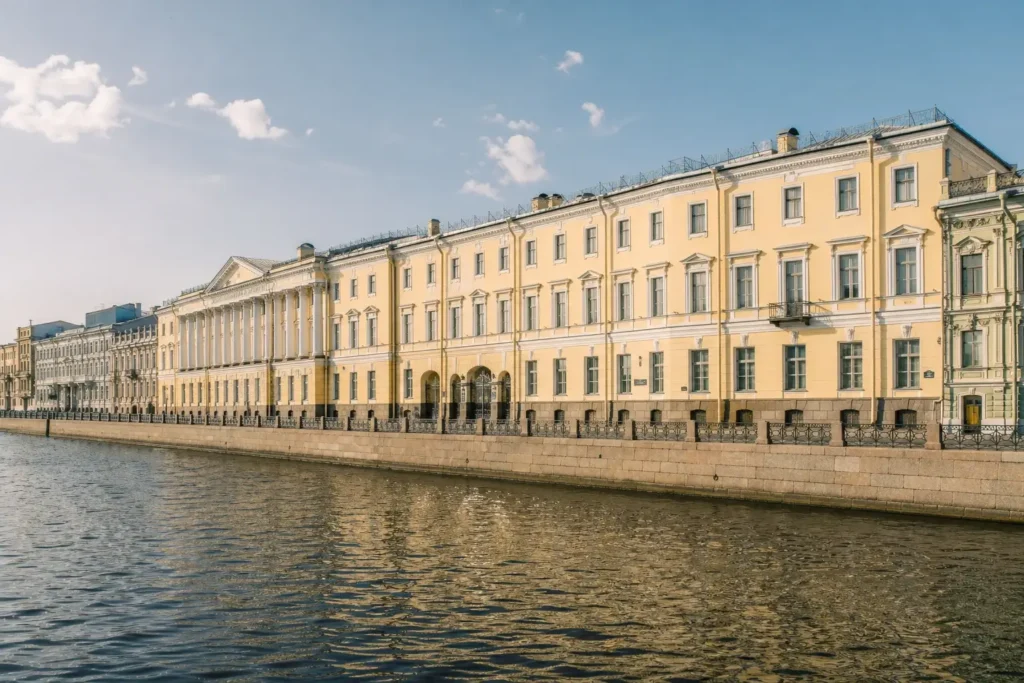
Yusupov Palace, Saint Petersburg stands on the Moika River in the Admiralteysky District, behind a restrained classical façade that gives little indication of the elaborate interiors inside. Once the residence of the wealthy Yusupov princely family, the palace preserves ceremonial halls, furnished private rooms, an intimate Home Theatre and spaces associated with the murder of Grigory Rasputin.
The building developed over generations, with much of its present appearance shaped by nineteenth-century alterations. Visitors can move from formal reception rooms decorated with gilding and chandeliers to smaller spaces reflecting the family’s private life. The theatrical interior and contrasting drawing rooms are particularly memorable. However, the palace operates several routes, and not every tour covers the same rooms. The Rasputin exhibition, private apartments and some specialist areas depend on the program selected. Understanding these differences is essential when planning a visit.
Quick Facts
| Russian name | Юсуповский дворец на Мойке |
|---|---|
| Built / opened | 1770s; substantially expanded and redesigned after 1830 |
| Architect(s) | Jean-Baptiste Vallin de la Mothe; later alterations by Andrey Mikhailov II, Bernard de Simon, Ippolit Monighetti, Vasily Kenel and others |
| Address | Санкт-Петербург, улица Декабристов, 21; исторический фасад: набережная реки Мойки, 94 OpenStreetMap · Google Maps |
| District | Admiralteysky |
| Metro | Sadovaya (Line 5 – Frunzensko-Primorskaya Line, Exit 3; approximately 20 minutes on foot, or continue by surface transport toward Teatralnaya Ploshchad.) Spasskaya (Line 4 – Pravoberezhnaya Line, Use the interchange toward Sadovaya and follow the pedestrian route to Dekabristov Street.) Sennaya Ploshchad (Line 2 – Moskovsko-Petrogradskaya Line, Approximately 20 minutes on foot via the surrounding central streets.) Admiralteyskaya (Line 5 – Frunzensko-Primorskaya Line, Walk southwest through the historic center toward the Moika and Dekabristov Street.) |
| Opening hours | Palace museum: daily, 10:00–19:30. Visits take place in scheduled sessions, with the final regular session at 18:00.
Ticket office and visitor entrance: daily, 09:30–18:00. The palace grounds and garden are open daily during daytime and evening hours. Individual exhibitions, concerts, theatrical performances and special programs follow their own schedules. (as of October 2026 – check the official site) |
| Admission | Standard palace routes: ₽₽. Comprehensive routes including additional private rooms and the Rasputin exhibition: ₽₽₽.
Guided and specialist programs: generally ₽₽–₽₽₽, depending on the route. Home Theatre performances have separate admission. Free and reduced categories depend on the program, age and eligibility. Some concessions are restricted to specified citizenship categories. (as of October 2026 – check the official site) |
| Best time to visit | Yusupov Palace is an indoor attraction that can be visited throughout the year. Its furnished rooms and theatre make it particularly suitable for cold, wet or windy days when outdoor sightseeing is less appealing.
Spring through autumn offers more comfortable conditions for exploring the estate garden and surrounding streets after the palace visit. Summer also provides opportunities to combine the museum with a longer walk along the Moika. For visitors planning a particular concert or specialist excursion, the program matters more than the season. The Home Theatre has its own repertoire, and museum routes operate in scheduled sessions. Weekday visits may provide a calmer setting than busy cultural weekends, but a specific crowd pattern for each route could not be verified. |
| Recommended duration | 1.5–2 hours for a standard palace route; approximately 2.5–3 hours for a comprehensive visit including the Rasputin exhibition. |
| Website | yusupov-palace.ru/en |
| Last updated | October 15, 2026 |
What Is (and Isn't) Part of a Visit to Yusupov Palace, Saint Petersburg?
| Part | Status | Notes |
|---|---|---|
| Main State Halls | Included in the standard ticket | The ceremonial rooms form the core of the standard introductory palace route. |
| White-Columned Hall | Included in the standard ticket | The grand Banquet Hall belongs to the principal ceremonial interiors. |
| Home Theatre auditorium | Included in the standard ticket | The historic auditorium is included in the museum's regular numbered routes. |
| Prince's private apartments | Separate ticket or institution | Choose a route explicitly including the living quarters to see these interiors. |
| Irina's rooms and the young couple's apartments | Separate ticket or institution | These additional domestic interiors appear in selected extended routes. |
| Rasputin murder exhibition | Separate ticket or institution | The reconstructed murder exhibition is included in designated combined or specialist routes. |
| Home Theatre performances | Separate ticket or institution | A concert or theatrical performance requires admission for the relevant event. |
| House Church | Separate ticket or institution | The restored church is not automatically included in a normal palace museum route. |
| Estate garden and courtyard | Outside / not part of it | The public garden and courtyard areas can be explored independently of the palace's ticketed interiors. |
| Mariinsky Theatre | Outside / not part of it | The nearby Mariinsky Theatre is a separate cultural institution and is not part of Yusupov Palace. |
Why Visit Yusupov Palace, Saint Petersburg?
Yusupov Palace offers a different perspective on imperial Saint Petersburg from the city’s major public museums. Its interiors were created for a princely household, allowing visitors to see how ceremonial entertaining and private family life occupied different spaces within the same estate.
The White-Columned Hall, richly colored drawing rooms and miniature Home Theatre provide a clear sense of aristocratic entertaining. The Prince’s private rooms reveal a more personal environment, including studies, dining rooms and interiors decorated in contrasting historical styles.
The palace also has a direct connection to the final years of imperial Russia. Its Rasputin exhibition explains the assassination that took place here in 1916 through reconstructed rooms and historical materials. Visitors interested in architecture, decorative arts and modern Russian history will find several distinct subjects within the same building.
How Yusupov Palace, Saint Petersburg Is Laid Out
The Yusupov Palace is more than the building visible from the Moika Embankment. It forms part of a historic urban estate extending inland toward Dekabristov Street, with a garden, courtyards and former service buildings.
The Moika façade forms the ceremonial riverfront side. Behind it, the main palace contains reception rooms, drawing rooms, galleries and private apartments arranged across different floors. The State Halls include formal spaces such as the White-Columned Hall and the colored drawing rooms. The Home Theatre is another part of the historic interior and remains in use for performances.
Private living quarters reveal a different scale of decoration, with studies, smaller drawing rooms and domestic spaces. The Rasputin exhibition occupies rooms associated with Prince Felix Yusupov, including a basement dining room reconstructed to explain the events of 1916.
The House Church occupies another area of the complex and has its own history. Former service buildings also support exhibitions and events.
The exact sequence of rooms depends on the selected visitor route. The most comprehensive programs connect the State Halls, private apartments, Home Theatre and Rasputin exhibition.
Highlights of Yusupov Palace, Saint Petersburg
The White-Columned Hall
The White-Columned Hall, also called the Banquet Hall, belongs to the major nineteenth-century rebuilding of the palace following its acquisition by the Yusupov family. Architect Andrey Mikhailov II created the grand classical interior as part of the expanded eastern wing. White columns with Corinthian capitals line the room, establishing a formal setting for receptions and ceremonial occasions. Its scale contrasts with the smaller domestic rooms elsewhere in the palace. Look at how the columns, ceiling decoration and open floor area work together to create an impression of aristocratic ceremony.
Tip: Stand near one end of the hall to appreciate the repeating columns before moving closer to the decorative details.
The Blue, Red and Green Drawing Rooms
The palace's colored drawing rooms illustrate the variety of decorative styles favored by its owners. Blue, red and green wall finishes establish distinct interiors, accompanied by elaborate ceilings, gilded ornament and period-style furnishings. These were not simply interchangeable reception spaces: each room presents a different combination of color, decoration and furniture. Moving between them makes the changes in atmosphere immediately apparent. Rather than examining individual objects in isolation, notice how the color of each room influences the appearance of its mirrors, chandeliers and carved details.
Tip: Compare the transitions between the drawing rooms. Their doorways provide useful perspectives on the contrasting interiors.
The Private Home Theatre
The Yusupov family's Home Theatre is an intimate performance space with gilded decoration, balconies and a small stage. Private theatrical entertainments were an important part of the household's cultural life, and members of the family performed alongside other aristocratic participants. The theatre also hosted musicians associated with Saint Petersburg's musical world. It continues to function as a performance venue. A museum route allows visitors to see the historic auditorium, while attending a concert or theatrical production is a separate experience with its own program.
Tip: Look toward the central and side boxes. The decoration includes details associated with the Yusupov family.
The Prince's Study and Private Rooms
The Prince's living quarters offer a more intimate perspective than the ceremonial halls. Rooms on the private route include the Prince's Study, the Music Drawing Room and the Oak Dining Room, along with interiors decorated in contrasting historical styles. These spaces suggest how the family separated entertaining from daily activities. Wood paneling, furniture, fireplaces and decorative details become more prominent as the rooms become smaller. The private apartments are included in selected visitor routes rather than every basic palace visit, so their availability depends on the chosen program.
Tip: Compare the proportions of the Prince's Study with the larger reception halls to understand the difference between public and private life.
The Moorish Drawing Room
The Moorish Drawing Room is one of the most distinctive interiors in the Prince's private apartments. Its decoration uses Moorish-inspired architectural forms and ornamental patterns rather than the classical vocabulary found in the State Halls. The result illustrates the nineteenth-century interest in historical and exoticized interior styles among wealthy European and Russian households. Look for the relationship between the decorative surfaces and the room's architectural elements. The room belongs to routes that include the private apartments and should not be assumed to form part of the shortest visit.
Tip: Notice how the ornamental treatment differs from the white classical columns and gilding in the ceremonial rooms.
Irina's Rooms and the Young Couple's Apartments
The palace contains rooms associated with Princess Irina and the younger generation of the Yusupov family. The more comprehensive visitor routes include the Silver Boudoir, Irina's Bedroom, the Small Ballroom and Felix's Large Drawing Room. These spaces belong to a different phase of the palace's domestic life from the formal nineteenth-century reception halls. The interiors combine private furnishings with carefully designed decorative schemes. Visitors interested in the final years of the family's residence should consider a route covering these rooms rather than one focused exclusively on the State Halls.
Tip: Follow the sequence from the earlier private rooms to the young couple's apartments to see how domestic interiors changed within the palace.
The Rasputin Murder Exhibition
Grigory Rasputin was assassinated in the palace in December 1916. The exhibition occupies rooms connected with Prince Felix Yusupov, including the conspirators' room and a basement dining room. Reconstructed interiors, wax figures, photographs and documents help visitors follow the events and their investigation. The display is a historical reconstruction, not an untouched crime scene. It is included in specific comprehensive and themed routes rather than every visit. The exhibition also has physical access limitations because of narrow interior passages.
Tip: Distinguish the historical rooms from the reconstructed scenes. The exhibition combines original spaces with later interpretive material.
The House Church
The Yusupov family's private church was designed by Vasily Kenel and consecrated in 1881. Located on an upper floor, it became an important setting for family ceremonies, including the marriage of Zinaida Yusupova and Felix Sumarokov-Elston in 1882. The church was dismantled during the Soviet period and later reconstructed, with religious use restored in 2014. It is not automatically part of a normal palace route. Visitors interested in this aspect of the family's history should check whether a dedicated program includes the church or its associated exhibition.
Tip: Treat the House Church as a separate point of interest rather than assuming the ordinary palace route reaches every upper-floor interior.
The Estate Garden and Main Courtyard
The historic estate extends from the Moika-facing palace toward Dekabristov Street. Its garden, main courtyard and former service buildings reveal that the residence originally operated as a substantial urban household rather than a single mansion. Carriages, servants, kitchens and other domestic functions occupied areas away from the principal ceremonial rooms. Some historic courtyard structures survive, including features associated with the earlier estate. Walking through the grounds helps visitors understand the relationship between the decorative palace and the practical spaces that supported it.
Tip: Use the courtyard and garden to understand the scale of the estate before concentrating on the furnished rooms.
Atmosphere
The exterior of Yusupov Palace is comparatively restrained: a long classical façade follows the Moika, while the more elaborate estate spaces lie behind it. This contrast becomes evident on entering the decorated rooms.
The State Halls feel formal, with polished floors, chandeliers, mirrors and richly colored walls. The White-Columned Hall provides a sense of scale, while the smaller apartments feel more domestic. The Home Theatre introduces a different atmosphere, with gilded balconies and a compact auditorium that recalls private aristocratic performances.
The Rasputin exhibition changes the mood again. Its reconstructed rooms and historical narrative focus attention on a dramatic episode rather than decorative luxury. In the garden and courtyards, the setting becomes quieter and easier to understand as an urban estate. Each route creates a somewhat different impression of the palace.
History of Yusupov Palace, Saint Petersburg
The palace’s origins reach back to the early development of Saint Petersburg. The property formed part of an urban estate near the Moika River. During the eighteenth century, the site passed through several owners before becoming associated with Count Andrey Shuvalov.
In the 1770s, architect Jean-Baptiste Vallin de la Mothe designed a classical residence for Shuvalov. It was smaller than the present palace, and the principal façade contained an archway through which carriages entered the estate. Courtyards and service buildings stood behind the riverfront residence.
Following Shuvalov’s death, Catherine II acquired the property for Alexandra Branitskaya, who received it as a hereditary possession in 1795. The estate remained associated with Branitskaya until 1830, when she sold the furnished palace to the Yusupov family.
Prince Boris Yusupov took possession of the residence, and members of the family settled there after the death of his father in 1831. This marked the beginning of extensive alterations. From 1832, the estate’s eastern buildings were enlarged and adapted to accommodate the family’s collections, servants and domestic activities.
Architect Andrey Mikhailov II played a leading role in the nineteenth-century rebuilding. The expanded palace gained new ceremonial interiors, including the White-Columned Hall. The family also developed private apartments, reception rooms and spaces for displaying works of art. The palace became both a residence and a setting for cultural entertainment.
Music had an important place in the household. In 1836, composer Mikhail Glinka rehearsed part of his opera A Life for the Tsar with the Yusupov orchestra. The private theatre hosted performances and musicians, including distinguished European visitors. Further alterations under architects such as Ippolit Monighetti contributed to the decorative variety of the residence.
In the early 1880s, the family added a private church. Designed by Vasily Kenel, it was consecrated in 1881. Zinaida Yusupova married Felix Sumarokov-Elston there in 1882. Later family ceremonies included the baptism of their grandson Felix in 1887 and the baptism of the youngest Felix’s daughter Irina in 1915.
The palace became internationally associated with Grigory Rasputin’s assassination. On the night of December 16–17, 1916, Rasputin was killed during a conspiracy involving Prince Felix Yusupov. The episode took place in the private part of the residence and became one of the most discussed political murders of the late Russian Empire.
The revolutionary period ended the palace’s existence as a princely family residence. The building was later used for cultural and educational purposes. In 1925, it was transferred to the educational authorities. The private House Church ceased operating and was subsequently dismantled, with its former space converted to other uses.
During the Siege of Leningrad, the building served as an evacuation hospital. Hospital beds and heating stoves were installed in its historic halls, while bombardment and wartime conditions damaged the interiors.
Conservation work began in 1943, followed by a large restoration program in 1946 under Irina Benois. Over subsequent decades, the palace’s ceremonial and private rooms were preserved and restored for cultural use.
During the 1990s, the institution developed into a wider historical and cultural center with exhibitions, guided visits and performances. The reconstructed House Church was consecrated again in 2014. Today, visitors encounter several historical periods within the same estate, from eighteenth-century classical architecture to the last years of imperial Russia and the building’s later public functions.
Tickets and Booking for Yusupov Palace, Saint Petersburg
| Ticket | Price | Includes |
|---|---|---|
| Standard introductory palace route | ₽₽ | The principal State Halls and other interiors specified for the shorter introductory route, including the historic Home Theatre. |
| State Halls and Prince's living quarters | ₽₽ | The ceremonial interiors and selected private apartments of the Yusupov family. |
| Comprehensive self-guided palace route | ₽₽₽ | The State Halls, Prince's private rooms, the young couple's apartments and the Rasputin murder exhibition. |
| Guided palace and Rasputin route | ₽₽₽ | The State Halls and Rasputin exhibition, with a guide explaining the historical setting and events. |
| Home Theatre performance | ₽₽–₽₽₽₽ | Admission to the selected concert or theatrical performance, without assuming access to the museum's other interiors. |
₽ budget · ₽₽ moderate · ₽₽₽ upscale · ₽₽₽₽ splurge. Price levels are estimates compared with typical prices for visitors.
Buy tickets through the official palace ticket system at tickets.yusupov-palace.ru or at the museum ticket office. Choose the route according to the rooms you want to see. The shorter introductory route covers the best-known State Halls, while the most comprehensive route includes the additional private apartments and the Rasputin exhibition.
For guided group tours, sales for the following month normally open on the 23rd of the current month. Other programs may have different availability. If your preferred date is not yet shown, check the official schedule again rather than assuming the visit is sold out.
The visitor entrance is at 21 Dekabristov Street. Allow approximately 15 minutes to cross the estate and reach the exhibition entrance. Palace entry is permitted no earlier than 30 minutes before the session. Electronic tickets do not require exchange at the ticket office. Same-day tickets can be purchased when sessions remain available.
The comprehensive self-guided audio route is offered in Russian, so confirm suitable language options before choosing. Reduced and free tickets require appropriate documentation; rates for Russian citizens and concessions differ. Check the official ticket information on yusupov-palace.ru for all categories.
Plan and Book
Suggested itineraries Yusupov Palace, Saint Petersburg
1 hour 15 minutes
Choose the introductory State Halls route. Begin with the ceremonial interiors and compare the differently decorated drawing rooms before reaching the White-Columned Hall. Continue through the gallery areas and finish with the miniature Home Theatre. This is a practical first visit for travellers primarily interested in architecture and aristocratic interiors.
1.5 hours
Select a route covering the State Halls and the Prince's private apartments. Start with the larger reception rooms, then move into the domestic section. Pay attention to the changes in room size, furniture and decoration. Include the Moorish Drawing Room and Prince's Study to understand how personal interiors differed from ceremonial spaces.
2 hours
Choose a comprehensive route that includes the Rasputin exhibition. Follow the ceremonial rooms and Home Theatre before continuing through the Prince's apartments and the young couple's rooms. Finish with the historical exhibition in the rooms associated with Felix Yusupov and the murder of Rasputin. This route combines decorative interiors with the palace's twentieth-century history.
Half day
Begin with a comprehensive palace visit, taking time to compare the ceremonial halls with the private apartments and Rasputin exhibition. After completing the interior route, explore the estate garden and courtyard. Continue outside to the Moika Embankment, where the restrained riverfront façade provides a contrasting final view of the building.
How to Get to Yusupov Palace, Saint Petersburg
From the Metro: Sadovaya, Spasskaya and Sennaya Ploshchad form a convenient interchange for reaching the palace. The walk from the station area is approximately 20 minutes. Sadovaya Exit 3 is identified in the palace’s accessibility directions.
By bus: The palace lists buses 3, 22 and 27 serving Teatralnaya Ploshchad. The stop is a short walk from the estate. Additional surface routes may be available; check the current operator information.
From central Saint Petersburg: Visitors already exploring the historic center can approach on foot through the streets around Saint Isaac’s Square or the Moika area. The journey from the Admiralty side is suitable for a longer city-center walk.
By taxi: Give the visitor entrance address rather than only the well-known riverfront address. The palace grounds extend between the Moika and Dekabristov Street.
Accessibility
Yusupov Palace is partially accessible to visitors with reduced mobility. The official accessibility information confirms a ramp and assistance call button at the Main Courtyard entrance. Wheelchair users can visit selected ground-floor interiors, including the Music Drawing Room, Prince's Study, Moorish Drawing Room and Winter Garden.
The palace does not have an ordinary public lift connecting all visitor floors. The State Halls and Home Theatre on the upper floor therefore present difficulties, while the Rasputin exhibition has narrow passages that cannot accommodate wheelchairs or large mobility devices.
A video presentation of the upper-floor ceremonial rooms is available in the Winter Garden. Accessible toilets and adapted visitor information are provided. The palace requests advance coordination for wheelchair visits and offers assistance through its staff.
Food Nearby
The palace has a café in its garden area, which can be reached independently of the museum interiors. This provides a practical option for refreshments before or after a visit.
The surrounding Admiralteysky District also contains cafés and restaurants along the central streets near Teatralnaya Ploshchad and the Moika. These areas can be explored on foot after leaving the estate.
Visitors combining the palace with the Mariinsky Theatre may find it convenient to plan a meal in the same general neighborhood. Restaurant operating hours and available menus should be checked individually, particularly when arranging an evening performance.
What to Bring
Wear comfortable shoes for walking across the estate and through the furnished rooms. During autumn and winter, bring footwear suitable for wet or snowy streets and follow the museum's requirements for protective shoe covers indoors.
A charged phone is useful for navigation and the palace's mobile audio-guide application. Visitors choosing an audio route may benefit from downloading the available material before arrival.
Bring only the belongings needed for the visit. Large travel bags and suitcases are not permitted, and outerwear, umbrellas and bulky personal items must be left in the designated storage areas.
Best Views and Photo Spots of Yusupov Palace, Saint Petersburg
Moika Embankment
The riverfront provides a view of the palace's long classical façade and its relationship to the Moika. The restrained exterior creates a useful contrast with the lavish interiors that visitors encounter inside.
Best time: Daylight with soft morning or late-afternoon light on the surrounding buildings.
Main Courtyard
The courtyard reveals the estate's formal arrangement, including historic architectural elements behind the riverfront palace. It helps show that the residence belonged to a larger urban household with gardens and service spaces.
Best time: Daylight, preferably before or after the main interior visit.
The White-Columned Hall
The repeated white columns, classical decoration and open ceremonial floor create a strong interior composition. A view along the hall emphasizes its scale and the symmetry of the architectural design.
Best time: During a permitted museum visit, when the interior lighting allows the full room to be seen.
The Colored Drawing Rooms
The Blue, Red and Green Drawing Rooms provide contrasting combinations of wall color, gilded decoration and furnishings. Doorways between the rooms can reveal how the interiors form a sequence of different decorative environments.
Best time: During the relevant interior route; natural illumination varies between rooms.
The Home Theatre
The miniature theatre combines a small stage, decorative balconies, gilded details and upholstered seating. A view toward the stage shows its intimate proportions and the theatrical setting once used by the princely household.
Best time: During a museum route when photography is permitted and the room is not being used for a performance.
The Moorish Drawing Room
The decorative forms and patterned surfaces of the Moorish Drawing Room contrast sharply with the classical State Halls. This makes it a useful subject for showing the range of interior styles within the palace.
Best time: During a route including the Prince's private apartments.
Photography Rules
Amateur photography and video are permitted for individual visitors without an additional photography charge. Professional equipment, tripods and selfie sticks are prohibited without special permission. Do not touch furnishings or cross barriers to improve a photograph. Follow staff instructions during guided visits, performances and temporary exhibitions.
Family Suitability
Yusupov Palace can appeal to families with older children interested in history, architecture and unusual interiors. The miniature Home Theatre, colored drawing rooms and stories of aristocratic life provide recognizable subjects beyond the palace's decorative details.
The Rasputin exhibition deals with a violent historical event and is less suitable for younger children. The comprehensive self-guided route carries an age recommendation of 16+, which should be considered when choosing a family visit.
Strollers are permitted, but the absence of a public lift and the narrow passages in some areas limit movement. The palace offers family-oriented activities for younger children during part of the year, providing an alternative to a lengthy historical tour.
Russia Vibes Tips
- Do not judge the palace by its modest-looking Moika façade. The architectural contrast between exterior and interior is part of what makes the visit distinctive.
- If architecture is your main interest, concentrate first on the State Halls and theatre. The Rasputin exhibition is a separate historical experience rather than the palace's only attraction.
- Pay attention to how the ceiling heights, furniture and ornament change as you move from ceremonial rooms into private apartments. This makes the former household's organization easier to understand.
- Look for the Yusupov family monogram in the Home Theatre. Small heraldic details connect the ornate auditorium directly with its former owners.
- Use the estate garden to understand the property's original scale. From the street, it is easy to mistake the palace for a single riverside building.
- Keep the Mariinsky Theatre and Yusupov Palace as separate cultural visits. Both have performance histories, but the palace's Home Theatre is a smaller, historically private venue.
Explore Nearby Yusupov Palace, Saint Petersburg
Sights near Yusupov Palace, Saint Petersburg
 Mariinsky Theatre, Saint Petersburg · typical visit: An evening: about 3 hours for a performance
Main image: AI-generated illustration. It may not show the place exactly as it looks.
 Saint Isaac's Cathedral, Saint Petersburg – about 750 m away (~12 min walk) · typical visit: 1.5–2 hours for the cathedral interior; allow another 45–60 minutes for the colonnade.
Main image: AI-generated illustration. It may not show the place exactly as it looks.
 Central Naval Museum, Saint Petersburgabout 350 m away (~5 min walk) · typical visit: 2–3 hours
Main image: AI-generated illustration. It may not show the place exactly as it looks.
 New Holland Island, Saint Petersburgabout 600 m away (~10 min walk) · typical visit: 1.5–2 hours
Main image: AI-generated illustration. It may not show the place exactly as it looks.
 Kunstkamera, Saint Petersburgabout 1.5 km away (~25 min walk) · typical visit: 2 hours
Main image: AI-generated illustration. It may not show the place exactly as it looks.
 Palace Bridge, Saint Petersburg – about 1.5 km away (~25 min walk) · typical visit: 30–45 minutes; allow 1.5–2 hours if you wait for the night raising
Main image: AI-generated illustration. It may not show the place exactly as it looks.
Metro stations near Yusupov Palace, Saint Petersburg
 Spasskaya Metro Station, Saint Petersburgabout 950 m away (~15 min walk)
Main image: AI-generated illustration. It may not show the place exactly as it looks.
 Sadovaya Metro Station, Saint Petersburgabout 950 m away (~15 min walk)
Main image: AI-generated illustration. It may not show the place exactly as it looks.
Train stations and river piers near Yusupov Palace, Saint Petersburg
 Rumyantsev Descent Pier, Saint Petersburgabout 1.1 km away (~19 min walk)
Main image: AI-generated illustration. It may not show the place exactly as it looks.
 Vitebsky Railway Station, Saint Petersburgabout 1.8 km away (~30 min walk)
Main image: AI-generated illustration. It may not show the place exactly as it looks.
Related guides
 Best Things to Do, Saint Petersburg: 10 Sights, Boats and Views
Main image: AI-generated illustration. It may not show the place exactly as it looks.
Browse more: More in Admiralteysky · All Museums · All Saint Petersburg · All Sightseeing · All Sightseeing in Saint Petersburg
FAQ: Yusupov Palace, Saint Petersburg
Is Yusupov Palace the place where Rasputin was murdered?
Yes. Grigory Rasputin was assassinated in the palace in December 1916 during a conspiracy involving Prince Felix Yusupov. The museum preserves rooms associated with the event and presents a reconstructed exhibition using figures, photographs and documents. The rooms are historically connected with the event, but the displayed scene is a later reconstruction.
Can I see the Rasputin exhibition with a standard ticket?
Not every palace route includes it. Visitors need a program that explicitly lists the Rasputin murder exhibition among its attractions. The comprehensive route includes the exhibition together with the ceremonial and private rooms. Check the route description in the ticket section rather than relying on the general palace name.
Which Yusupov Palace tour is best for a first visit?
The introductory route is appropriate if you want to see the principal ceremonial halls and the Home Theatre without spending time on every private apartment. A comprehensive route is more suitable for visitors interested in both the family interiors and the Rasputin story. The choice depends on which part of the palace interests you most.
Is the Yusupov Palace Home Theatre still used?
Yes. The miniature private theatre continues to host concerts and theatrical performances. Its historic auditorium can also be viewed during regular museum routes. Seeing the room on a tour and attending a live performance are different experiences, so the current theater program should be considered separately from ordinary sightseeing.
Can I visit Yusupov Palace without a guide?
Yes, the palace offers self-guided routes using an audio guide or mobile application. However, visitors must follow the designated route and cannot freely enter rooms outside their selected program. The comprehensive audio route is listed in Russian, so international visitors should verify whether a suitable language option is available.
How far in advance can I book Yusupov Palace tickets?
The palace normally opens sales for guided group excursions for the following month on the 23rd of the current month. This does not necessarily describe the booking window for every self-guided or special program. Consult the official ticket calendar for your selected route and use the booking section for the relevant arrangements.
Is Yusupov Palace wheelchair accessible?
The palace is partially accessible. Selected first-floor interiors can be visited in a wheelchair, while the upper State Halls and Rasputin exhibition have significant limitations. The museum provides assistance and a video presentation of the upper-floor rooms. Visitors should contact the institution in advance to arrange an appropriate route.
Is Yusupov Palace close to the Mariinsky Theatre?
Yes, the palace is within walking distance of the Mariinsky Theatre in the Admiralteysky District. The two buildings are separate institutions, however, and a performance at one does not include entry to the other. Their proximity makes it possible to combine a palace visit with another cultural activity on the same day.
Russia Vibes is a one-person project. A coffee keeps it going
Last updated: October 15, 2026. Found an error or something out of date? Report it and we will check and fix it.
How we research and update our guides
About this guide: AI assistance and accuracy
This guide is created with the help of AI and is based on official sources where available. Mistakes can still happen. Opening hours, prices, rules and other details are given to the best of our knowledge as of the date shown and can change without notice. It offers general recommendations only, not professional, legal or travel advice. Please confirm important details with the official source before you travel; you are responsible for your own plans and decisions.
International sanctions affect payments between Russia and many other countries. In practice, cards issued in the EU, the UK, the US and several other countries often do not work in Russia, Russian cards usually do not work abroad, and some booking platforms, airlines and payment providers limit or suspend their services for Russia. The situation changes frequently. We do not give legal or financial advice, and this site does not encourage anyone to break or circumvent sanctions. Whatever you plan, you are responsible for following the laws and regulations that apply to you, including those of your country of residence and citizenship. Many travelers still organise their stay lawfully. It is worth asking your bank or payment provider what is currently permitted, contacting hotels, tour operators and carriers directly about the payment methods they accept, and checking which services are open to customers from your country. Clarify payment, cancellation and refund terms before you commit to a booking, and keep your plans flexible. Partner links on this site may not be available in every country, and prices, availability and rules in our guides can differ from what you see when you book.Paying for your trip: please read

Take this guide with you
Get a free PDF of this guide to print or read offline: key facts, tips and a map link on a few clean pages.