
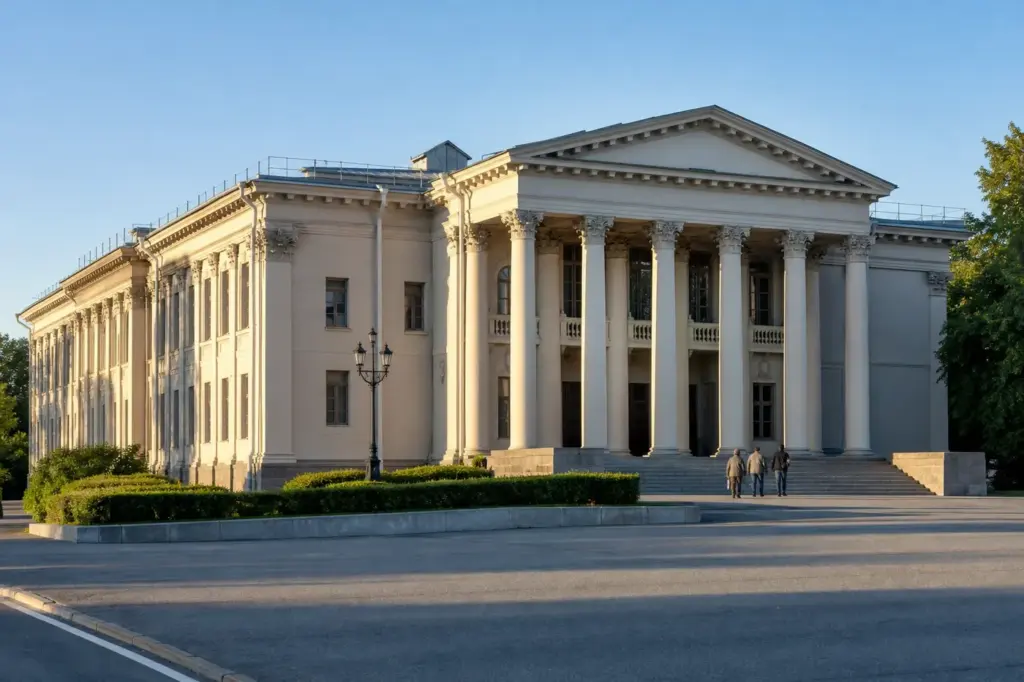
The National Museum of the Republic of Karelia occupies a historic architectural ensemble in the heart of Petrozavodsk, the capital of the Republic of Karelia. Originally established in 1871, the museum relocated to its current building in 1993. The collection contains more than 230,000 items and is housed in the historical center on Lenin Square, which is a cultural monument of federal significance.
What makes this museum essential is its comprehensive presentation of a distinct regional identity. Across 24 permanent exhibition halls, visitors encounter the history and culture of the region from ancient times to the end of the 19th century. The museum offers more than just displays—it provides context for understanding Karelia’s place between Russian and Finnish cultural spheres, and its rich archaeological past.
Quick Facts
| Russian name | Национальный музей Республики Карелия |
|---|---|
| Built / opened | 1871 |
| Address | Ploshchad Lenina 1, Petrozavodsk, Republic of Karelia, 185035 Google MapsApple MapsYandex Maps2GIS |
| District | Petrozavodsk |
| Admission | ₽ for permanent exhibition; ₽ for temporary exhibitions |
| Best time to visit | Weekday mornings (Tuesday through Friday, before 12:00) offer the quietest experience for reading displays and reflecting without crowds. Weekends and afternoons can attract school groups and local visitors, particularly Saturday and Sunday. The museum is open year-round; there is no seasonal advantage for comfort, though summer brings more international tourists to Petrozavodsk generally. |
| Website | kareliamuseum.ru |
What Is (and Isn't) Part of a Visit to National Museum of the Republic of Karelia, Karelia?
| Part | Status | Notes |
|---|---|---|
| Permanent Exhibition in Main Building | Included in the standard ticket | 24 halls covering history, culture, archaeology and ethnography from ancient times through the 19th century. |
| Temporary Exhibitions | Separate ticket or institution | Rotating special exhibitions require a separate ticket; check the official website to see current offerings. |
| Audio-guides and Guided Tours | Separate ticket or institution | Audio-guides and conducted tours are available for an additional fee; reserve in advance by phone for groups. |
| Museum Gift Shop | Included in the standard ticket | Accessible free of charge; sells books, reproductions, and Karelian crafts. |
| Children's Programs and Educational Activities | Separate ticket or institution | Special programs for school groups and families are offered seasonally; inquire at the ticket desk. |
| Kizhi Museum-Reserve Branches | Outside / not part of it | The Kizhi Island museum complex operates separately with its own tickets and requires ferry transport; not part of this museum. |
| Museum of Fine Arts of the Republic of Karelia | Outside / not part of it | Located at Karl Marx Avenue 8, a separate institution with its own collection of icons and Russian art; separate ticket required. |
Why Visit National Museum of the Republic of Karelia, Karelia?
This museum is your best single entry point to understanding Karelia’s layered history and way of life. Collections range from goods from Western Europe to the Russian Empire, revealing the region’s historical connections and trade networks. The museum sits in buildings that are themselves part of the story—historic structures on Lenin Square that have witnessed Petrozavodsk’s development.
The display is designed for engagement: interactive exhibits can be touched, audio-excursions are available, and facilities for visitors with disabilities are provided. Whether you are interested in regional archaeology, ethnography or the practical life of Karelian communities, the museum offers concrete visual evidence rather than abstraction.
How National Museum of the Republic of Karelia, Karelia Is Laid Out
The museum occupies a complex of historic buildings on Lenin Square, with the main permanent exhibition housed in the primary building and additional halls nearby. Visitors enter through the main facade on Lenin Square. The 24 exhibition halls flow through the structure, covering different periods and themes—from prehistoric archaeology and natural history through medieval and imperial periods. Allow time to navigate between halls, particularly if using audio guides or attending themed sections. The museum shop and visitor services occupy ground-floor areas near the main entrance.
Highlights of National Museum of the Republic of Karelia, Karelia
Prehistoric and Ancient Karelia Gallery
This section traces human settlement and development in the region from earliest times through the medieval period. Display cases feature stone tools, ceramic vessels, and hunting implements that illustrate how people adapted to Karelia's lake-and-forest landscape. Look for the carefully labeled archaeological finds that show trade connections with neighboring regions—evidence of objects traveling along waterways.
Tip: Read the labels carefully; bilingual descriptions in English and Russian explain the significance of seemingly ordinary objects like fishing hooks and reindeer bones.
Ethnographic Collections
The museum's ethnographic sections showcase traditional Karelian, Vepsian and Sámi material culture—clothing, household tools, wooden furniture and seasonal equipment. Textiles are particularly striking, with traditional patterns and weaving techniques on display. These halls help visitors understand the practical realities of forest and water-based life across centuries.
Tip: Notice the seasonal variations in clothing and tools—the museum explains how climate and available resources shaped daily life differently across Karelia's regions.
Icons and Religious Art
Karelia has a significant tradition of Orthodox icon painting, and this gallery displays works spanning several centuries. The icons show both high-quality metropolitan examples and works by local craftsmen. Some date to periods when the region was contested between Orthodox Russia and Lutheran Scandinavia.
Tip: The lighting in this gallery is deliberately soft to preserve the icons; let your eyes adjust to see the fine details and gold leaf work.
Natural History and Wildlife
An exhibition on the nature of Karelia presents more than two hundred species of animals and birds of the region, plus modern multimedia kiosks. This gallery explains the ecosystem that shaped human settlement and provides context for understanding why certain locations in Karelia became important for hunting, fishing and trade.
Tip: This section works well if you are planning field trips to Karelia's lakes or forests—seeing the animal and plant species first helps you recognize them in nature.
Medieval Period and Trade Networks
Galleries covering the medieval period reveal Karelia's role as a crossroads. Archaeological finds show contact with Scandinavia, the Baltic and Russia. Objects like coins, metal work, and fragments of fortifications tell the story of a region that was culturally and economically significant despite its remote location.
Tip: Ask staff where the medieval fortification sites are located; several of these archaeological sites are accessible as day trips from Petrozavodsk.
Temporary Exhibitions
The museum regularly hosts temporary exhibitions that complement the permanent displays. These rotate and cover themes ranging from contemporary Karelian art to focused historical topics. Thematic exhibitions often provide depth on subjects that the permanent galleries touch lightly.
Tip: Check the official website before your visit to see what temporary exhibition is on display—sometimes they relate directly to nearby sites you might want to visit.
Interactive and Educational Spaces
The museum offers interactive elements designed to engage visitors, with exhibits that can be touched and handled. These spaces allow hands-on learning about historical crafts, tools and daily life.
Tip: If you are traveling with children or are interested in a more tactile experience, ask staff which galleries have the most interactive components.
Atmosphere
The museum occupies historic buildings that themselves convey a sense of permanence and careful stewardship. Wide corridors and well-lit exhibition halls create a calm, contemplative environment. Display cases are thoughtfully arranged, and the bilingual captions in Russian and English make the content accessible. On weekday mornings, the museum is often quiet—you can move through galleries without crowding.
The tone is scholarly but approachable, never pedantic. The displays are praised for their informative content with bilingual descriptions, offering a deep dive into the rich culture of Karelia. Occasionally you will encounter school groups, particularly on weekends, but the building’s scale absorbs them. The ground-floor gift shop has a modest but genuine selection of Karelian crafts and books.
History of National Museum of the Republic of Karelia, Karelia
The National Museum of the Republic of Karelia was founded in 1871 by Olonets Governor Grigory Grigoriev. This date places it among Russia’s older regional museums, reflecting both Karelia’s historical importance and the 19th-century Russian tradition of documenting regional culture. The founding occurred during a period when Karelia was administratively part of the Russian Empire, though culturally and geographically it maintained distinct character and connections across the border with Finland.
In 1993, the museum relocated to its current building of the historical architectural group. This relocation to the buildings on Lenin Square—part of a historic ensemble dating to earlier periods—symbolized the museum’s integration into Petrozavodsk’s civic identity following the Soviet era and the independence of the Republic of Karelia in 1991. The move also allowed for expanded galleries and improved facilities.
The museum is located in the historical center of Petrozavodsk in the buildings of the historical and architectural ensemble of the Round Square, now Lenin Square, and is a cultural monument of federal significance. These neoclassical and 19th-century buildings themselves are historical artifacts, originally constructed to serve administrative and civic functions. The transformation of these structures into museum space represents the continuity of their cultural importance to the city.
The museum collection contains more than 230,000 items and makes it possible to present the originality of the region in the context of the spiritual and material wealth of Karelia. Over more than 150 years, the collection has grown through acquisitions, donations and archaeological fieldwork, creating an archive of material evidence for understanding regional life across centuries. The scale of the collection allows the museum to mount comprehensive thematic exhibitions and to serve as a research center for scholars studying Karelia and the broader northwestern Russian and northern European region.
Tickets and Booking for National Museum of the Republic of Karelia, Karelia
| Ticket | Price | Includes |
|---|---|---|
| Permanent Exhibition (Foreign Adults) | ₽ | Access to 24 permanent exhibition halls covering history, culture, archaeology and ethnography of the region. |
| Temporary Exhibition | ₽ | Access to rotating special exhibitions; valid on the day of purchase. |
| Children under 3 years old | Free | Free admission for very young children. |
| Children and Students (age varies) | ₽ | Reduced admission for children and full-time students with valid identification. Concession rates apply to Russian citizens and several other categories. |
₽ budget · ₽₽ moderate · ₽₽₽ upscale · ₽₽₽₽ splurge. Price levels are estimates compared with typical prices for visitors.
Tickets are purchased at the museum entrance. Online advance booking is available through the official website kareliamuseum.ru. For international visitors, day-of-visit ticket purchase is generally straightforward; queues are typically short except on Saturday mornings and Sunday afternoons. No ID is required beyond a passport to confirm foreigner status for the applicable ticket rate.
Audio-guides and guided tours must be reserved in advance by phone: +7 (8142) 55-96-20. Tours are available in Russian, English, and Finnish. Last entry is at 17:30; plan to arrive at least 90 minutes before closing to see the main galleries without rushing.
Payment is accepted in cash (Russian rubles) and by card. The official website states that rates and categories for Russian citizens, students, pensioners, veterans, disabled visitors and other groups differ from international adult rates. Consult kareliamuseum.ru for the complete and current ticket structure and concession categories.
Plan and Book
Suggested itineraries National Museum of the Republic of Karelia, Karelia
1.5 hours
Enter through the main foyer and begin with the prehistoric and ancient periods gallery to understand Karelia's deep human history. Move through the ethnographic halls to see traditional material culture. End with the natural history section to grasp the landscape that shaped settlement. This gives a compressed overview of the region's story without overwhelming detail.
2.5 hours
Follow the chronological flow: ancient and medieval archaeology, then ethnographic collections organized by Karelian, Vepsian and Sámi cultures. Dedicate time to the icons and religious art gallery, which contextualizes Karelia's spiritual heritage. View the natural history exhibition. Take a break in the gift shop area before departing.
3 hours or more
Spend unhurried time in all 24 permanent halls, reading descriptions and studying objects closely. Use an audio-guide to deepen understanding of key themes. Examine the medieval trade goods and fortification artifacts to appreciate Karelia's historical significance. Visit any temporary exhibition on display. This allows real engagement with the material rather than rushed scanning.
How to Get to National Museum of the Republic of Karelia, Karelia
The museum is located on Lenin Square in the heart of Petrozavodsk’s historical center, within walking distance of the main waterfront and city center. From Petrozavodsk Railway Station: Exit the station and turn left onto Karl Marx Avenue (Prospekt Karl Marksa). Walk north approximately 15 minutes, following the avenue as it curves toward the city center. You will pass local shops and cafes. Continue until you reach Lenin Square (Ploshchad Lenina) on your right. The museum occupies the neoclassical buildings on the square.
By local transport: Bus lines serve central Petrozavodsk; ask at the station for routes to Lenin Square (Ploshchad Lenina). A taxi from the railway station costs a modest fare and takes 5–10 minutes depending on traffic.
From hotels: Most central hotels are within 10–15 minutes’ walk. Ask hotel staff for directions to Lenin Square; the square and its historic buildings are well-known city landmarks.
Accessibility
The main permanent exhibition is housed on ground and upper floors. Lifts are available to access upper galleries. For visitors with physical disabilities, the museum provides marking of ladder steps and doorways for visually impaired visitors, interactive exhibits that can be taken into hands, audio-excursions, and wheelchairs are available. Ground-floor galleries and the gift shop are accessible without stairs. Contact the museum in advance by phone (+7 (8142) 55-96-20) if you require specific accessibility arrangements or a companion pass.
Food Nearby
Petrozavodsk's city center around Lenin Square has several cafes and restaurants within a 5-minute walk. The most immediate options are small cafes on Karl Marx Avenue and side streets near the square, offering light meals, sandwiches, coffee and local pastries. A few blocks away toward the waterfront are restaurants serving Russian and international cuisine, as well as pizza establishments and kebab stands. The museum does not have an internal cafe, so plan a meal break before or after your visit, or step out to a nearby venue between halls if the visit is long.
What to Bring
Wear comfortable walking shoes; the museum involves moving between 24 exhibition halls on multiple levels. A notebook is useful if you plan to sketch or note details of objects. The museum halls are well-lit and temperature-controlled. Bring a light layer in cooler months (October through April). Small bags are permitted; large rucksacks may be restricted during crowded times. Photography policies should be confirmed at the entrance (see Photography section below).
Best Views and Photo Spots of National Museum of the Republic of Karelia, Karelia
Lenin Square Exterior
The neoclassical and 19th-century buildings of the museum ensemble form a handsome architectural group on the square. The facade of the main building, with its classical columns and proportions, photographs well in morning or late afternoon light. The square itself is often populated with locals, adding human scale.
Best time: Early morning (before 11:00) or late afternoon (after 16:00) in spring through autumn for softer light and minimal crowd shadows. Winter offers starker, dramatic light on the stone facade.
Museum Interior Gallery View
Many exhibition halls have visually interesting displays with well-arranged artifacts, archaeological finds, and period furnishings. If photography is permitted, a good interior photograph shows the museum's thoughtful curation and the scale of the collections.
Best time: Weekday mornings when halls are less crowded and lighting is consistent. Avoid shooting into display case glass to minimize reflections.
Lenin Square from the Museum Steps
Standing on the museum entrance steps and looking out onto Lenin Square, you frame the square and surrounding historic buildings. This perspective conveys the museum's central role in Petrozavodsk's civic identity.
Best time: Late afternoon in summer and early autumn when the square is animated with people and the light is warm and angled across the square.
Photography Rules
Check with staff at the entrance regarding photography policies. Indoor flash photography is typically not permitted to protect artifacts and create a respectful museum environment. Tripods, video cameras and drones are generally restricted. Taking reference photographs for personal use of displayed objects is usually allowed without flash; ask staff if uncertain about specific galleries.
Family Suitability
The museum is suitable for families with school-age children (roughly 8 and up). Older children with an interest in history, archaeology or regional culture will find the exhibits engaging. The museum regularly organizes kids' educational activities and special programs for school students. Younger children may find long stretches of reading labels and studying static objects tiring; plan a shorter visit (1.5 hours) if traveling with ages 5–7. Pushchairs (strollers) are manageable on ground-floor gallery areas but may be difficult to navigate all 24 halls on upper levels. Family subscriptions are available for weekend visits; inquire at the ticket desk. The gift shop has books and maps suitable for children interested in Karelia.
Russia Vibes Tips
- Arrive early in the day to avoid school group visits. Tuesday through Thursday mornings before 11:00 are typically the quietest times, giving you space to read labels carefully and linger over interesting objects without feeling rushed or crowded.
- Use an audio-guide if you have time. The narration provides context and stories that enliven the static displays and help you understand why particular objects matter to understanding Karelia's history and culture.
- Do not miss the ethnographic sections. These galleries, showing traditional clothing, household objects and seasonal equipment, are often underappreciated but are visually striking and help you understand daily life across centuries. The weaving and textile displays are particularly fine.
- Check the official website before you go to see what temporary exhibition is on display. Sometimes these complement the permanent galleries and provide fresh perspectives; other times they are unrelated. Plan accordingly for your available time.
- Ask staff for a map or orientation guide if you feel overwhelmed by the 24 halls. A few galleries are more essential than others; staff can help you prioritize based on your interests and time available.
- If you are also visiting Kizhi Island (an open-air museum of wooden churches and traditional buildings, accessible by ferry), the Karelia National Museum provides excellent context for understanding the architectural and cultural heritage you will see there. Consider the museum as a preparation or follow-up to a Kizhi visit.
Explore Nearby National Museum of the Republic of Karelia, Karelia
Browse more: More in Petrozavodsk · All Karelia · All Museums · All Sightseeing · All Sightseeing in Karelia
FAQ: National Museum of the Republic of Karelia, Karelia
Is the National Museum of the Republic of Karelia the same as the Museum of Fine Arts?
No, they are separate institutions. The National Museum focuses on history, archaeology, ethnography and natural history. The Museum of Fine Arts (Muzey Izobrazitelnych Iskusstv) on Karl Marx Avenue specializes in Russian and Karelian art, icons and painting. Both require separate tickets.
Can I visit the museum on a Monday?
No. The museum welcomes guests from Tuesday to Sunday, with Monday being a traditional day off when exhibitions are closed to the public. Plan your visit for another day.
How long should I spend at the museum?
The recommended sightseeing time is 1–2 hours for a quick overview, though 2.5–3 hours allows more leisurely engagement with the 24 permanent halls. If you use an audio-guide or attend a conducted tour, add 30–60 minutes.
What does my ticket include?
A ticket to the permanent exhibition includes access to the 24 main halls displaying the museum's collections. Temporary exhibitions (if on display) require a separate ticket. Guided tours, audio-guides, and educational programs are additional.
Is the museum suitable for children?
Yes, for school-age children with interest in history or archaeology. The museum regularly organizes kids' educational activities and special programs for school students. Younger children may find it less engaging. Ask staff about family programs on weekends.
Can I take photographs inside?
Photography policies vary by gallery. Check with staff at the entrance. Flash photography is typically not permitted. Video cameras and tripods are generally restricted. Staff can advise you on specific galleries where photography is allowed.
Is there wheelchair access?
Yes. The museum provides access for visitors with physical disabilities, including lifts, marking of steps for visually impaired visitors, interactive exhibits, and wheelchairs are available. Call ahead to arrange specific accommodations.
Can I buy tickets online?
Online booking is available through the official website kareliamuseum.ru. You can also purchase tickets on arrival at the museum entrance. Day-of-purchase queues are usually short.
Russia Vibes is a one-person project. A coffee keeps it going
How we research and update our guides
About this guide: AI assistance and accuracy
This guide is created with the help of AI and is based on official sources where available. Mistakes can still happen. Opening hours, prices, rules and other details are given to the best of our knowledge as of the date shown and can change without notice. It offers general recommendations only, not professional, legal or travel advice. Please confirm important details with the official source before you travel; you are responsible for your own plans and decisions.
Packing for this trip
* Affiliate link: as an Amazon Associate we earn from qualifying purchases at no extra cost to you.

Take this guide with you
Get a free PDF of this guide to print or read offline: key facts, tips and a map link on a few clean pages.
Report an issue on this page
Paying for your trip: please read
International sanctions affect payments between Russia and many other countries. In practice, cards issued in the EU, the UK, the US and several other countries often do not work in Russia, Russian cards usually do not work abroad, and some booking platforms, airlines and payment providers limit or suspend their services for Russia. The situation changes frequently.
We do not give legal or financial advice, and this site does not encourage anyone to break or circumvent sanctions. Whatever you plan, you are responsible for following the laws and regulations that apply to you, including those of your country of residence and citizenship.
Many travelers still organise their stay lawfully. It is worth asking your bank or payment provider what is currently permitted, contacting hotels, tour operators and carriers directly about the payment methods they accept, and checking which services are open to customers from your country. Clarify payment, cancellation and refund terms before you commit to a booking, and keep your plans flexible.
Partner links on this site may not be available in every country, and prices, availability and rules in our guides can differ from what you see when you book.