
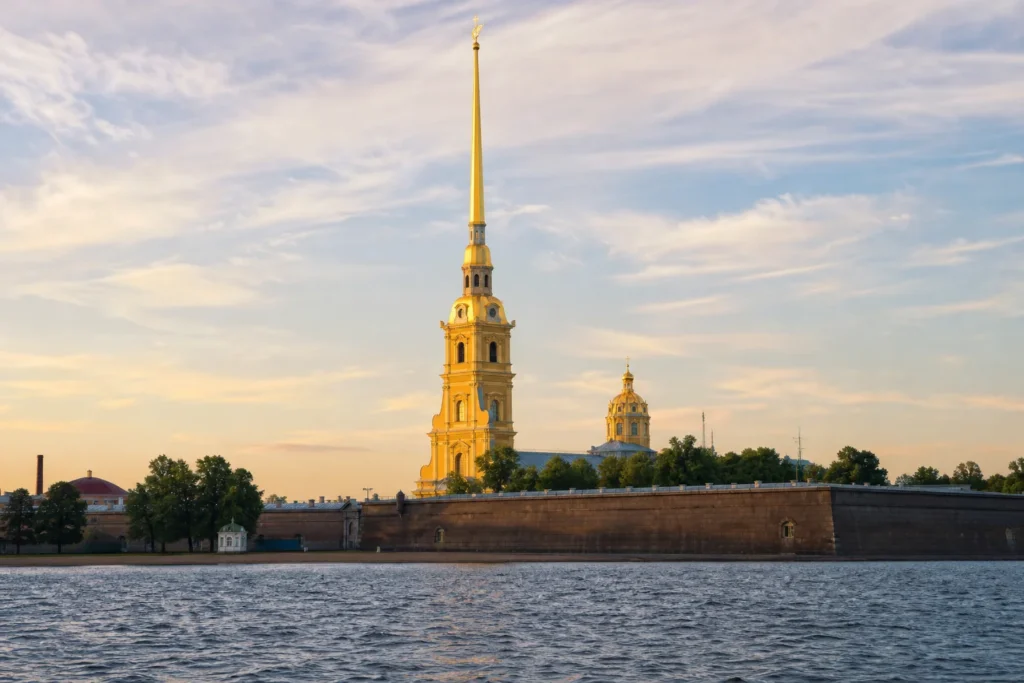
The Peter and Paul Fortress is where Saint Petersburg started. Peter the Great founded it on Zayachy (Hare) Island in the Neva delta on 27 May 1703, and the date is still counted as the birthday of the city. Today it stands in the Petrogradsky District, directly across the water from the Winter Palace, and it is part of the State Museum of the History of Saint Petersburg.
It is both a place to walk and a set of museums. You can wander the walls, bastions and the central square for free, then pay only for the parts you want: the cathedral where the Russian emperors are buried, the old prison at the Trubetskoy Bastion, and several exhibitions. This guide explains what is free, what needs a ticket and how to build a route.
Quick Facts
| Russian name | Петропавловская крепость |
|---|---|
| Built / opened | 1703 |
| Architect(s) | Domenico Trezzini (stone fortress and cathedral); first layout by J. G. Lambert with Peter the Great |
| Address | Петропавловская крепость, Заячий остров, Санкт-Петербург |
| District | Petrogradsky District |
| Metro | Gorkovskaya (Line 2, Short walk toward the Ioannovsky Bridge) Sportivnaya (Line 5, Slightly longer walk across the park) |
| Opening hours | The grounds are open daily and free to enter. The museum sites inside open from 10:00 and are closed on Wednesday, when all exhibitions, information desks and ticket offices shut.
The Cathedral and the Trubetskoy Bastion prison close an hour earlier on Tuesday, the Cathedral opens an hour later on Sunday, and its hours can change on days with church services. Hours of the grounds and closing times vary by season (as of October 2026 – check the official site). |
| Admission | Walking the grounds is free. Museum sites inside need tickets: a combined ticket (₽₽) or separate tickets for the Cathedral (₽₽) and the prison (₽). |
| Best time to visit | Go in the morning for calmer grounds and cooler light, or late in the day for soft light on the walls. The walls are pleasant in spring and summer, and the island is atmospheric in winter snow, though cold winds off the Neva can be sharp. |
| Recommended duration | 2–4 hours |
| Website | spbmuseum.ru |
| Last updated | October 15, 2026 |
What Is (and Isn't) Part of a Visit to Peter and Paul Fortress, Saint Petersburg?
| Part | Status | Notes |
|---|---|---|
| Grounds, walls and bastions | Included in the standard ticket | Free to enter and walk; no ticket is needed. |
| Peter the Great monument | Included in the standard ticket | Outdoors on the grounds and free to see. |
| Peter and Paul Cathedral and grand ducal burial chapel | Separate ticket or institution | Needs its own ticket or the combined ticket. |
| Trubetskoy Bastion prison | Separate ticket or institution | Has its own ticket or is covered by the combined ticket. |
| Commandant's House exhibition | Separate ticket or institution | An exhibition of the museum with its own admission. |
| Bell tower exhibition | Separate ticket or institution | A separate museum exhibition about the history of the bell tower. |
| Glushko Museum of Cosmonautics and Rocket Technology | Separate ticket or institution | A separate museum object on the grounds; check which ticket covers it. |
| The Mint | Outside / not part of it | A working enterprise that still makes coins and medals, not a visitor museum. |
Why Visit Peter and Paul Fortress, Saint Petersburg?
The fortress gives you the oldest layer of the city in one compact place. The star-shaped citadel, six bastions and ceremonial gate show how Peter’s new capital was first defended, and the cathedral inside is the burial place of almost all Russian rulers from Peter I to Nicholas II.
It is also useful for a more sober part of the story: the Trubetskoy Bastion was a prison for political prisoners, and its exhibition tells their stories.
Finally, the island is a good vantage point. From the walls you look across the Neva to the Winter Palace and the Admiralty, which puts the city’s layout into perspective.
How Peter and Paul Fortress, Saint Petersburg Is Laid Out
The fortress is an elongated hexagon that follows the shape of the island. Six curtain walls connect six large bastions, and two outworks called ravelins, Ioannovsky and Alekseevsky, close the defences on the west and east. Two bridges, the Ioannovsky and the Kronverksky, link the island to Petrogradsky Island.
Most visitors enter over the Ioannovsky Bridge through St Peter’s Gate, the ceremonial gate designed in 1718. A short walk leads to Cathedral Square, the open centre of the complex, with the Cathedral and its tall gilded spire on one side and the Commandant’s House and other historic buildings around it.
For a sensible route, enter by the main gate, see Cathedral Square and the Cathedral, walk to the Trubetskoy Bastion, and finish with a loop along the walls toward the river.
Highlights of Peter and Paul Fortress, Saint Petersburg
Peter and Paul Cathedral
The cathedral was built between 1712 and 1733 to a baroque design by Domenico Trezzini and is the visual centre of the fortress, topped by a slender gilded spire. Inside, the carved and gilded iconostasis and the canopy over the altar were gifts from Peter I and Catherine I, according to the museum.
The cathedral is the burial place of Russian rulers from Peter I to Nicholas II, except Peter II and Ivan VI.
Tip: Look for the grand ducal burial chapel as well, which is included with the cathedral visit.
St Peter's Gate and the walls
The main gate was designed by Trezzini in 1718 and is the only triumphal gate left from Peter's time. It sits behind the Ioannovsky Ravelin, which was built to protect it.
The walls and bastions are free to walk, and the thick brick and stone make the military purpose very clear. The bastions are named after Peter's close associates.
Tip: Walk part of the wall on the Neva side for the river views before going to the museums.
Trubetskoy Bastion prison
The prison was built within the fortress in 1870–72 and held political prisoners until the early twentieth century. The museum's exhibition tells the history of the prison, the people who passed through its cells and the regime they lived under.
It needs its own ticket, or the combined ticket, and the visit is short but memorable.
Tip: Go after the cathedral, since the combined route in the museum's tour follows that order.
Commandant's House and the city's story
The former residence of the fortress commandant now holds an exhibition on the history of Saint Petersburg–Petrograd from 1830 to 1918. It follows the city through industrial growth, culture and the revolutions of 1917.
This is a separate exhibition with its own ticket, and it gives context to the founding story you see on the island.
Tip: Do it if you want a time-line of the city, otherwise skip it and keep time for the grounds.
The Peter the Great monument
A well-known statue of Peter I stands in the fortress. It dates from 1991 and is by the sculptor Mikhail Shemyakin; it is an unusual, unconventional portrait of the founder, unlike the heroic equestrian monuments elsewhere in the city.
It is outdoors and free to see, and it is a popular place for photographs.
Tip: Take your photo early in the day, before tour groups arrive.
Space and rocket museum
The Glushko Museum of Cosmonautics and Rocket Technology is inside the fortress and tells the story of Russian space and rocket science, including the role of Petersburg–Leningrad scientists and engineers. A rocket research laboratory worked on the fortress grounds in the early Soviet period.
It is a separate museum object, so check whether your ticket covers it.
Tip: Choose it if you are interested in technology; otherwise it can be left out of a first visit.
Atmosphere
The first impression is of low brick walls and wide skies. Inside the gate, the square is open and often windy, and the gilded spire of the cathedral dominates every view. School groups, tour parties and couples share the space, and the walls are a favourite place to stop and look across the Neva.
In the morning the grounds are calmer, and in the evening the light on the river and the brick gives the island a softer mood. In winter the snow and cold make the fortress feel closer to its military past, while in summer people gather on the grass and by the water.
History of Peter and Paul Fortress, Saint Petersburg
In 1702–1703 Russia regained control of the Neva during the Great Northern War, and Peter the Great decided to build a fortress at the river mouth. The Saint Petersburg (Peter and Paul) Fortress was founded on 27 May 1703 on Zayachy Island. The first fortress was an earth-and-wood structure, and its plan, a stretched hexagon, followed the shape of the island. According to the museum, the first layout was drawn up by the French engineer J. G. Lambert with the tsar’s participation.
On 29 June 1703 a small wooden church dedicated to the Apostles Peter and Paul was laid down in the middle of the fortress. From 1706 the walls began to be rebuilt in brick and stone, starting with the Menshikov Bastion, and Domenico Trezzini took over the main design work. His St Peter’s Gate dates from 1718.
The stone cathedral was built between 1712 and 1733, and it became the burial place of the Russian emperors. Peter I was buried there, and from then on almost every ruler from Peter I to Nicholas II was laid to rest in it, with the exception of Peter II and Ivan VI. The cathedral served as the cathedral church of the capital from 1731 to 1858.
The fortress also became a prison. Political prisoners were held in its bastions for generations, and it earned a reputation as the Russian Bastille. The Trubetskoy Bastion prison was built in 1870–72 and used for political prisoners until the early twentieth century.
In the revolutionary year 1917 the garrison joined the revolutionaries and the prisoners were freed. In the 1920s the cathedral and prison began to be shown as museums, and a rocket research laboratory worked on the grounds. During the Second World War the fortress was damaged by bombing and later restored.
In 1954 the complex was transferred to the State Museum of the History of Leningrad, today’s State Museum of the History of Saint Petersburg. The Mint, built in 1805 on the grounds, continues to produce coins, medals and badges, and in 1991 the Peter the Great monument was added.
Today the fortress is a museum complex with free access to the grounds and ticketed exhibitions, and it remains one of the symbols of the city.
Legends and Myths about Peter and Paul Fortress, Saint Petersburg
Peter chose the island himself
Legend – historically unreliable. A well-known story says that Peter I personally picked the small Hare Island for the new fortress. The museum itself introduces this with the words 'as per the legend'.
The tale is part of the founding myth of the city, but the decision was made in the middle of a war and by a team of engineers, so it should be read as tradition rather than documented fact.
The eagle at the founding
Legend – historically unreliable. A popular tale says that an eagle hovered over the island at the moment of the founding and was taken as a good omen.
The story is retold in many guided tours, but it is not backed by a firm historical record this editor verified, so it belongs to folklore.
Tickets and Booking for Peter and Paul Fortress, Saint Petersburg
| Ticket | Price | Includes |
|---|---|---|
| Grounds | Free | Walking the walls, bastions, Cathedral Square and the monument. |
| Combined ticket | ₽₽ | Several museum sites on the island, valid for three days according to the museum, and the museum's walking tour with the Cathedral and the Trubetskoy Bastion. |
| Cathedral ticket | ₽₽ | The Peter and Paul Cathedral and the grand ducal burial chapel only. |
| Trubetskoy Bastion ticket | ₽ | The prison exhibition only. |
₽ budget · ₽₽ moderate · ₽₽₽ upscale · ₽₽₽₽ splurge. Price levels are estimates compared with typical prices for visitors.
Entry to the grounds is free. For museum sites, buy a combined or single ticket at the museum’s ticket offices on the day or in advance on the official website, in the section for visitors.
- Tour: the combined ticket includes a walking tour of about an hour and a half, covering the walk around the fortress and two expositions, the Cathedral with the burial chapel and the Trubetskoy Bastion prison.
- Re-entry: each of the Cathedral and the prison can be visited only once, so there is no coming back after a tour.
- Rates differ for Russian citizens and concession groups, so check your own category.
Use the museum’s official website (spbmuseum.ru) as the single source for ticket types, rates and the current rules.
Plan and Book
Suggested Itineraries for Peter and Paul Fortress, Saint Petersburg
2 hours
Enter by the Ioannovsky Bridge and St Peter's Gate, spend an hour in the Cathedral and burial chapel, then walk the wall toward the Neva. Skip the extra museums and keep time for photographs at the monument.
3 hours
Follow the museum's combined route: the Cathedral and burial chapel, then the Trubetskoy Bastion prison. Add the Commandant's House exhibition if the story of the city interests you, and finish with a walk along the river-facing wall.
Half day
Do the combined tickets and one of the extra museums, such as the cosmonautics museum. Take a long walk on the walls and bastions, then cross the bridge toward Alexander Park or the nearby streets for lunch.
How to Get to Peter and Paul Fortress, Saint Petersburg
The nearest metro station is Gorkovskaya (Line 2), and Sportivnaya (Line 5) is also listed by the city’s official tourism portal. From either station it is a short walk through the park and across the Ioannovsky Bridge to St Peter’s Gate.
- From the Winter Palace side, you can walk across the river by bridge, which takes a while, or take the metro or a taxi.
- A taxi to the main gate is easy from the centre.
Accessibility
The museum has a dedicated accessibility page on its website with information for visitors with disabilities. The grounds include cobbled and uneven surfaces and long distances between sites, so contact the museum in advance to ask about access to specific exhibitions and assistance.
Food Nearby
The streets around Gorkovskaya station and Kamennoostrovsky Prospekt have cafes and restaurants of many kinds. Inside the grounds there are limited snack options, so plan lunch outside the walls.
What to Bring
Comfortable shoes for cobblestones, a windproof layer because the island is exposed, and a bottle of water in summer. Expect a security check at the entrance to the museum sites.
Best Views and Photo Spots of Peter and Paul Fortress, Saint Petersburg
The Ioannovsky Bridge and St Peter's Gate
The approach to the ceremonial gate with the walls on both sides, which shows the defensive layout.
Best time: Morning, when it is quiet.
Cathedral Square
The gilded spire rising above the open square, with the low buildings around it for scale.
Best time: Late afternoon light.
The wall facing the Neva
A view across the river to the Winter Palace and the Admiralty, with the water in the foreground.
Best time: Sunset.
The Peter the Great monument
A close portrait of the unusual statue against the brick buildings.
Best time: Early morning, before groups arrive.
Photography Rules
Photography rules differ by exhibition and are set by the museum, so follow posted signs and ask staff. Flash and tripods are commonly restricted in museum interiors, and a drone should not be assumed to be allowed over the fortress.
Family Suitability
Children can enjoy the open grounds, the walls and the monument, and the space is good for letting them walk. The prison exhibition may be heavy for young children. Cobbles make strollers harder, so a carrier or a light stroller is easier.
Russia Vibes Tips
- Treat the grounds as a free walk and the museums as optional add-ons; you do not need a ticket to enjoy the walls and the river views.
- Do the Cathedral first and the prison second, so that you move from the grandeur of the imperial burials to the harsher story of the political prisoners.
- Look for the small details on the gate and the bastions, which show how carefully the military design was made.
- Combine the fortress with a walk through Alexander Park and the streets nearby, rather than hurrying back to the metro.
- Plan your visit around the museum's closing day, since the grounds stay open but the exhibitions do not.
- Leave time for the river-facing wall at the end, because the view across to the Winter Palace is the best summary of the city's layout.
Explore Nearby Peter and Paul Fortress, Saint Petersburg
Sights near Peter and Paul Fortress, Saint Petersburg
- State Hermitage Museum, Saint Petersburg · typical visit: 3-5 hours for the main highlights
Browse more: More in Petrogradsky District · All Landmarks · All Saint Petersburg · All Sightseeing · All Sightseeing in Saint Petersburg
FAQ: Peter and Paul Fortress, Saint Petersburg
Do I have to pay to enter the Peter and Paul Fortress?
No. The grounds are free to enter, according to the museum. You pay only for the museum sites inside, such as the Cathedral and the Trubetskoy Bastion prison, or for a combined ticket.
Is the cathedral part of the fortress?
Yes. The Peter and Paul Cathedral stands inside the fortress and is its centrepiece, but it needs its own ticket or the combined ticket.
Is the Mint open to visitors?
The Mint on the grounds is a working enterprise that still produces coins, medals and badges, so it is not a regular visitor museum. You can see the building from outside.
Can I visit the cathedral twice?
No. The museum says the Cathedral and the prison can be visited only once on a ticket, so there is no re-entry after your visit or tour.
Do I need a guide?
Not strictly. The grounds are easy to explore alone, and the combined ticket includes a museum tour. A guide helps if you want the full story of the prison and the burials.
Are the rulers all buried in the cathedral?
Almost. According to the museum, rulers from Peter I to Nicholas II are buried there, with the exceptions of Peter II and Ivan VI.
How is it different from the Hermitage?
The Hermitage is a palace art museum, while the fortress is the city's original citadel with the imperial burial cathedral and the prison. They are on opposite banks of the Neva and need separate tickets.
What does the combined ticket give me?
It covers several museum sites on the island and, according to the museum, is valid for three days. See the booking section for how to buy it and how re-entry works.
Russia Vibes is a one-person project. A coffee keeps it going
Last updated: October 15, 2026. Found an error or something out of date? Report it and we will check and fix it.
How we research and update our guides
About this guide: AI assistance and accuracy
This guide is created with the help of AI and is based on official sources where available. Mistakes can still happen. Opening hours, prices, rules and other details are given to the best of our knowledge as of the date shown and can change without notice. It offers general recommendations only, not professional, legal or travel advice. Please confirm important details with the official source before you travel; you are responsible for your own plans and decisions.
International sanctions affect payments between Russia and many other countries. In practice, cards issued in the EU, the UK, the US and several other countries often do not work in Russia, Russian cards usually do not work abroad, and some booking platforms, airlines and payment providers limit or suspend their services for Russia. The situation changes frequently. We do not give legal or financial advice, and this site does not encourage anyone to break or circumvent sanctions. Whatever you plan, you are responsible for following the laws and regulations that apply to you, including those of your country of residence and citizenship. Many travelers still organise their stay lawfully. It is worth asking your bank or payment provider what is currently permitted, contacting hotels, tour operators and carriers directly about the payment methods they accept, and checking which services are open to customers from your country. Clarify payment, cancellation and refund terms before you commit to a booking, and keep your plans flexible. Partner links on this site may not be available in every country, and prices, availability and rules in our guides can differ from what you see when you book.Paying for your trip: please read
 Ask Masha