
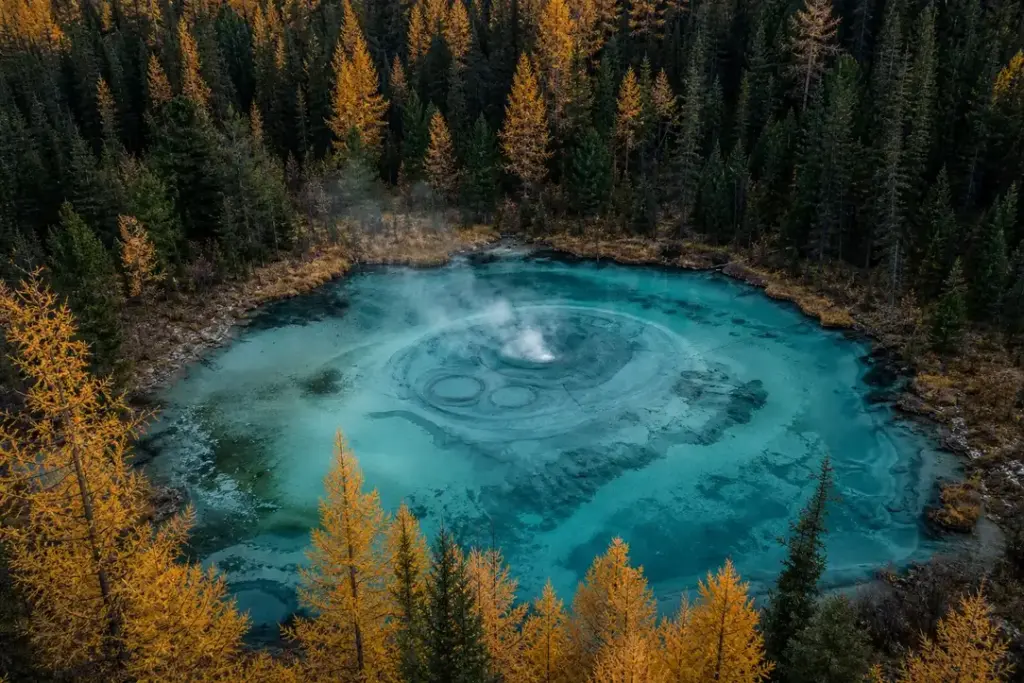
The road winds between the mountains, and suddenly the forest opens up—a quiet clearing opens up before you, with a sky-blue lake in the center. Geyser Lake is located near the Chuya Highway, 6 kilometers from the village of Aktash. The lake has a small size: 30 meters in diameter, and 2 meters deep.
The visual effect, which is similar to the activity of a geyser, is obtained as a result of pulsating water from sources, with one powerful spring and three small ones at the bottom of the lake. There are no geysers in the Geyser Lake, but the thermal springs and mineral-rich clay create a unique natural phenomenon that draws visitors from across Russia and beyond.
Quick Facts
| Russian name | Гейзерное озеро |
|---|---|
| Built / opened | 2005 |
| Address | Chuysky Tract (Chuya Highway), near Aktash, Ulagansky District, Altai Republic Google MapsApple MapsYandex Maps2GIS |
| District | Ulagansky |
| Best time to visit | It's best to arrive in the morning or at sunset, when the light is soft and the water takes on a particularly rich turquoise color. In autumn, the surrounding forest is golden, and the lake looks like a precious stone set in foliage.Summer (June–September) offers the easiest access and warmest weather, though crowds are largest in July and August. Autumn (September–October) provides golden larch foliage and fewer visitors. Winter visits are rewarding for photography and solitude, but access is more difficult and the cold is intense. Spring (April–May) is muddy and sometimes inaccessible due to snowmelt and swampy terrain. |
| Recommended duration | 1–2 hours |
What Is (and Isn't) Part of a Visit to Geyser Lake, Altai Mountains?
| Part | Status | Notes |
|---|---|---|
| The thermal lake and viewing platform | Included in the standard ticket | The small turquoise lake, the wooden boardwalk, and the observation area are part of the main visit. |
| Access and parking | Included in the standard ticket | Parking at the turnoff from the Chuysky Tract and the walk through the forest to the lake are included in the standard visit. |
| Tourist base and accommodation | Separate ticket or institution | The local tourist base that manages the lake offers lodging and meals separately. This is a different service and not included in a day visit. |
| Guided tours | Separate ticket or institution | Professional guides are available for hire separately to explain the geology and ecology of the site. |
| Swimming and wading | Not open to visitors | Visitors are not permitted to swim or wade in the lake; the boardwalk allows viewing only. |
Why Visit Geyser Lake, Altai Mountains?
It’s small, only about thirty meters in diameter, but it seems to have a life of its own. Something is constantly moving at the bottom: hot springs eject sand and clay, creating intricate circles and patterns. Blue clay gives a very bright azure shade to the lake water. This color of water can be found in other lakes of Russia, but there are no changing patterns on the bottom.
The water is as clear as glass and doesn’t freeze even in winter. Due to its transport accessibility, most tourists coming to Altay visit it.
Highlights of Geyser Lake, Altai Mountains
The Thermal Spring Patterns
The bottom of the lake is covered with blue clay, which rises and settles in streams of pulsating spring water. This clay diverges at the bottom of the lake in circles, and their pattern changes approximately every half hour along with new powerful water emissions from the source. Watch from the wooden observation platform as the patterns shift and reform, revealing different concentric shapes.
Tip: Arrive in the morning light to see the patterns most clearly; the sun reflecting off the water makes the blue circles most distinct.
Turquoise Water and Mineral Composition
Blue clay gives a very bright azure shade to the lake water. The water is as clear as glass and doesn't freeze even in winter. The transparency and color come from the thermal springs and the glacial silt they bring from underground.
Tip: Avoid wearing white clothing if you plan to wade or sit close to the water's edge, as the mineral-rich silt can stain fabric.
Forest and Taiga Setting
There's a wooden trail through the forest, just a few hundred meters on foot. The lake sits in a clearing surrounded by taiga with larch and pine trees. The contrast between the brilliant turquoise water and the dark forest creates a striking visual effect.
Tip: It's best to arrive in the morning or at sunset, when the light is soft and the water takes on a particularly rich turquoise color. In autumn, the surrounding forest is golden, and the lake looks like a precious stone set in foliage.
The Geological Mystery
Geyser Lake was found in 2005. Previously, it was not known and there is an opinion that it was formed as a result of an earthquake that occurred in Altay in 2003. The lake's sudden appearance adds to its mystique and marks it as a recent natural curiosity.
Tip: The earthquake connection is not definitively proven; the lake may have existed before but was only discovered later. Ask your guide if they have any local knowledge about the discovery.
Year-Round Ice-Free Water
The water is as clear as glass and doesn't freeze even in winter. The thermal springs maintain water temperatures above freezing, making the lake accessible and visually striking even in the coldest months. In winter, steam rises from the surface.
Tip: Winter visits are rewarding but require warm clothing and careful footing on frozen ground. The contrast between steam and snow creates an otherworldly atmosphere.
Wooden Observation Boardwalk
There's a wooden trail through the forest, just a few hundred meters on foot. The boardwalk protects both visitors and the surrounding swampy terrain. The path from the Chuya Highway to the Geyser Lake passes through a swampy area with wooden deck laid here.
Tip: The wooden boardwalk can be slippery in wet or icy conditions. Wear shoes with good grip, especially in spring when snowmelt makes the boards wet.
Atmosphere
Geyser Lake feels removed from the world despite its accessibility. The small clearing opens suddenly after walking through dark taiga, and the brilliant turquoise water seems almost unreal against the forest and sky. A faint mineral smell and wisps of steam (especially in cold months) suggest something alive beneath the surface.
The lake is peaceful, with few crowds outside peak summer hours. Visitors gather at the observation area in small groups, mostly quiet and absorbed in watching the water patterns. In early morning or late afternoon, the light turns the lake even more vivid. In autumn, golden larch needles frame the turquoise water. The temperature is cool year-round, and the forest muffles most sound.
History of Geyser Lake, Altai Mountains
Geyser Lake was found in 2005. Previously, it was not known and there is an opinion that it was formed as a result of an earthquake that occurred in Altay in 2003. The lake’s origins are disputed among geologists and researchers. Some theories suggest that the 2003 earthquake caused the thermal springs to breach the surface and create the lake, while others propose that the lake may have existed earlier but was only discovered when tourism infrastructure was developed in the region.
Because of this earthquake, hats fell on some Stone Mushrooms in the Valley of the Chulyshman River, but perhaps an equally unique attraction appeared. The earthquake’s effects were felt widely across the Altai, and Geyser Lake’s emergence coincided with other geological shifts in the region.
The lake remained largely unknown to tourists until the mid-2000s. As access improved along the Chuysky Tract and lodging and guides became available in the region, visitors began to discover the site. Due to its transport accessibility, most tourists coming to Altay visit it. Today, the lake is leased and managed by a local tourist base, and a simple wooden boardwalk provides safe access.
Legends and Myths about Geyser Lake, Altai Mountains
The Geyser That Isn't
Legend – historically unreliable. There are no geysers in the Geyser Lake. The visual effect, which is similar to the activity of a geyser, is obtained as a result of pulsating water from sources. The name is misleading—what visitors see is not a true geyser eruption but the rhythmic upwelling of thermal spring water that lifts sediment from the lake bed. This misunderstanding has become part of the lake's legend, with many visitors expecting dramatic geysers and instead discovering a subtler, slower dance of water and clay.
The 2003 Earthquake Creation Myth
Disputed by historians. There is an opinion that it was formed as a result of an earthquake that occurred in Altay in 2003. Local guides sometimes tell visitors that the lake sprang into existence overnight after the earthquake, a dramatic story that appeals to tourists. However, this account is not scientifically confirmed, and the lake's true origins remain uncertain. It may have been formed gradually or even have existed before 2005 but gone unnoticed.
Tickets and Booking for Geyser Lake, Altai Mountains
Geyser Lake is accessible as a day visit from the Chuysky Tract highway. There is no formal ticketing system at most times. You stop, you buy a ticket, and you walk on special wooden bridges, about 500 meters. If a local attendant is present, a small fee may be collected for site maintenance. Payment is typically in cash (Russian rubles). No advance booking is required.
The journey from Gorno-Altaisk takes about seven hours by car. There’s a parking lot at the turnoff, and then a wooden trail through the forest, just a few hundred meters on foot. The site is open to visitors during daylight hours, though specific opening times are not formally published. Arrive early in the day for the best light and fewer crowds.
Plan and Book
Suggested itineraries Geyser Lake, Altai Mountains
1 hour
Park at the turnoff from the Chuysky Tract. Walk the wooden boardwalk to the lake (a few hundred meters). Spend 20–30 minutes observing the water patterns and taking photos from the observation area. Walk back to the car. Good for travelers with limited time or those passing through on a longer road trip.
2 hours
Allow time to explore the clearing around the lake from different angles. Sit quietly by the water to watch the thermal spring patterns change over time. Walk a short distance into the surrounding forest to see the taiga environment. Bring a picnic or snacks to enjoy while observing the lake.
Half day
Start early in the morning for the best light. Spend 2–3 hours at Geyser Lake, including time for photos and observation. Drive or bike to nearby sites along the Chuysky Tract, such as the Chuya Meanders, a short distance away. Return to Aktash village for a late lunch before continuing your journey.
How to Get to Geyser Lake, Altai Mountains
It’s located near the village of Aktash in the Ulagansky District. You can get there via the Chuysky Tract—the journey from Gorno-Altaisk takes about seven hours by car. The Chuysky Tract (P-256 highway) is the main route through the Altai. There’s a parking lot at the turnoff, and then a wooden trail through the forest, just a few hundred meters on foot.
The turnoff to Geyser Lake is clearly marked along the highway. In summer, the road is passable in a standard car, though driving time can vary with road conditions. In winter, a four-wheel-drive vehicle is safer due to snow and ice. Public transport options are limited; organized tours from Gorno-Altaisk or Aktash are the most convenient option for visitors without their own transport. A local guide or driver from Aktash can provide transport and interpretation.
Accessibility
The boardwalk to the lake is relatively short and flat (a few hundred meters), making it accessible for most visitors. The wooden trail through the forest is constructed to protect visitors from swampy ground. However, the wooden boards can be slippery when wet or icy, and there are no formal accessibility facilities such as ramps or handrails. Visitors with mobility difficulties should be aware that the terrain is uneven in places. There is no wheelchair access reported at the site.
Food Nearby
No food or drink is available at Geyser Lake itself. Bring water and snacks with you. The nearest village is Aktash, about 5–7 km away by car, where basic supplies and meals can be found. In summer, roadside vendors and small cafés along the Chuysky Tract near Aktash offer simple food and drinks. Plan to bring a picnic or eat in Aktash before or after your visit.
What to Bring
Bring water and snacks, as none are available at the lake. Wear shoes with good grip—the wooden boardwalk is slippery when wet or icy. In warm months, bring sunscreen and insect repellent. In winter, bundle up warmly; the lake sits in a clearing with little shelter from wind, and the cool micro-climate near the thermal water is colder than surrounding areas. Binoculars can help you observe patterns in the water from a distance. A camera is essential. The path from the Chuya Highway passes through a swampy area with a wooden deck laid here, so avoid white shoes and be prepared for muddy conditions in spring and early summer.
Best Views and Photo Spots of Geyser Lake, Altai Mountains
Main observation platform
The boardwalk offers direct views of the lake's patterns and the surrounding forest. This is the closest vantage point for detail shots of the water and clay circles.
Best time: Early morning (6–8am) when sunlight is soft and the forest is quiet. Overcast days also work well.
Forest clearing edge
Stand at the clearing's edge to capture the lake framed by dark taiga. This perspective emphasizes the contrast between the brilliant turquoise and the surrounding vegetation.
Best time: Late afternoon (4–6pm) when the sun angles through the trees. Autumn offers golden larch frames.
Elevated vantage point (drone perspective)
Aerial views show the concentric clay circles most clearly and reveal the lake's small size against the vast forest.
Best time: Midday (10am–2pm) when sunlight is strong enough to define the patterns clearly underwater.
Boardwalk over water
Standing on the wooden boardwalk directly over the thermal spring allows close-ups of the pattern formations and steam rising from the water.
Best time: Winter or early morning when steam is visible. Calm water (on windless days) shows reflections.
Photography Rules
Arrive in the morning or at sunset, when the light is soft and the water takes on a particularly rich turquoise color. In autumn, the surrounding forest is golden, and the lake looks like a precious stone set in foliage. Overhead shots from drones offer striking perspectives of the concentric clay patterns, though check local regulations before flying. No flash photography restrictions are reported, and tripods are permitted. The water's clarity and color photograph best in overcast light or early morning when the sun is low.
Family Suitability
Geyser Lake is suitable for families with children old enough to walk and follow boardwalk safety rules (ages 4 and up). The short walk is manageable for most children, and the unique water colors and patterns hold children's interest. However, adults must supervise carefully—the lake and thermal springs have no barriers, and the water is not accessible for swimming. Very young children in strollers may have difficulty on the uneven wooden boardwalk. In winter, the cold and icy conditions make visits challenging for small children.
Russia Vibes Tips
- Arrive in the first hour after the site opens or in late afternoon to avoid crowds. Mid-summer afternoons can draw multiple tour groups.
- The clay patterns change every 30 minutes with pulses of thermal spring water. Time your visit to observe at least two pattern changes if you want to see the transformation.
- Bring insect repellent in summer. The surrounding swampy forest harbors mosquitoes, especially in July and August.
- Don't expect dramatic geyser eruptions. The 'geyser' effect is subtle—pulsing springs that lift fine silt rather than hot steam or water spouts.
- The wind direction affects steam visibility in winter. If you want photos with steam, check the wind before choosing your position.
Explore Nearby Geyser Lake, Altai Mountains
Sights near Geyser Lake, Altai Mountains
 Chuysky Trakt, Altai Mountains · typical visit: 2–3 days
Main image: AI-generated illustration. It may not show the place exactly as it looks.
Related guides
 Altai Mountains: Best Places, Scenic Routes and Travel Tips
Main image: AI-generated illustration. It may not show the place exactly as it looks.
 Ak-Kurum Stone Mushrooms: Natural Geological Formations in Remote Altai
Main image: AI-generated illustration. It may not show the place exactly as it looks.
 Chulyshman Valley: Remote Altai Canyon, Stone Formations and Waterfalls
Main image: AI-generated illustration. It may not show the place exactly as it looks.
Browse more: More in Ulagansky · All Altai Mountains · All Sightseeing · All Sightseeing in Altai Mountains · All Viewpoints
FAQ: Geyser Lake, Altai Mountains
Is Geyser Lake accessible year-round?
The water is as clear as glass and doesn't freeze even in winter. The lake is accessible year-round from the Chuysky Tract, but winter access requires a sturdy vehicle and careful driving. The boardwalk becomes icy and dangerous in heavy snow or frost.
How far is Geyser Lake from Gorno-Altaisk?
The journey from Gorno-Altaisk takes about seven hours by car via the Chuysky Tract. The distance is roughly 300–330 km, depending on the exact route.
Can you swim or wade in the lake?
No. Swimming and wading are not permitted. The lake is shallow and fed by hot thermal springs, and visitors are restricted to the wooden boardwalk and observation area.
Why is it called Geyser Lake if there are no geysers?
There are no geysers in the Geyser Lake. The visual effect, which is similar to the activity of a geyser, is obtained as a result of pulsating water from sources. The thermal springs pulse periodically, creating an effect reminiscent of geysers, but they are not true geysers.
How long is the walk from the parking area to the lake?
There's a wooden trail through the forest, just a few hundred meters on foot. Most visitors reach the lake in 5–10 minutes of walking.
What makes the water so blue?
Blue clay gives a very bright azure shade to the lake water. Thermal springs bring mineral-rich clay and silt from underground. The particles refract light, creating the vivid turquoise color.
When was Geyser Lake discovered?
Geyser Lake was found in 2005. Previously, it was not known and there is an opinion that it was formed as a result of an earthquake that occurred in Altay in 2003. The origins are uncertain—it may have formed in 2003 or existed earlier but unnoticed.
What should I bring to Geyser Lake?
Bring water, snacks, and a camera. Wear shoes with good grip for the slippery boardwalk. In summer, bring insect repellent. In winter, dress very warmly. No food, water, or facilities are available at the site.
Russia Vibes is a one-person project. A coffee keeps it going
How we research and update our guides
About this guide: AI assistance and accuracy
This guide is created with the help of AI and is based on official sources where available. Mistakes can still happen. Opening hours, prices, rules and other details are given to the best of our knowledge as of the date shown and can change without notice. It offers general recommendations only, not professional, legal or travel advice. Please confirm important details with the official source before you travel; you are responsible for your own plans and decisions.
Packing for this trip
* Affiliate link: as an Amazon Associate we earn from qualifying purchases at no extra cost to you.

Take this guide with you
Get a free PDF of this guide to print or read offline: key facts, tips and a map link on a few clean pages.
Report an issue on this page
Paying for your trip: please read
International sanctions affect payments between Russia and many other countries. In practice, cards issued in the EU, the UK, the US and several other countries often do not work in Russia, Russian cards usually do not work abroad, and some booking platforms, airlines and payment providers limit or suspend their services for Russia. The situation changes frequently.
We do not give legal or financial advice, and this site does not encourage anyone to break or circumvent sanctions. Whatever you plan, you are responsible for following the laws and regulations that apply to you, including those of your country of residence and citizenship.
Many travelers still organise their stay lawfully. It is worth asking your bank or payment provider what is currently permitted, contacting hotels, tour operators and carriers directly about the payment methods they accept, and checking which services are open to customers from your country. Clarify payment, cancellation and refund terms before you commit to a booking, and keep your plans flexible.
Partner links on this site may not be available in every country, and prices, availability and rules in our guides can differ from what you see when you book.