
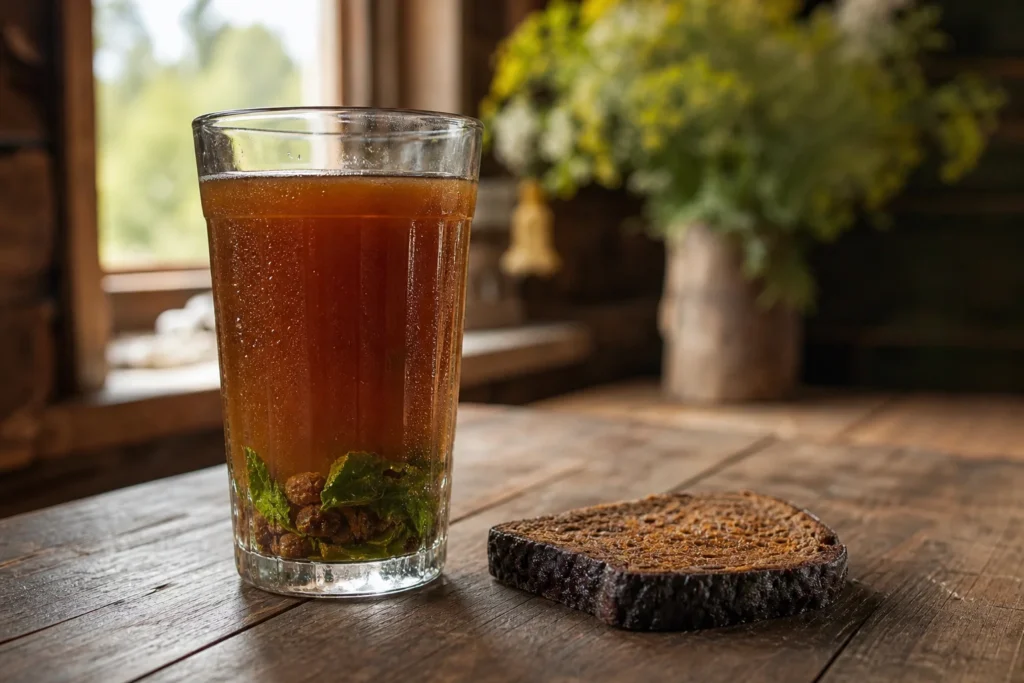
Kvass is a traditional Eastern European fermented beverage that has been part of Russian life for over a thousand years. Whether you encounter it at a street stall in Nizhny Novgorod or want to brew it at home, understanding how to make kvass teaches you about one of the world’s oldest fermented drinks and a genuine part of Russian culture.
This guide shows you how to make authentic kvass using simple ingredients and basic fermentation. The recommended method takes 2–5 days at room temperature and requires only dark rye bread, water, sugar, and yeast or a natural starter. The result is a cloudy, fizzy drink with a malty taste and just enough tartness to refresh.
Quick answer: Toast dark rye bread until very dark, soak it in hot water for hours, strain the liquid, add sugar and yeast or starter culture, and ferment at room temperature for 2–5 days. Bottle it to carbonate further, then chill. Total time: 2–5 days plus 1–2 days bottling.
At a Glance
| Type | Drinks |
|---|---|
| Local name | Квас |
| Origin | Eastern Europe (Russia, Ukraine, Belarus, Poland, Baltic states) |
| Servings | 2–4 |
| Total time | 2–5 days plus 1–2 days bottling |
| Difficulty | Easy |
History and Story of Kvass, Nizhny Novgorod
Kvass is documented in written sources from 988 AD, when Grand Prince Vladimir of Kiev distributed food, honey and kvass to celebrate the Christianisation of Kievan Rus. The drink has remained universal across social classes for over a thousand years—from medieval peasants to modern city dwellers. Historically, kvass was brewed from rye bread because rye grows where wheat cannot, making it a staple across the Russian and Ukrainian steppe. During the Soviet era, traditional home fermentation gave way to industrial production. Street vendors sold kvass from yellow tanks fitted with taps, making it accessible to workers. This cultural memory of kvass from communal barrels persists today as an image of Russian life.
Ingredients
- 400 g dark rye bread (stale is fine)
- 4 litres water
- 150–200 g sugar
- 1/4 teaspoon dried yeast or 1 tablespoon sourdough starter
- Optional: handful of raisins, fresh mint or lemon
How Kvass, Nizhny Novgorod Is Made
Step 1: Toast the rye bread
Cut the dark rye bread into cubes or chunks about the size of croutons. Place them on a baking sheet and toast in an oven at 160–170°C (320–340°F) for around 30 minutes, or toast in a pan on the stove until very dark brown. The bread should be nearly charred in places—the darker the toast, the deeper the colour and flavour of the finished kvass. Do not burn it completely.
Tip: Stale bread works just as well as fresh. The toasting develops malty sugars that feed the fermentation.
Step 2: Steep the toasted bread
Boil 4 litres of water and allow it to cool slightly to around 80–90°C (176–194°F). Place the toasted bread cubes in a large, clean glass jar or ceramic vessel. Pour the hot water over the bread, stir gently, and cover with a cloth or lid. Let this steep for at least 4 hours, ideally 8–24 hours. The longer the soak, the more flavour and colour extracts from the bread.
Tip: Use chlorine-free or filtered water if possible. Chlorine can inhibit fermentation.
Step 3: Strain and prepare the wort
After steeping, pour the liquid through a fine strainer or cheesecloth into a clean fermentation vessel, squeezing the wet bread gently to extract all the liquid. Discard the spent bread. This strained liquid is called the wort. You should have approximately 3.5–3.8 litres.
Tip: Save a spoonful of the wet bread if you plan to make kvass again—it can serve as a natural starter for the next batch.
Step 4: Add sugar and starter culture
Dissolve 150–200 g of sugar into the warm wort by stirring well. Then add either 1/4 teaspoon of dried yeast or 1 tablespoon of active sourdough starter (wild fermentation is more traditional). Stir thoroughly to combine. If using optional flavourings like raisins, mint, lemon peel or fresh ginger, add them now.
Tip: Use less sugar for a sourer kvass, more for a sweeter one. The yeast and bacteria will consume the sugar during fermentation.
Step 5: Ferment at room temperature
Cover the vessel with a clean cloth secured loosely with a rubber band, or use a loose-fitting lid to allow air circulation while keeping dust out. Place it in a warm spot away from direct sunlight (18–24°C / 64–75°F is ideal). Fermentation will become visible within 6–24 hours—you'll see foaming and bubbling. Stir occasionally if you notice the bread solids settling.
Tip: Ferment for 2–5 days depending on temperature and your taste preference. Taste it daily from day 2 onwards to find your preferred balance of sweetness and tartness.
Step 6: Strain and bottle
When fermentation has progressed to your liking, strain the kvass through a fine-mesh strainer or cheesecloth into clean bottles. Leave a little space at the top. You may add a raisin or two to each bottle for extra carbonation during secondary fermentation. Seal the bottles loosely at first.
Tip: Use plastic bottles or swing-top bottles rather than rigid glass, as carbonation builds pressure during the second fermentation.
Step 7: Secondary fermentation and chill
Leave the sealed bottles at room temperature for 1–2 days to allow natural carbonation to develop. You should feel gentle pressure in the bottles. Then refrigerate. The kvass will continue to ferment slowly in the fridge. It is ready to drink once fully chilled—after about 3 days in the refrigerator—but will improve and build carbonation for another 1–2 weeks.
Tip: Open the bottles carefully after bottling to avoid over-carbonation. Release pressure every few days.
Variants
- Mint kvass: Add fresh or dried mint to the wort before fermentation for a cooling, herbal note.
- Berry kvass: Add dried berries, raisins or berry juice during fermentation for fruity depth.
- Beetroot kvass: Ferment sliced raw beets in salted water instead of using bread—this is a different preparation with a distinctly earthy taste.
- Honey kvass: Replace some sugar with honey or birch syrup, which is traditional in Russia, for a richer, smoother flavour.
- White kvass: Use lighter rye bread or even white bread for a pale colour and milder taste.
Common Mistakes to Avoid
- Burning the bread during toasting: Very dark is good; completely black ruins the flavour. Watch carefully and stir halfway through.
- Using chlorinated tap water: Chlorine inhibits natural fermentation. Use filtered, boiled, or spring water if possible.
- Adding yeast while water is still too hot: If the wort is above 40°C (104°F) when you add yeast, heat will kill it. Let it cool before adding.
- Sealing bottles too tightly before the second fermentation: This risks exploding bottles from over-carbonation. Seal loosely at first, then tighten after pressure has developed.
- Fermenting in a cold place: Below 15°C (59°F), fermentation slows dramatically or stops. Find a warm corner, such as a kitchen cabinet away from direct sun.
- Skipping the taste test: Kvass ferments at different speeds depending on temperature and starter strength. Taste daily from day 2 to avoid over-fermenting or stopping too early.
How to Order and Eat It
Kvass is served cold, usually in a glass. Pour it straight from the bottle. The drink is typically cloudy and may have sediment—this is normal and harmless. Stir or swirl the bottle gently to mix any settled particles before pouring. Traditionally, kvass is paired with savoury Russian bread, ginger bread (Gorobets), or as an accompaniment to hearty soups and stews. In modern settings, it is enjoyed as a refreshing non-alcoholic alternative to beer or soft drinks. Some Russians drink it as a morning or midday pick-me-up. The slight tartness and carbonation make it particularly thirst-quenching on warm days.
To order: Я бы хотела квас [Ya bi khotela kvas]
Russia Vibes Tips
- Buy kvass from street vendors or local shops rather than bottled supermarket versions if you want authentic flavour. Soviet-era street culture of selling kvass from taps survives in many Russian cities, and the quality is often superior to mass-produced alternatives.
- Fermentation speed varies dramatically with temperature. In summer (22–24°C), kvass ferments in 2–3 days. In cooler conditions (16–18°C), it may take 4–5 days or longer. Patience is key.
- Save the sediment from your first batch of kvass—it contains active cultures and can be used as a starter for subsequent batches. You will need only half the yeast on the second try.
- Kvass tastes best when very fresh and well-chilled. Flavour peaks within the first week of bottling. After 2–3 weeks in the fridge, it begins to lose carbonation and becomes increasingly sour.
- Do not sterilize equipment obsessively. Clean bottles and jars are sufficient. Over-sterilization can remove beneficial bacteria needed for natural fermentation and may actually increase contamination risk.
Where to Find Kvass, Nizhny Novgorod in Russia
Related guides
 Bolshaya Pokrovskaya: Nizhny Novgorod’s Historic Pedestrian Street
 Nizhny Novgorod Kremlin: Medieval Fortress and River ViewsOpen daily 06:00–22:00
 Chkalov Staircase: Russia’s Longest Monument, Hours and What to ExpectOpen 24 hours
 Nizhny Novgorod State Art Museum: Russian and European Masterworks
 Best Restaurants for Traditional Russian Cuisine, Nizhny Novgorod: Where to Eat Local
Browse more: All Food & Drink · All Food & Drink in Nizhny Novgorod · All Nizhny Novgorod · All Other
FAQ
Is kvass alcoholic?
Yes, kvass contains low levels of alcohol—typically 0.5–2% by volume—from the fermentation process. This is comparable to non-alcoholic beer or some soft drinks and is not enough to cause intoxication. Children and adults alike have drunk kvass for centuries.
Can I use commercial yeast instead of sourdough starter?
Yes. Dried baker's yeast or instant bread yeast works fine and will ferment faster than natural starters. Commercial yeast will produce a slightly harsher, less complex flavour than wild fermentation, but the drink remains authentic. Many modern Russian kvass makers use commercial yeast for speed and predictability.
Why does my kvass taste sour?
Sourness comes from lactic acid produced by beneficial bacteria during fermentation. Longer fermentation increases sourness. If you prefer a sweeter kvass, reduce fermentation time by tasting from day 2 onwards and bottling when the balance suits you. Higher sugar content also masks sourness.
Is the cloudy appearance normal?
Yes. Cloudiness comes from bread particles, yeast cells, and bacteria suspended in the liquid. This is characteristic of authentic kvass. Sediment will settle over time in the bottle. Shake gently before pouring if you prefer a consistent appearance.
How long does homemade kvass keep?
Refrigerated kvass stays fresh and fizzy for 1–2 weeks. After that, carbonation decreases and flavour becomes increasingly sour as fermentation continues slowly in the cold. It does not spoil but becomes less pleasant. Many Russian families use it within a few days of bottling.
Can I make kvass without yeast?
Yes. Traditional kvass relies on wild fermentation using natural bacteria and yeast already present on the bread and in the environment. This takes longer (5–7 days) and is less predictable but entirely possible. Sourdough starter provides a reliable wild fermentation culture.
Where can I buy kvass in Nizhny Novgorod?
Street vendors, local shops, and cafés throughout Nizhny Novgorod sell kvass. Try street stalls on Bolshaya Pokrovskaya Street (the main pedestrian area) or smaller streets. Many traditional Russian pubs and stolovayas (casual cafeterias) also serve it. Authentic vendors often sell from small tanks with taps, continuing a Soviet-era tradition.
What does kvass taste like?
Kvass tastes like a cross between mild non-alcoholic beer and tangy soda—malty, slightly sweet, and lightly sour with a subtle rye flavour. Cold kvass is refreshing and naturally fizzy. The exact taste depends on fermentation length, sugar content, and any added flavourings like mint or berries.
Russia Vibes is a one-person project. A coffee keeps it going
How we research and update our guides
About this guide: AI assistance and accuracy
This guide is created with the help of AI and is based on official sources where available. Mistakes can still happen. Opening hours, prices, rules and other details are given to the best of our knowledge as of the date shown and can change without notice. It offers general recommendations only, not professional, legal or travel advice. Please confirm important details with the official source before you travel; you are responsible for your own plans and decisions.

Take this guide with you
Get a free PDF of this guide to print or read offline: key facts, tips and a map link on a few clean pages.
Report an issue on this page
Paying for your trip: please read
International sanctions affect payments between Russia and many other countries. In practice, cards issued in the EU, the UK, the US and several other countries often do not work in Russia, Russian cards usually do not work abroad, and some booking platforms, airlines and payment providers limit or suspend their services for Russia. The situation changes frequently.
We do not give legal or financial advice, and this site does not encourage anyone to break or circumvent sanctions. Whatever you plan, you are responsible for following the laws and regulations that apply to you, including those of your country of residence and citizenship.
Many travelers still organise their stay lawfully. It is worth asking your bank or payment provider what is currently permitted, contacting hotels, tour operators and carriers directly about the payment methods they accept, and checking which services are open to customers from your country. Clarify payment, cancellation and refund terms before you commit to a booking, and keep your plans flexible.
Partner links on this site may not be available in every country, and prices, availability and rules in our guides can differ from what you see when you book.