
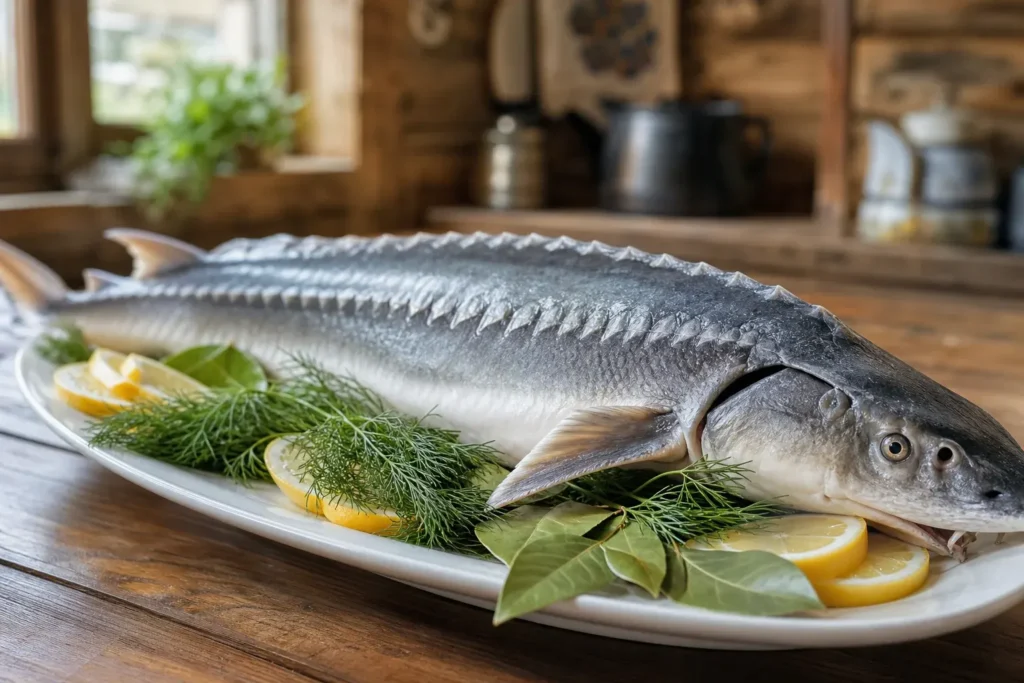
Sterlet appears on restaurant menus across Nizhny Novgorod and throughout Russia, where it holds a place of honor in culinary tradition. This article is for visitors who encounter sterlet on a menu and want to understand what they’re eating, or home cooks seeking to prepare it authentically. You will learn how to select, prepare and cook sterlet, plus the classic serving methods Russians have used for centuries.
The recommended approach is gentle poaching or baking, methods that preserve the fish’s delicate flavor and firm, slightly gelatinous texture.
Quick answer: Sterlet is a small sturgeon found in Russian rivers. Before cooking, remove the bony scutes and the viziga (the notochord along the spine), then poach whole in salted liquid for 30–45 minutes or bake at 180°C for 25–30 minutes. Total preparation and cooking time: 45–60 minutes; cost is ₽₽₽.
At a Glance
| Type | Dishes |
|---|---|
| Local name | Стерлядь |
| Origin | Russia; historically found in waters of the Volga, Black Sea and Caspian Sea basins |
| Servings | 2–4 people per whole fish (1–2 kg) |
| Total time | 45–60 minutes (including preparation and cooking) |
| Difficulty | Medium |
History and Story of Sterlet, Nizhny Novgorod
In old Russia, sterlet was a gourmet food served whole with sauerkraut, pickled cucumbers, mushrooms and onion. Sterlet was considered the best fish of Russian cuisine and one of the most ceremonial-required dishes, often served at diplomatic dinners. Traditionally it was poached whole in champagne and served with horseradish cream. In Gorodets, near Nizhny Novgorod, sterlet depictions appear on large spice cookies as a symbol of prosperity, and at the time the sterlet pryanik was a city emblem.
Ingredients
- 1 whole sterlet, cleaned and scaled (1–2 kg)
- Salt, to taste
- Fresh lemon, sliced (optional)
- Fresh dill (optional)
- White wine or court-bouillon (optional)
- Butter (for baking)
How Sterlet, Nizhny Novgorod Is Made
Step 1: Remove the scutes
Wash the sterlet thoroughly in cold water. Using a sharp knife, run the blade under each bony scute (the protective plates along the body and back) and lever it off carefully. Scutes are hard and inedible and must be removed. This takes 5–10 minutes. Discard the scutes.
Tip: Work methodically along both sides and the back. The scutes come off cleanly if you get the knife angle right.
Step 2: Remove the viziga
Cut a shallow line along the spine lengthwise. Locate the viziga—a white, gelatinous cord running through the inside of the spine. Carefully pull it out in one piece; it should come away cleanly. Leaving the viziga in causes an unpleasant rubbery texture in the cooked fish. This step is unique to sturgeon and essential.
Tip: Be patient; pulling too hard may break the cord. If it breaks, use the tip of your knife to extract each piece.
Step 3: Gut and rinse
Cut open the belly cavity and remove the innards. Rinse the cavity thoroughly under cold running water until clean. Pat the outside and inside dry with a clean cloth or paper towel.
Step 4: Prepare the cooking liquid
Fill a large pot with lightly salted water or court-bouillon (water with bay leaves, peppercorns, and aromatic vegetables). Bring to a gentle simmer. The liquid should be warm but not boiling when you add the fish; a violent boil can break the delicate flesh.
Tip: For a more luxurious finish, use a mixture of half white wine and half water, or poach in champagne as in 19th-century tsarist banquets.
Step 5: Cook by poaching
Carefully place the whole sterlet into the simmering liquid. Bring to a gentle simmer—the surface should barely bubble. Whole sterlet (1–2 kg) needs 30–45 minutes. The fish is done when the flesh is opaque and pulls cleanly from the bone. Do not boil; gentle heat ensures firm, tender meat.
Tip: Skim any foam that rises to the surface. Add salt only in the final 10 minutes of cooking.
Step 6: Alternative: Bake with lemon and herbs
If baking, stuff the cavity with lemon slices and fresh dill. Place the prepared sterlet on foil in a baking dish, drizzle with white wine or butter, and bake at 180°C (350°F) for 25–30 minutes until the flesh is opaque and a skewer glides through easily. Cover loosely with foil if the skin browns too quickly.
Tip: Baking is faster than poaching and creates a slight crust on the skin.
Step 7: Serve
Remove the spine carefully after cooking. Serve whole or in pieces with boiled potatoes, rice, or fresh vegetables. Traditional Russian accompaniments include horseradish cream, sour cream-based sauces, or a simple mixture of horseradish and vinegar. Drizzle with the cooking broth or melted butter.
Tip: In formal settings, the whole fish is presented rolled into a ring shape, tail held between its teeth—an old Russian presentation style.
Variants
- Sterlet in champagne: poached whole in champagne with herbs and served in the cooking liquid
- Stuffed sterlet: cavity filled with lemon cubes and dill, then baked in white wine
- Fried sterlet with sour-sweet sauce: pieces coated and fried, served with a sauce of vinegar, sugar and spices
- Royal marinated sterlet: boiled, cut into pieces and marinated in vinegar with bay leaves, cloves and cinnamon
- Sterlet in Tsar ukha: the whole fish stewed (not boiled) in broth to create a clear, rich soup
- Sterlet with horseradish and vinegar: simply boiled and served with a pungent sauce of grated horseradish and vinegar
Common Mistakes to Avoid
- Boiling rather than simmering: High heat causes the delicate flesh to fall apart and become mushy. Always use a gentle simmer.
- Forgetting to remove the viziga: Leaving this cord in results in an unpleasant, rubbery texture. It is not edible and must be extracted before cooking.
- Not removing the scutes: These hard, bony plates are inedible and will interfere with eating. Remove every one.
- Overcooking: Sterlet cooks quickly. Test at 30 minutes for whole fish; a skewer should glide through the thickest part with no resistance.
- Skipping the rinse: The cavity can contain blood or sand. A thorough rinse removes flavors that can make the broth bitter.
- Using old or heavily frozen fish: Fresh or high-quality frozen sterlet has better texture. Damaged or thawed-and-refrozen specimens may be mushy.
How to Order and Eat It
Sterlet is traditionally eaten whole or in thick cross-section pieces. The flesh separates cleanly from the spine. The head is often eaten—the cheeks and around the eye contain tender, flavorful meat. Scoop the flesh toward you with your fork. In formal Russian dining, the fish may be presented rolled into a ring shape, which requires careful eating. Serve with horseradish cream, sour cream or vinegar-based sauces, and boiled or steamed vegetables. The broth itself—rich and gelatinous due to the fish’s natural collagen—is meant to be savored.
To order: Стерлядь [sterlyad]
Diet and Allergens
- gluten-free
Russia Vibes Tips
- Visit Pyatkin or Vitalich restaurants in Nizhny Novgorod to taste sterlet prepared by professional chefs. Both serve traditional Volga sterlet dishes, often with creamy sauce.
- Ask your fishmonger to clean and remove the scutes before you take the fish home. This saves 15 minutes and requires professional technique. You still must remove the viziga yourself before cooking.
- If sterlet is unavailable, smaller sturgeon pieces can substitute, but they lack the delicate flavor. Buying fresh is far superior to frozen if you can find it.
- The broth left after poaching sterlet is rich in collagen and makes an excellent base for fish soup or aspic. Save and refrigerate it; it will gel.
- Sterlet is leaner than most fish. Don't skip fat (butter, sour cream, or sauce) in cooking or serving; it carries the subtle flavor and prevents dryness.
Explore Nearby Sterlet, Nizhny Novgorod
Browse more: All Food & Drink · All Food & Drink in Nizhny Novgorod · All Nizhny Novgorod · All Other
FAQ
What exactly is sterlet?
Sterlet is the smallest of the sturgeon family and one of the most prized freshwater fish in Russian and Central European cuisine. Unlike the giant Beluga or Siberian sturgeon, sterlet rarely exceeds 1 to 2 kg.
Why does sterlet need such careful preparation?
Sterlet is considered a delicacy in Russian, Ukrainian, and Central European cuisine. The bony scutes along the body sides and back are hard and inedible. The viziga—a white, gelatinous cord running through the inside of the spine—must be removed because leaving it in causes an unpleasant texture in the finished dish.
How does sterlet taste?
Sterlet has white, firm, and slightly gelatinous flesh with a subtle, exceptional flavor unlike any other fish. The flavor is delicate and refined, which is why it was favored by Russian aristocracy.
Is sterlet available in restaurants in Nizhny Novgorod?
The menu at Pyatkin features Volgan sterlet with creamy sauce. Vitalich restaurant offers sterlet fish and fish ravioli. Check restaurant menus or call ahead to confirm availability, as sterlet is seasonal and not always in stock.
Can I cook sterlet in ways other than poaching?
Sterlet can be baked, smoked, stewed, grilled or fried in a pan. Baking with lemon and herbs is a simpler home method that takes 25–30 minutes.
What does 'court-bouillon' mean in sterlet recipes?
Court-bouillon is a flavored poaching liquid made from water with bay leaves, peppercorns, herbs and sometimes wine or vinegar. It infuses the fish with subtle flavor and is traditional for cooking premium fish like sterlet.
Why does the recipe mention 'sturgeon marrow'?
In historical Russian recipes, 'sturgeon marrow' refers to the viziga—the white cord inside the spine. Old recipes sometimes asked cooks to remove it; modern cooking always does because it creates an unpleasant rubbery texture.
How do I know when sterlet is cooked?
The flesh should turn opaque and pull cleanly from the bone. A skewer or small knife inserted into the thickest part should glide through with no resistance. For whole sterlet (1–2 kg) at a gentle simmer, expect 30–45 minutes.
Russia Vibes is a one-person project. A coffee keeps it going
How we research and update our guides
About this guide: AI assistance and accuracy
This guide is created with the help of AI and is based on official sources where available. Mistakes can still happen. Opening hours, prices, rules and other details are given to the best of our knowledge as of the date shown and can change without notice. It offers general recommendations only, not professional, legal or travel advice. Please confirm important details with the official source before you travel; you are responsible for your own plans and decisions.

Take this guide with you
Get a free PDF of this guide to print or read offline: key facts, tips and a map link on a few clean pages.
Report an issue on this page
Paying for your trip: please read
International sanctions affect payments between Russia and many other countries. In practice, cards issued in the EU, the UK, the US and several other countries often do not work in Russia, Russian cards usually do not work abroad, and some booking platforms, airlines and payment providers limit or suspend their services for Russia. The situation changes frequently.
We do not give legal or financial advice, and this site does not encourage anyone to break or circumvent sanctions. Whatever you plan, you are responsible for following the laws and regulations that apply to you, including those of your country of residence and citizenship.
Many travelers still organise their stay lawfully. It is worth asking your bank or payment provider what is currently permitted, contacting hotels, tour operators and carriers directly about the payment methods they accept, and checking which services are open to customers from your country. Clarify payment, cancellation and refund terms before you commit to a booking, and keep your plans flexible.
Partner links on this site may not be available in every country, and prices, availability and rules in our guides can differ from what you see when you book.