
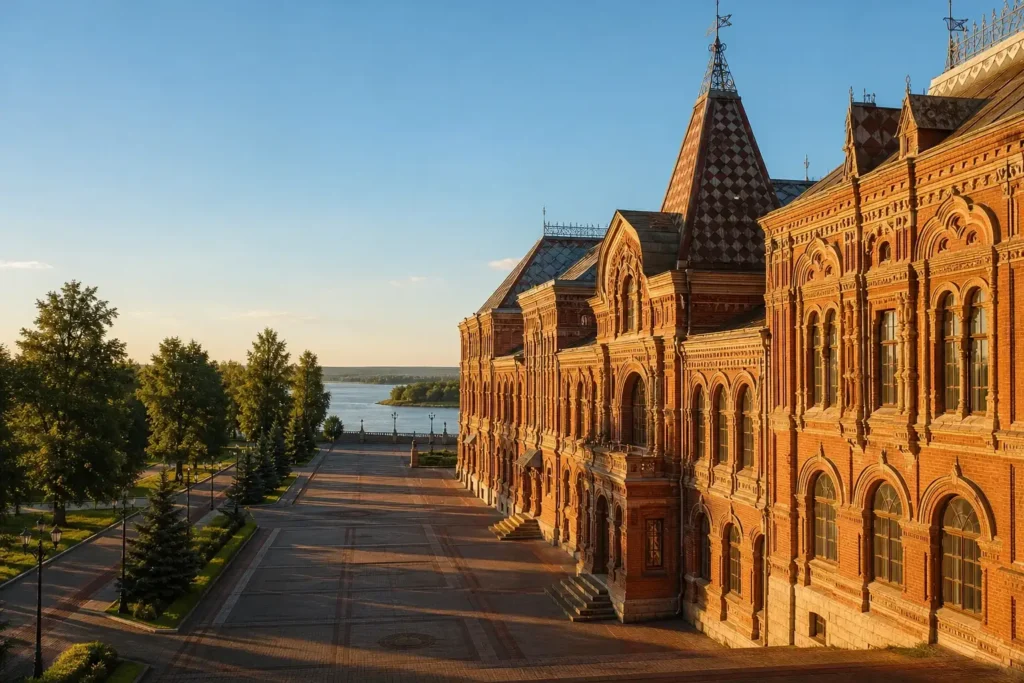
The Nizhny Novgorod Fair was held annually every July from the mid-16th century to 1816 near Makaryev Monastery on the left bank of the Volga River. Following a massive fire in 1816, it was moved to Nizhny Novgorod, and a society named Nizhegorodskaya yarmarka was created in 1991 with its headquarters in the former main fair building; however, today it is not actually a fair, but an exhibition center.
In the 19th century, the saying “Petersburg is the head, Moscow is the heart, and Nizhny Novgorod is the pocket of Russia” was coined to reflect the fair’s commercial significance. Walking through the restored grounds today, you can see why: the elegant Main Fair Building and surrounding structures are recognizable landmarks in the city, drawing visitors interested in Russian trade history and 19th-century architecture.
Quick Facts
| Russian name | Нижегородская ярмарка |
|---|---|
| Built / opened | 1822 |
| Architect(s) | Auguste de Montferrand |
| Address | 13 Sovnarkomovskaya Street OpenStreetMap · Google Maps |
| District | Kanavinsky |
| Opening hours | Daily 10:00-19:00 |
| Admission | free |
| Best time to visit | Late spring through early autumn (May to September) offers pleasant weather for exploring the outdoor grounds and river views. Historically, the fair operated from July to September, a pattern reflected in the site's seasonal programming today. Winter brings holiday events and a skating rink if available; crowds peak in late December. Weekday mornings are quietest; weekends draw families and local history enthusiasts. Avoid mid-afternoon heat in July and August; early morning or late afternoon light is ideal for photography. |
| Recommended duration | 1–2 hours |
| Website | yarmarka.ru |
What Is (and Isn't) Part of a Visit to Nizhny Novgorod Fair, Nizhny Novgorod?
| Part | Status | Notes |
|---|---|---|
| Main Fair Building and Exhibition Halls | Included in the standard ticket | The primary structure, open to the public during posted hours, hosts exhibitions and events. |
| Fair Grounds and Plazas | Included in the standard ticket | The outdoor areas and heritage structures are accessible during operating hours. |
| Old Fair Church of the Transfiguration | Included in the standard ticket | Part of the fair complex; religious services and visiting have varying schedules—check ahead. |
| Alexander Nevsky Cathedral | Outside / not part of it | Built on former fair territory (1868–1881) but is a separate religious institution, not part of the fair complex. |
| Seasonal Events (skating rinks, New Year celebrations) | Separate ticket or institution | Special programming is announced separately; some events may have additional entry fees or requirements. |
| Special Exhibitions | Separate ticket or institution | Temporary exhibitions sometimes require separate paid admission; check the official website for current programming. |
Why Visit Nizhny Novgorod Fair, Nizhny Novgorod?
The fair attracted foreign merchants from India, Iran, and Central Asia, making it a genuine crossroads of empire. At its peak in 1905, the fair consisted of 60 buildings, 2,500 bazaars and 8,000 exhibits, with goods for sale, along with a broad range of performances for the public. The Main Fair Building itself, completed in 1896 in Russian Revival style, is an architectural achievement—similar to the GUM department store on Red Square but appearing earlier. History buffs and architecture lovers will find the restored fairgrounds an essential stop for understanding 19th-century Russian commerce and urban ambition.
How Nizhny Novgorod Fair, Nizhny Novgorod Is Laid Out
The Main Fair Building is an elegant Russian-style building located at 13 Sovnarkomovskaya Street. The fair complex stretches across several blocks on the left bank of the Volga in the Kanavinsky district, historically known as Old Kanavino. The Main Fair Building dominates the site, its distinctive architecture visible from various approach points. The grounds are organized around open plazas and pathways that reflect the original layout of trading courts. Begin at the Main Fair Building for orientation, then explore the surrounding heritage structures, including the Old Fair Church of the Transfiguration, which dates to the early fair period.
Highlights of Nizhny Novgorod Fair, Nizhny Novgorod
Main Fair Building
Construction of a new main fair building in the Russian style was completed in 1896, and it was designed by architect Auguste de Montferrand. The building's ornate façade and imposing halls are unmistakable once you approach—look for the distinctive Russian Revival stonework and arched windows. During the 19th century, this building symbolized Russia's commercial power. Today it hosts exhibitions and events. The main entrance faces Sovnarkomovskaya Street.
Tip: Visit in the morning when daylight best illuminates the building's architectural details and fewer crowds allow you to move freely through public areas.
Historical Trading Arcade Layout
In 1905, the fair consisted of 60 buildings, 2,500 bazaars and 8,000 exhibits. Although most of these structures no longer exist, the restored ground layout preserves the original street pattern and plaza arrangement where merchants once displayed goods. Walking the grounds, you can imagine the bustling commerce: stalls arranged in orderly rows, merchants from across Asia and Europe, the energy of a trading city within a city.
Tip: Ask at the main building about self-guided walking maps showing the original fair layout and heritage structures that remain on site.
Old Fair Church of the Transfiguration
This late-classical temple, whose construction began in 1816, stands as a spiritual center for the fair. It became known as the Old Fair Cathedral after the construction of a new Alexander Nevsky Cathedral. The church's simple elegant columns and neoclassical proportions contrast with the ornate Main Fair Building, showing the range of 19th-century architectural styles present on the grounds.
Tip: The church is part of the fair complex but sometimes has limited visiting hours; check with the main building staff or call ahead.
Trade Routes and Volga Commerce
The fair attracted foreign merchants from India, Iran, and Central Asia, connected by the Volga River. Standing on the grounds, you see why location was everything: the Volga enabled cargo transport from Central Asia and the Caucasus into Europe. Electricity and water supply were brought to the site in the 1870s-1880s, and one of the first tram lines in Russia was inaugurated there in 1896, making Nizhny Novgorod a model of infrastructure for its time.
Tip: Walk to the river's edge to observe how easily barges could be loaded and unloaded; the flat terrain made logistics simple for merchants.
Commercial Peak and Decline
From the mid-19th century, the official duration of the fair was a little over a month, but trading continued from July to September, with more than 200,000 people arriving in Nizhny Novgorod during the period of trading. The fair ceased in 1929 as railways and new shipping routes diminished the need for a central trading post. Yet the buildings remain, silent witnesses to Russia's mercantile golden age.
Tip: Seasonal exhibitions often mark different eras of fair history; check the official website for current programming.
Atmosphere
Walking the fair grounds today feels like stepping into a preserved historical moment. The main building’s red-brick and stone façade stands imposing and grand, almost eerily quiet compared to its roaring 19th-century past when traders haggled in dozens of languages and carts rattled across the plazas. The open spaces are dotted with trees, creating pockets of shade. In winter, the fair often hosts a skating rink and New Year celebrations, filling the grounds with families and festive cheer—a modern echo of the public performances and circuses that once entertained merchants during trading season.
The grounds feel protected and slightly removed from the busier parts of Nizhny Novgorod, perched on the Volga’s left bank. Visitors are few during weekdays, lending an contemplative quality. Local historians and architecture students frequent the site; you’ll see them sketching details of the cornices and columns. The air carries a blend of industrial heritage and scholarly reverence for preserved Russia.
History of Nizhny Novgorod Fair, Nizhny Novgorod
The Nizhny Novgorod Fair originated from an annual fair held every July from the mid-16th century near Makaryev Monastery on the left bank of the Volga River. The fair was established by Muscovite princes to compete with, and draw commerce away from, a fair held since 1257 at Kazan, the Tartar capital. Held annually on August 7th, the feast day of St. Macarius, the trading event initially lasted only one day; in 1627, Tsar Mikhail Fedorovich ordered the monastery collect dues from the fair, and in 1641 he gave permission for the fair to be held for the entire month of July.
On August 18, 1816, the grounds were destroyed in a massive fire, and a year later the decision was made to move the fair to Nizhny Novgorod. Merchants brought merchandise worth 24 million rubles to the first fair, which opened on the new site in 1817, with the figure increasing to 57 million rubles by 1846. The fair rapidly became the economic heart of the Russian Empire.
From the mid-19th century onwards, the official duration of the fair was a little over a month, but trading continued from July to September. More than 200,000 people would arrive in Nizhny Novgorod during the period of trading, and the fair had a positive impact on the whole city, with convenient infrastructure facilities and extensive hotel and inn construction. In 1896, the All-Russia Industrial and Art Exhibition was held in the grounds of the Nizhny Novgorod Fair, the biggest such exhibition in the history of the Russian Empire. Construction of a new main fair building in the Russian style was completed in the same year, designed by architect Auguste de Montferrand.
The fair ceased in 1929 as transportation networks modernized and traders no longer needed a seasonal gathering place. A society named Nizhegorodskaya yarmarka was created in 1991 with its headquarters in the former main fair building; however, today it is not actually a fair, but an exhibition center. The complex now serves as a venue for exhibitions, conferences, and cultural events, preserving the legacy of one of the 19th century’s greatest commercial enterprises.
Legends and Myths about Nizhny Novgorod Fair, Nizhny Novgorod
The Pocket of Russia
Legend – historically unreliable. The saying "Petersburg is the head, Moscow is the heart, and Nizhny Novgorod is the pocket of Russia" was coined in the 19th century to coincide with the transfer of the fairgrounds. The phrase captured the fair's role as the financial engine of the empire, where merchants grew wealthy and taxes flowed to the treasury. Whether the saying was widely used at the time or became legendary afterward, it endured as a symbol of Nizhny Novgorod's importance.
The Fire of 1816
Disputed by historians. On August 18, 1816, the grounds of the original Makaryev Fair were destroyed in a massive fire. The disaster was dramatic enough to reshape Russian commerce: within a year, authorities decided to move the entire fair to Nizhny Novgorod, a decision that transformed the city. Local accounts sometimes embellish the fire's scale and consequences, but its historical role as a turning point is unquestionable.
Tickets and Booking for Nizhny Novgorod Fair, Nizhny Novgorod
| Ticket | Price | Includes |
|---|---|---|
| Fair Grounds Access | Free | Access to outdoor plazas, heritage structures, and the fair complex during posted hours. |
| Main Fair Building Exhibitions | ₽₽ | Entry to exhibitions and events held within the Main Fair Building; rates vary by exhibition. |
₽ budget · ₽₽ moderate · ₽₽₽ upscale · ₽₽₽₽ splurge. Price levels are estimates compared with typical prices for visitors.
The fair grounds are free to access during posted hours (10:00–19:00 daily, as of October 2026). Entry to special exhibitions within the Main Fair Building may require a paid ticket; rates vary by exhibition and are published on the official website at yarmarka.ru.
Tickets for exhibitions can typically be purchased on-site at the main building entrance. For large events or group visits, contact the venue in advance. The grounds accommodate walk-in visitors year-round. Check the official website for current exhibition schedules and any seasonal programming. Rates for Russian citizens and concessions differ; visit yarmarka.ru for the full ticket categories.
Plan and Book
Suggested itineraries Nizhny Novgorod Fair, Nizhny Novgorod
1 hour
Enter at the main gate on Sovnarkomovskaya Street. Tour the exterior and public areas of the Main Fair Building, noting the Russian Revival architecture and distinctive stonework. Walk the central plaza and observe the open-air layout showing the original trading court arrangement. Stop at the information board or entrance for a brief overview of fair history.
1.5–2 hours
Begin with the Main Fair Building exterior and interior public spaces. Walk the heritage grounds to locate the Old Fair Church of the Transfiguration. Explore the perimeter toward the Volga riverside to appreciate the fair's location and transportation context. If an exhibition is open, allocate time inside the Main Fair Building. Sketch or photograph architectural details. Conclude by standing on the grounds to imagine the 19th-century bustling commerce.
Half day
Spend focused time at the fair in the morning. Tour the Main Fair Building and any current exhibitions. Walk all accessible heritage structures and plazas. Visit the nearby Alexander Nevsky Cathedral (a short walk, separate institution) to contrast its ornate Byzantine style with the fair's pragmatic commercial architecture. Have lunch at a nearby café. Return to the fair grounds in late afternoon light to photograph the Main Building's façade. Evening visits offer a quieter, more contemplative experience.
How to Get to Nizhny Novgorod Fair, Nizhny Novgorod
The Nizhny Novgorod Fair is located on the left bank of the Volga River at 13 Sovnarkomovskaya Street, in the Kanavinsky district (historically Old Kanavino). By Metro: The nearest metro station is Komsomolskaya (Red Line); from there, a 15–20 minute walk (or short taxi ride) crosses the Volga toward the fair grounds via Okskiy bridge. By Tram: Several tram lines serve the left bank; confirm the current routes and stops at the tourist office. By Taxi or Ride-Share: Provide the driver with the address: 13 Sovnarkomovskaya Street. The journey from the city center (around the Kremlin) takes 15–25 minutes depending on traffic. Walking: If staying near the city center on the right bank, allow 30–40 minutes for a scenic walk crossing the Okskiy bridge with river views. Street signage in Russian names the fair; ask locals if unsure of the route.
Accessibility
The grounds are partially accessible to visitors with mobility challenges; the main plazas are paved and relatively level. The Main Fair Building entrance is accessible, though some interior exhibition spaces may have stairs. Information on specific accessibility features (elevators, ramps, accessible restrooms) is not published on the official website; call ahead at the venue or check yarmarka.ru for current details. Stroller access is generally feasible on outdoor paths but may be limited in some heritage structure interiors.
Food Nearby
Several cafés and small restaurants operate near the fair grounds on Sovnarkomovskaya Street and adjacent streets. The neighborhood offers basic Russian cuisine and casual eateries but is not a dining destination. For more substantial meal options, walk or take a short taxi ride to the city center (right bank) or the Kremlin area, where restaurants and cafés are numerous. Pack snacks and water if visiting for an extended period, as on-site food vendors are limited.
What to Bring
Comfortable walking shoes are essential for exploring the outdoor grounds and historic structures. Bring a hat, sunscreen, and water in warm months; the plazas offer little shade. In cool or rainy seasons, bring layers and a light jacket. A camera or smartphone for photography is worthwhile given the architectural details. Respectful attire is appropriate if visiting the Old Fair Church. Bags are permitted; no unusual restrictions apply to the fair grounds.
Best Views and Photo Spots of Nizhny Novgorod Fair, Nizhny Novgorod
Main Fair Building South Façade
The ornate Russian Revival stone façade with its arched windows, turrets, and detailed cornicing is most striking from the south side facing Sovnarkomovskaya Street. The building's mass and architectural elements are fully visible from this angle, showing the deliberate grandeur of late-19th-century commercial design.
Best time: Mid-morning (9:00–11:00) provides soft directional light that accentuates the stonework details without harsh shadows. Afternoon light also works well but intensifies shadows. Overcast days reduce contrast; clear weather is preferable.
Central Plaza from Building Steps
Standing on or near the Main Building's front steps, the expansive central plaza opens before you, with heritage structures and tree-lined pathways visible across the grounds. This wide-angle view captures the scale of the fair complex and the original trading court arrangement.
Best time: Late afternoon (16:00–18:00) in spring and autumn casts warm, directional light across the plaza, emphasizing depth and texture. Summer evenings are ideal if the grounds remain open.
Old Fair Church Tower from Plaza
The simple neoclassical proportions of the Old Fair Church tower contrast beautifully with the ornate Main Building visible in the frame. This composition shows the stylistic range of the fair's architecture and the church's role as a spiritual anchor within the commercial complex.
Best time: Early morning or late afternoon light side-lights the church tower, emphasizing its clean classical lines. Soft autumn or spring light is ideal; the church tower is silhouetted dramatically against a golden sky in evening hours.
Riverbank Path Toward Volga
Walking toward the Volga reveals open views of the river and, on the opposite bank, the city skyline including the Kremlin and Alexander Nevsky Cathedral. This vantage point connects the fair's commercial purpose—river transport—to the surrounding cityscape.
Best time: Early morning or before sunset captures the Volga's reflective surface and the opposite bank in favorable light. The view is most striking in clear weather; avoid midday glare.
Arch or Portico Detail (Various)
Zooming in on architectural details—ornate stonework, capitals, arched windows, and carved reliefs—reveals the craftsmanship of late-19th-century construction. These close-up shots emphasize texture and historical skill.
Best time: Soft overhead or side-lighting shows texture best. Overcast days eliminate harsh shadows; morning or late afternoon in clear weather is ideal for detail photography.
Photography Rules
General photography is permitted on the fair grounds and exterior of buildings. Tripods and professional equipment may require advance permission from the venue; check with staff at the main entrance or contact yarmarka.ru beforehand. Flash photography inside exhibitions or heritage structures may be restricted. Drones are not permitted. Respectful photography in the Old Fair Church follows standard church etiquette.
Family Suitability
The fair grounds are suitable for families with older children (ages 8 and up) interested in history and architecture. The outdoor plazas and open spaces appeal to younger children but offer limited interactive exhibits or play areas. Strollers can navigate the paved main paths but may encounter uneven surfaces in some areas. The space is quiet and peaceful, making it appropriate for calm exploration rather than active recreation. Teenagers studying Russian history or architecture will find the site genuinely educational. No formal children's programming is standard on the grounds, though seasonal events like skating rinks (winter) expand family appeal.
Russia Vibes Tips
- Visit weekday mornings for the quietest experience and best light for photography. You'll have the plazas largely to yourself, a vivid contrast to the 200,000 merchants and traders who once crowded these same grounds.
- The fair is easier to navigate if you understand the original layout: trading courts arranged in rows, with the Main Building at the center. Ask staff for a map showing original structures or consult historical guides before arrival to frame your walk meaningfully.
- Do not confuse the Alexander Nevsky Cathedral (built on former fair territory) with the fair itself. They are separate institutions with distinct opening hours and purposes. The cathedral is a functioning Orthodox church; the fair is a historic complex and exhibition venue.
- The river views are exceptional but often overlooked. Walk to the Volga's edge to appreciate why the fair's location was commercially strategic and to see how modern Nizhny Novgorod has developed around this historic core.
- Current exhibitions vary; check yarmarka.ru before visiting if you plan to enter the Main Fair Building. Some exhibitions are free; others require paid admission. Programming changes seasonally, so what's on display in summer may differ from autumn or winter.
- The Old Fair Church's visiting hours are irregular and depend on religious services and maintenance schedules. Do not assume it is open; ask at the main building or call ahead if seeing the interior is a priority.
Explore Nearby Nizhny Novgorod Fair, Nizhny Novgorod
Sights near Nizhny Novgorod Fair, Nizhny Novgorod
 Nizhny Novgorod Kremlin – about 2.6 km away · typical visit: 2–3 hoursOpen daily 06:00–22:00
Main image: AI-generated illustration. It may not show the place exactly as it looks.
 Bolshaya Pokrovskaya Street, Nizhny Novgorod – about 2.5 km away · typical visit: 1.5–2 hoursOpen 24 hours
Main image: AI-generated illustration. It may not show the place exactly as it looks.
 Nizhny Novgorod State Art Museumabout 2.8 km away · typical visit: 2–3 hours
Main image: AI-generated illustration. It may not show the place exactly as it looks.
Hotels near Nizhny Novgorod Fair, Nizhny Novgorod
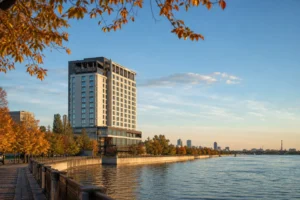 Marins Park Hotel Nizhny Novgorod, Nizhny Novgorodabout 350 m away (~6 min walk)
Main image: AI-generated illustration. It may not show the place exactly as it looks.
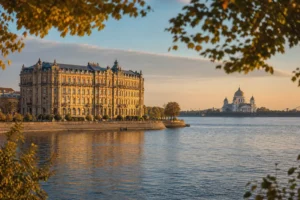 Nikitin Hotel, Nizhny Novgorodabout 950 m away (~15 min walk)
Main image: AI-generated illustration. It may not show the place exactly as it looks.
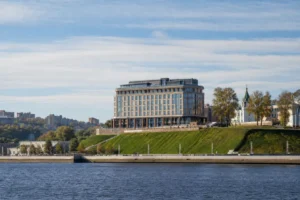 AZIMUT Hotel Nizhny Novgorod, Nizhny Novgorodabout 1.4 km away (~22 min walk)
Main image: AI-generated illustration. It may not show the place exactly as it looks.
Related guides
 Bakery Madlen: Fresh French Pastries on Historic Rozhdestvenskaya Street
Main image: AI-generated illustration. It may not show the place exactly as it looks.
Browse more: More in Kanavinsky · All Landmarks · All Nizhny Novgorod · All Sightseeing · All Sightseeing in Nizhny Novgorod
FAQ: Nizhny Novgorod Fair, Nizhny Novgorod
Is the Nizhny Novgorod Fair still a working fair where merchants trade?
No. Today it is not actually a fair, but an exhibition center. The fair ceased in 1929, and a society named Nizhegorodskaya yarmarka was created in 1991 with its headquarters in the former main fair building. It now hosts exhibitions, conferences, and cultural events rather than daily trade.
Do I need to pay to enter the fair grounds?
Access to the outdoor fair grounds and plazas is free. Entry to exhibitions within the Main Fair Building may require paid admission, though rates vary by exhibition. Check the official website (yarmarka.ru) for current exhibitions and their costs.
What is the difference between the Nizhny Novgorod Fair and the Alexander Nevsky Cathedral?
The Alexander Nevsky Cathedral is located on the former territory of the Nizhny Novgorod Fair, but they are separate institutions. The cathedral is a functioning Orthodox church built in the 1860s–1880s; the fair is a historic complex founded in 1822. Do not confuse them when planning your visit—they have different hours and purposes.
Can I visit the inside of the Main Fair Building?
Yes, but only when exhibitions or events are held. The building is not a museum with permanent collections; it functions as an exhibition hall. Check yarmarka.ru to see what is currently on display and whether admission is required.
Is the Nizhny Novgorod Fair accessible by metro?
The nearest metro station is Komsomolskaya (Red Line). From there, it is a 15–20 minute walk (or short taxi ride) to the fair grounds on the left bank of the Volga. The fair itself is not directly on a metro line but is reachable by combining metro and walking or by taxi.
What is the history of the fair?
The fair was held annually every July from the mid-16th century near Makaryev Monastery on the left bank of the Volga River until 1816. Following a massive fire in 1816, it was moved to Nizhny Novgorod. The fair was a commerce centre to sell up to half the total production of export goods in Russia.
Who designed the Main Fair Building?
The architect was Auguste de Montferrand. Construction of a new main fair building in the Russian style was completed in 1896, making it one of the era's notable commercial structures.
When should I visit to see seasonal events like a skating rink?
Seasonal events, especially winter holidays with skating rinks, typically run from December through early January. Check the official website for the current year's schedule, as dates and programming vary annually.
Russia Vibes is a one-person project. A coffee keeps it going
How we research and update our guides
About this guide: AI assistance and accuracy
This guide is created with the help of AI and is based on official sources where available. Mistakes can still happen. Opening hours, prices, rules and other details are given to the best of our knowledge as of the date shown and can change without notice. It offers general recommendations only, not professional, legal or travel advice. Please confirm important details with the official source before you travel; you are responsible for your own plans and decisions.

Take this guide with you
Get a free PDF of this guide to print or read offline: key facts, tips and a map link on a few clean pages.
Report an issue on this page
Paying for your trip: please read
International sanctions affect payments between Russia and many other countries. In practice, cards issued in the EU, the UK, the US and several other countries often do not work in Russia, Russian cards usually do not work abroad, and some booking platforms, airlines and payment providers limit or suspend their services for Russia. The situation changes frequently.
We do not give legal or financial advice, and this site does not encourage anyone to break or circumvent sanctions. Whatever you plan, you are responsible for following the laws and regulations that apply to you, including those of your country of residence and citizenship.
Many travelers still organise their stay lawfully. It is worth asking your bank or payment provider what is currently permitted, contacting hotels, tour operators and carriers directly about the payment methods they accept, and checking which services are open to customers from your country. Clarify payment, cancellation and refund terms before you commit to a booking, and keep your plans flexible.
Partner links on this site may not be available in every country, and prices, availability and rules in our guides can differ from what you see when you book.